Bitcoin Comes to UAE Banking: What Rakbank Islamic's New Crypto Service Means for Blockchain Adoption

By Tausif AhmedFounder and CTO
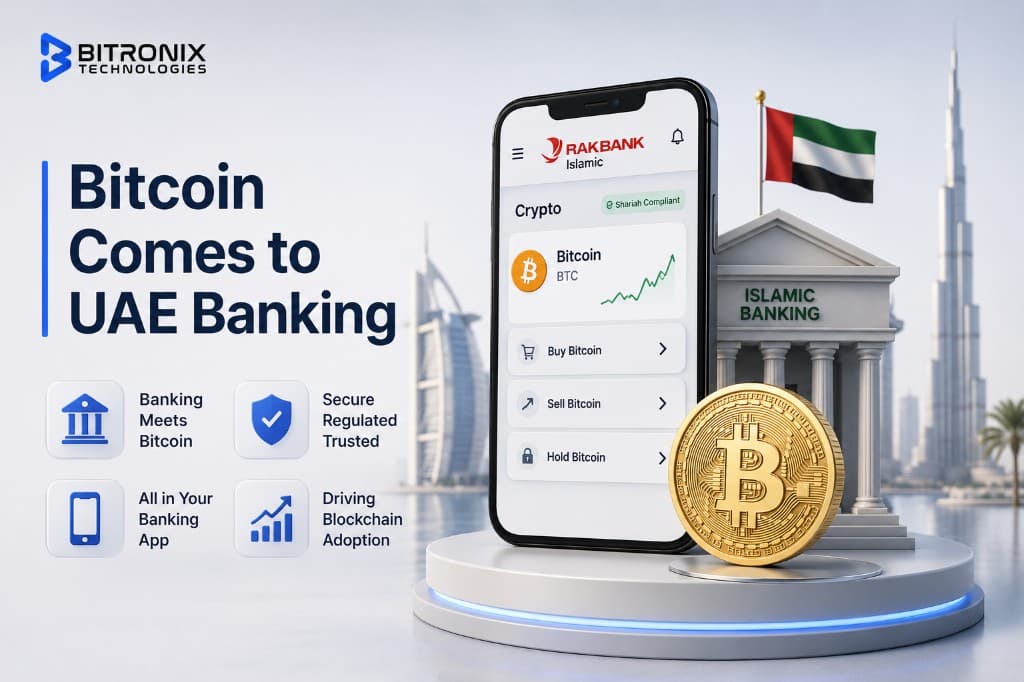
A UAE bank just made buying Bitcoin about as complicated as paying a phone bill. That's a bigger deal than the headline makes it sound.
On August 24, 2026, Rakbank announced that customers using Rakbank Islamic, the bank's Islamic banking arm, can now buy, sell and hold Bitcoin directly from the Rakbank mobile app. No new app to download. No separate account to open. No wiring money to an exchange sitting outside the UAE's banking system. Just Bitcoin, sitting next to your checking account balance, inside the app you already use.
For a market that's been talking about blockchain adoption for years, this is one of those moments where the theory finally shows up as something you can tap on a screen. And for businesses watching from the sidelines wondering whether now is the right time to build something similar, it's worth breaking down exactly what happened, why it worked and what it would actually take to build a version of this yourself.
What Rakbank Islamic Actually Launched
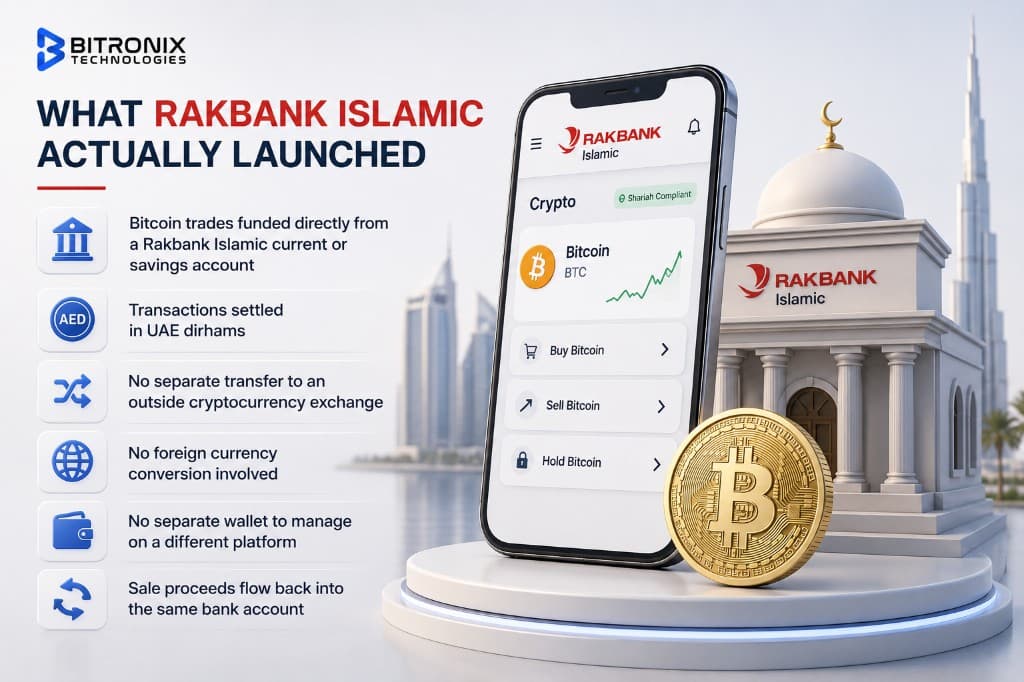
The service lets Rakbank Islamic customers trade Bitcoin using funds straight from their existing current or savings account, in AED. That last part matters more than it sounds. Up until now, someone wanting to buy Bitcoin in the UAE typically needed a separate cryptocurrency exchange account, a transfer from their bank to that exchange and often a currency conversion along the way. Each of those steps adds friction and friction is usually where people give up.
Rakbank removed the friction by folding the trading experience into the banking app itself. Customers fund purchases directly from their Islamic banking balance and when they sell, the proceeds flow back into the same account. There's no separate wallet to manage on a different platform and no second login to remember.
It sounds simple from the outside. From the inside, getting a regulated bank to that point takes a fair amount of engineering, compliance work and careful integration between two very different kinds of financial systems, one built on decades of banking regulation, the other built on blockchain infrastructure that didn't exist twenty years ago.
Who's Actually Running the Trading Platform
Here's the part worth understanding clearly, because it's easy to gloss over: Rakbank isn't the one executing Bitcoin trades. The trading itself runs through Bitpanda Broker MENA DMCC, which is Bitpanda's entity licensed by Dubai's Virtual Assets Regulatory Authority (VARA). Rakbank's role is to provide banking access and make sure everything lines up with Shari'ah principles for its Islamic banking customers.
Vikas Suri, Managing Director of Wholesale Banking Group Products at Rakbank, described the goal as giving customers "greater confidence, clarity and control" as they explore Bitcoin as an asset class.
That division of labor, bank handles banking, licensed virtual asset provider handles the actual trading, is exactly how the UAE's regulatory structure is built. Banking activity falls under the Central Bank's supervision. Virtual asset trading falls under VARA or the relevant emirate-level authority. A bank offering crypto access doesn't mean the bank became an exchange. It means the bank found a compliant way to plug a licensed exchange into its app.
This structure is also the blueprint for how most bank-embedded crypto products get built anywhere in the world right now. Very few banks are pursuing their own virtual asset license from scratch. Almost all of them are partnering with an already-licensed provider and building the integration layer on top.
Why This Is Different From "Just Another Crypto App"
The UAE already has plenty of regulated places to buy Bitcoin. Standalone exchanges have operated under VARA licenses for a while now. So what makes a bank-embedded version worth writing about?
Distribution. A crypto exchange, no matter how well-regulated, is still an extra step for the average bank customer. It requires seeking it out, signing up separately and trusting a brand they may not have a prior relationship with. A banking app doesn't have that problem. People already trust it enough to keep their salary there.
That's the actual shift here. Blockchain-based assets are moving from something you go find, to something that's simply present inside the financial infrastructure people already rely on every day. It's the same pattern that played out with online banking, then mobile payments, then buy-now-pay-later options getting folded into checkout flows. Each time, the technology existed first as a separate destination, then eventually got absorbed into the tools people were already using.
Part of a Bigger Pattern, Not a One-Off
This isn't Rakbank's first move into crypto. In 2025, the bank became the first conventional UAE bank to offer crypto brokerage services to its standard retail customers, also built on Bitpanda's infrastructure, also settled in AED. The Islamic banking rollout extends that same access to a customer base that specifically needs services aligned with Shari'ah principles, which is a meaningful segment of the UAE's banking population.
It also fits a broader trend across the region. UAE banks have been signaling interest in virtual assets for a while and industry watchers have openly asked how soon other banks would follow Rakbank's lead. Every time one bank makes the move and shows it can be done within existing regulatory boundaries, it lowers the perceived risk for the next bank considering the same thing.
That's usually how institutional adoption works. Nobody wants to be first. Everybody wants to be second, once someone else has proven the compliance model holds up.
The UAE's Wider Digital Asset Momentum
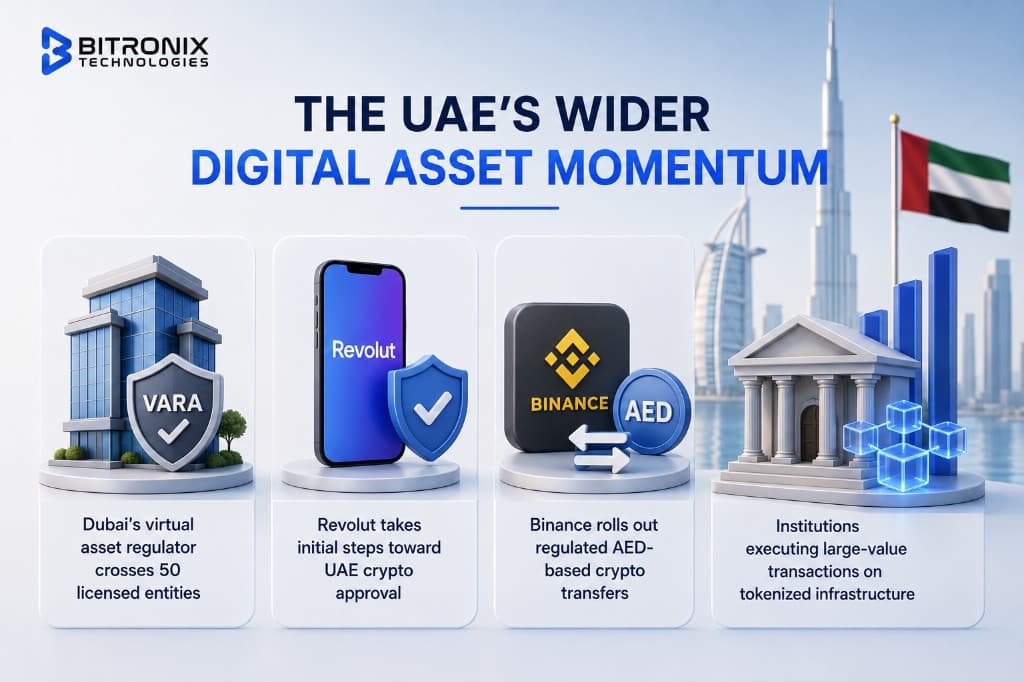
Rakbank Islamic's launch didn't happen in a vacuum. It landed in the middle of a genuinely active few months for institutional crypto activity in the UAE and looking at that wider context helps explain why now was the right moment for a launch like this.
Dubai's virtual asset regulator recently crossed a milestone of fifty licensed entities, a sign of how much the regulated side of the market has grown rather than staying niche. International players have been paying attention too. Revolut has taken initial steps toward securing UAE crypto approval and Binance has rolled out regulated AED-based crypto transfers for the local market. On the institutional settlement side, firms have started executing large-value transactions on tokenized infrastructure, with one recent example involving a transaction worth over one hundred million dirhams settled on a regional blockchain network.
None of these are isolated stories. Together, they paint a picture of a market where the regulatory groundwork has matured enough that banks, exchanges and institutions are comfortable building real products on top of it instead of waiting on the sidelines. Rakbank Islamic's Bitcoin launch is one visible, consumer-facing piece of a much larger shift happening across UAE financial infrastructure.
What This Means for Blockchain Adoption in the UAE
A few things worth taking away from this launch, beyond the headline:
Banking and virtual asset licensing are staying separate, on purpose. The UAE isn't handing banks a blanket license to run crypto exchanges themselves. Instead, banks are partnering with VARA-licensed providers and building access points on top of that regulated infrastructure. That's a deliberate design choice and it's one that keeps the trading activity itself under specialized oversight while still letting banks offer the convenience layer.
Islamic finance and virtual assets aren't treated as incompatible. A meaningful part of the UAE's population banks specifically through Islamic windows and this launch shows that virtual asset access can be structured to align with Shari'ah principles rather than being seen as automatically outside that framework.
The next wave of blockchain adoption in the UAE will look boring and that's the point. Nobody's launching a flashy new app. They're quietly adding a feature to an app that already exists. That's usually the sign that a technology has moved from early adopter territory into mainstream infrastructure.
For businesses building in this space, whether that's tokenized real-world assets, real estate tokenization platforms, or broader Web3 real estate applications, the signal is the same one Rakbank just sent: regulators in the UAE are comfortable enough with well-structured, compliant blockchain infrastructure to let it sit inside mainstream financial products. That's a very different environment than it was even two or three years ago and it changes how a blockchain app development project gets scoped when the UAE is part of the target market.
What It Actually Takes to Build a Rakbank-Style Integration
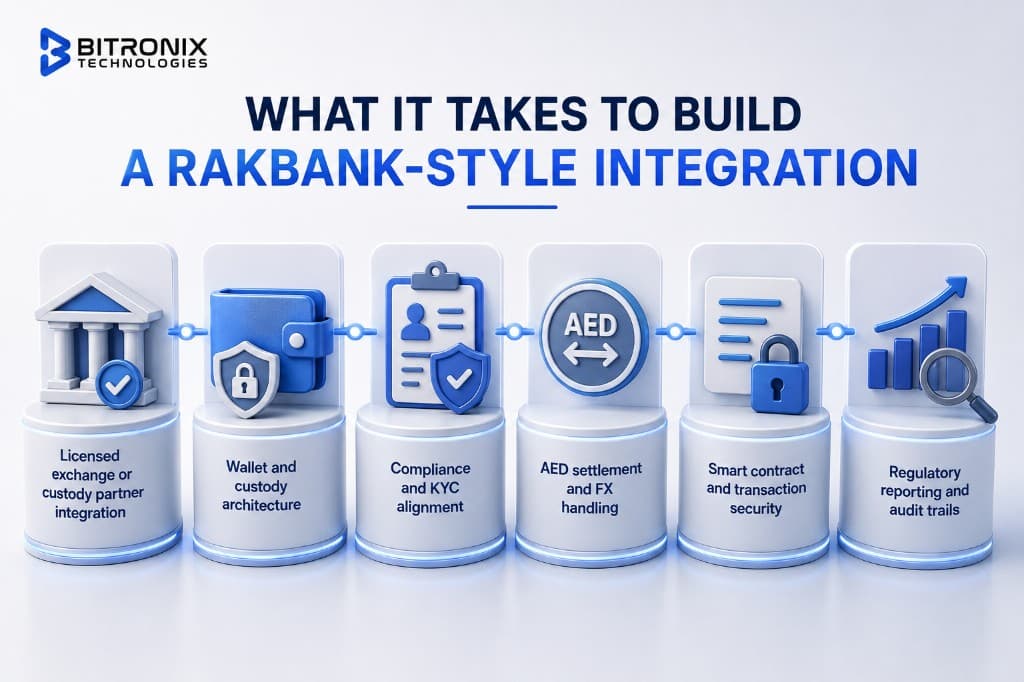
It's worth pulling back the curtain on what a project like this really involves, because "connect Bitcoin to a banking app" undersells the engineering. Here's roughly what goes into building something at this level:
Licensed partner integration. Since most banks and fintechs won't pursue their own VASP license, the build starts with integrating a licensed exchange or custody provider through an API and making sure that integration handles authentication, transaction routing and settlement without exposing either system to unnecessary risk.
Wallet and custody architecture. Someone has to decide where the actual Bitcoin sits, who holds the private keys and how that custody model gets audited. Get this wrong and you've built a security liability instead of a product.
Compliance and KYC alignment. A bank customer is already KYC-verified for their banking relationship, but virtual asset trading often carries separate compliance requirements. The integration has to reconcile both without forcing the customer through redundant verification steps.
AED settlement and FX handling. Removing the currency conversion step, like Rakbank did, means building settlement logic that can move value between fiat and crypto rails cleanly, in the local currency, without the friction or cost of an intermediate conversion.
Smart contract and transaction security. Even when the trading engine itself belongs to a licensed partner, any custom logic built around it, transaction limits, account linking, reporting, needs the same security rigor as a standalone smart contract system, including testing and independent audit before anything goes live.
Regulatory reporting and audit trails. Every transaction needs to be traceable and reportable in a way that satisfies both banking regulators and virtual asset authorities, which usually means building dedicated compliance dashboards rather than bolting reporting on at the end.
This is the part most "should we add crypto" conversations skip past. The partnership announcement is the easy part. The engineering underneath it is where most projects either succeed quietly or fail publicly.
Planning to Build a Blockchain App Like Rakbank? Here's Where Bitronix Fits In
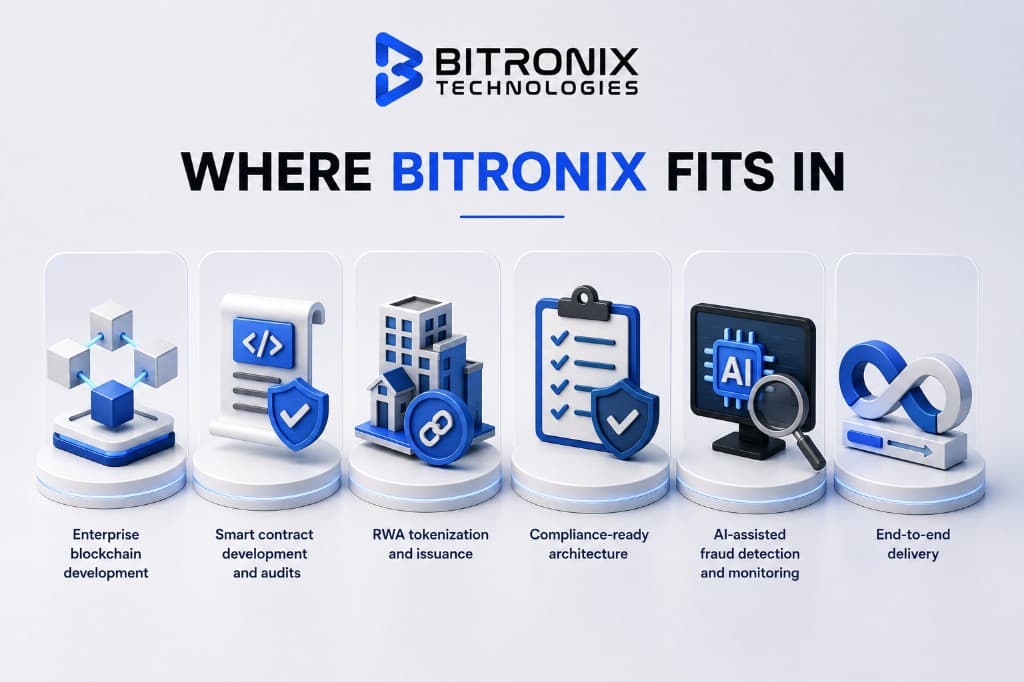
If this story has you thinking about what a similar integration could look like for your own bank, fintech, or platform, that's exactly the kind of project Bitronix Technologies builds.
We're not a generalist agency that also does blockchain on the side. Blockchain and AI infrastructure is the entire business and a meaningful part of our work sits in the same regulated space Rakbank just moved into.
Enterprise blockchain development. We design and build the infrastructure layer that lets financial institutions connect to blockchain networks and licensed virtual asset providers without exposing themselves to unnecessary technical or compliance risk, the same kind of architecture behind a bank-embedded crypto feature.
Smart contract development and audits. Whether it's custom transaction logic sitting on top of a licensed exchange integration, or a fully custom tokenization system, we build contracts with security testing and audit readiness built in from the first line of code, not added as an afterthought before launch.
RWA tokenization and issuance. If Bitcoin access is the entry point, tokenized real-world assets, real estate, private credit, commodities, are often the next stage financial institutions move toward. Our real estate tokenization work covers exactly this kind of build, from legal structuring alignment through smart contract issuance and compliance infrastructure.
Compliance-ready architecture. We build with SOC 2, GDPR and MiCA-aligned frameworks in mind from the start, which matters just as much in the UAE's VARA-regulated environment as it does anywhere else. Compliance isn't a checklist we run at the end. It's part of the architecture decisions we make on day one.
AI-assisted fraud detection and monitoring. Institutions offering virtual asset access need more than a working integration. They need ongoing monitoring for suspicious activity, transaction anomalies and compliance drift, which is where our AI automation work plugs directly into blockchain infrastructure.
End-to-end delivery. From architecture and scoping through development, audits and post-launch support, one team handles the full build instead of you coordinating between five different vendors for five different pieces of the same product.
If you're a bank, fintech, or platform thinking about what your own version of this looks like, whether that's crypto access, tokenized asset offerings, or broader blockchain infrastructure, talk to our team about what it would actually take to build it.
What Businesses Should Take From This
If you're building anything in the blockchain or digital asset space with UAE ambitions, a few practical points follow from this launch:
- Compliance-first architecture isn't optional anymore. Rakbank didn't bolt Bitcoin access onto its app as an afterthought. The entire structure, VARA-licensed partner, Shari'ah alignment, AED settlement, was built around regulatory requirements from the start. Projects that treat compliance as something to figure out later tend to hit expensive rework when they eventually have to retrofit it.
- Partnerships with licensed providers are often faster than building your own license from scratch. Rakbank didn't apply for its own VARA license to run a Bitcoin exchange. It partnered with a company that already had one. That's a pattern worth considering for any business that wants virtual asset functionality without taking on the full weight of becoming a licensed VASP itself.
- User experience is now a competitive factor, not just a technical one. The functional ability to trade Bitcoin already existed in the UAE before this launch. What Rakbank added was convenience. As more institutions enter this space, the ones that remove friction, not just the ones that check the regulatory boxes, will be the ones customers actually use.
- The infrastructure decisions you make early are the ones you're stuck with later. Custody model, compliance architecture and integration design are all much cheaper to get right at the start than to rebuild once real customers and real money are already moving through the system.
What Comes Next for UAE Blockchain Adoption
If the pattern holds, Rakbank won't be the last conventional bank to add virtual asset access and Bitcoin likely won't be the last asset type banks offer through this kind of integration. Ethereum, Solana and other major tokens are natural next additions once the compliance and custody groundwork is already in place, since most of the underlying infrastructure doesn't need to be rebuilt from scratch for each new asset.
The more interesting question is what happens beyond simple buy-sell-hold access. Once a bank has built the rails to connect customer accounts to regulated blockchain infrastructure, tokenized real-world assets, real estate, private credit, even loyalty points, become a much smaller technical leap than they would have been starting from zero. The Rakbank Islamic launch isn't just a Bitcoin story. It's a signal that the underlying plumbing connecting UAE banking to blockchain infrastructure is now mature enough to build on.
Frequently Asked Questions
What did Rakbank Islamic actually launch?
Rakbank Islamic customers can now buy, sell and hold Bitcoin directly from the Rakbank mobile app, funded from their existing Islamic current or savings account in UAE dirhams.
Who provides the actual crypto trading platform?
Bitpanda, through its Dubai VARA-regulated entity, Bitpanda Broker MENA DMCC. Rakbank provides the banking access and account integration.
Is this the first time a UAE bank has offered crypto trading?
No. Rakbank launched crypto brokerage for its conventional retail accounts in 2025. This new launch extends that access specifically to Rakbank Islamic customers, making it the first Islamic banking window at a conventional UAE bank to offer regulated virtual asset trading.
Does this mean Rakbank is now a licensed crypto exchange?
No. Rakbank remains a bank operating under Central Bank supervision. The virtual asset trading itself is run by Bitpanda Broker MENA DMCC under its own VARA license.
Why does this matter for blockchain adoption more broadly?
Because it moves Bitcoin access from a separate destination people have to seek out, into infrastructure people already use daily. That kind of embedded access tends to drive adoption faster than a standalone product ever could.
What does it actually take to build a similar integration?
A licensed exchange or custody partnership, wallet and custody architecture, compliance and KYC alignment, AED or local currency settlement logic, audited smart contracts for any custom transaction handling and regulatory reporting infrastructure built in from the start rather than added later.
What should businesses take away from this if they're building in blockchain?
That UAE regulators are comfortable with well-structured, compliant blockchain products sitting inside mainstream financial services and that partnering with an already-licensed provider is often a faster, lower-risk path than pursuing a license independently.
Can Bitronix help build something like this?
Yes. Bitronix Technologies builds enterprise blockchain infrastructure, smart contract systems and tokenization platforms for financial institutions and fintechs operating in regulated environments like the UAE's, covering everything from architecture and compliance design through development, audits and post-launch support.
Building Compliant Blockchain Infrastructure
Launches like this work because the compliance architecture was built in from day one, not patched on after the fact. That's true whether you're a bank adding Bitcoin access or a company building a real estate tokenization platform, a soulbound token system, or any other regulated digital asset product.
Bitronix Technologies builds enterprise blockchain and tokenization infrastructure for companies operating in exactly this kind of regulated environment, across the UAE and beyond. If you're scoping a blockchain product that needs to work inside real regulatory boundaries, whether that looks like Rakbank's Bitcoin integration or something entirely your own, talk to our team.
Founder and CTO
Founder and CTO of Bitronix Technologies. Builds enterprise blockchain infrastructure, smart contract systems and tokenization platforms for financial institutions operating in regulated environments like the UAE.
Related Posts
 Blockchain
October 14, 202615 min read
Crypto Token Development Cost in 2027: Pricing, Features and Budget Breakdown
Explore crypto token development cost in 2027, with estimated pricing, key cost factors, smart contract audits, development timelines, & hidden expenses.
Read article Blockchain
October 1, 202613 min read
Top 10 Companies to Hire Blockchain Developers in India 2026-2027
Find the top 10 companies to hire blockchain developers in India. Compare blockchain services, expertise, use cases, & tips for choosing a development partner.
Read article Blockchain
September 25, 202616 min read
RWA Tokenization in Singapore: Regulations, Licensing & Complete Guide 2026
Learn about RWA tokenization in Singapore, including MAS regulations, licensing, compliance, use cases, costs and how to build an RWA platform in 2026.
Read article