Real Estate Tokenization Development Guide

By Tausif AhmedFounder and CTO
Real estate has always been a solid place to park money, but it has never been an easy one to get into. High entry costs, slow closings, piles of paperwork and limited liquidity have kept large parts of the property market out of reach for everyday investors, while developers sit on capital that is hard to move quickly. Blockchain is starting to change that. By turning property ownership into digital tokens, real estate tokenization makes fractional ownership, faster settlement and global investor access possible in a way traditional property transactions never could.
At Bitronix Technologies, we build tokenization platforms for real estate developers, investment firms and property management companies who want to modernize how property ownership is issued, traded and managed. This guide walks through what real estate tokenization actually involves, how the development process works, where AI fits into the picture, what it costs and what to look for when picking a development partner.
What Is Real Estate Tokenization?
Real estate tokenization is the process of converting ownership of a physical property, or a share of it, into a digital token on a blockchain. Instead of one buyer purchasing an entire building outright, a property can be split into hundreds or thousands of tokens, each one representing a fractional ownership stake. Smart contracts define how those tokens are issued, transferred and managed, cutting down on the manual paperwork and intermediaries usually involved in property transactions.
The token is usually backed by a legal structure, most commonly a special purpose vehicle (SPV) or trust that holds the actual title to the property. That way, owning the token maps back to a real, enforceable legal claim rather than existing only on-chain.
Tokenized real estate generally falls into one of a few models:
- Equity tokenization gives token holders a direct fractional ownership stake in the property itself, along with a share of rental income or capital appreciation.
- Debt tokenization represents a loan secured against the property, where token holders earn interest rather than holding ownership.
- Hybrid models combine elements of both, structuring returns around a mix of income sharing and fixed yield.
The choice of model shapes almost everything downstream: which token standard fits, which securities exemptions apply and how investor rights are structured in the smart contract.
Why Businesses Are Building Real Estate Tokenization Platforms
Traditional real estate markets suffer from low liquidity, high barriers to entry, long transaction cycles and limited access to global capital. Tokenization addresses these problems by converting property ownership into digital tokens that are issued, controlled and traded through blockchain networks. Businesses build real estate tokenization platforms to:
- Make fractional ownership available: Splitting a property into smaller tradable units means investors can put in a few thousand dollars instead of needing the full purchase price, opening high-value assets like commercial buildings and hotels to a much wider investor base.
- Boost liquidity: Real estate has traditionally been one of the least liquid asset classes, often taking months to sell. A secondary market for tokens lets investors exit a position by selling their tokens rather than waiting on a full property sale.
- Lower barriers to entry: Minimum investment amounts drop significantly when ownership is split into tokens, letting retail investors participate in asset classes that were previously limited to institutions and high-net-worth individuals.
- Increase access for international investors: Tokenized platforms can onboard verified investors from multiple countries, opening a property to a global pool of capital instead of a local one.
- Automate ownership and transactions: Smart contracts can handle rent distribution, dividend payouts and ownership transfers automatically, cutting down on manual admin, legal drafting and the back-and-forth that slows down traditional closings.
For developers and asset owners, tokenization also opens up new ways to raise capital. A project can be funded by a broad base of smaller investors instead of depending on a handful of large institutional buyers.
How Real Estate Tokenization Works
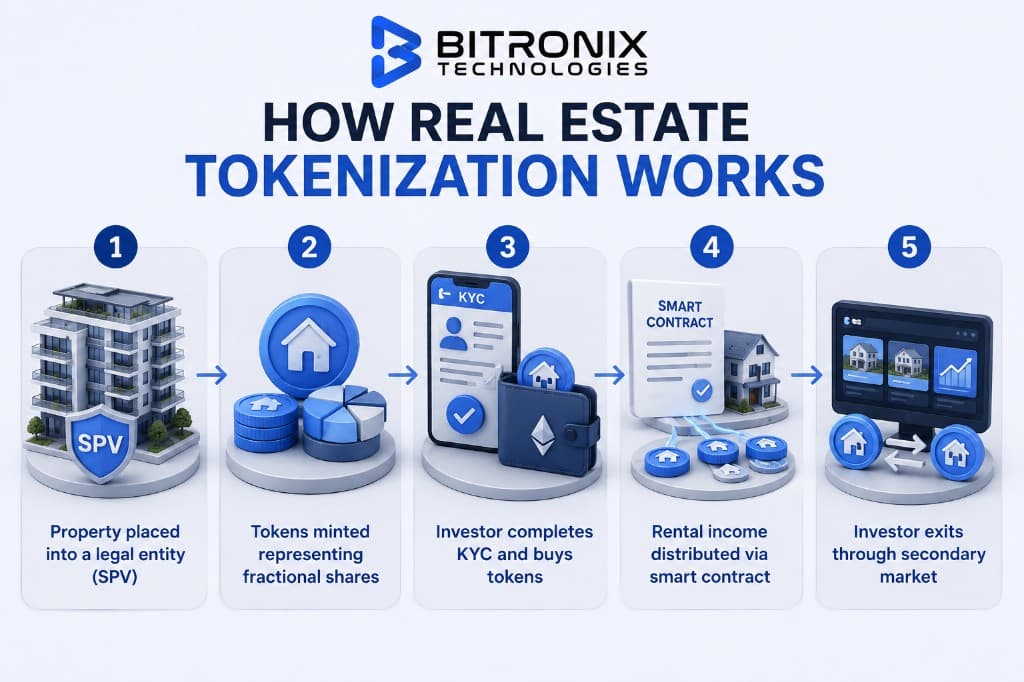
Turning a property into a tokenized, tradable digital asset generally follows six steps:
- Asset Digitization: The physical property is converted into a blockchain-based digital asset. This starts with legal structuring, usually through an SPV, along with preparing ownership documentation, title records and an independent valuation that will anchor the token's initial pricing.
- Smart Contract Development: Smart contracts are written to define the ownership logic: how tokens are minted, how many exist, how transfers are validated, what restrictions apply and how redemption or buyback works if the underlying property is ever sold.
- Token Issuance: Asset-backed tokens are created, each one representing an ownership share, using a token standard suited to securities such as ERC-3643 or ERC-1400. The issuance round is typically structured around a specific securities exemption, which determines how the offering can be marketed and who can invest.
- KYC and Compliance: Investor identity verification, accreditation checks and AML screening are built into the onboarding flow so only verified, eligible investors can hold tokens. This step also sets up the identity registry that the smart contract checks before allowing any transfer.
- Platform Integration: Tokens are put on a platform for trading and administration, including investor dashboards, wallet connections, payment rails and secondary market access. This is also where reporting tools for issuers and regulators get built in.
- Token Lifecycle Management: This covers everything after launch: ownership updates, rent or dividend distribution, compliance monitoring, secondary trading and eventually redemption or wind-down if the property is sold or the fund matures.
Compliance Infrastructure for Real Estate Tokenization
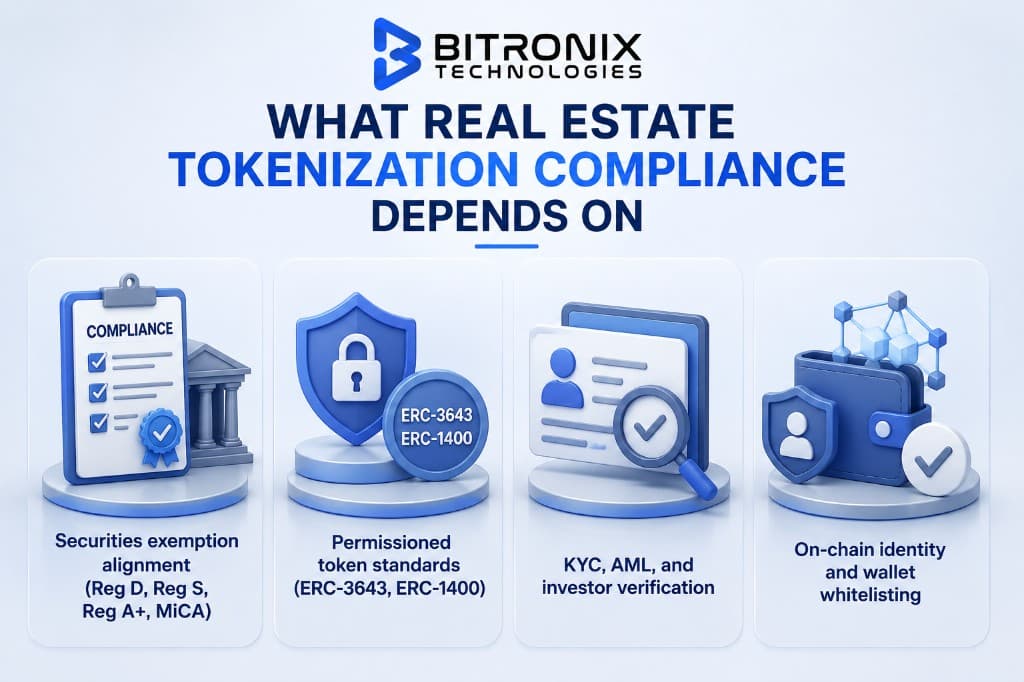
Tokenized real estate is treated as a security in most jurisdictions, so compliance has to be built into the platform from day one rather than added on afterward. A production-ready platform typically needs to account for:
- Securities compliance: In the US, this means structuring offerings around applicable exemptions such as Regulation D, Regulation S, or Regulation A+, each with different investor eligibility and marketing rules. In the EU, it means aligning with MiCA (EU Regulation 2023/1114), covering issuer disclosures, governance controls and CASP (Crypto-Asset Service Provider) readiness.
- Permissioned token standards: ERC-3643, also known as the T-REX protocol and ERC-1400 both build identity checks and transfer restrictions directly into the token contract rather than relying on enforcement outside the chain. ERC-1400 also supports lock-up periods, jurisdiction controls and forced transfers where legally required, which matters for platforms that need to unwind a position for regulatory reasons.
- KYC, AML and investor verification: Onboarding workflows need to screen for sanctions, PEP (politically exposed person) status and investor accreditation, in line with FATF guidelines, FinCEN's BSA requirements and EU AML directives. This isn't a one-time check either; ongoing monitoring is expected as investors continue to hold and trade tokens.
- Accredited investor compliance: For private offerings, eligibility verification and investor classification workflows keep participation within SEC accredited investor rules, which typically means verifying income, net worth, or professional certifications.
- On-chain identity and wallet whitelisting: Verified investor identities are linked to approved wallet addresses so only eligible holders can receive or trade tokens, enforcing jurisdiction restrictions at the contract level rather than through a separate compliance team checking every transaction manually.
- FATF Travel Rule support: For platforms handling cross-border transfers, this means supporting sender-beneficiary information exchange and coordination between VASPs (virtual asset service providers) whenever tokens move across regulated entities.
- Regulatory reporting and audit trails: Ownership changes, investor activity and compliance checks need to be recorded in a way that holds up for regulators and auditors, especially for platforms operating across multiple jurisdictions at once.
- Data privacy: Platforms serving EU investors need GDPR-aligned handling of investor and property data, covering consent management, data minimization and access controls.
Most delays in tokenization projects trace back to compliance being treated as something to bolt on later instead of part of the core architecture from the start. Retrofitting identity checks and transfer restrictions into a smart contract that wasn't designed for them is far more expensive than building it in from the beginning.
Core Features of a Real Estate Tokenization Platform
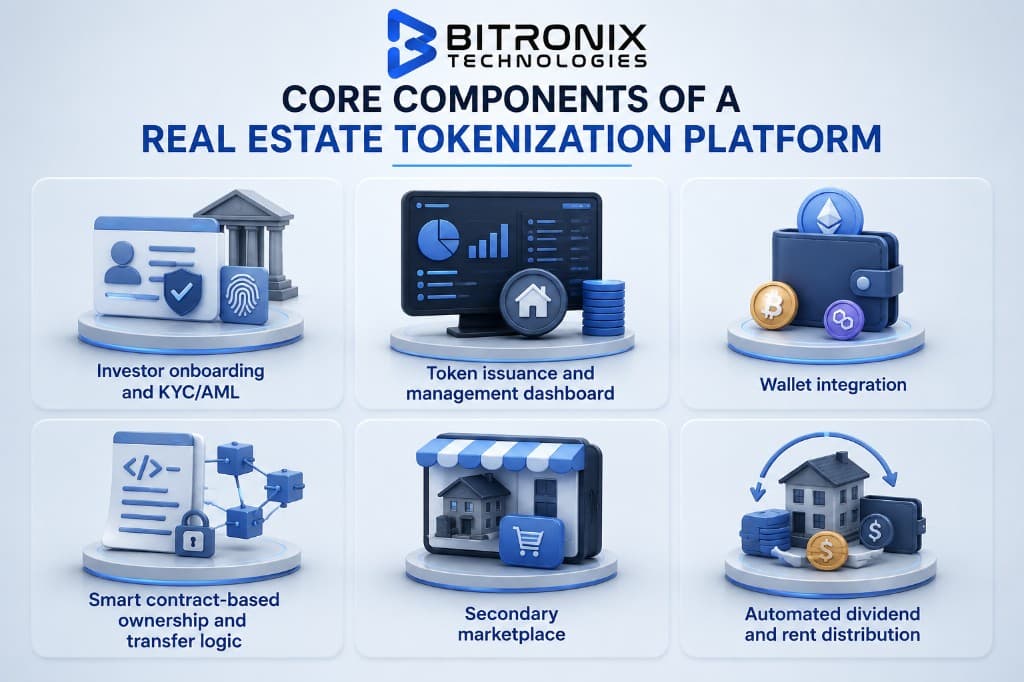
A well-built platform generally includes:
- Investor onboarding and KYC/AML workflows: A guided sign-up flow that collects identity documents, runs sanctions and PEP screening and verifies accreditation status before an investor can buy tokens.
- Token issuance and management dashboard: An admin panel for issuers to configure token supply, pricing, lock-up periods and distribution schedules without needing to touch smart contract code directly.
- Wallet integration: Support for both custodial wallets, useful for investors who don't want to manage private keys themselves and non-custodial wallets like MetaMask for investors who prefer full control.
- Smart contract-based ownership and transfer logic: The on-chain rules that govern minting, transferring and redeeming tokens, including whitelist checks before any transfer executes.
- Secondary marketplace: A trading venue, built in-platform or integrated with an external one, where verified investors can buy and sell tokens from each other rather than waiting for the issuer to buy back their position.
- Automated dividend and rent distribution: Smart contract logic that calculates and distributes rental income or profit shares to token holders on a set schedule, without manual payment processing.
- Compliance and reporting dashboards: Tools for issuers to generate audit trails, ownership reports and regulatory filings on demand.
- Multi-chain or cross-chain support: Depending on the target investor base, a platform might need to operate across more than one blockchain network to reach investors who are already active on a particular chain.
- Admin controls: The ability to enforce lock-up periods, freeze suspicious wallets, apply jurisdiction-based transfer restrictions and execute forced transfers where a court order or regulatory action requires it.
How AI Is Being Used in Real Estate Tokenization
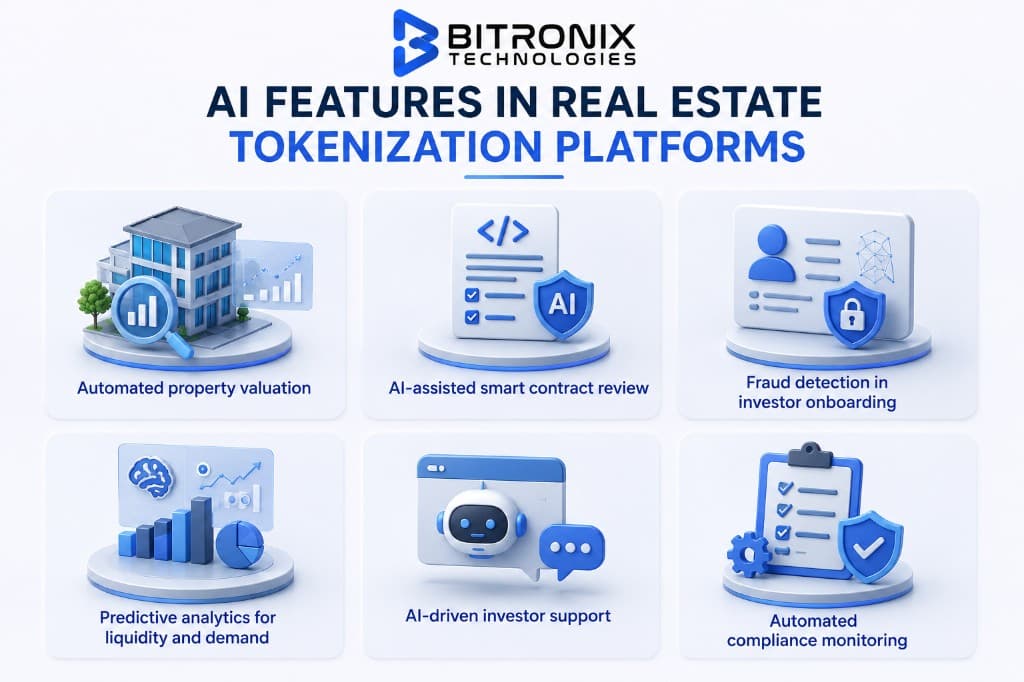
Blockchain handles the ownership and transaction layer of a tokenization platform, but AI is increasingly being layered on top to handle the parts of the process that involve judgment, pattern recognition and scale. A few areas where this shows up in practice:
- Property valuation and pricing: Machine learning models trained on comparable sales, rental yield data, location factors and market trends can help generate more consistent, data-backed valuations for the properties being tokenized, supplementing traditional appraisals rather than replacing them.
- AI-assisted smart contract generation and review: Large language models can help draft initial versions of tokenization smart contracts based on defined parameters and can flag common vulnerability patterns before a contract goes to formal audit. This speeds up development, though it doesn't replace a third-party security audit before deployment.
- Fraud detection in investor onboarding: AI-based anomaly detection can flag suspicious KYC submissions, mismatched identity documents, or unusual transaction patterns that might indicate fraud or money laundering, adding a layer of screening on top of standard AML checks.
- Predictive analytics for liquidity and demand: AI models can analyze historical trading patterns on a platform to help issuers understand which properties or token structures are likely to see stronger secondary market demand, informing how future offerings are structured.
- AI-driven investor support: Chatbots and AI assistants can handle common investor questions about token mechanics, distribution schedules and platform navigation, reducing the load on human support teams while keeping response times fast.
- Automated compliance monitoring: AI systems can continuously scan transaction activity and investor behavior against regulatory rule sets, flagging potential violations for human review faster than manual periodic audits would catch them.
AI works best here as an assistive layer rather than an autonomous decision-maker, particularly for anything touching valuation, compliance, or fraud flags. Human review still needs to sit on top of AI outputs in a regulated asset class like real estate, but AI can meaningfully cut down the manual effort required to operate a platform at scale.
A Look at the Real Estate Tokenization Tech Stack
The right stack depends on the target blockchain, jurisdiction and scale of the platform, but a typical build draws on:
| Layer | Common Technologies |
|---|---|
| Smart contracts | Solidity, ERC-3643, ERC-1400 |
| Blockchain networks | Ethereum, Polygon, Avalanche, Solana, BNB Chain |
| Backend | Node.js, Express.js |
| Frontend | Angular, React |
| Web3 integration | Web3.js, Ethers.js |
| Wallets | MetaMask, WalletConnect, custodial wallet providers |
| Storage | IPFS, Filecoin, Pinata |
| Infrastructure | AWS, MongoDB |
| Testing | Truffle, Hardhat, Ganache |
Smart contracts are typically written in Solidity and deployed on Ethereum or an EVM-compatible network like Polygon, Avalanche, or BNB Chain, chosen based on transaction cost, speed and where the target investor base is already active. Backend services built on Node.js and Express.js handle the off-chain logic like KYC processing, notifications and reporting, while the frontend, usually built in Angular or React, gives investors and admins a usable interface on top of the blockchain layer. Property documents, valuations and other supporting files are often stored on decentralized storage like IPFS or Filecoin, pinned through a service like Pinata to keep them reliably accessible. Truffle, Hardhat and Ganache are used for local testing and deployment before contracts go live on mainnet.
Who Uses Real Estate Tokenization Platforms
- Real estate developers use tokenization to digitize assets, streamline project funding and attract investment from a global pool of buyers instead of a narrow local market. This is particularly useful for large-scale developments where traditional financing would mean taking on debt or giving up a large equity stake to a small number of institutional backers.
- Investment firms build tokenized property portfolios to diversify holdings, increase liquidity and offer investors a more transparent, efficient way into real estate. Tokenization also gives firms a way to offer smaller minimum investments without the administrative overhead of managing hundreds of individual paper agreements.
- Property management companies use smart contracts to automate lease tracking, rent collection and payment distribution, cutting down on manual admin work for both owners and tenants, while giving both sides a transparent record of payment history.
- Commercial real estate owners tokenize office and retail assets to create liquidity and open up fractional investment opportunities to institutional and retail investors alike, particularly useful for large single-tenant buildings that would otherwise require one buyer for the entire asset.
- Residential real estate platforms use tokenization to enable smaller-ticket investment in housing, letting investors buy into residential property from anywhere without the friction of a traditional mortgage-backed purchase.
- Real estate marketplaces use tokenization to connect buyers, sellers and investors on a single platform with secure, transparent transactions, often layering in secondary trading so investors aren't locked into a position until the underlying property sells.
Real Estate Tokenization Development Process
Here is how we typically approach a build at Bitronix Technologies:
- Step 1: Strategy and Asset Evaluation — We assess the property or portfolio, define the tokenization model (equity, debt, or hybrid) and map out the legal structure and applicable token standard based on your target investor base and jurisdictions.
- Step 2: Platform Design and Development — Our team builds the full platform, including smart contracts, investor-facing interfaces, admin dashboards and blockchain infrastructure, all tailored to your investment model and branding.
- Step 3: Compliance and Integration — We implement KYC/AML workflows, identity registries and transfer restriction logic and integrate with custody, banking, or payment partners as needed for your target markets.
- Step 4: Testing and Security Audits — Smart contracts go through internal testing and third-party security audits before deployment, since a vulnerability discovered after tokens are issued and trading is far more costly to fix than one caught before launch.
- Step 5: Launch and Scaling — Post-launch, we manage token lifecycle operations, monitor platform performance and scale infrastructure as the investor base and asset portfolio grow, including adding new properties or expanding into new jurisdictions.
What Does a Real Estate Tokenization Platform Cost?
Cost depends on a handful of factors:
- The token standard and blockchain network chosen, since gas costs and development complexity vary by network
- How deep the compliance requirements go, single jurisdiction versus multiple, since each added jurisdiction adds legal and technical overhead
- Custody and banking integrations, particularly for platforms handling fiat on-ramps and off-ramps
- Whether a secondary marketplace is part of the build, since matching engines and order books add development time
- Whether the platform is fully custom or built on a white-label foundation, which can significantly cut both cost and timeline
Most platforms take somewhere between 8 and 20 weeks to build, depending on feature scope, integrations and regulatory complexity. A narrower MVP with core issuance and KYC functionality can move faster. A full multi-jurisdiction platform with secondary trading and institutional custody integration takes longer.
Why Work With Bitronix Technologies
Building a real estate tokenization platform takes blockchain engineering, securities-aware token design and real compliance knowledge working together. Getting any one of those wrong creates risk for both issuers and investors. At Bitronix Technologies, we bring:
- Blockchain and smart contract expertise across Ethereum, Polygon and other major networks, with experience across ERC-3643 and ERC-1400 implementations for regulated offerings.
- End-to-end delivery, from strategy and legal structuring alignment through development, audits and post-launch scaling, so you're not coordinating between multiple vendors for different pieces of the platform.
- Compliance-first architecture built around ERC-3643, ERC-1400, KYC/AML and jurisdiction-specific regulatory frameworks, designed in from the start rather than retrofitted later.
- AI-assisted development and monitoring tools that speed up smart contract review and give platforms an added layer of fraud and compliance monitoring once live.
- Platform design built to scale as your asset portfolio and investor base grow, so the architecture that works for your first property also works for your fiftieth.
Frequently Asked Questions
What is real estate tokenization?
It's the process of converting ownership rights in a physical property into digital tokens on a blockchain, enabling fractional ownership and easier transfer of that ownership between investors.
Is real estate tokenization legal?
Yes, when structured correctly. Compliant platforms build in KYC/AML, investor eligibility checks and securities-law-aligned token structures from the start, typically under an applicable exemption like Reg D, Reg S, Reg A+, or a MiCA-aligned framework in the EU.
What token standards are used for real estate tokenization?
ERC-3643 and ERC-1400 are the most widely used, since both support identity verification and transfer restrictions natively at the smart contract level, which matters for assets that are legally treated as securities.
How long does it take to build a real estate tokenization platform?
Most projects take 8 to 20 weeks depending on feature scope, compliance requirements and integrations.
What types of properties can be tokenized?
Residential properties, commercial buildings, hotels, land, rental portfolios and REITs can all be tokenized.
Do you offer white-label tokenization platforms?
Yes. A white-label foundation can cut time-to-market significantly for issuers who don't need a fully custom build from day one.
How does AI fit into a real estate tokenization platform?
AI is typically used to assist with property valuation, flag fraud during investor onboarding, support smart contract review and monitor compliance activity at scale, working alongside human review rather than replacing it.
Which blockchain should I use for a real estate tokenization platform?
It depends on your investor base and transaction cost tolerance. Ethereum offers the deepest ecosystem and tooling, while networks like Polygon, Avalanche and BNB Chain offer lower transaction costs for platforms expecting high transaction volume.

Founder and CTO
Founder and CTO of Bitronix Technologies. Builds RWA tokenization platforms, permissioned token standards and compliance-ready real estate digital asset infrastructure.
Related Posts
 Blockchain
October 14, 202615 min read
Crypto Token Development Cost in 2027: Pricing, Features and Budget Breakdown
Explore crypto token development cost in 2027, with estimated pricing, key cost factors, smart contract audits, development timelines, & hidden expenses.
Read article Blockchain
October 1, 202613 min read
Top 10 Companies to Hire Blockchain Developers in India 2026-2027
Find the top 10 companies to hire blockchain developers in India. Compare blockchain services, expertise, use cases, & tips for choosing a development partner.
Read article Blockchain
September 25, 202616 min read
RWA Tokenization in Singapore: Regulations, Licensing & Complete Guide 2026
Learn about RWA tokenization in Singapore, including MAS regulations, licensing, compliance, use cases, costs and how to build an RWA platform in 2026.
Read article