




DEX Consulting
Before writing a single contract, we walk through your AMM model, target chains, token requirements, and audit timeline — so architecture is decided properly instead of rushed into a quote.
Empowering Secure & Scalable Trading Platforms
Bitronix builds decentralized exchange platforms that let users trade directly from their own wallets, with no account, no custody, and no company standing between a trader and their funds. As a decentralized exchange development company, we handle the full build: smart contracts, liquidity pools, swap routing, wallet integration, and the admin tools you need to run the platform once it is live.
Decentralized exchange development is the process of building a trading platform where transactions settle directly on the blockchain instead of through a company-run order book. Users connect a wallet, trade against smart contracts, and keep control of their assets at every step. There is no sign-up form and no internal ledger that a company controls behind the scenes.
Bitronix designs and builds this kind of platform for startups, DeFi protocols, token projects, and enterprises moving into Web3. We work on the parts that actually decide whether a DEX succeeds: the AMM pricing logic, the routing engine that finds the best trade, the pool contracts that hold user liquidity, and the audit process that keeps those contracts safe before real money touches them.
Our recent work includes ProSwap, an automated market maker built with configurable liquidity pools and custom swap routing — one example of what a Bitronix-built DEX looks like in production.
A DEX is not one piece of software — it is several systems working together: contracts, routing logic, a frontend, and the tools an operator needs after launch. Bitronix covers each part as a dedicated service.
Before writing a single contract, we walk through your AMM model, target chains, token requirements, and audit timeline — so architecture is decided properly instead of rushed into a quote.
A DEX built from your specifications, not a template with your logo on it. Pool structure, fee tiers, governance rules, and routing logic designed around how you want the exchange to work.
Pool contracts that hold paired assets, issue LP tokens, and calculate pricing through your chosen AMM curve — constant product, stableswap, or concentrated liquidity.
An aggregator layer that routes a trade across your pools and outside exchanges to find the best available price — useful while your own liquidity is still building.
Connection flows for MetaMask, WalletConnect-compatible mobile wallets, and hardware wallets, with clear transaction prompts so users know exactly what they are signing.
The same core contract logic deployed consistently across the chains you choose, with a shared frontend and a shared approach to liquidity.
Trading interfaces for iOS and Android that connect to the same contracts as your web app — same pricing, routing, and security as desktop.
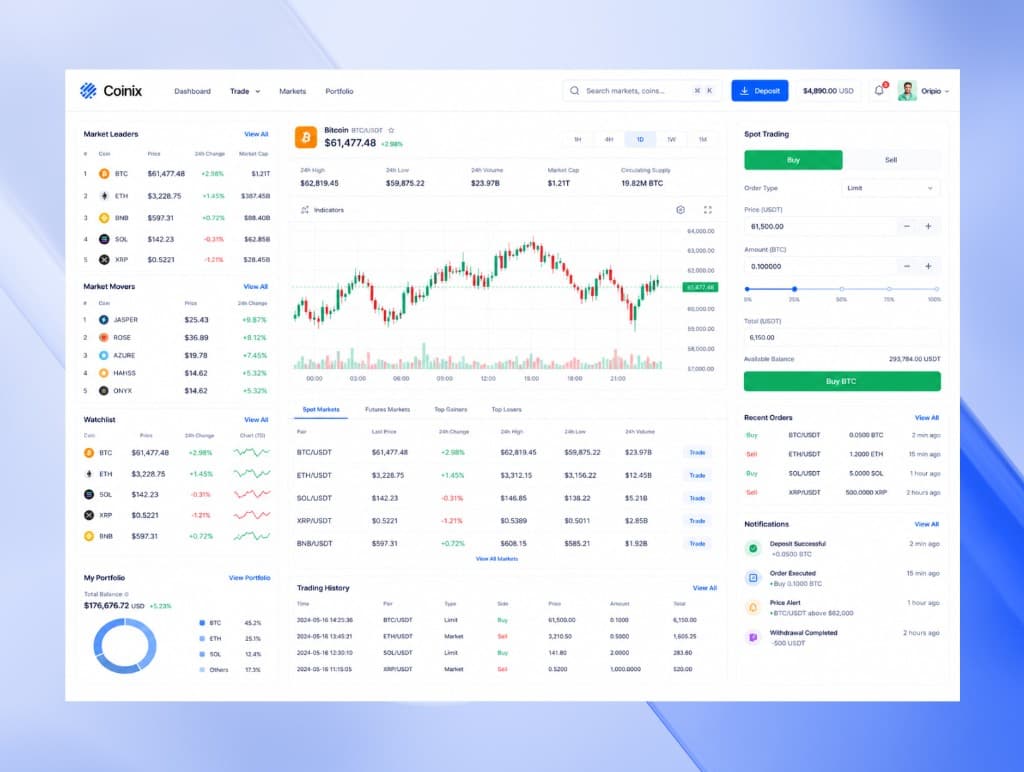
Not every DEX works the same way. The right model depends on your assets, your users, and how much liquidity you expect to start with.
Uses liquidity pools instead of a traditional order book, so prices are set algorithmically from the ratio of assets in each pool. Instant liquidity without a professional market maker quoting prices.
Matches buy and sell orders directly, either fully on-chain or with off-chain matching and on-chain settlement — closer to how a traditional exchange order book behaves.
Supports futures, perpetuals, or options contracts on-chain for platforms that need leveraged trading rather than simple spot swaps. Higher design and audit complexity than a spot AMM.
Separate pools per chain with a shared frontend, or actual cross-chain swap routing — a bigger architectural commitment scoped separately when needed.
Combines AMM pricing with order-book-style controls, or blends on-chain settlement with faster off-chain matching — speed of a CEX with the custody model of a DEX.
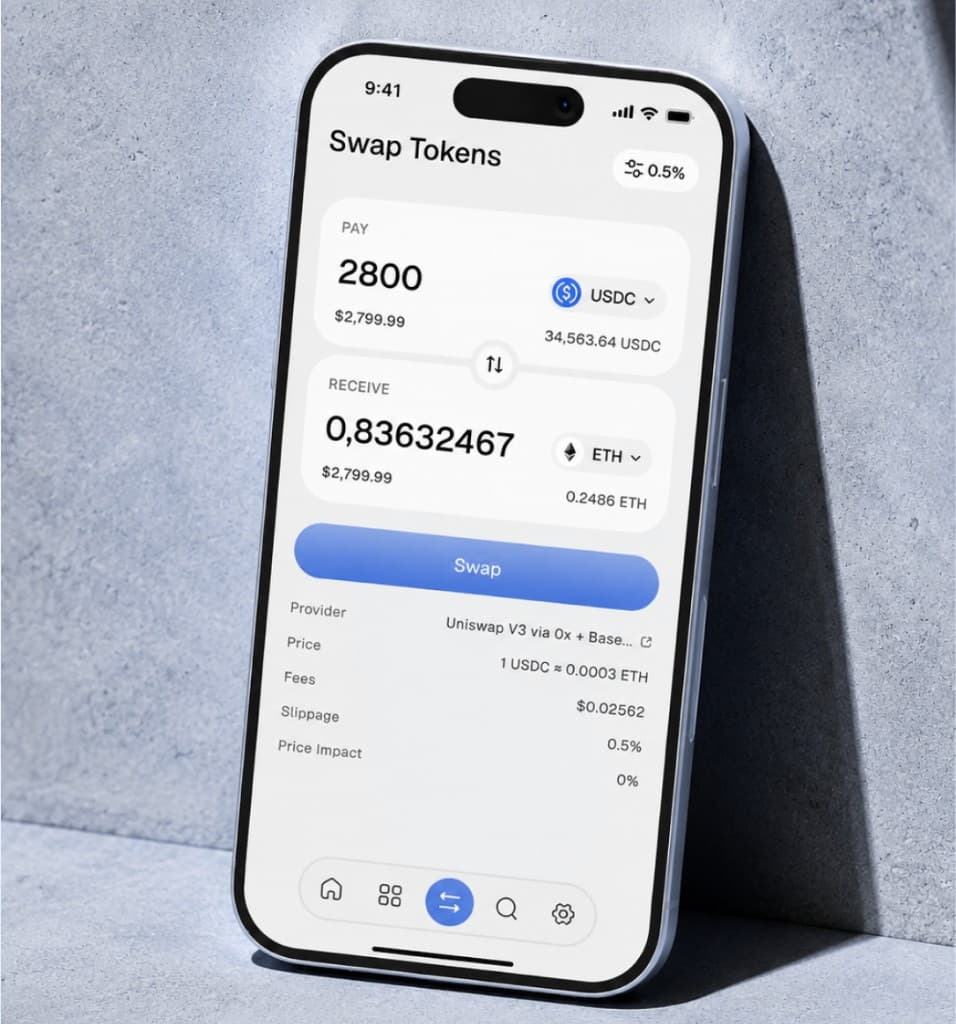
A DEX needs to work for three different people: the trader, the liquidity provider, and the operator running the platform.
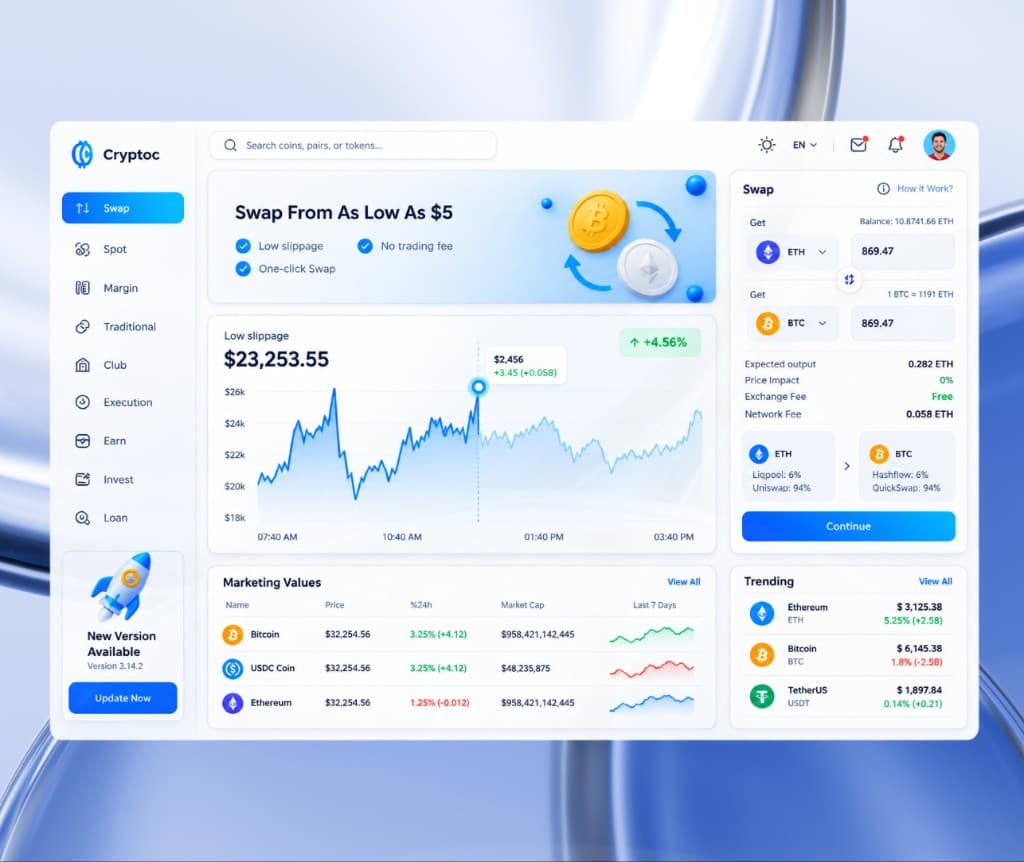
Instant swaps priced through your liquidity pools — no order matching wait, no counterparty needed.
Direct buying and selling at current market prices for users who want a straightforward trade.
Market orders for instant execution; limit orders where your DEX model supports specific entry or exit prices.
When no direct pair exists — or splitting gets a better price — the router finds that path and shows it before the user signs.
Every quote shows expected price impact and lets users set slippage tolerance so bad fills revert instead of executing.
Routes across your own pools and outside liquidity sources for the best available price.
Trade and move assets across the chains your platform supports where architecture includes multi-chain deployment.
Users connect a wallet they already control. No account creation and no funds held by the platform.
Deposit assets into pools and earn a share of trading fees, represented by LP tokens in their own wallet.
Token holders can vote on protocol parameters, fee changes, or treasury decisions when a governance module is included.
A clear view of holdings, LP positions, and past trades without needing a third-party tracker.
Optional staking or LP incentive programs structured so rewards support early liquidity growth without running indefinitely at the same rate.
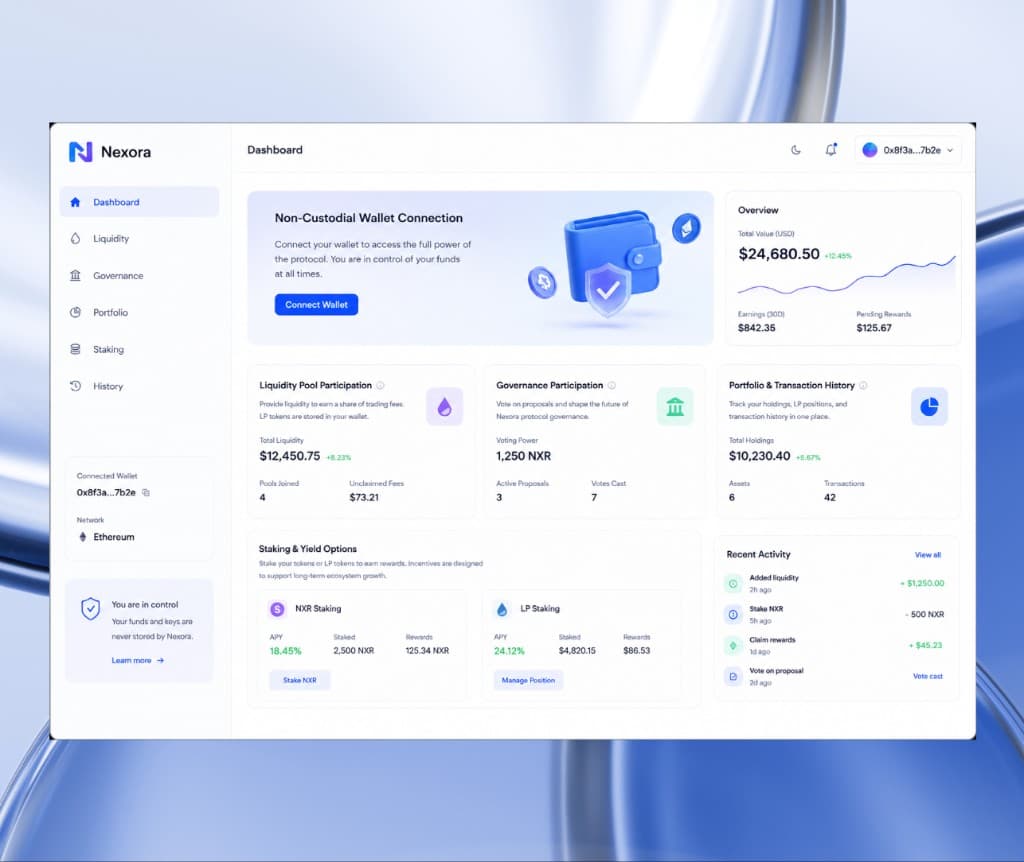
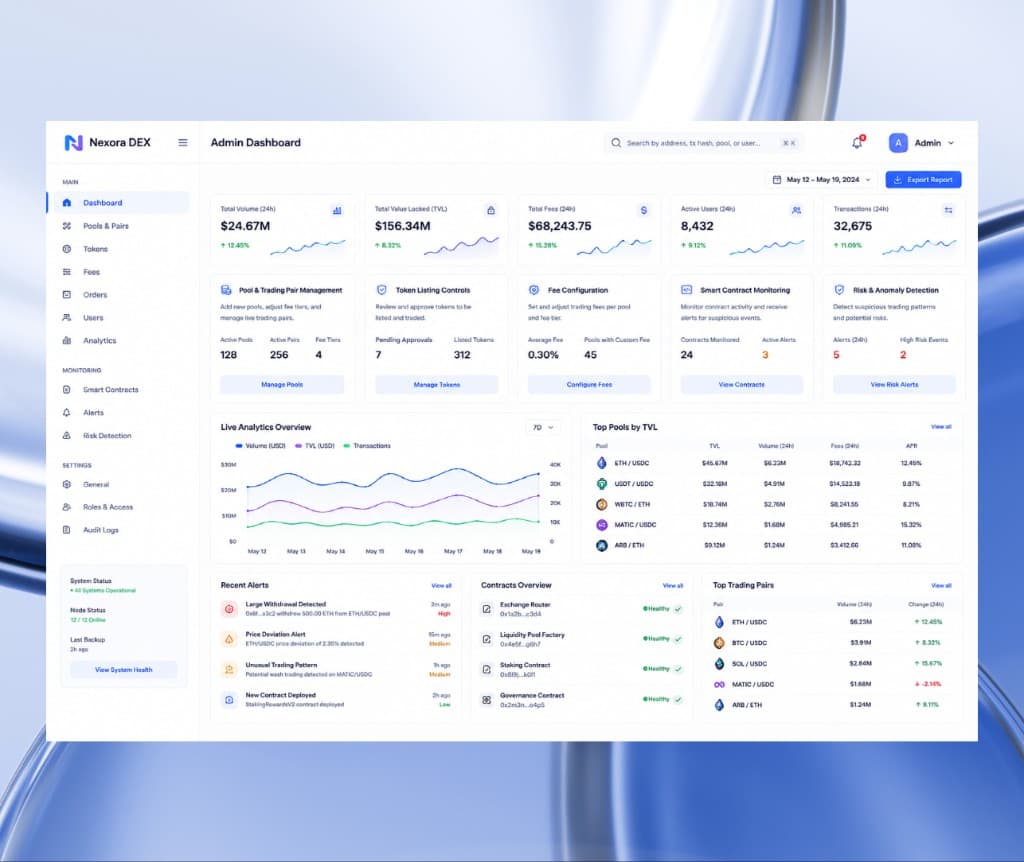
Add pools, adjust fee tiers, and manage live pairs without an engineer for every change.
Volume, TVL, pool performance, and user activity in one view.
A defined process for approving which tokens can be listed so listings stay intentional.
Set and adjust trading fees per pool as your revenue model matures.
Visibility into unusual withdrawal patterns or price deviations, with alerts routed to your team.
Monitoring for wash trading or coordinated activity so issues get flagged early.
The mechanics behind a DEX are simpler than they look from the outside. Here is the actual path a trade takes.

STEP 1
A user connects their existing wallet — MetaMask, WalletConnect, or similar — directly to the platform. No sign-up form, no password.
STEP 2
Instead of a username and password, the wallet signs a message to prove ownership of the address. This is the user's identity on the platform.
STEP 3
Behind every trading pair sits a liquidity pool, funded by users who deposited assets in exchange for a share of trading fees.
STEP 4
When a user submits a swap, the smart contract calculates the price from the pool ratio (or from routing across pools), and the user reviews the price and slippage before signing.
STEP 5
Once signed, the trade executes and settles in the same blockchain transaction. There is no separate matching step and no waiting period — the trade is final once the transaction confirms.
STEP 6
The traded assets move straight from the pool contract to the user's wallet. At no point does the platform hold custody of the funds.
A decentralized exchange changes what your users have to trust, and what your business has to manage.
Since the platform never holds user funds, there is no custodial wallet infrastructure to secure and no single point of failure that can lose customer assets.
Every trade, pool balance, and fee is visible on-chain. Users do not have to take your word for how the platform works — they can verify it directly.
No KYC gate by default and no account approval process — users can start trading as soon as they connect a wallet, unless you add frontend-level restrictions.
Available to anyone with an internet connection and a wallet, without the account creation and regional onboarding friction a centralized platform usually has.
Governance modules let token holders vote on protocol decisions — building a more engaged base than a platform where every decision comes from the top down.
A DEX built on standard patterns can plug into lending protocols, yield aggregators, and other dApps that expect standard pool and token interfaces.

Instead of a rigid template, Bitronix works from a modular DEX framework: pool contracts, router logic, wallet integration, and admin tools that already follow tested patterns — customized around your fee structure, governance model, and chain choice.
Different AMM designs solve different liquidity problems. Here are the models our smart contract team builds against, described by mechanics rather than by brand name, since the right fit depends on your assets, not on copying another platform's product.
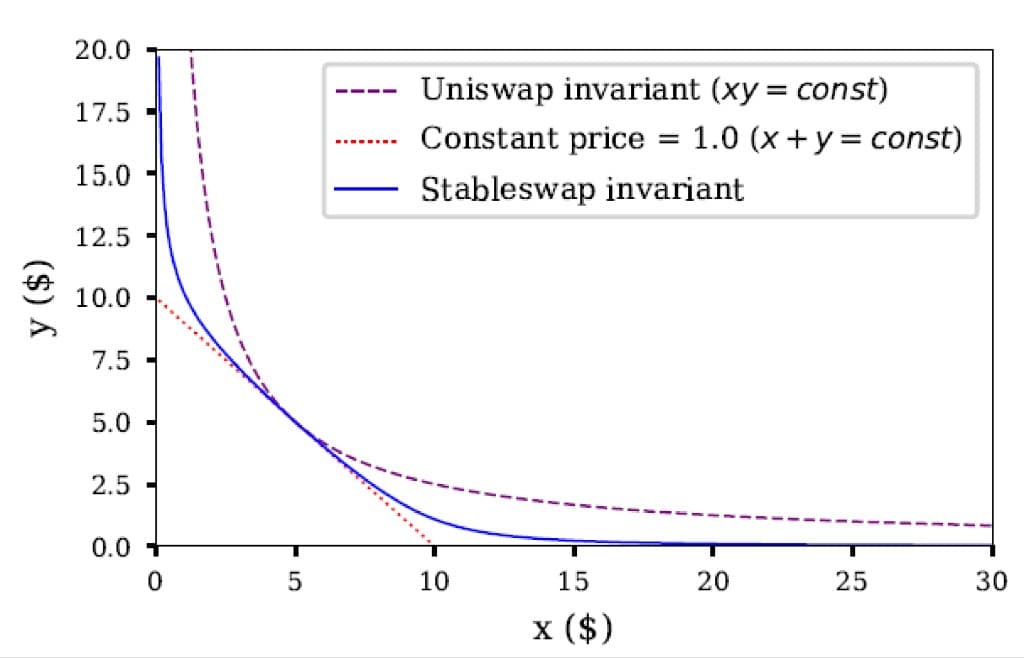
The standard AMM design, pricing assets based on the ratio held in a pool. Works well for most token pairs and is the simplest model to reason about and audit.
Built for pairs of assets expected to trade near the same value, like stablecoins or pegged tokens. Produces far lower slippage than a constant product pool for these specific pairs.
Pools holding more than two assets at custom weight ratios, useful for index-style products or projects that want a single pool to represent a basket of tokens instead of a single pair.
Lets liquidity providers focus their capital within a specific price range instead of spreading it across the full price curve, improving capital efficiency for pairs with predictable trading ranges.
For chains like Solana, AMM logic built around that chain's transaction model, aimed at fast, low-fee swaps where transaction volume is high.
A DEX has real monetization paths beyond speculation. Here is where the revenue actually comes from.
A small percentage on every swap, split between the platform and liquidity providers depending on your fee structure.
Some platforms charge or require liquidity commitments from projects that want a dedicated pool, particularly for curated listing models.
Even where the platform doesn't keep listing fees, structuring fee splits with LPs keeps liquidity deep, which keeps trading volume, and platform fee revenue, healthy.
A well-designed governance token can align long-term platform growth with token holder incentives, though this is a token design decision, not a guaranteed revenue source.
Advanced trading tools, analytics, or API access can be gated as a paid tier for power users and integrators, depending on your product strategy.
If your DEX includes an aggregator layer, a small routing fee on trades executed through outside liquidity sources adds a separate revenue line.
DeFi regulation is still developing and varies significantly by jurisdiction. A DEX's smart contracts are typically permissionless by design, but that does not mean compliance is irrelevant to your business.
Frontend-Level Controls Geographic restrictions or address screening — if your legal counsel determines you need them — are usually implemented at the interface layer rather than inside the contracts, since the underlying protocol stays open.
Governance And Treasury Structure How your DAO or governance token is structured has legal implications that vary by jurisdiction, and should be reviewed with counsel before launch, not after.
Token Classification. Whether your governance or platform token could be treated as a security depends on how it is designed and distributed — a legal question, not a technical one.
Bitronix builds the technology and the controls your legal team asks for. We are not a law firm, and any compliance decision should go through your own counsel first.
Chain choice affects fees, speed, and which users you can reach. We build against the network that fits your users, not the one that is easiest for us.
The most established smart contract ecosystem, with the deepest DeFi liquidity and tooling. Higher gas costs, but the widest reach for serious DeFi users.
Lower transaction fees and fast confirmation — popular for retail-focused trading platforms.
Ethereum-compatible tooling with far lower gas costs — a common choice for projects that want Ethereum's ecosystem without Ethereum's fees.
Ethereum security with rollup-level speed and cost improvements, suited to platforms expecting high trading volume.
Built for high transaction throughput and low fees — suited to AMMs expecting heavy swap volume, at the cost of a different development stack.
Fast finality and EVM compatibility — a middle ground for teams that want Ethereum tooling with better performance.
Our process
From discovery through mainnet launch — a clear path with audit coordination built in, not bolted on at the end.

Chains, AMM model, token requirements, governance design, and audit scope get defined before any code is written.
Step 01
Step 01
Chains, AMM model, token requirements, governance design, and audit scope get defined before any code is written.
Step 02
Contract architecture, pool and fee structure, routing logic, and frontend design get finalized.
Step 02
Contract architecture, pool and fee structure, routing logic, and frontend design get finalized.
Core contracts get built, internally reviewed, and tested against your specification.
Step 03
Step 03
Core contracts get built, internally reviewed, and tested against your specification.
Step 04
Full test suites run against the contracts, followed by testnet deployment and coordination with your chosen independent auditor.
Step 04
Full test suites run against the contracts, followed by testnet deployment and coordination with your chosen independent auditor.
Mainnet deployment, liquidity seeding coordination, and frontend go-live.
Step 05
Step 05
Mainnet deployment, liquidity seeding coordination, and frontend go-live.
Step 06
Monitoring, governance support, and a clear path for adding new pools, chains, or modules as your platform grows.
Step 06
Monitoring, governance support, and a clear path for adding new pools, chains, or modules as your platform grows.
We are not the largest DEX development shop, and we are not going to claim a project count we can't show you. What we can show you is actual work: ProSwap, an AMM DEX built with configurable pools and custom swap routing, and Harbor, an on-chain settlement build for tokenized real-world assets with the same policy-gated contract discipline a DEX needs.
We would rather tell you honestly what building a DEX involves than sell you a countdown timer and a discount code.
Tooling
Production tooling chosen for auditability, ecosystem fit, and operational clarity.
| Area | What we use |
|---|---|
01Smart contracts | Solidity for EVM chains; Rust or chain-specific languages for non-EVM targets |
02Testing | Unit, integration, and fuzz testing before every audit |
03Indexing | Subgraph-style indexing for fast historical and analytics queries |
04Frontend | React-based interfaces with wallet-connection libraries and live pool data |
05Infrastructure | Standard RPC providers; containerized backend services for analytics and admin tools |
06Analytics | On-chain data pipelines for volume, TVL, and activity reporting |
FAQ
Straight answers on timelines, cost, audits, multi-chain scope, and ownership.
DEX development is building a decentralized exchange — a trading platform where users swap tokens directly from their own wallet through smart contracts, without a company holding their funds or matching trades internally.
A centralized exchange holds user funds in company-controlled accounts and matches orders internally. A decentralized exchange never takes custody, and trades settle directly on-chain through smart contracts, usually priced through liquidity pools instead of an order book.
It depends on your AMM model, chain count, and audit timeline, which your chosen auditor controls rather than the development team. A single-chain AMM with a standard feature set moves faster than a multi-chain platform with governance and aggregation built in. We give a real estimate after a scoping call, not before.
Cost depends on scope: the AMM model, number of chains, whether you need an aggregator layer or governance module, and your audit requirements. There is no fixed number that applies to every project, which is why we start with a discovery call before quoting anything.
Yes. Any contract holding or moving user funds should go through an independent third-party audit before mainnet deployment. This is standard practice, not an optional add-on, and we build with audit readiness in mind from the first contract.
Yes. Multi-chain DEX development means deploying the same core contract logic across several networks, typically with a shared frontend and separate liquidity per chain, since assets don't move between chains without a dedicated bridging mechanism.
A DEX aggregator routes trades across multiple liquidity sources, including other exchanges, to find the best price instead of relying on a single pool. It is useful when your own liquidity is still growing and users need competitive pricing right away.
Legality depends on your jurisdiction and how your platform is structured, and this is a question for your own legal counsel, not something we can answer generically. We build the technology and the controls your legal team asks for.
Ownership terms are defined in the statement of work before development starts, so there is no ambiguity about it later.
Insights from our engineering team
Notes on architecture, security, and shipping AI in regulated environments.
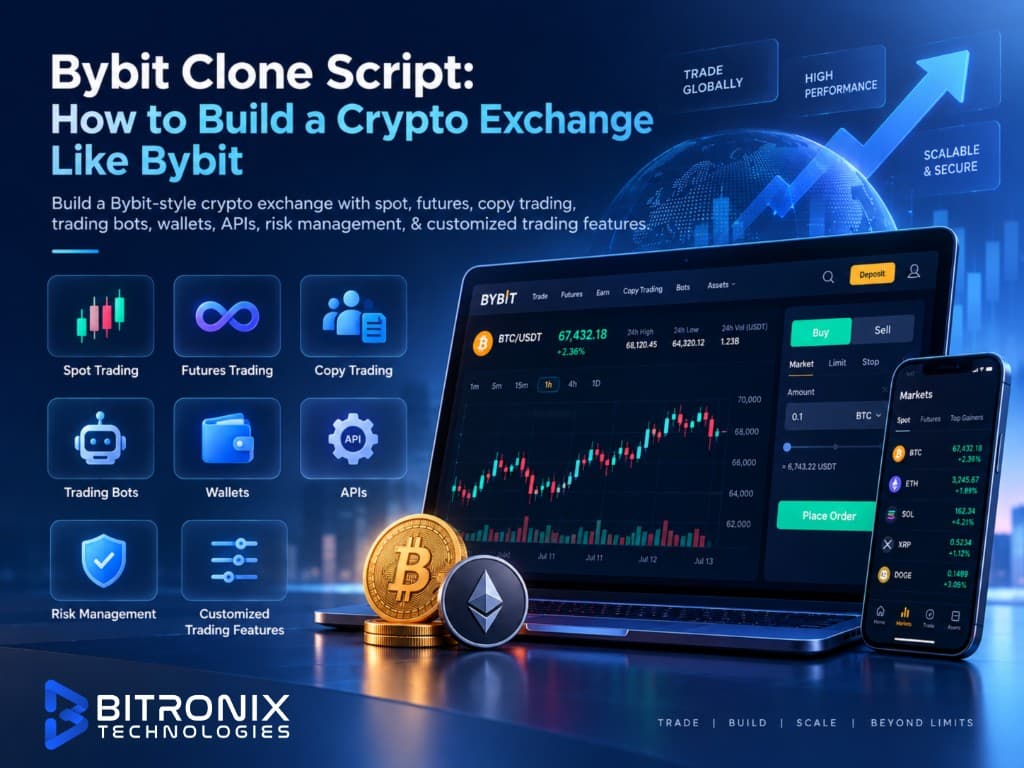
Build a Bybit-style crypto exchange with spot, futures, copy trading, trading bots, wallets, APIs, risk management, & customized trading features.
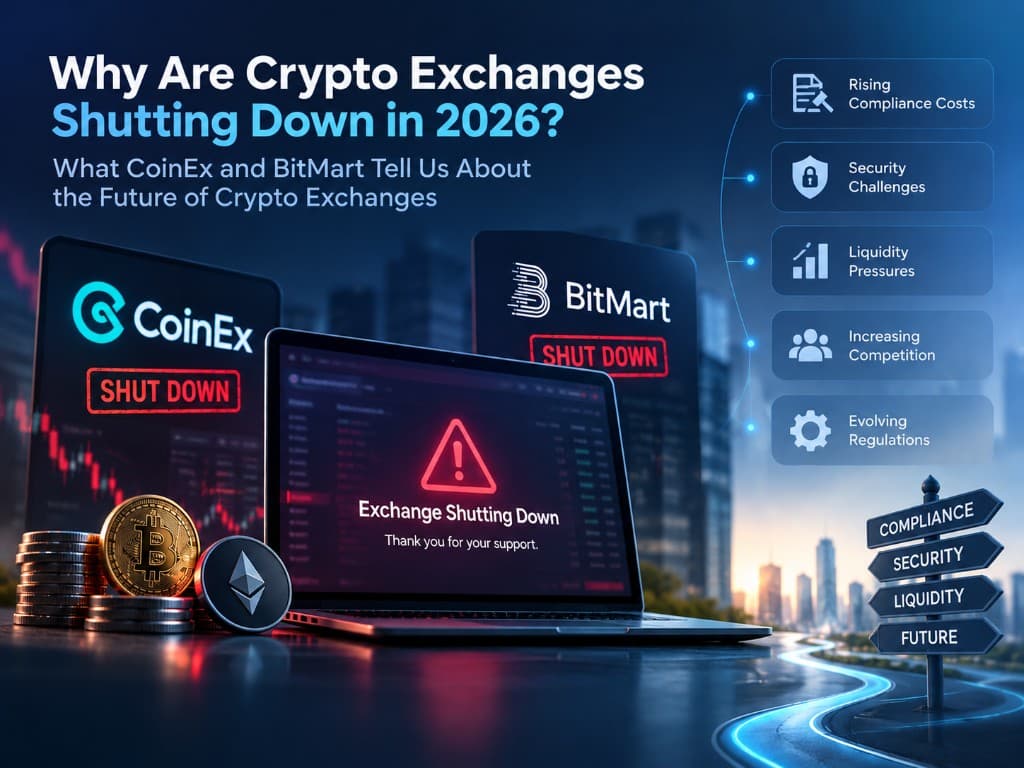
Why are crypto exchanges shutting down in 2026? Explore CoinEx, BitMart, rising compliance costs, security, liquidity & the future of crypto exchange development.
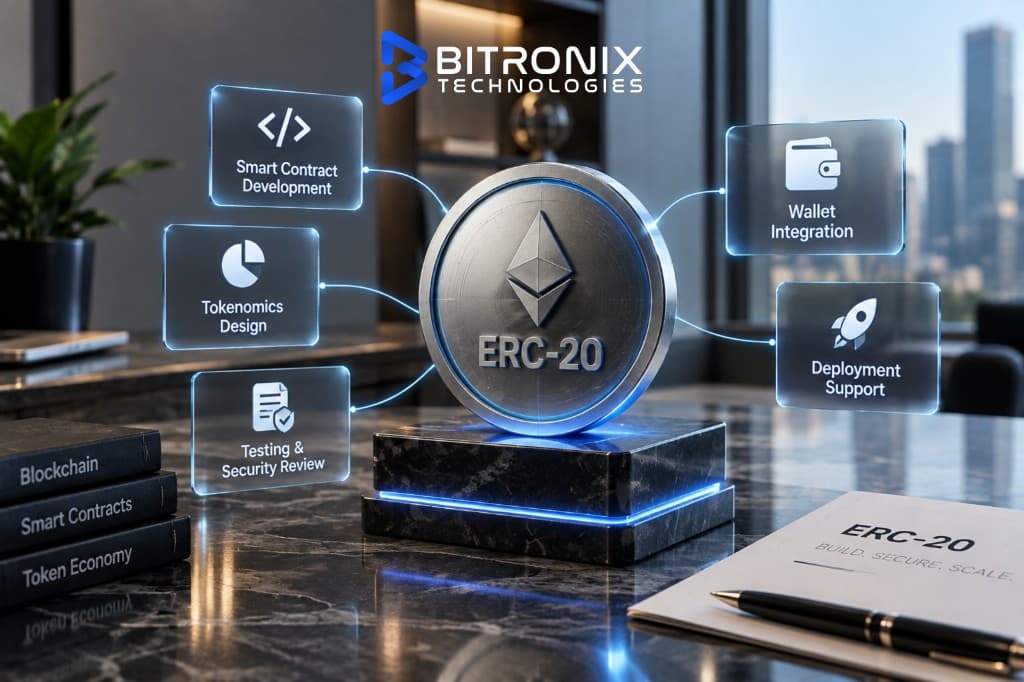
Build a custom ERC-20 token with Bitronix. Get smart contract development, tokenomics, testing, security review, wallet integration, and deployment support.
Get in touch
We take on 4 new enterprise clients per quarter. Tell us what you're building.
Our offices
Direct lines to our delivery hubs. Same-day routing for qualified enterprise enquiries.
Global headquarters


