Why Are Crypto Exchanges Shutting Down in 2026? What CoinEx and BitMart Tell Us About the Future of Crypto Exchanges

By Tausif AhmedFounder and CTO
It is useful to separate the facts from the broader discussion about the crypto market.
CoinEx and BitMart: What Actually Happened?
CoinEx
CoinEx announced on September 15, 2026, that it would stop operating and begin an orderly liquidation process.
According to CoinEx's own announcement, the decision followed a prolonged downturn in the crypto market, a significant reduction in industry trading volume and liquidity, increasing regulatory requirements, and compliance and operating costs that the company considered unsustainable.
The shutdown is being carried out in stages.
CoinEx's published schedule says:
- New user registration stopped on September 15
- Several non-spot services are being discontinued
- Deposits are scheduled to stop on September 22
- Spot trading is scheduled to end on September 29
- Withdrawals are scheduled to remain available until December 22
- The platform is scheduled to close after the withdrawal period
BitMart
BitMart announced an orderly wind-down in July 2026.
The exchange stopped accepting new registrations, deposits, and new trading orders as part of the process. Its spot, futures, and other trading services ended on August 26, while the planned end of platform operations is January 31, 2027.
BitMart initially described the decision in terms of its operating conditions, market environment, and future strategic direction rather than providing the same detailed explanation that CoinEx later gave.
That distinction matters.
Not every exchange shutdown has the same cause.
It would be inaccurate to assume that every closure is caused by regulation, liquidity, security, or declining demand alone.
Why Is Running a Crypto Exchange Harder Today?
The basic idea behind an exchange has not changed:
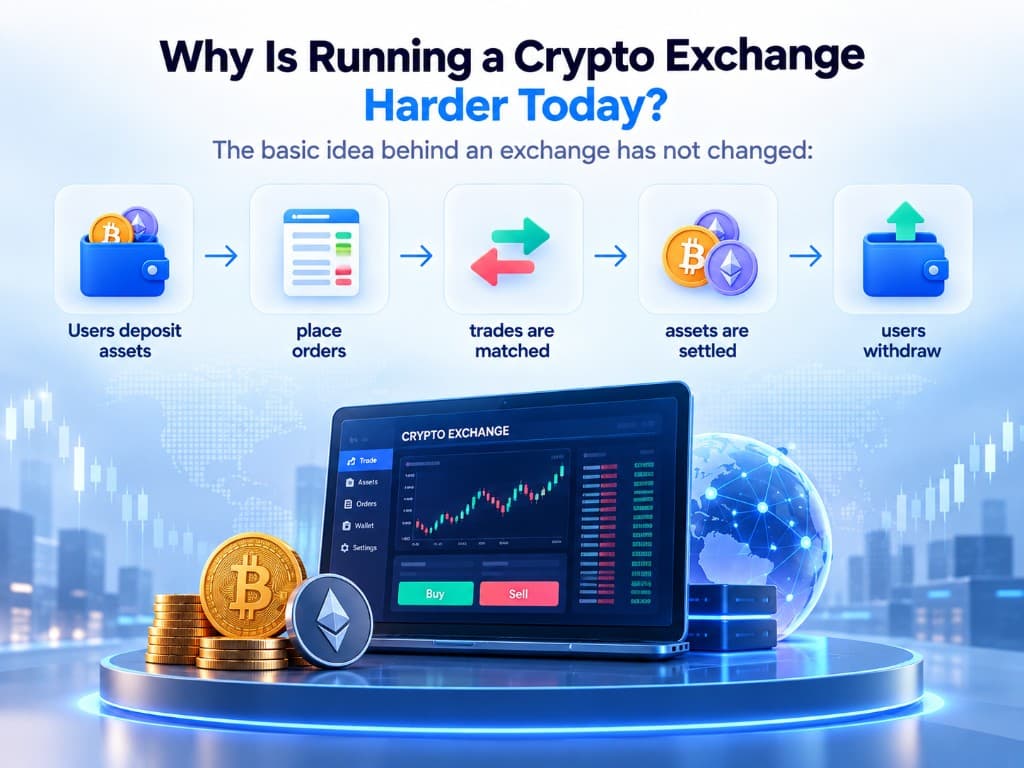
The infrastructure behind that process, however, has become considerably more complicated.
A modern exchange may need to manage:
- Trading infrastructure
- Blockchain connectivity
- Wallets and custody
- Liquidity
- KYC
- AML controls
- Transaction monitoring
- Risk management
- Cybersecurity
- Compliance reporting
- Customer support
- Banking relationships
- Data security
- Business continuity
- Regulatory requirements
This means an exchange is no longer simply a software product.
It is an operational and financial infrastructure business.
1. Compliance Has Become Core Exchange Infrastructure
One of the biggest changes is the growing importance of compliance.
A crypto exchange may need systems for:
KYC
Know Your Customer processes help establish and verify customer identities according to applicable requirements.
AML Monitoring
Anti-money-laundering controls can help identify transactions or patterns that require further investigation.
Transaction Monitoring
An exchange may need to monitor deposits, withdrawals, trading activity, and blockchain transactions for risk indicators.
Sanctions Screening
Depending on jurisdiction and business model, exchanges may need controls for applicable sanctions requirements.
Travel Rule Compliance
Where applicable, exchange infrastructure may need to handle information associated with certain crypto transfers.
Regulatory Reporting
Some jurisdictions require regulated businesses to maintain records and provide specific reports to authorities.
This creates an important difference between an exchange prototype and a production exchange.
A trading interface can be built relatively quickly. A compliant operating environment is a much larger undertaking.
2. Security Is No Longer Just a Technical Feature
Crypto exchanges hold assets that can be moved digitally.
That makes security fundamental to the business.
A serious exchange needs to think about multiple layers of protection.
Wallet Security
Hot and cold wallet strategies can be designed according to the platform's custody model and operational requirements.
Key Management
Private keys need strong controls because unauthorized access can result in irreversible asset movements.
Account Security
User accounts can require:
- Multi-factor authentication
- Withdrawal controls
- Device monitoring
- Login alerts
- Session management
API Security
Many traders and institutional users connect through APIs, making API authentication and permissions an important part of exchange security.
Infrastructure Security
Servers, databases, cloud environments, internal services, and network infrastructure all need protection.
Monitoring
Security teams need systems capable of detecting unusual activity and responding to incidents.
The important point is simple:
Security cannot be treated as a feature that is added just before launch.
It needs to be part of the architecture from the beginning.
3. Liquidity Still Matters
Technology alone cannot create a healthy exchange.
Users need enough market liquidity to execute trades efficiently.
An exchange therefore needs to consider:
- Market makers
- Trading volume
- Order-book depth
- Asset availability
- Liquidity partnerships
- Trading pairs
- Spread management
- Market stability
An exchange with a beautiful interface but thin liquidity can struggle to attract and retain active traders.
This is one reason exchange businesses need to think about the commercial side of infrastructure, not just software development.
4. The Cost of Trust Has Increased
Customers expect an exchange to provide more than a place to buy and sell cryptocurrency.
They want confidence that:
- Their assets can be withdrawn
- Their accounts are protected
- Transactions are processed correctly
- Their personal information is handled responsibly
- The platform will remain available
- Problems will be addressed quickly
Institutional users can have additional requirements around governance, custody, reporting, security, and operational resilience.
Regulators also expect businesses operating in regulated markets to demonstrate appropriate controls.
As a result, trust becomes an operating cost as well as a brand asset.
5. Banking and Fiat Infrastructure Can Be Complicated
Crypto exchanges that support fiat currencies may depend on banking and payment relationships.
This introduces another layer of operational requirements.
An exchange may need to manage:
- Fiat deposits
- Fiat withdrawals
- Payment processors
- Bank accounts
- Reconciliation
- Fraud controls
- Payment compliance
- Currency conversion
The crypto trading engine is therefore only one part of the overall platform.
6. The Exchange Business Model Has Changed
The early exchange model was relatively straightforward:
Bring users → generate trading volume → collect trading fees.
Today, operators have to consider a much wider cost base.
These can include:
- Technology development
- Cloud infrastructure
- Blockchain infrastructure
- Cybersecurity
- Compliance teams
- Legal services
- Risk management
- Customer support
- Liquidity
- Banking
- Insurance where available
- Audits
- Regulatory licensing
- Ongoing maintenance
This changes the economics of starting an exchange.
A platform may have strong technology and still struggle if its operational costs grow faster than sustainable revenue.
Are Crypto Exchanges Losing Momentum?
The recent shutdowns naturally create concern, but exchange closures alone do not provide enough evidence to conclude that the entire crypto industry is losing momentum.
Different businesses can leave a market for different reasons.
CoinEx specifically pointed to market contraction, lower trading activity and liquidity, regulatory requirements, and compliance costs.
BitMart cited its operating conditions, market environment, and future strategic direction when announcing its wind-down.
At the same time, other parts of the digital-asset industry continue to develop.
Recent industry activity includes investment in tokenized assets, crypto payment infrastructure, custody, stablecoins, and blockchain-based financial products. For example, CoinDesk reported in September 2026 on continued expansion in tokenized assets and institutional digital-asset infrastructure.
So the more accurate takeaway is:
Crypto activity is changing, and different business models are facing different pressures.
What Is Changing in Crypto Exchange Development?
The biggest change may be the shift from:
"Build an exchange and attract users."
to:
"Build an exchange that can operate responsibly at scale."
That means exchange architecture increasingly needs to consider the full operating environment.
Traditional Exchange Development
A basic exchange project may focus on:
- Trading engine
- User registration
- Wallets
- Deposits
- Withdrawals
- Trading interface
- Admin panel
These are still important.
But they are no longer enough for many serious exchange businesses.
Modern Exchange Infrastructure
A more complete architecture may include:
- Matching engine
- Multi-chain wallet infrastructure
- Custody controls
- KYC integration
- AML monitoring
- Risk engine
- Transaction monitoring
- Compliance dashboard
- Market surveillance
- Liquidity management
- API infrastructure
- Security monitoring
- Audit logs
- Reporting systems
- Business continuity planning
This is why the term crypto exchange development increasingly covers much more than the trading interface.
What Should Businesses Consider Before Launching a Crypto Exchange?
If you're planning to launch a cryptocurrency exchange, the first step should not be choosing the user interface.
Start with the business model.
1. Define Your Target Market
Will your exchange focus on:
- Retail traders?
- Institutional users?
- Businesses?
- A specific region?
- Web3 users?
- Professional traders?
The answer will influence the entire architecture.
2. Choose the Exchange Model
Possible models include:
- Centralized exchange
- Decentralized exchange
- Hybrid exchange
- Spot exchange
- Derivatives platform
- Broker-style platform
3. Understand Regulatory Requirements
Identify the jurisdictions in which the exchange will operate and determine the applicable licensing and compliance requirements with qualified legal and compliance professionals.
4. Plan Custody
Decide how customer assets will be held and who will control the relevant wallets and keys.
5. Plan Liquidity
Determine how trading liquidity will be sourced and maintained.
6. Build Security Into the Architecture
Security should be considered before development begins, not after deployment.
7. Plan Operational Support
A live exchange needs people and systems for:
- Customer support
- Compliance
- Security
- Risk
- Technical operations
- Incident response
This is where many business plans need to go beyond the initial software budget.
The Future of Crypto Exchanges: What Will Matter Most?
The next generation of exchanges may be defined less by the number of features they launch with and more by the quality of the infrastructure underneath those features.
Several areas are likely to remain important.
Stronger Compliance Systems
Exchanges operating in regulated markets will need increasingly structured compliance processes.
Better Security
Custody protection, account security, infrastructure security, and incident response will remain essential.
Institutional-Grade Infrastructure
As professional and institutional participation develops, exchanges may need stronger reporting, custody, API, governance, and operational systems.
Transparent Operations
Users increasingly want clearer information about how their assets and transactions are handled.
Multi-Chain Support
Supporting multiple blockchain networks can broaden asset coverage, but it also increases technical and operational complexity.
Better Risk Management
Exchanges need to monitor not only markets but also customers, transactions, wallets, APIs, and operational events.
Sustainable Economics
A platform needs a revenue model that can support its technology and operational costs over the long term.
What This Means for Crypto Exchange Startups
For startups, the lesson from recent exchange shutdowns is not simply "don't build an exchange."
The more useful lesson is:
Understand the full cost of operating one before you build it.
A startup may initially budget for:
- Exchange software
- Website
- Mobile application
- Trading engine
- Wallets
But the actual operating model may also require:
- Compliance infrastructure
- Licensing
- Security
- Liquidity
- Banking
- Customer support
- Risk management
- Legal resources
- Monitoring
- Auditing
- Ongoing technology maintenance
That difference can significantly affect the project's financial planning.
How Bitronix Can Help With Crypto Exchange Development
At Bitronix Technologies, we approach cryptocurrency exchange development as a combination of technology, blockchain infrastructure, security, and operational requirements.
Depending on the project scope, exchange development can include:
- Centralized crypto exchange development
- White-label exchange development
- Custom exchange development
- Trading engine development
- Multi-chain wallet integration
- Liquidity integration
- Spot trading
- Advanced trading interfaces
- Admin dashboards
- KYC/AML integrations
- Transaction monitoring
- API development
- Security architecture
- Mobile exchange applications
- Blockchain integrations
- Exchange maintenance and upgrades
The technical architecture can be planned around the exchange model, target market, supported assets, jurisdictions, and long-term business roadmap.
The goal is not simply to launch another trading interface.
It is to create infrastructure that can support the way the business intends to operate.
Crypto Exchange Development in 2026: From Speed to Sustainability
The crypto industry has always moved quickly.
But speed alone is becoming less useful as a measure of success.
An exchange can launch quickly and still struggle with liquidity, compliance, security, customer support, banking, or operational costs.
That is why exchange development in 2026 increasingly needs to balance:
Technology + Security + Compliance + Liquidity + Risk Management + Operations
Leaving one of these areas out can create problems later.
The companies that build sustainable crypto infrastructure will need to think beyond launch day.
Final Thoughts
The shutdowns of CoinEx and BitMart are important developments for the cryptocurrency exchange industry.
But they should not be viewed only as evidence that crypto is disappearing.
They also show how much the exchange business has changed.
The industry is moving toward an environment where technology alone is not enough.
A successful exchange needs dependable infrastructure, strong security, appropriate compliance systems, sufficient liquidity, risk controls, reliable operations, and a business model that can support those requirements over time.
CoinEx's decision highlights the financial pressure that can come from market conditions, liquidity, regulation, and compliance costs. BitMart's wind-down shows that individual exchanges can also make strategic decisions based on their operating environment.
The next phase of crypto exchange development is therefore less about how quickly an exchange can launch and more about how well it can operate after launch.
Crypto is changing. The infrastructure around it has to change with it.
Frequently Asked Questions
Why are crypto exchanges shutting down in 2026?
There is no single reason for every shutdown. CoinEx cited prolonged market weakness, lower trading volume and liquidity, increasing regulatory requirements, and rising compliance and operating costs. BitMart cited its operating conditions, market environment, and future strategic direction.
Is crypto losing momentum because exchanges are closing?
Exchange closures alone do not establish that crypto as a whole is losing momentum. They do show that some exchange operators are facing significant market, regulatory, security, and operating pressures.
What happened to CoinEx?
CoinEx announced an orderly cessation of operations in September 2026. Its published schedule includes ending spot trading on September 29 and keeping withdrawals open through December 22, 2026.
What happened to BitMart?
BitMart began an orderly wind-down in July 2026. Trading services ended on August 26, while the platform's planned full cessation of operations is January 31, 2027.
Is crypto exchange development still relevant?
Exchange development remains relevant for businesses exploring digital-asset markets, but the requirements are broader than they were in the earlier stages of the industry. Technology, security, liquidity, compliance, risk management, and operations all need to be considered.
What does a modern crypto exchange need?
A modern exchange can require a trading engine, wallets and custody infrastructure, liquidity, blockchain connectivity, security controls, KYC/AML systems, transaction monitoring, APIs, risk management, reporting, and operational support.
How much does it cost to build a crypto exchange?
There is no universal price. Cost depends on the exchange model, trading features, number of blockchain networks, custody architecture, liquidity requirements, compliance integrations, security scope, mobile apps, and other infrastructure.
How long does crypto exchange development take?
The timeline depends on the complexity of the exchange. A limited MVP will require less development than a multi-chain exchange with advanced trading, custody, compliance, liquidity, APIs, mobile applications, and institutional features.

Founder and CTO
Founder and CTO of Bitronix Technologies. Helps founders plan crypto exchange architecture around security, compliance, liquidity, and long-term operations not just launch speed.
Related Posts
 Blockchain
September 18, 202616 min read
Bybit Clone Script: How to Build a Crypto Exchange Like Bybit
Build a Bybit-style crypto exchange with spot, futures, copy trading, trading bots, wallets, APIs, risk management, & customized trading features.
Read article Blockchain
September 16, 202611 min read
ERC-20 Token Development Company: Build & Launch Your Custom Token
Build a custom ERC-20 token with Bitronix. Get smart contract development, tokenomics, testing, security review, wallet integration, and deployment support.
Read article Blockchain
September 15, 202614 min read
CoinPayments Clone Script: Build Your Own Crypto Payment Gateway
Build a CoinPayments clone script with crypto payments, wallets, invoices, APIs, merchant tools, payouts, and multi-chain payment gateway features.
Read article