CoinPayments Clone Script: Build Your Own Crypto Payment Gateway

By Tausif AhmedFounder and CTO

Cryptocurrency is becoming a practical payment option for online businesses, SaaS companies, marketplaces, gaming platforms, and Web3 businesses. But accepting crypto is not as simple as adding a wallet address to a checkout page.
Businesses need a reliable way to create payment requests, track blockchain transactions, manage wallets, confirm payments, handle settlements, and connect crypto payments with their existing websites or applications.
This is where a CoinPayments clone script can be useful.
A CoinPayments-style payment gateway provides the foundation for building your own crypto payment platform. You can customize the platform with your own brand, supported cryptocurrencies, merchant features, payment flows, fees, APIs, and integrations.
At Bitronix, we develop customized crypto payment gateway solutions for businesses that want more control over how they accept and manage digital asset payments.
What Is a CoinPayments Clone Script?
A CoinPayments clone script is a customizable software solution for building a cryptocurrency payment gateway similar in concept to CoinPayments.
It provides the core infrastructure required to accept crypto payments and manage related activities from a centralized platform.
Instead of developing every component from the beginning, businesses can start with a structured payment gateway foundation and customize it according to their requirements.
Depending on the project, the platform can include:
- Cryptocurrency payment processing
- Multi-currency wallets
- Merchant accounts
- Payment invoices
- Payment links
- Crypto checkout
- Transaction tracking
- Payout management
- API integration
- Webhooks
- eCommerce integration
- Admin controls
- Reports and analytics
The current CoinPayments API, for example, provides capabilities around invoices, wallets, transactions, and event-driven webhooks.
The objective of a clone solution is not to copy CoinPayments' proprietary platform or branding. It is to use a similar business concept as a starting point for your own independent crypto payment product.
Why Build a Crypto Payment Gateway Like CoinPayments?
Crypto businesses often face a simple problem: customers may want to pay with digital assets, but merchants don't want to deal with blockchain transactions manually.
A payment gateway bridges that gap.
Instead of asking a merchant to manage different wallets, blockchain networks, transaction confirmations, and payment records separately, the gateway can bring these functions into one dashboard.
A business can use its own platform to:
- Accept cryptocurrency payments
- Create payment requests
- Monitor transactions
- Manage merchant wallets
- Generate invoices
- Process payouts
- Connect external applications
- Track payment activity
- Manage settlement preferences
This makes the model useful for businesses that want to build their own crypto payment infrastructure rather than depend entirely on a third-party provider. A broader blockchain development service can also support the networks and transaction systems behind the gateway.
How Does a CoinPayments-Style Crypto Payment Gateway Work?
The payment flow can be kept straightforward.
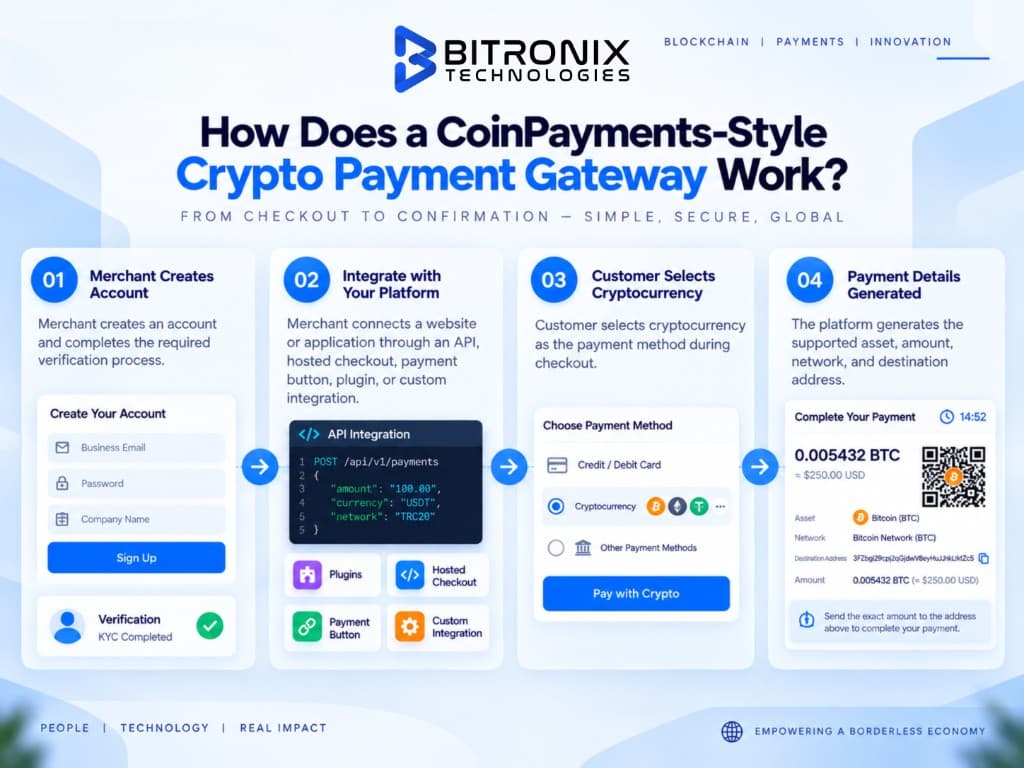
1. Merchant Creates an Account
The merchant registers on your platform and completes the required verification process.
2. Merchant Connects the Payment Gateway
The business can connect its website or application through an API, hosted checkout, payment button, plugin, or custom integration.
3. Customer Selects Crypto Payment
During checkout, the customer chooses cryptocurrency as the payment method.
4. Payment Details Are Generated
The platform provides the customer with the required payment information, such as the supported asset, amount, network, and destination address.
5. Blockchain Transaction Is Detected
The payment gateway monitors the relevant blockchain network and identifies the incoming transaction.
6. Payment Is Confirmed
After the required confirmation conditions are met, the transaction status can be updated automatically.
7. Funds Are Settled
The merchant can receive the cryptocurrency according to the configured settlement method.
For more advanced implementations, wallet and address infrastructure can be used to associate individual customer payments with the correct merchant or order. CoinPayments' current documentation describes both invoice-based checkout and wallet/address-based integrations.
Key Features of a CoinPayments Clone Script
The features should be selected according to your target customers rather than adding every possible function.
Multi-Cryptocurrency Payments
Allow merchants to accept multiple cryptocurrencies and tokens through one payment gateway. Supported assets can be selected according to the blockchain networks and markets your platform plans to serve. If you plan to issue a native settlement or utility asset, coin and token development can be considered as a separate product track.
Multi-Currency Wallets
Merchants can have wallets for supported cryptocurrencies and monitor their balances from one dashboard. Wallet infrastructure can also support dedicated deposit addresses where the business model requires them.
Crypto Payment Invoices
Merchants can create invoices containing:
- Payment amount
- Cryptocurrency
- Order details
- Customer information
- Expiration time
- Payment status
This is useful for businesses that do not want to build a complete checkout system.
Payment Links
A merchant can generate a payment link and share it with a customer through email, messaging apps, social media, or other channels. This is particularly useful for service businesses and freelancers.
Hosted Checkout
A hosted checkout page gives merchants an easy way to accept crypto without building the complete payment interface themselves.
Merchant Dashboard
The merchant dashboard can provide access to:
- Wallet balances
- Payments
- Invoices
- Withdrawals
- Settlements
- Transaction history
- API credentials
- Reports
- Account settings
Transaction Tracking
Merchants can track payment activity and view the current status of individual transactions. The underlying transaction layer can also be designed to support sending, receiving, reconciliation, and transaction history.
API Integration
An API allows businesses to connect the payment gateway with their own software. This can include:
- Websites
- Mobile applications
- SaaS platforms
- Marketplaces
- eCommerce stores
- Accounting systems
- Internal business software
Webhook Integration
Webhooks can notify connected applications when important payment events occur.
This allows the merchant's system to react automatically instead of repeatedly checking the gateway.
Automated Settlement
Some businesses may want to keep received cryptocurrency, while others may prefer conversion into another supported asset. Settlement options can therefore be designed according to the business model and available third-party liquidity or conversion services.
User-Side Features
A well-designed crypto payment gateway should be simple for customers to use.
Account Registration
Customers can create and manage their accounts where required by the business model.
Wallet Management
Users can connect or manage supported payment wallets.
Payment History
Customers can review previous transactions and payment statuses.
Invoice Payments
Customers can open an invoice and complete the requested crypto payment.
QR Code Payments
QR-based checkout can make mobile wallet payments easier.
Payment Notifications
Customers can receive updates when payments are:
- Created
- Pending
- Confirmed
- Failed
- Refunded
Merchant-Side Features
Merchants are the core users of a crypto payment gateway, so their dashboard should focus on simplicity.
Merchant Registration
Businesses can create accounts and complete required verification.
Payment Management
Merchants can view and manage incoming crypto payments.
Invoice Management
Create, send, track, and manage payment invoices.
API Key Management
Merchants can create and manage API credentials for their applications.
Withdrawal Management
Provide controls for eligible withdrawals and settlements.
Payment Reports
Merchants can review transaction activity and download relevant reports.
Store Integration
Connect the gateway with websites, applications, or eCommerce platforms.
Admin Panel Features
The admin panel gives the platform owner control over the complete payment ecosystem. Important modules can include:
- Admin dashboard
- Merchant management
- User management
- Wallet management
- Cryptocurrency management
- Transaction monitoring
- Payment monitoring
- Withdrawal management
- Fee management
- API management
- KYC/AML controls
- Support management
- Reports
- CMS
- Role-based permissions
- Security settings
A role-based admin system is especially useful when different employees are responsible for finance, compliance, support, and technical operations.
Security Features for a Crypto Payment Gateway
Security should be part of the architecture from the beginning. A CoinPayments-style platform can include:
Two-Factor Authentication
Add another verification layer for merchant and administrator accounts.
Secure API Authentication
API requests should use proper authentication, signing, access controls, and rate limiting.
Wallet Protection
Wallet infrastructure should be designed to minimize unauthorized access and operational risk.
Encryption
Sensitive information should be protected during transmission and storage using appropriate encryption practices.
Access Control
Administrators can receive permissions according to their role.
Transaction Monitoring
The system can monitor transactions and flag activity that requires further review.
Audit Logs
Important account, administrative, and payment actions can be recorded for accountability and troubleshooting.
KYC & AML Integration
Depending on the business model and target market, third-party compliance services can be integrated for identity verification and transaction monitoring.
Additional Features You Can Add
Your crypto payment gateway does not have to remain limited to basic payment processing. Additional modules can include:
Recurring Crypto Payments
Useful for SaaS platforms, subscriptions, memberships, and digital services.
Crypto-to-Fiat Conversion
Integrate supported conversion services when merchants want to settle received crypto into fiat.
Refund Management
Allow merchants to initiate and track eligible refunds.
Bulk Payouts
Useful for businesses that need to make payments to multiple recipients.
Payment Buttons
Give merchants simple payment buttons that can be added to their websites.
eCommerce Plugins
Plugins or extensions can be developed for platforms such as:
- WooCommerce
- Shopify
- Magento
- OpenCart
- Custom eCommerce systems
Advanced Analytics
Provide information about:
- Payment volume
- Transaction frequency
- Successful payments
- Failed payments
- Popular assets
- Merchant activity
- Settlement history
Mobile Application
A mobile app can allow merchants to monitor payments, view transactions, manage invoices, and receive payment notifications while away from their desktops.
CoinPayments Clone Script vs Custom Crypto Payment Gateway
There is no single development approach that works for every business.
| Factor | Clone-Based Development | Custom Development |
|---|---|---|
| Starting Point | Existing foundation | Built from scratch |
| Development Time | Usually shorter | Usually longer |
| Initial Development Work | Lower | Higher |
| Customization | High | Very high |
| Business-Specific Features | Can be added | Designed from the beginning |
| Cost | Generally more controlled | Usually higher |
| Best For | Startups and new payment products | Complex enterprise platforms |
A clone-based approach can be a practical starting point when you want to validate the business model before investing in a completely custom infrastructure. You can also compare the related CoinGate clone script guide for another gateway-focused perspective.
How Can a Crypto Payment Gateway Make Money?
The platform can use different revenue models depending on its target market.
Transaction Fees
Charge merchants a small fee for processed payments.
Withdrawal Fees
Apply a fee to certain withdrawal or payout transactions.
Merchant Plans
Offer monthly or annual plans with different features and transaction limits.
API Usage Plans
Create API packages based on transaction volume or usage.
Premium Integrations
Charge for custom integrations with eCommerce, ERP, accounting, or business software.
Enterprise Services
Large merchants can be offered custom settlement, reporting, support, and integration packages.
The best model usually combines competitive pricing with enough margin to cover blockchain fees, infrastructure, compliance, support, and operational costs.
Who Can Use a CoinPayments-Style Payment Gateway?
A crypto payment gateway can serve different types of businesses.
eCommerce Stores
Accept digital assets during online checkout.
SaaS Businesses
Support crypto payments for subscriptions and software services.
Marketplaces
Enable crypto payments between buyers and sellers.
Web3 Businesses
Provide payment infrastructure for blockchain-based products.
Digital Service Providers
Allow international customers to pay for digital services using supported cryptocurrencies.
Gaming Businesses
Add crypto payment options where appropriate and legally permitted.
Travel Platforms
Accept digital assets for selected travel-related products and services.
Benefits of Building Your Own Crypto Payment Gateway
Greater Control
You control the payment experience, fee structure, supported assets, and merchant policies.
Your Own Brand
Build the platform under your own company name instead of sending customers to another payment provider.
Flexible Integrations
Connect your gateway with your existing products and internal systems.
Expandable Infrastructure
Start with the features you actually need and add new payment networks, currencies, integrations, and services later.
Multiple Revenue Opportunities
A payment platform can generate revenue through transaction fees, subscriptions, API plans, and premium services.
Better Product Ownership
Your platform can become part of your long-term fintech or Web3 product strategy.
How Bitronix Can Help Build a CoinPayments-Style Platform
At Bitronix, we approach crypto payment gateway development around the business use case rather than simply reproducing an existing platform.
We can help design and develop a payment gateway with the components your business actually needs. Our development scope can include:
- Crypto payment gateway development
- Multi-chain integration
- Wallet integration
- Merchant dashboard
- Customer checkout
- Payment APIs
- Webhooks
- Crypto invoices
- Payment links
- Payout systems
- eCommerce integration
- Admin panel
- Security implementation
- KYC/AML integration
- Analytics
- Mobile applications
- Testing and deployment
- Post-launch maintenance
The platform can also be structured in modules, allowing you to start with an MVP and expand as your merchant base grows.
CoinPayments Clone Development Process
1. Business Requirement Analysis
We first understand your target market, merchant type, supported assets, payment flow, revenue model, and launch requirements.
2. Technical Planning
The blockchain networks, wallet architecture, payment infrastructure, API layer, database, and security requirements are defined.
3. UI/UX Design
The customer checkout and merchant dashboard are designed to keep the payment experience simple.
4. Development
The required frontend, backend, blockchain integrations, wallets, APIs, admin features, and payment modules are developed.
5. Integration
Third-party services such as compliance providers, exchange/conversion services, notification systems, and eCommerce platforms can be integrated where required.
6. Testing
The platform is tested for payment flows, blockchain transactions, API responses, security, performance, and different user scenarios.
7. Deployment
After final testing, the platform can be deployed to the required infrastructure.
8. Ongoing Support
New cryptocurrencies, integrations, features, security improvements, and platform updates can be introduced as the business grows.
How Much Does a CoinPayments Clone Script Cost?
There is no fixed price for developing a crypto payment gateway because the scope can vary significantly between projects.
The cost depends on factors such as:
- Number of cryptocurrencies
- Blockchain networks
- Wallet architecture
- Payment processing requirements
- API complexity
- Merchant dashboard
- Admin functionality
- Mobile applications
- eCommerce integrations
- Compliance integrations
- Security requirements
- Conversion and settlement infrastructure
- Third-party services
A basic payment gateway with a limited number of assets will require less development than a multi-chain platform with wallets, merchant APIs, automated settlement, mobile apps, analytics, and advanced compliance features.
For this reason, it is better to define the MVP first and then estimate the complete development scope.
Final Thoughts
A crypto payment gateway can do much more than simply receive cryptocurrency.
When designed properly, it can become a complete payment infrastructure where merchants can accept digital assets, create invoices, manage wallets, track transactions, connect APIs, and handle settlements from one place.
A CoinPayments clone script can provide a practical starting point for businesses that want to enter this market without designing every common payment component from the ground up.
The important part is customization. Your platform should be built around your target merchants, supported cryptocurrencies, payment flow, compliance requirements, revenue model, and long-term product plans.
Bitronix can help you turn your crypto payment gateway idea into a customized, scalable platform designed around your business requirements.
Frequently Asked Questions
What is a CoinPayments clone script?
A CoinPayments clone script is a customizable foundation for developing your own cryptocurrency payment gateway with features such as crypto payments, wallets, invoices, merchant tools, APIs, and transaction management.
Can I customize the CoinPayments clone script?
Yes. The branding, user interface, supported cryptocurrencies, payment flows, fees, APIs, dashboards, and additional modules can be customized around your business requirements.
Can I support multiple cryptocurrencies?
Yes. Multiple cryptocurrencies and blockchain networks can be integrated depending on your technical requirements and the networks you want to support.
Can merchants use the gateway on their own websites?
Yes. Merchants can connect the payment gateway through APIs, plugins, hosted checkout pages, payment buttons, or custom integrations.
Can I add a crypto wallet to the platform?
Yes. Wallet functionality can be integrated for supported cryptocurrencies and networks. The architecture can also support dedicated deposit addresses when required.
Can I add crypto-to-fiat conversion?
Yes, conversion functionality can be integrated through suitable third-party liquidity or exchange services, subject to availability and applicable regulations.
Is a CoinPayments clone legal?
The software itself does not automatically make the business legally compliant. Operating a crypto payment service may involve licensing, KYC/AML, tax, consumer protection, data privacy, and other regulatory obligations depending on the jurisdiction.
How long does it take to build a CoinPayments-style payment gateway?
The timeline depends on the number of blockchain networks, payment features, wallet architecture, integrations, security requirements, compliance needs, and whether you are launching an MVP or a full-scale platform.

Founder and CTO
Founder and CTO of Bitronix Technologies, helping businesses design secure, scalable crypto payment gateways with practical wallet, merchant, and multi-chain infrastructure.
Related Posts
 Blockchain
September 18, 202616 min read
Bybit Clone Script: How to Build a Crypto Exchange Like Bybit
Build a Bybit-style crypto exchange with spot, futures, copy trading, trading bots, wallets, APIs, risk management, & customized trading features.
Read article Blockchain
September 17, 202613 min read
Why Are Crypto Exchanges Shutting Down in 2026? What CoinEx and BitMart Tell Us About the Future of Crypto Exchanges
Why are crypto exchanges shutting down in 2026? Explore CoinEx, BitMart, rising compliance costs, security, liquidity & the future of crypto exchange development.
Read article Blockchain
September 16, 202611 min read
ERC-20 Token Development Company: Build & Launch Your Custom Token
Build a custom ERC-20 token with Bitronix. Get smart contract development, tokenomics, testing, security review, wallet integration, and deployment support.
Read article