CoinGate Clone Script: Build Your Own Crypto Payment Gateway

By Tausif AhmedFounder and CTO
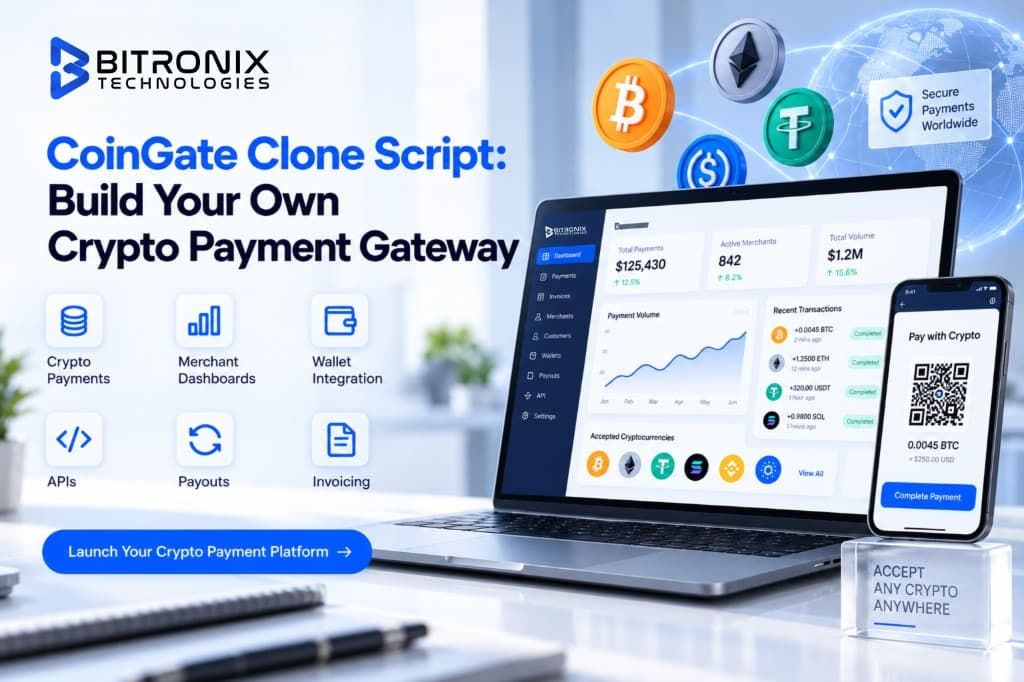
Cryptocurrency is becoming a practical payment option for online businesses, digital platforms, SaaS companies, gaming businesses and global marketplaces. As more customers look for faster and borderless ways to pay, businesses are exploring crypto payment gateways that can handle transactions without creating a complicated checkout experience.
A CoinGate clone script gives entrepreneurs a starting point for launching their own cryptocurrency payment gateway. Instead of developing every component from the ground up, businesses can use a ready-made foundation and customize it around their brand, supported cryptocurrencies, payment flow, merchant requirements and business model.
At Bitronix, we help businesses develop customized crypto payment gateway solutions designed around operational and technical requirements, including merchant payments, crypto settlements, invoicing, payouts and API integrations.
What Is a CoinGate Clone Script?
A CoinGate clone script is a customizable crypto payment gateway solution inspired by the core payment functionality of platforms such as CoinGate.
The purpose is not to duplicate another company's branding or proprietary technology. Instead, the software provides a foundation for creating an independent payment platform with your own interface, features, transaction rules, supported assets, fee structure and administration system.
A typical platform can allow merchants to:
- Accept cryptocurrency payments
- Generate payment requests and invoices
- Track incoming transactions
- Manage crypto settlements
- Convert supported digital assets
- Process payouts
- Connect through APIs
- Integrate with eCommerce platforms
- Monitor payment activity from a central dashboard
Why Build a Crypto Payment Gateway Like CoinGate?
The biggest opportunity is not simply accepting cryptocurrency. It is creating payment infrastructure that makes crypto transactions easier for businesses and their customers.
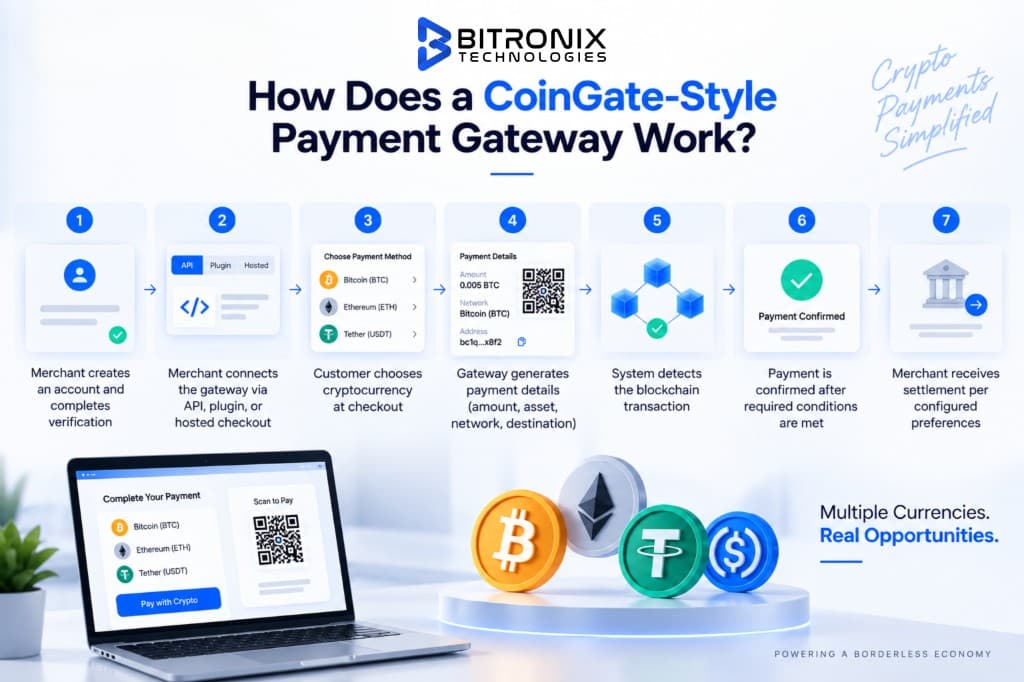
A well-designed gateway can connect: Customer → Crypto Wallet → Payment Gateway → Blockchain Network → Merchant → Settlement
- Faster market entry
- Greater control over payment processing
- Custom merchant experiences
- Multiple cryptocurrency options
- Automated transaction management
- Flexible settlement methods
- API-based integrations
- New transaction-based revenue opportunities
Key Features of a CoinGate Clone Script
Feature scope should match your target users and business model. A basic gateway may need payment processing and merchant management; an enterprise platform may require advanced settlement, compliance, analytics and API infrastructure.
Merchant Dashboard
- Account balances, payment status and transactions
- Settlements, payouts and payment requests
- API credentials and reporting
Crypto Payment Processing
The gateway can let customers pay merchants with supported cryptocurrencies, generate payment details and monitor the transaction until required blockchain confirmations are received.
Crypto Invoicing
- Payment amount and supported cryptocurrency
- Expiry time and customer information
- Payment status and transaction reference
Settlement, Payouts and Payment API
- Automatic settlement for crypto, stablecoins, or supported fiat preferences
- Crypto payouts for refunds, vendors, affiliates, employees and merchant settlements
- Payment API for websites, mobile apps, marketplaces, SaaS platforms and internal systems
E-commerce Integration
- WooCommerce, Shopify, Magento, OpenCart, PrestaShop
- Custom eCommerce platforms via plugins, extensions, or APIs
Real-Time Tracking and Notifications
- Pending, confirmed, failed and expired payments
- Settlements and refund status
- Email, SMS, webhooks and dashboard alerts
Security Features for a Crypto Payment Gateway
- Two-factor authentication for merchant and admin accounts
- Role-based access aligned to team responsibilities
- API security with keys, validation, rate limiting and access controls
- Wallet security designed to protect operational funds
- Transaction monitoring for unusual activity
- Audit logs for account, admin, API and payment actions
- KYC & AML integration where jurisdiction and business model require it
Important: Cryptocurrency payment businesses need to consider applicable financial, tax, AML/KYC, licensing, consumer-protection and data regulations before launching in a particular market.
How Does a CoinGate-Style Payment Gateway Work?
Additional Modules You Can Add
- Multi-currency and stablecoin support
- Recurring payments and subscription billing
- Refund management and payment links
- POS payments for physical businesses
- Advanced analytics and webhooks
Business Models for a Crypto Payment Gateway
- Transaction fees (percentage or fixed)
- Merchant subscription plans
- Settlement fees
- API usage packages
- Premium merchant services
- Paid integration services
CoinGate Clone Script vs Custom Crypto Payment Gateway
| Factor | Clone-Based Solution | Custom Development |
|---|---|---|
| Development Speed | Faster | Longer |
| Initial Development Work | Lower | Higher |
| Customization | High | Very High |
| Starting Cost | Usually Lower | Usually Higher |
| Core Modules | Pre-built foundation | Built from scratch |
| Business-Specific Features | Can be added | Fully tailored |
| Best For | Startups & faster launches | Complex enterprise requirements |
Who Can Use a CoinGate Clone Platform?
- eCommerce businesses and online marketplaces
- SaaS companies needing crypto billing
- Gaming and travel platforms
- Digital agencies accepting international payments
- Web3 businesses connecting apps to payment infrastructure
Why Choose Bitronix for CoinGate Clone Development?
Bitronix focuses on blockchain and Web3 products around real business needs rather than one-size-fits-all templates. CoinGate-style gateway development can be customized around your business model, supported assets, payment workflows, integrations and user experience.
- Requirement analysis and payment gateway architecture
- Blockchain and crypto wallet integration
- Merchant dashboard and customer checkout
- Payment API and eCommerce integrations
- Security implementation, admin panel, testing and deployment
- Post-launch technical support
How Much Does a CoinGate Clone Script Cost?
Cost depends on supported cryptocurrencies and networks, wallet architecture, APIs, dashboards, mobile apps, eCommerce integrations, KYC/AML, security, conversion partners and deployment infrastructure. A basic gateway costs less than an enterprise platform with multi-network settlement, analytics and extensive integrations.
CoinGate Clone Script Development Process at Bitronix
- Requirement analysis — customers, payment model, assets, markets and goals
- Architecture planning — blockchain, backend, wallet, API, database and security
- UI/UX design — simple checkout and efficient merchant/admin dashboards
- Development — payment, wallet, blockchain, API and admin modules
- Security & testing — functional, security, integration and performance checks
- Deployment — infrastructure and third-party service connections
- Support & improvements — new features, integrations and optimization after launch
Frequently Asked Questions
What is a CoinGate clone script?
A CoinGate clone script is a customizable crypto payment gateway foundation for developing a payment platform with functionality similar to CoinGate.
Can I customize a CoinGate clone script?
Yes. Interface, branding, supported cryptocurrencies, payment workflows, fees, APIs, merchant features and other components can be customized to your requirements.
Can the platform support multiple cryptocurrencies?
Yes. Multiple cryptocurrencies and blockchain networks can be integrated depending on technical architecture and business needs.
Can merchants receive fiat after accepting crypto?
A settlement or conversion system can be integrated so merchants receive supported fiat or other digital assets, subject to third-party services and applicable regulations.
Can I integrate the gateway with my eCommerce website?
Yes. API integration, plugins, payment buttons, hosted checkout, or custom integrations can be developed for your eCommerce platform.
Is a CoinGate clone legal?
The software itself is not a substitute for regulatory approval. Operating a cryptocurrency payment business may be subject to licensing, AML/KYC, tax, financial-services, data and other requirements depending on the countries where you operate.
How long does it take to develop a CoinGate-style payment gateway?
Timeline depends on required features, blockchain networks, integrations, security architecture and compliance requirements. A clearly defined MVP can generally be delivered faster than a fully customized enterprise platform.
Final Thoughts
Building a crypto payment gateway like CoinGate can give businesses infrastructure for accepting and managing digital asset payments. The goal should not be to simply reproduce another platform. A successful gateway should be designed around a clear target market, simple UX, reliable blockchain infrastructure, strong security, flexible integrations and a sustainable revenue model.
With the right technology partner, businesses can start with a focused payment gateway and expand over time with additional cryptocurrencies, merchant tools, APIs, settlement options and analytics.

Founder and CTO
Founder and CTO of Bitronix Technologies. Helps founders scope crypto payment gateways with clear ownership, security and integration requirements.
Related Posts
 Blockchain
October 23, 202619 min read
DEX Clone Script: Features, Development Cost & How to Build a Decentralized Exchange
Explore DEX clone script features, development costs, smart contracts, liquidity pools, security, and the steps to build a decentralized exchange.
Read article Blockchain
October 21, 202613 min read
Agricultural Commodity Tokenization in 2027: Benefits, Process & Cost
Learn how agricultural commodity tokenization works, its benefits, development process, costs, use cases, and key regulatory considerations.
Read article Blockchain
October 21, 202618 min read
CoinMarketCap Clone Script: Features, Cost, and How to Build a Crypto Price Tracking Platform
Explore CoinMarketCap clone script features, development costs, APIs, revenue models, and how to build a cryptocurrency market data platform.
Read article