















Answers Nobody Can Verify
An AI response that sounds confident but has no citation or source attached doesn't earn trust, it just shifts the burden of fact-checking onto the user. Once that happens a few times, people stop using the tool.
Learn moreData & Models
Exchange Platforms
Wallet Platforms
Tokenization Platforms
Marketplaces & Launchpads
Ready-Made Platforms

Bitronix builds custom LLM and RAG systems, retrieval-augmented generation grounded in your real enterprise data, so AI answers come with sources instead of guesses. We handle the whole path, architecture, retrieval design, evaluation and secure deployment, because a working demo and a system your team actually trusts to use every day are two very different things.
The real blockers
A lot of companies already have a pilot chatbot or an early copilot running somewhere. The hard part isn't building something that works in a demo, it's turning that into a system people actually rely on. Here's where that usually breaks down.
An AI response that sounds confident but has no citation or source attached doesn't earn trust, it just shifts the burden of fact-checking onto the user. Once that happens a few times, people stop using the tool.
Learn moreYour knowledge isn't in one place. It's spread across documents, tickets, wikis, CRMs and internal tools and a RAG system built without accounting for that fragmentation gives incomplete or outdated answers no matter how good the underlying model is.
Learn morePlenty of pilots can answer a question. Far fewer can take an action, update a record, trigger an approval, complete a task inside a real business process. That gap is usually where the actual ROI was supposed to come from.
Learn moreWithout benchmark data and clear quality metrics tied to real tasks, teams are left guessing whether the system is actually helping or just sounds like it is.
Learn moreIf there's no dashboard connecting the AI system's performance to an actual business outcome, faster resolution, less manual work, fewer escalations, leadership has no way to know if it's paying for itself.
Learn moreA demo handles the happy path. Real users ask unexpected questions, hit edge cases and use the system in ways nobody scripted for and that's exactly where a lot of early builds break.
Learn moreModel choice, infrastructure and retrieval design all affect response time and cost per query. Get this wrong and a system that worked fine in testing becomes slow or expensive the moment real traffic hits it.
Learn moreProduction AI needs role-based access, data isolation and audit logging from day one, not something patched in after a client or compliance team asks about it.
Learn moreDocuments get updated, policies change and new information comes in constantly. A system that isn't built to refresh its knowledge base regularly starts giving outdated answers within weeks of launch and usually nobody notices until a user catches it.
Learn moreWhat we build
Bitronix offers LLM and RAG development services covering the full system, retrieval, generation, evaluation and the security controls that make it safe to actually run.
SERVICE 01 / 06
We build retrieval-augmented generation systems that pull from your actual documents, databases and internal tools, so answers come grounded in your real information instead of the model's best guess.
What we deliver
How we deliver
A structured path from the real problem to a production system your team can trust, with evaluation and security built in at every step.

We start by understanding the actual problem, what information people need, where it currently lives and what a genuinely useful answer looks like, before assuming a specific architecture is the right one.
Step 01
Step 01
We start by understanding the actual problem, what information people need, where it currently lives and what a genuinely useful answer looks like, before assuming a specific architecture is the right one.
Step 02
We design how the system will actually pull and use information, ingestion, indexing, retrieval strategy and how the LLM fits into all of it, mapped out before development starts.
Step 02
We design how the system will actually pull and use information, ingestion, indexing, retrieval strategy and how the LLM fits into all of it, mapped out before development starts.
We build the system, grounding responses in your verified data with citations, so what comes back is something a user can actually check rather than take on faith.
Step 03
Step 03
We build the system, grounding responses in your verified data with citations, so what comes back is something a user can actually check rather than take on faith.
Step 04
We test the system against real tasks and edge cases, not just clean examples, checking retrieval accuracy, response quality and where it's likely to fail before it ever reaches a real user.
Step 04
We test the system against real tasks and edge cases, not just clean examples, checking retrieval accuracy, response quality and where it's likely to fail before it ever reaches a real user.
We deploy with access controls, monitoring and audit logging active from day one, so security isn't something added after the fact.
Step 05
Step 05
We deploy with access controls, monitoring and audit logging active from day one, so security isn't something added after the fact.
Step 06
Once live, we track accuracy, cost and performance and keep refining the retrieval and generation logic as your data and usage patterns change.
Step 06
Once live, we track accuracy, cost and performance and keep refining the retrieval and generation logic as your data and usage patterns change.
Grounded AI that fits how each industry actually works, not a one-size-fits-all chatbot template.
Grounded answers for research, compliance questions and client support, pulled from verified internal sources instead of a model's general knowledge.
Clinical and administrative knowledge assistants that cite their sources, built with the privacy and access controls this kind of data actually requires.
Contract review, case research and document analysis systems that ground every answer in the actual source document, not a plausible-sounding summary.
Claims and policy support tools that pull accurate information from policy documents and internal systems, cutting the manual search time adjusters spend digging through files.
Internal knowledge assistants and customer-facing copilots that answer accurately from your actual documentation instead of generic training data.
Technical knowledge systems that help engineers and technicians find the right procedure or spec quickly, grounded in your actual manuals and records.
Customer support and internal knowledge tools that reduce repetitive questions by giving accurate, source-backed answers instantly.
High-volume support automation, voice and text, built to handle real call and ticket volume without losing accuracy under load.
Research and knowledge assistants that cut the hours spent searching across scattered documents and past project records.
We pick the right tools for your specific use case, not a fixed stack we force onto every project.
GPT, Claude, Gemini, LLaMA, Mistral and open-source or fine-tuned models chosen per use case.
 GPT-4 and GPT-4o
 Claude
 Gemini
 LLaMA
LLaMA Mistral
Orchestration and retrieval tooling for grounded generation over your enterprise knowledge.
 LangChainLlamaIndex
 Hugging Face Transformers
Vector databases, hybrid keyword and semantic search and reranking pipelines.
 Vector databases
 Elasticsearch
 Redis
RedisLangGraph, CrewAI, AutoGen and tool-calling frameworks for multi-step agent workflows.
 CrewAILangChain
 Anthropic MCP
Python, TypeScript, FastAPI, Node.js and REST and GraphQL APIs for enterprise integration.
 Python
 FastAPI
 GraphQL and REST APIs
 OpenAPI
PostgreSQL, MongoDB, vector stores and document and knowledge repositories.
 PostgreSQL
 MongoDBQdrant
 Neo4j
Neo4jAWS, Google Cloud and Microsoft Azure sized to latency, cost and compliance needs.
 AWS
AWS Google Cloud
 Microsoft Azure
Role-based access control, tenant isolation, encrypted data handling and audit logging.
 Role-based access control
 Encrypted data handling
 Audit logging
 Auth0
Auth0Why Bitronix
Every RAG system we build returns answers with citations back to the source, so your team never has to take an AI response on faith.
We test against your real use cases and failure modes before launch and keep monitoring after, so quality issues get caught early instead of discovered by users.
Access controls, audit logging and data isolation are part of the design from the start, not something added once a client or compliance team asks.
Models and data change over time. We keep monitoring performance and refining the system, so it doesn't quietly get worse the longer it runs.
Tell us what you're trying to solve. We'll walk through architecture, retrieval design and timeline on the first call, no generic proposal until we've agreed there's a real fit.
RAG, or retrieval-augmented generation, lets an AI system answer questions using your own documents and data instead of relying only on what a general model already knows. That means answers stay accurate and current as your actual information changes.
A basic chatbot answers from general training data and can't reliably tell you where an answer came from. A production LLM and RAG system pulls from your verified information, cites its sources and can be tested for accuracy, which is what actually earns user trust.
Agents are useful anywhere work spans multiple steps and systems, checking records, updating data, routing requests, preparing reports. We build them with defined permissions and human checkpoints so autonomy doesn't mean losing control.
We ground responses in your verified data and build in guardrails that limit answers to what's actually known. When the system reaches the edge of what it knows, it should say so or escalate, not guess with confidence.
We test against real tasks and failure scenarios, not clean, ideal examples and track retrieval accuracy, response quality and task completion, both before launch and continuously after.
We work across GPT, Claude, Gemini, LLaMA and other leading models and choose based on your use case, data sensitivity, latency needs and cost, not a fixed default.
Yes. We often review existing pilots, find where retrieval or reliability is falling short and build the evaluation and architecture improvements needed to get it production-ready.
Access controls, data isolation and audit logging are part of the architecture from day one. Specific compliance requirements are scoped based on your industry and data sensitivity.
A focused proof of concept can be ready in a few weeks. A full production system with integrations and evaluation typically takes a few months, depending on complexity.
Yes. We monitor accuracy, cost and performance after launch and update models, prompts and retrieval logic as your data and needs change over time.
Google reviews
Verified feedback from our Google Business Profile.
 Google
Really good experience with Bitronix Technologies. The team was professional, helpful and easy to communicate with. They understood my requirements and did a great job delivering the project. I really appreciated their attention to detail and willingness to help throughout the process. Would definitely recommend them!
Mohammad Haroon
a day ago · Google review
GoogleWe compared a few companies before choosing Bitronix and I think we made the right decision. The quality of work was good and the overall cost was reasonable. They were also flexible when we had some changes during development. Good technical team and good value for money.
Shivranjan Kumar
3 weeks ago · Google review
GoogleI had a very good experience with Bitronix Technologies. Their team is very smart, helpful and knows their work well. They completed my project on time and the quality of work was really good. Thank you to the whole team for the hard work and support. I would surely recommend them.
Asif Ali
4 months ago · Google review
GoogleMy experience with Bitronix Technologies was excellent The staff were polite and professional, communication was clear and the project was completed on schedule. Their transparent pricing and smooth process made everything stress-free. Strongly recommend their services.
VISHAKHA CHAUDHARY
4 months ago · Google review
GoogleWorked with Bitronix Technologies for a blockchain project and honestly couldn't be happier. They delivered everything on time, no delays, no excuses - and the pricing was very reasonable for the quality of work. The team clearly knows their stuff. Highly recommend if you're looking for reliable tech development!
Monty Thakur
4 months ago · Google review
GoogleHad a great experience with Bitronix Technologies. They understood my requirements from the very first call. The process was smooth, communication was clear and the project was delivered on time. Pricing was fair and transparent with no hidden surprises. Highly recommended!
md empire
4 months ago · Google review
GoogleA extremely brilliant experience. We are mesmerised by their services and the immense knowledge they have in their field. We certainly look forward to have a great relationship with this company and hope to do many projects together, learning and using their expertise for our business.
M محمد Riaz Vali Sayed
4 months ago · Google review
GoogleExcellent service and communication, fast response and transparent , will do more business in future.
Asif Shahzad
4 months ago · Google review
GoogleReally good experience with Bitronix Technologies. The team was professional, helpful and easy to communicate with. They understood my requirements and did a great job delivering the project. I really appreciated their attention to detail and willingness to help throughout the process. Would definitely recommend them!
Mohammad Haroon
a day ago · Google review
GoogleWe compared a few companies before choosing Bitronix and I think we made the right decision. The quality of work was good and the overall cost was reasonable. They were also flexible when we had some changes during development. Good technical team and good value for money.
Shivranjan Kumar
3 weeks ago · Google review
GoogleI had a very good experience with Bitronix Technologies. Their team is very smart, helpful and knows their work well. They completed my project on time and the quality of work was really good. Thank you to the whole team for the hard work and support. I would surely recommend them.
Asif Ali
4 months ago · Google review
GoogleMy experience with Bitronix Technologies was excellent The staff were polite and professional, communication was clear and the project was completed on schedule. Their transparent pricing and smooth process made everything stress-free. Strongly recommend their services.
VISHAKHA CHAUDHARY
4 months ago · Google review
GoogleWorked with Bitronix Technologies for a blockchain project and honestly couldn't be happier. They delivered everything on time, no delays, no excuses - and the pricing was very reasonable for the quality of work. The team clearly knows their stuff. Highly recommend if you're looking for reliable tech development!
Monty Thakur
4 months ago · Google review
GoogleHad a great experience with Bitronix Technologies. They understood my requirements from the very first call. The process was smooth, communication was clear and the project was delivered on time. Pricing was fair and transparent with no hidden surprises. Highly recommended!
md empire
4 months ago · Google review
GoogleA extremely brilliant experience. We are mesmerised by their services and the immense knowledge they have in their field. We certainly look forward to have a great relationship with this company and hope to do many projects together, learning and using their expertise for our business.
M محمد Riaz Vali Sayed
4 months ago · Google review
GoogleExcellent service and communication, fast response and transparent , will do more business in future.
Asif Shahzad
4 months ago · Google review
Insights from our engineering team
Notes on architecture, security and shipping AI in regulated environments.
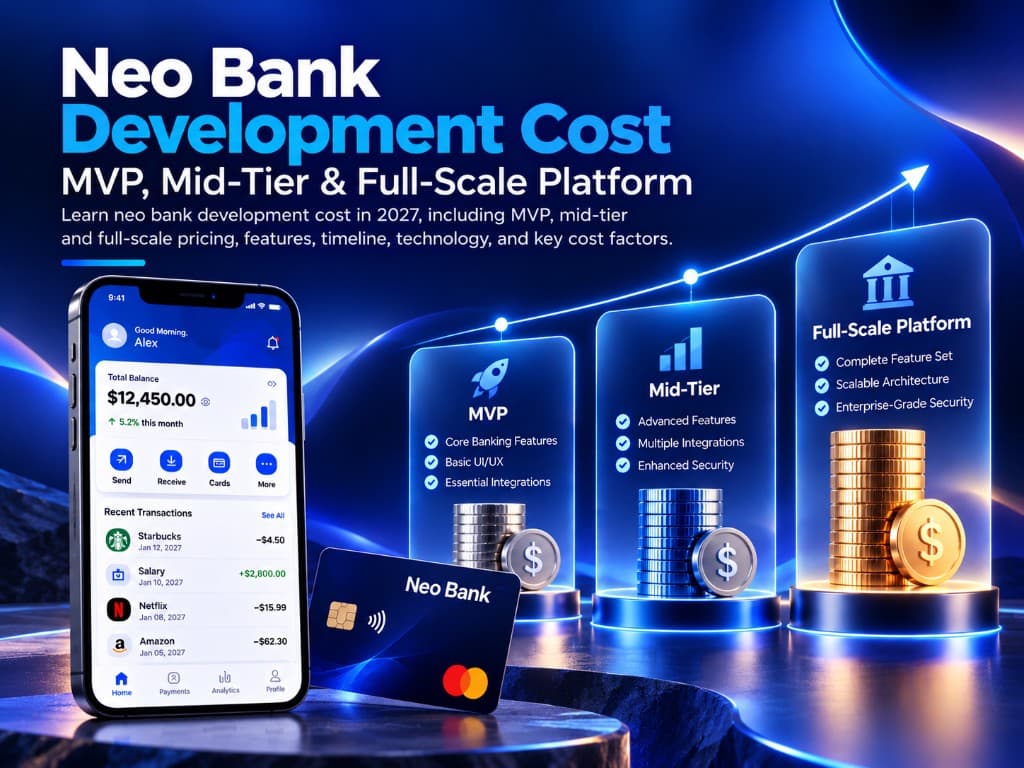
Learn neo bank development cost in 2027, including MVP, mid-tier and full-scale pricing, features, timeline, technology, and key cost factors.

Find the top 10 companies to hire blockchain developers in India. Compare blockchain services, expertise, use cases, & tips for choosing a development partner.
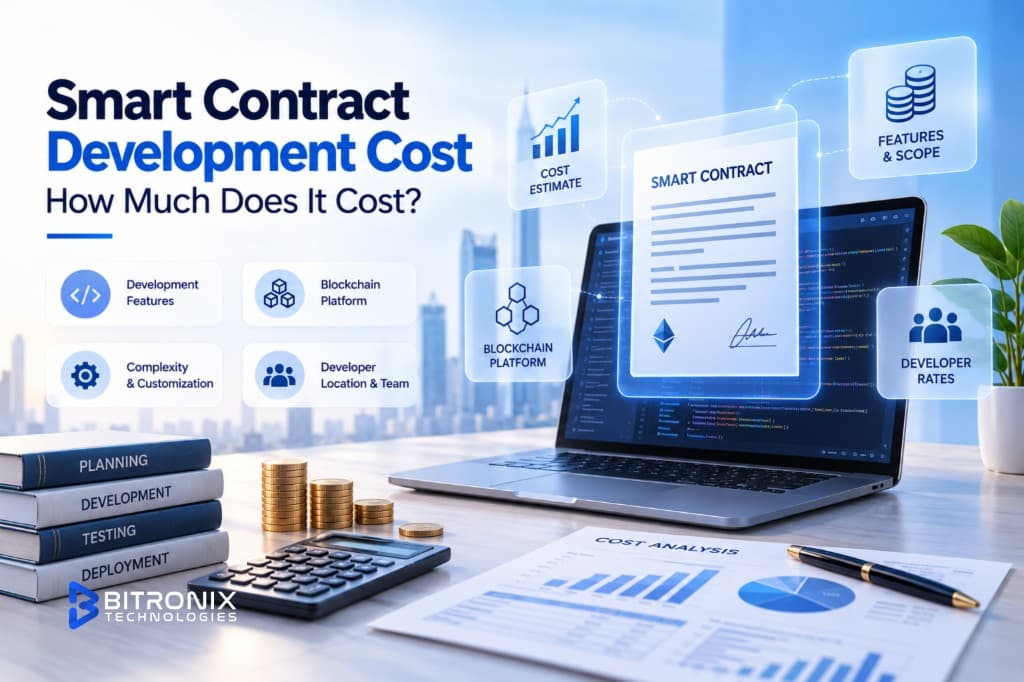
Discover smart contract development costs in 2027. Compare pricing from $5,000, project types, audit fees, timelines, & development factors.
Get in touch
We take on 4 new enterprise clients per quarter. Tell us what you're building.
Our offices
Direct lines to our delivery hubs. Same-day routing for qualified enterprise enquiries.
Global headquarters