Meridian Lending Markets: Isolated-Pool DeFi Lending for Institutional Desks
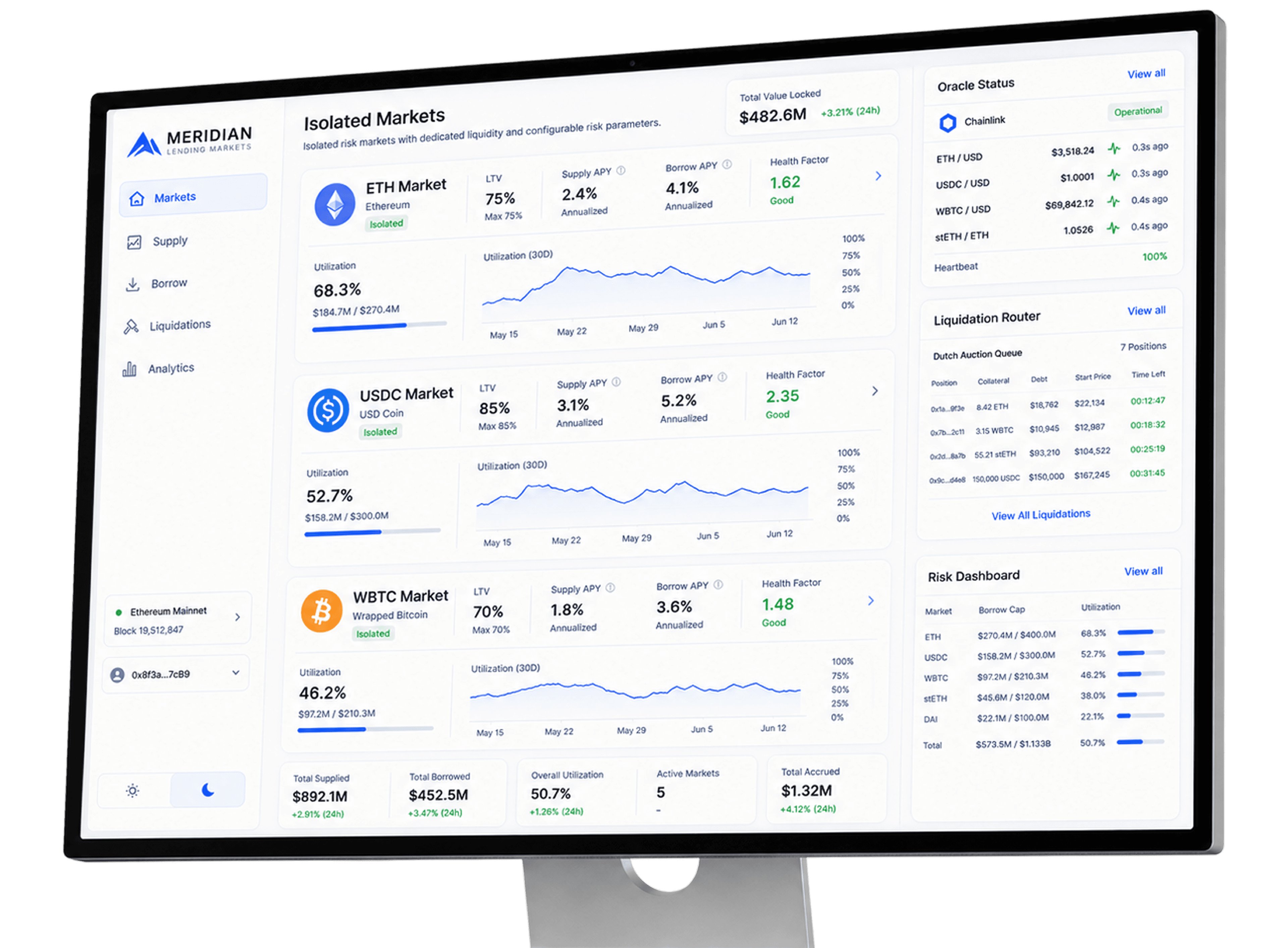
DeFi lending protocol development - isolated pools, configurable LTV, risk-bounded liquidations, and Chainlink oracle safeguards
Tech stack
- Solidity
- Foundry
- Chainlink
- TypeScript
- Ethereum
Project snapshot
| Industry | DeFi / Institutional |
|---|---|
| Service line | DeFi lending protocol development |
| Pool model | Isolated per-asset markets (no shared liquidity) |
| Stack | Solidity, Foundry, Chainlink, TypeScript, Ethereum |
| Risk controls | Configurable LTV, liquidation bonuses, borrow caps, oracle safeguards |
| Outcome | An audit-oriented lending protocol institutional desks can extend with new collateral types without re-architecting core market contracts |
The challenge: capital efficiency without cross-asset contagion
Institutional DeFi lending protocol development demands two things that usually pull in opposite directions: high capital efficiency and conservative, provable risk limits. Reconciling them shaped every design decision in Meridian - and generic lending protocol smart contracts copied from retail DeFi rarely meet an institutional bar.
Four constraints defined the brief:
- Isolated markets only - shared liquidity pools were ruled out because contagion across assets was unacceptable.
- Fail-closed oracles - stale or anomalous price feeds must halt action rather than misprice collateral.
- Resilient liquidations - no dependence on a single keeper topology that could stall or be gamed during volatility.
- Provable solvency under stress - the protocol must remain auditable precisely when markets are most adverse.
The brief, in short: build an isolated-pool lending protocol where risk parameters are configurable, liquidations are predictable, and solvency claims can be verified - not assumed.
Our approach: isolated Solidity markets + oracle safeguards + liquidation router
We engineered Meridian as a set of composable on-chain modules - isolated markets, hardened oracle inputs, and a liquidation router - with Foundry tests proving accounting correctness under stress.
1. Isolated lending markets (Solidity)
Each market is a self-contained silo with its own collateral, borrow asset, and risk parameters:
- Explicit borrow caps limiting exposure per market.
- Configurable LTV and liquidation bonuses tuned per asset pair.
- Per-market interest-rate curves driving supply and borrow dynamics.
- Isolated accounting so one market's stress cannot drain another.
2. Chainlink oracle safeguards
We integrated Chainlink-compatible price feeds with heartbeat and circuit-breaker semantics - so stale or anomalous prices halt borrowing and liquidation paths rather than propagating bad state through the protocol. This is the Chainlink oracle circuit breaker pattern institutional desks expect before approving collateral types.
3. Composable liquidation router
A composable Dutch auction liquidation router supports competitive, time-decaying collateral sales and partial repayments - removing single-keeper risk and giving operators predictable paths to restore market health when positions go underwater.
4. Foundry invariant and differential testing
To prove correctness under stress, we wrote Foundry invariant testing for DeFi covering interest-accrual edge cases across long time skips - the scenarios where lending math typically drifts. Differential tests compared implementation output against reference calculations so auditors could verify properties quickly.
Key features delivered
- Isolated per-asset lending markets with no shared-liquidity contagion.
- Configurable LTV and liquidation bonuses per collateral type.
- Borrow caps and interest-rate curves per market.
- Chainlink oracle heartbeat and circuit-breaker integration.
- Dutch-style liquidation auctions with partial repayment support.
- Composable liquidation router decoupled from core market logic.
- Foundry invariant and differential test suites for accrual and solvency properties.
The outcome: an audit-oriented lending protocol institutional desks can extend
We delivered a production-ready, audit-oriented lending protocol with fully isolated per-asset markets, configurable risk parameters, and a liquidation router institutional desks can operate with confidence. The architecture lets the client onboard new collateral types and tune LTV and liquidation bonuses without re-architecting the core market contracts - protecting the investment through audits, parameter changes, and future market launches.
Why this matters for lending protocol projects
If you're evaluating how to build an isolated-pool lending protocol, the gap between a Compound fork and an institutional-grade system is isolated accounting, oracle fail-closed behavior, liquidation topology, and tested interest math - not just a UI on top of shared pools. Meridian was engineered around those realities from day one. Before external audit, the same preparation we describe in Five things we fix before the audit firm sees the code and smart contract audit readiness applies directly to lending markets.
If you are scoping institutional DeFi lending infrastructure, our DeFi development and smart contract development teams design lending protocols to this standard.
Frequently asked questions
How long does DeFi lending protocol development take?
Timelines depend on how many isolated markets you launch, the collateral types supported, liquidation mechanism complexity, and oracle integration depth. A single-market MVP with standard liquidations ships faster than a multi-asset protocol with custom auction routers and institutional governance - we scope each engagement to your launch goals.
What are isolated lending pools vs shared liquidity pools?
Isolated pools confine risk to a single collateral-borrow asset pair, so a failure or mispricing in one market cannot drain liquidity from others. Shared pools offer capital efficiency but propagate contagion across assets - unacceptable for many institutional desks, which is why Meridian uses per-asset silos.
Why do lending protocols need oracle circuit breakers?
Price feeds can stall, spike, or report anomalous values during volatility. Circuit-breaker and heartbeat semantics halt borrowing, liquidations, or both when a feed is stale or out of bounds - failing closed rather than acting on bad prices that could insolvent a market.
What is a Dutch-style liquidation auction?
In a Dutch auction liquidation, the collateral discount starts high and decreases over time until a keeper or bidder fills the position. This removes dependence on a single keeper topology and gives the protocol predictable, competitive paths to restore market health under stress.
How do you test lending protocol math for correctness?
Foundry invariant suites and differential tests exercise interest accrual, borrow index updates, and liquidation math across long time skips and edge-case states - the scenarios where lending protocols typically drift from their intended accounting.
Ready to Build Something Similar?
We design and ship production Web3 systems - marketplaces, DeFi protocols, and enterprise blockchain platforms - with audit-ready engineering from day one.
More Case Studies
 Gaming & Metaverse
Custom NFT marketplace development - minting, auctions, royalties, and collection discovery on MERN + Solidity
NFT Universe
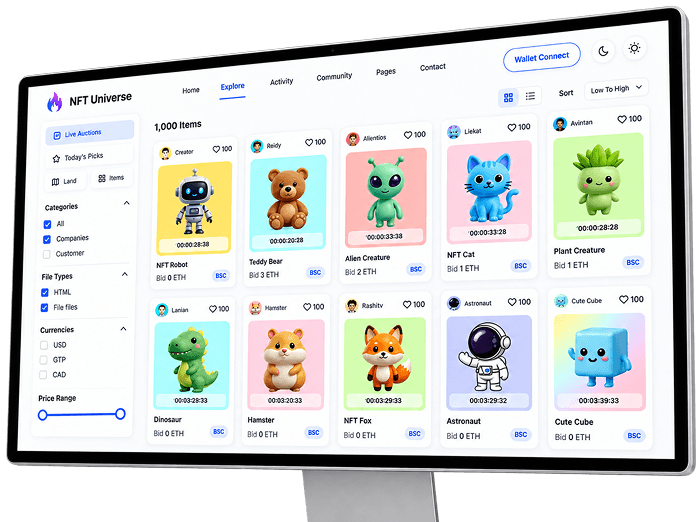
NFT Universe is a full-featured, production-grade NFT marketplace Bitronix Technologies designed and built for creators and collectors. Rather than reskinning a generic white-label template, we engineered a marketplace with the trading flows users expect from leading venues - wallet onboarding, gas-aware minting, on-chain royalties, live auctions, and an indexer-backed explorer that stays accurate under load.
Read case studyTech stack
- MongoDB
- Express
- React
- Node.js
- Solidity
- Ethereum
- IPFS
 FinTech
Polymarket-style prediction market development - outcome-share trading, Chainlink resolution, and collateral accounting on MEAN/MERN + Solidity
Uwin
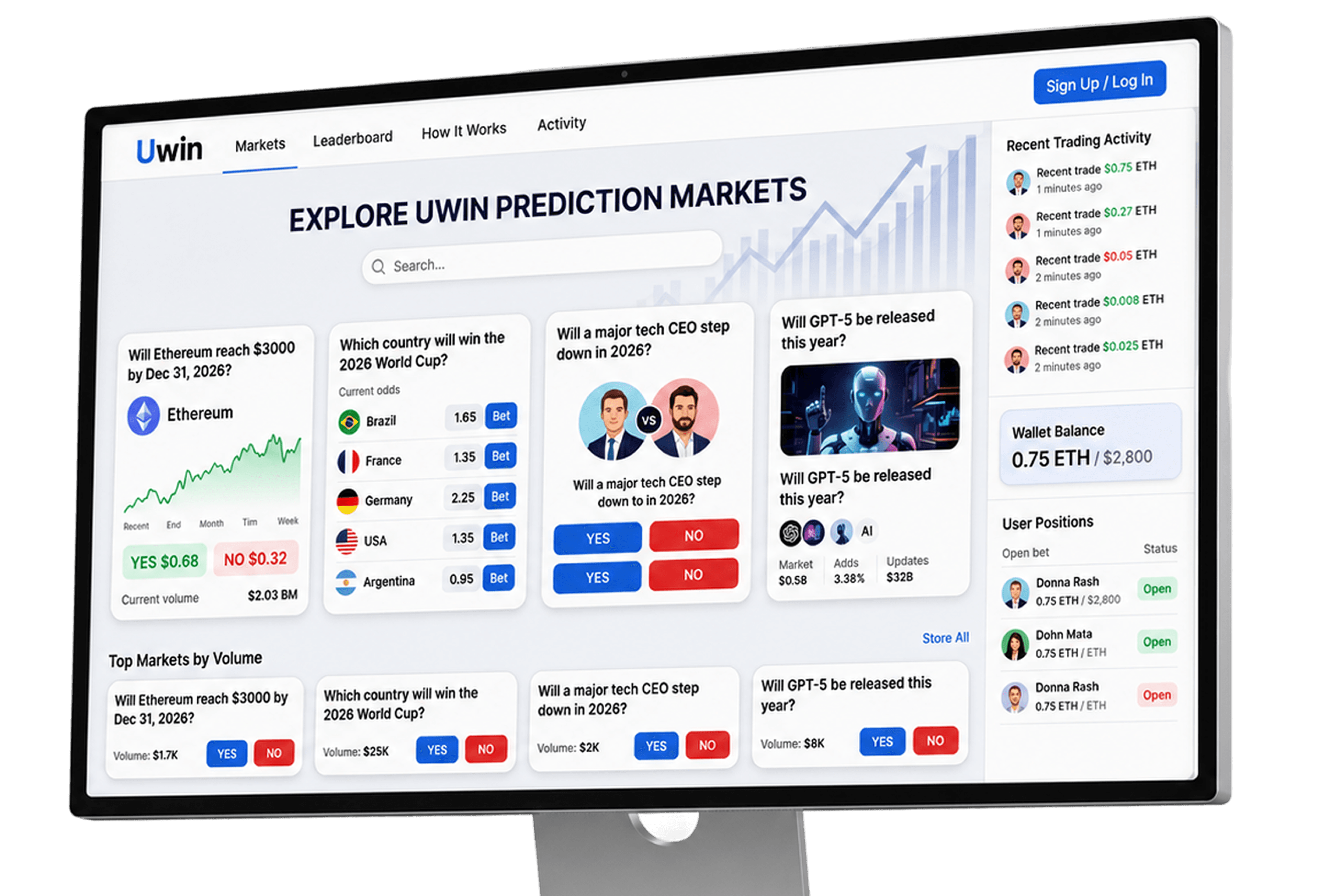
Uwin is a custom prediction market platform we built end-to-end, inspired by Polymarket: traders buy and sell outcome shares on real-world events, with transparent resolution rules and deep liquidity across binary and multi-outcome markets. Bitronix delivered the full surface - trader app, operator console, smart contracts, and oracle-backed settlement - rather than skinning a generic template.
Read case studyTech stack
- MongoDB
- Express
- React
- Angular
- Node.js
- Solidity
- Chainlink
 DeFi
DeFiUniswap-style AMM DEX development - constant-product and stable pools, swap router, and liquidity analytics on MERN + Solidity
ProSwap
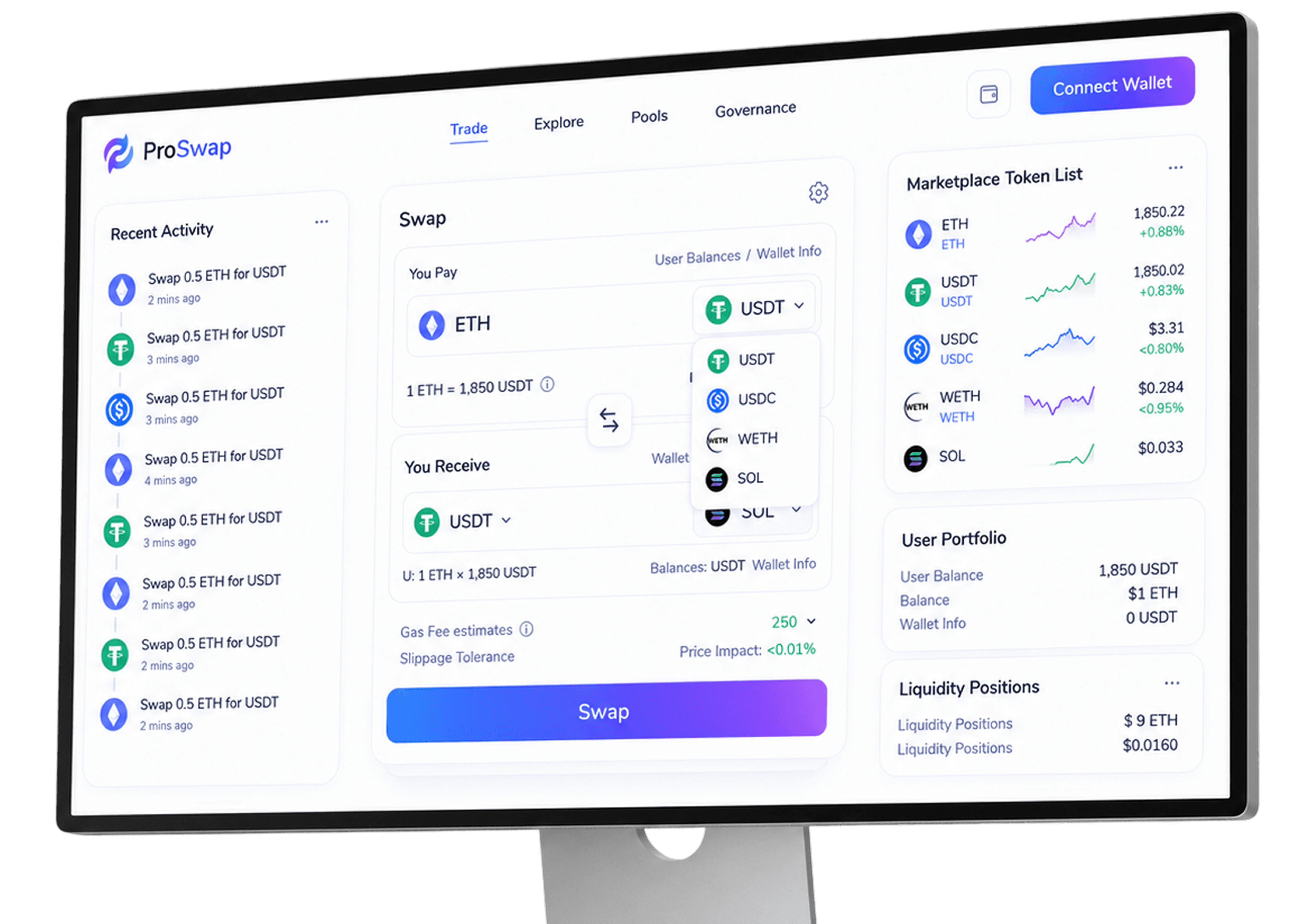
ProSwap is a custom decentralized exchange (DEX) we built in the Uniswap tradition: an automated market maker with constant-product and stable-style pools, configurable slippage controls, and a swap router the client could brand and deploy to their target chain. Bitronix delivered the full AMM stack - Solidity pool and router contracts, a trader-facing swap app, pool analytics, and an operator panel - engineered for a controlled mainnet launch.
Read case studyTech stack
- MongoDB
- Express
- React
- Node.js
- Solidity
- Ethereum
- TypeScript