NFT Universe: An OpenSea-Class NFT Marketplace, Shipped End-to-End
Custom NFT marketplace development - minting, auctions, royalties, and collection discovery on MERN + Solidity
Tech stack
- MongoDB
- Express
- React
- Node.js
- Solidity
- Ethereum
- IPFS
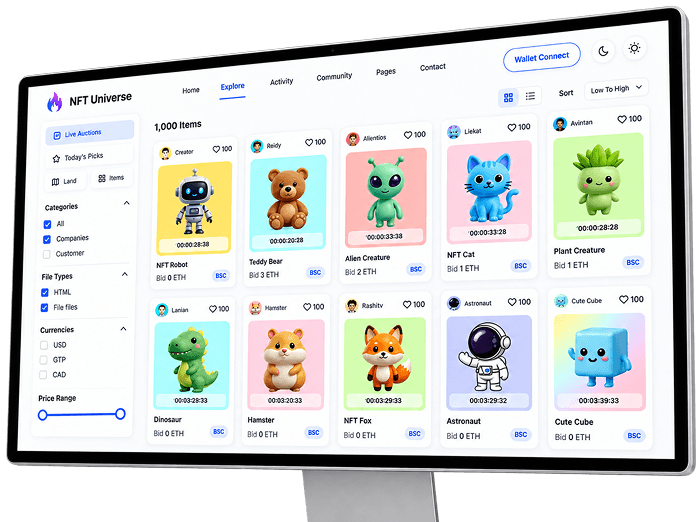
Project snapshot
| Industry | Gaming & Metaverse / Web3 |
|---|---|
| Service line | Custom NFT marketplace development |
| Token standards | ERC-721 and ERC-1155 |
| Stack | MongoDB, Express, React, Node.js (MERN), Solidity, Ethereum, IPFS |
| Marketplace type | OpenSea-class, multi-category, auctions + fixed-price |
| Outcome | A production marketplace the client can operate and extend without re-architecting core contracts |
The challenge: a credible alternative to white-label NFT templates
The client didn't want another cookie-cutter, white-label NFT marketplace. Off-the-shelf templates tend to fall apart in exactly the places that matter for real trading volume. They needed a marketplace that could stand up to the experience of an established venue, with four hard requirements:
- Reliable wallet onboarding - a connect-wallet flow that works consistently across providers and doesn't strand first-time users.
- Gas-aware minting - a minting path that accounts for network fees so creators understand cost before they commit a transaction.
- Royalty enforcement - creator royalties honored at the contract level on secondary sales, not left to goodwill.
- An indexer-backed explorer - a discovery layer that stays accurate and responsive under load, instead of querying the chain directly on every page view.
The brief, in short: build a custom NFT marketplace that feels like a leading marketplace, behaves predictably at scale, and gives the client full ownership of the codebase.
Our approach: MERN application surface + Solidity contract layer
We split the build into two coordinated layers - a fast, familiar web application surface and a hardened on-chain contract layer - so each could be developed, tested, and scaled independently.
1. Application layer (MongoDB, Express, React, Node.js)
The MERN stack powers everything users see and interact with off-chain:
- Accounts and profiles for creators and collectors, tied to connected wallets.
- Search and discovery across collections, items, and creators.
- Media handling for high-resolution NFT artwork and previews.
- Collection pages that present a creator's full catalog in one place.
2. Smart contract layer (Solidity on Ethereum)
We wrote and deployed Solidity contracts covering the core marketplace economics:
- ERC-721 and ERC-1155 listings - support for both one-of-one and multi-edition NFTs.
- Market fees - protocol fees handled transparently at settlement.
- On-chain royalties - creator royalties enforced automatically on resales.
3. Metadata, indexing, and admin tooling
To keep the marketplace fast and trustworthy, we added three supporting systems:
- IPFS-backed metadata so NFT metadata and media are stored on decentralized, content-addressed infrastructure.
- A dedicated indexing worker that listens to on-chain events and keeps the explorer accurate - so discovery and listings stay correct under load without hammering the chain.
- Admin tooling for moderation, featured drops, and day-to-day operations.
Key features delivered
- Gas-aware NFT minting that surfaces network cost before a creator commits.
- Live auctions and fixed-price listings running side by side.
- Offer and counter-offer flows for negotiated trades between buyers and sellers.
- Collection discovery with category filters, sorting, and search.
- Royalty enforcement baked into the ERC-721/1155 contracts.
- Responsive trading UX that holds up across desktop and mobile.
- Featured drops and moderation through purpose-built admin tooling.
The outcome: a production marketplace the client owns
We delivered a production NFT marketplace with collection pages, offer and counter-offer flows, and a responsive trading experience - ready for the client to operate and extend. Crucially, the architecture lets the team grow the product (new categories, new drops, new features) without re-architecting the core smart contracts, protecting their long-term investment.
Why this matters for NFT marketplace projects
If you're evaluating how to build an NFT marketplace like OpenSea, the difference between a demo and a production system lives in the unglamorous parts: an indexer that stays in sync, minting that respects gas, royalties that actually pay out, and contracts you can extend later. NFT Universe was engineered around those realities from day one.
Frequently asked questions
How long does custom NFT marketplace development take?
Timelines depend on the standards you support (ERC-721, ERC-1155, or both), the auction and listing types required, and the depth of admin tooling. A focused scope ships faster than a multi-chain platform - we scope each engagement to the client's launch goals.
What's the difference between a white-label NFT marketplace and a custom build?
White-label templates get you live quickly but tend to break under real trading load and limit how you can extend the product. A custom marketplace - like NFT Universe - gives you full ownership of the contracts and codebase, predictable behavior at scale, and room to grow.
Can you enforce creator royalties on secondary sales?
Yes. We implement royalty logic at the smart-contract level so it's enforced on resales rather than depending on platform goodwill.
Why use IPFS for NFT metadata?
IPFS stores NFT metadata and media on decentralized, content-addressed infrastructure, which keeps assets verifiable and resilient instead of tied to a single server.
Do you build on chains other than Ethereum?
NFT Universe was delivered on Ethereum with Solidity contracts. We can discuss other EVM-compatible chains depending on your audience, fee tolerance, and ecosystem.
Ready to Build Something Similar?
We design and ship production Web3 systems - marketplaces, DeFi protocols, and enterprise blockchain platforms - with audit-ready engineering from day one.
More Case Studies
 FinTech
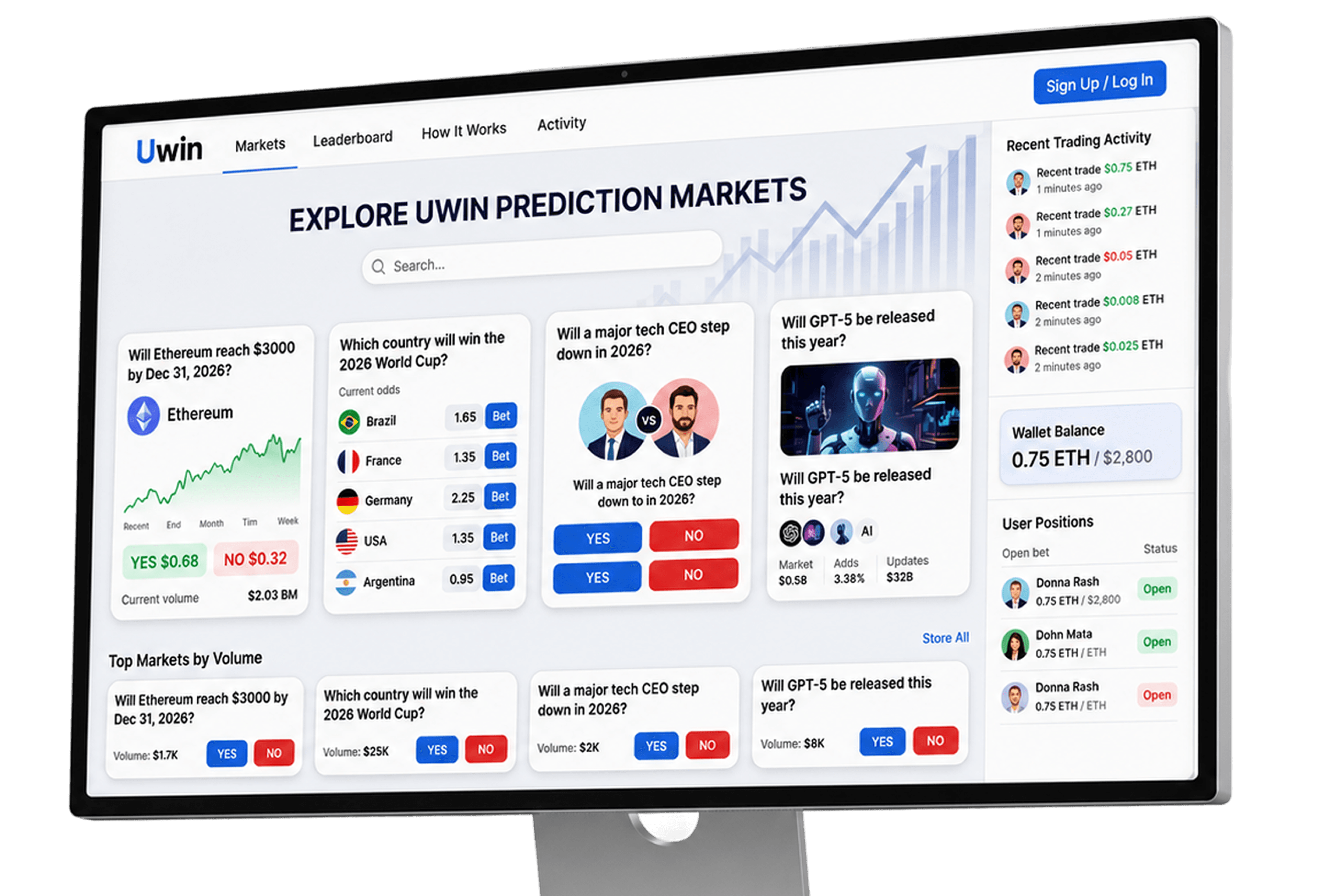
Polymarket-style prediction market development - outcome-share trading, Chainlink resolution, and collateral accounting on MEAN/MERN + Solidity
Uwin
Uwin is a custom prediction market platform we built end-to-end, inspired by Polymarket: traders buy and sell outcome shares on real-world events, with transparent resolution rules and deep liquidity across binary and multi-outcome markets. Bitronix delivered the full surface - trader app, operator console, smart contracts, and oracle-backed settlement - rather than skinning a generic template.
Read case studyTech stack
- MongoDB
- Express
- React
- Angular
- Node.js
- Solidity
- Chainlink
 DeFi
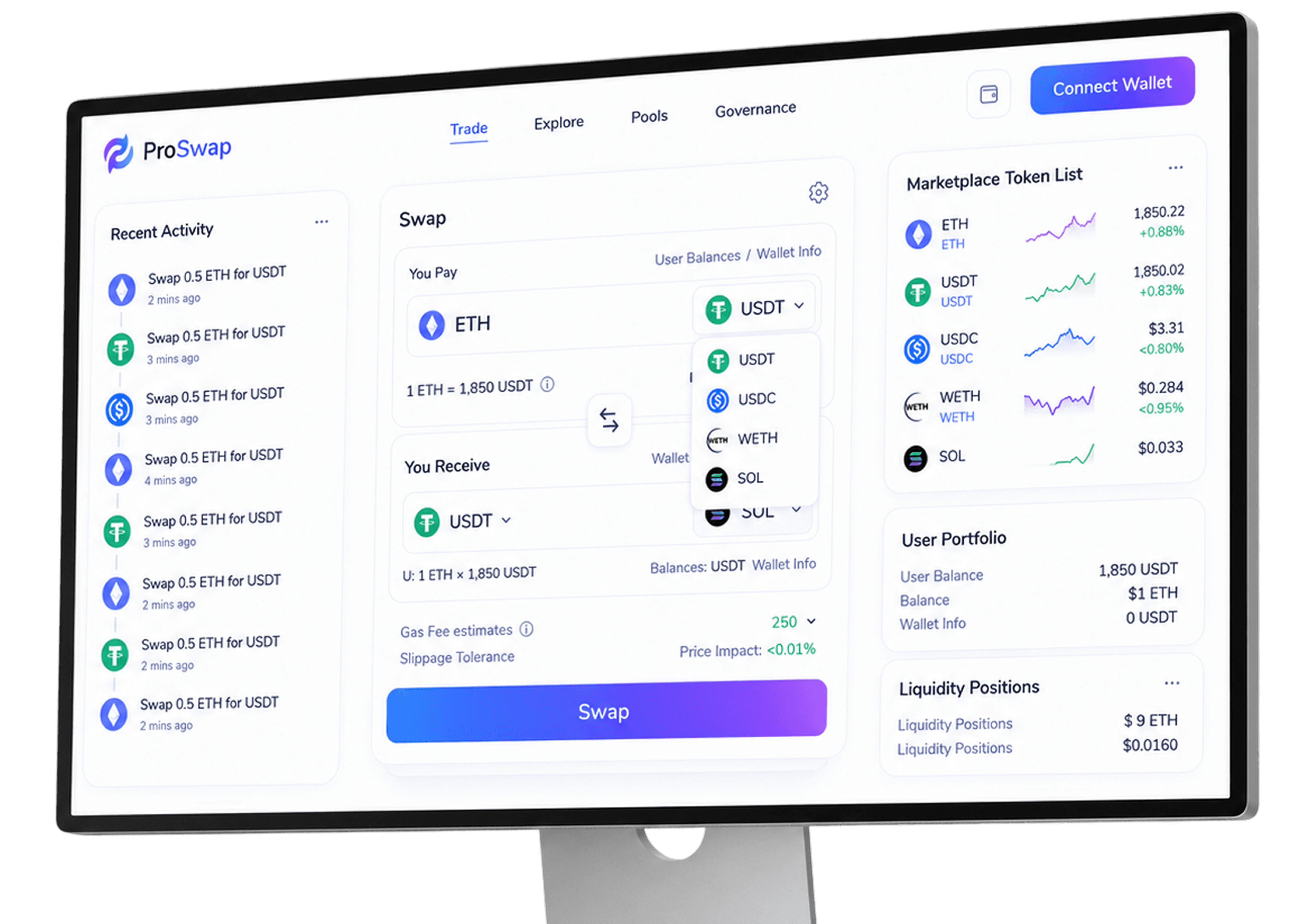
DeFiUniswap-style AMM DEX development - constant-product and stable pools, swap router, and liquidity analytics on MERN + Solidity
ProSwap
ProSwap is a custom decentralized exchange (DEX) we built in the Uniswap tradition: an automated market maker with constant-product and stable-style pools, configurable slippage controls, and a swap router the client could brand and deploy to their target chain. Bitronix delivered the full AMM stack - Solidity pool and router contracts, a trader-facing swap app, pool analytics, and an operator panel - engineered for a controlled mainnet launch.
Read case studyTech stack
- MongoDB
- Express
- React
- Node.js
- Solidity
- Ethereum
- TypeScript
 DeFi
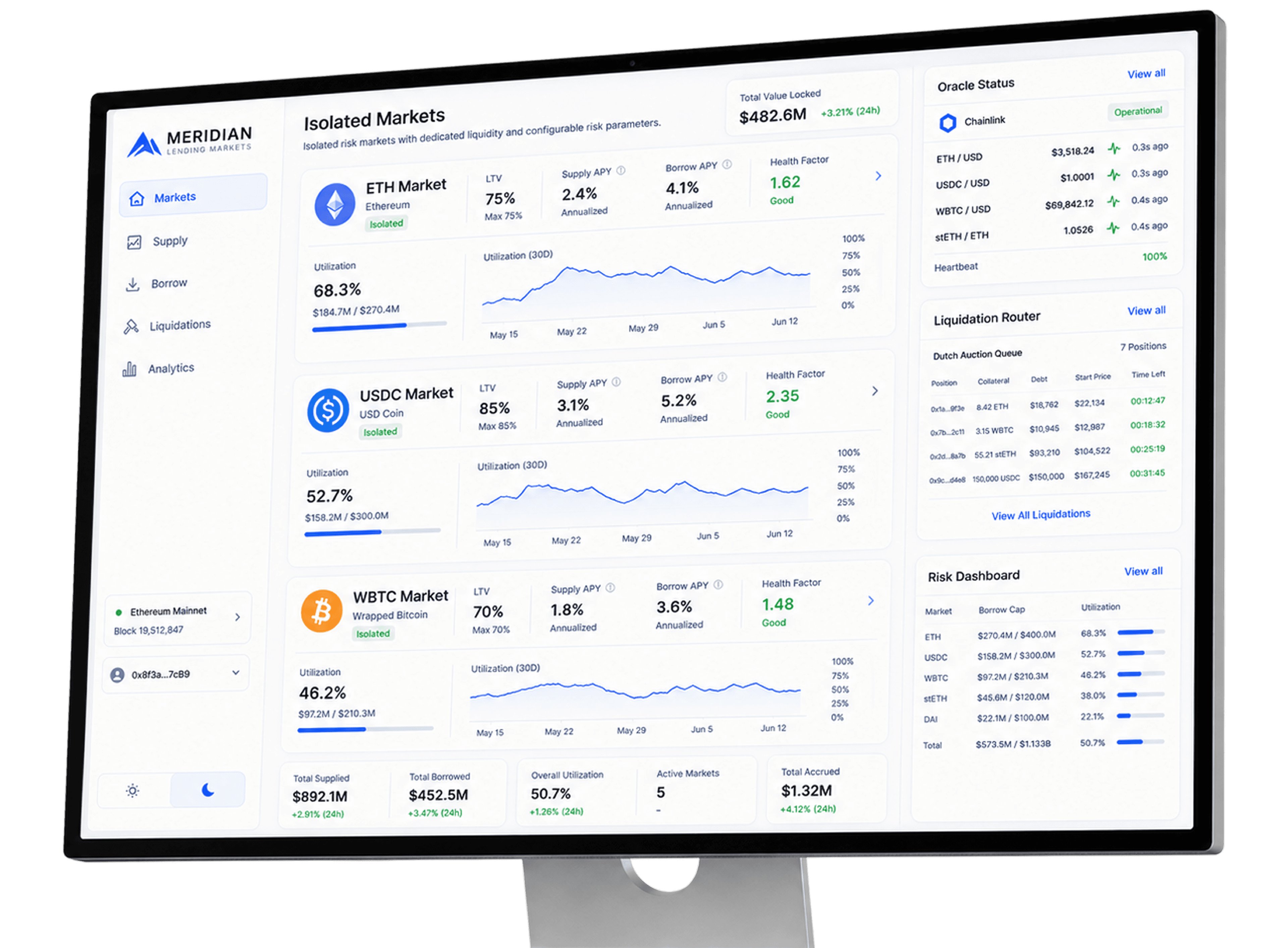
DeFiDeFi lending protocol development - isolated pools, configurable LTV, risk-bounded liquidations, and Chainlink oracle safeguards
Meridian Lending Markets
Meridian is an isolated-pool DeFi lending protocol we engineered for institutional desks. It pairs aggressive capital efficiency with conservative risk controls: per-asset silos, configurable loan-to-value (LTV) and liquidation bonuses, and predictable auction paths that keep solvency provable under stress. Bitronix delivered the full lending-protocol surface - Solidity markets, oracle safeguards, and a composable liquidation router - built audit-ready from day one.
Read case studyTech stack
- Solidity
- Foundry
- Chainlink
- TypeScript
- Ethereum