Uwin: A Polymarket-Style Prediction Market with On-Chain Settlement
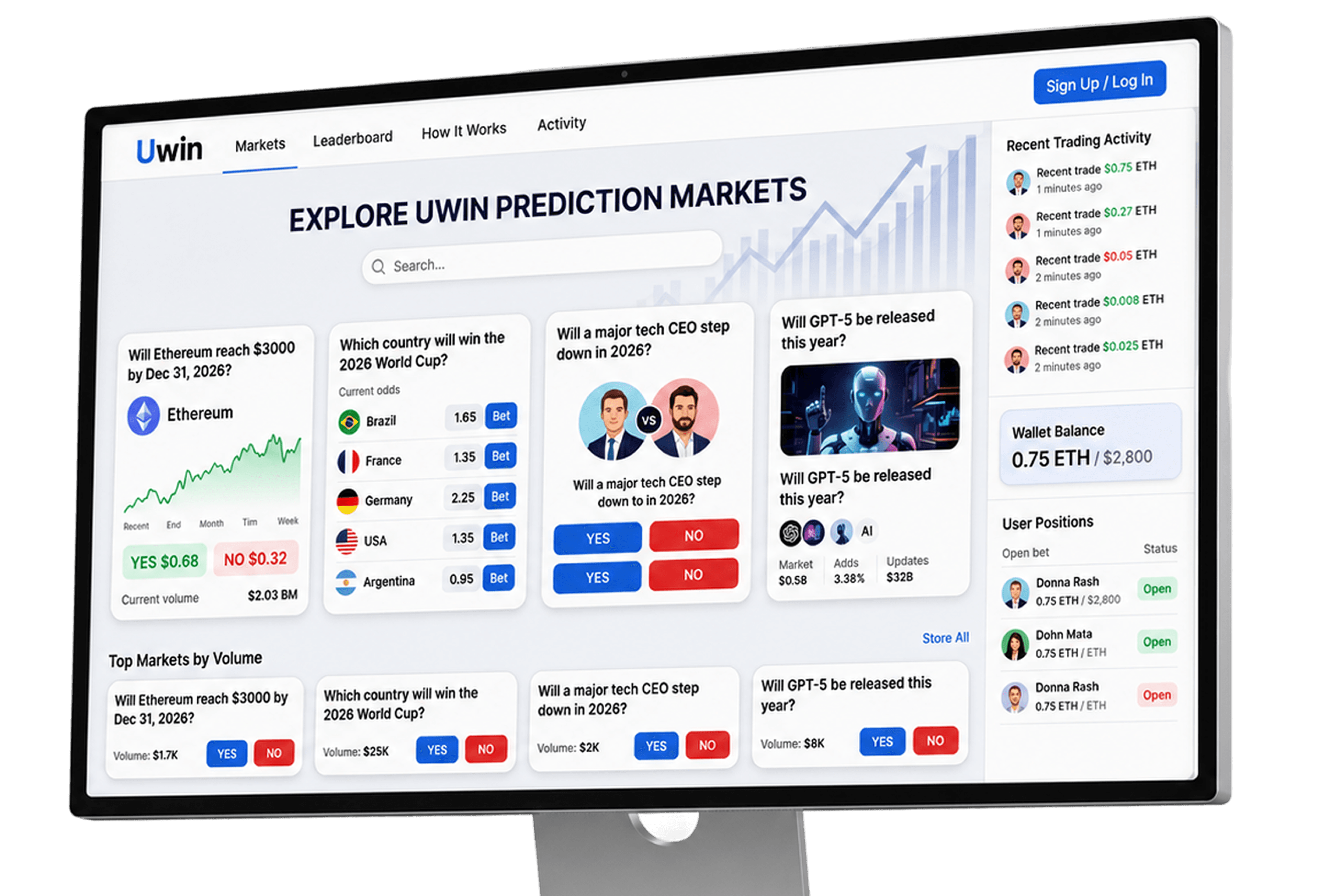
Polymarket-style prediction market development - outcome-share trading, Chainlink resolution, and collateral accounting on MEAN/MERN + Solidity
Tech stack
- MongoDB
- Express
- React
- Angular
- Node.js
- Solidity
- Chainlink
Project snapshot
| Industry | FinTech / Web3 |
|---|---|
| Service line | Custom prediction market development |
| Market type | Polymarket-style, binary and multi-outcome |
| Stack | MongoDB, Express, React, Angular, Node.js, Solidity, Chainlink |
| Settlement | On-chain collateral with oracle-backed resolution |
| Outcome | A working prediction venue the client can operate and extend without re-architecting core settlement contracts |
The challenge: fast trading UX with provably fair on-chain settlement
A prediction market development project lives or dies on trust. Users need a fast, exchange-grade trading experience off-chain, but settlement has to be provably fair on-chain. The hard part was reconciling the two - and off-the-shelf prediction-market templates rarely survive the edge cases that matter in production.
The client needed a Polymarket-style prediction market engineered around four hard requirements:
- Clear oracle boundaries - defined rules for how events resolve, which feeds are authoritative, and what happens when data is delayed or contested.
- Precise collateral accounting - every open position fully backed at all times, with no silent shortfalls between off-chain books and on-chain state.
- Dispute-safe resolution - protection against ambiguous or disputed outcomes without freezing user funds indefinitely.
- Operator autonomy - market creation, risk dashboards, and resolution playbooks the ops team can run without engineering for every event.
The brief, in short: build a custom prediction market that trades like a leading venue, settles transparently on-chain, and gives the client full ownership of the codebase.
Our approach: MEAN/MERN application surface + Solidity settlement layer
We built on the MEAN/MERN hybrid stack the client had standardised on, split into a fast application surface for traders and operators and a hardened on-chain layer for collateral and settlement.
1. Application layer (MongoDB, Express, React, Angular, Node.js)
The application stack powers everything users and operators interact with off-chain:
- MongoDB and Express APIs for market metadata, user positions, and risk dashboards.
- React trader app for fast, exchange-grade outcome-share trading.
- Angular operator console for early market creation, oversight, and resolution workflows.
- Node.js workers for event indexing and real-time notifications so order books and positions stay accurate under load.
2. Smart contract layer (Solidity)
Solidity contracts manage the settlement economics that must never drift from reality:
- Collateral custody - user funds locked and released only through defined contract paths.
- Outcome-share minting and burning - positions represented as tradable shares tied to specific event outcomes.
- Resolution hooks - on-chain settlement triggered when an oracle reports a final result.
3. Oracle integration and resolution playbooks
For objectively verifiable events, we integrated audited Chainlink oracle feeds so resolution inputs are tamper-resistant and consumable on-chain. Each market type maps to a documented resolution path - including dispute windows and operator escalation steps - so the team knows exactly what to do when an outcome is contested.
Key features delivered
- Binary and multi-outcome markets with transparent resolution rules published before trading opens.
- Order-style matching patterns for outcome shares with off-chain speed and on-chain finality.
- Self-serve market creation workflows for operators launching new events.
- Risk dashboards surfacing open interest, collateral coverage, and resolution status.
- Chainlink-backed resolution for objectively verifiable real-world events.
- Real-time indexing and notifications keeping positions and order books in sync under load.
- Repeatable resolution playbooks operators can execute without pulling in engineering.
The outcome: a prediction venue the client can operate and extend
We delivered a working prediction venue with self-serve market creation workflows, order-style matching for outcome shares, and resolution playbooks the operations team can run without engineering for every event. Crucially, the architecture lets the client launch new binary and multi-outcome markets, plug in new oracle feeds, and scale liquidity without re-architecting the core settlement contracts.
Why this matters for prediction market projects
If you're evaluating how to build a prediction market like Polymarket, the difference between a demo and a production system lives in collateral accounting, oracle boundaries, and disputed-resolution paths - not in the trading UI alone. Uwin was engineered around those realities from day one. For the contract layer specifically, the same audit-ready discipline we apply to DeFi protocols applies here: explicit invariants, tested settlement paths, and a handoff auditors can verify quickly.
If you are scoping a decentralized prediction market or an institutional outcome-trading platform, our DeFi development and smart contract development teams design settlement systems to this standard.
Frequently asked questions
How long does prediction market development take?
Timelines depend on whether you launch binary markets only or multi-outcome events, the depth of operator tooling, and how many oracle integrations you need. A focused MVP with a single resolution path ships faster than a multi-category venue with custom dispute flows - we scope each engagement to your launch goals.
What's the difference between off-chain trading and on-chain settlement?
Off-chain layers handle the fast UX traders expect - order books, position updates, and notifications - while on-chain contracts hold collateral, mint and burn outcome shares, and execute final settlement when an event resolves. The architecture must keep both layers in sync without ever leaving positions under-collateralized.
How do you handle disputed or ambiguous event outcomes?
We define oracle boundaries upfront: which feeds resolve which market types, what happens when a feed is delayed or contested, and how user funds move during a dispute window. Resolution playbooks document each path so operators can act without improvising under pressure.
Why use Chainlink oracles for prediction market resolution?
For objectively verifiable events - sports scores, election results, price thresholds - audited Chainlink feeds provide tamper-resistant inputs that smart contracts can consume on-chain. Subjective or editorial outcomes need a different governance model; we design the resolution hook to match the event type.
Can you support both binary and multi-outcome prediction markets?
Yes. Uwin supports binary yes/no markets and multi-outcome events where traders hold shares in specific outcomes. Collateral accounting and share minting logic differ between the two, and both must reconcile cleanly at resolution.
Ready to Build Something Similar?
We design and ship production Web3 systems - marketplaces, DeFi protocols, and enterprise blockchain platforms - with audit-ready engineering from day one.
More Case Studies
 Gaming & Metaverse
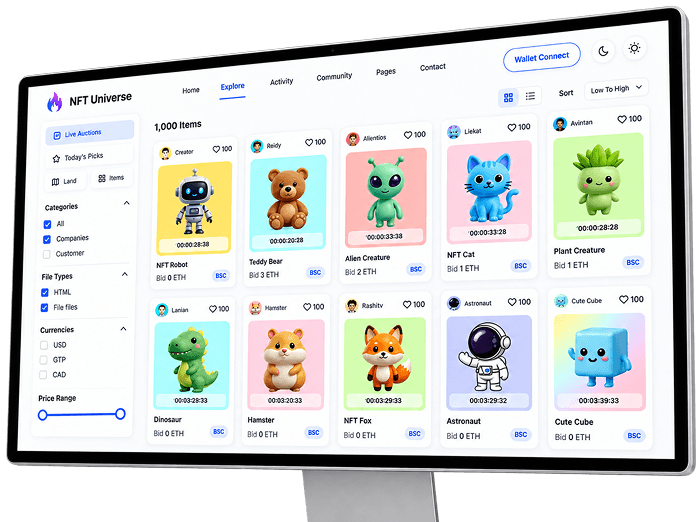
Custom NFT marketplace development - minting, auctions, royalties, and collection discovery on MERN + Solidity
NFT Universe
NFT Universe is a full-featured, production-grade NFT marketplace Bitronix Technologies designed and built for creators and collectors. Rather than reskinning a generic white-label template, we engineered a marketplace with the trading flows users expect from leading venues - wallet onboarding, gas-aware minting, on-chain royalties, live auctions, and an indexer-backed explorer that stays accurate under load.
Read case studyTech stack
- MongoDB
- Express
- React
- Node.js
- Solidity
- Ethereum
- IPFS
 DeFi
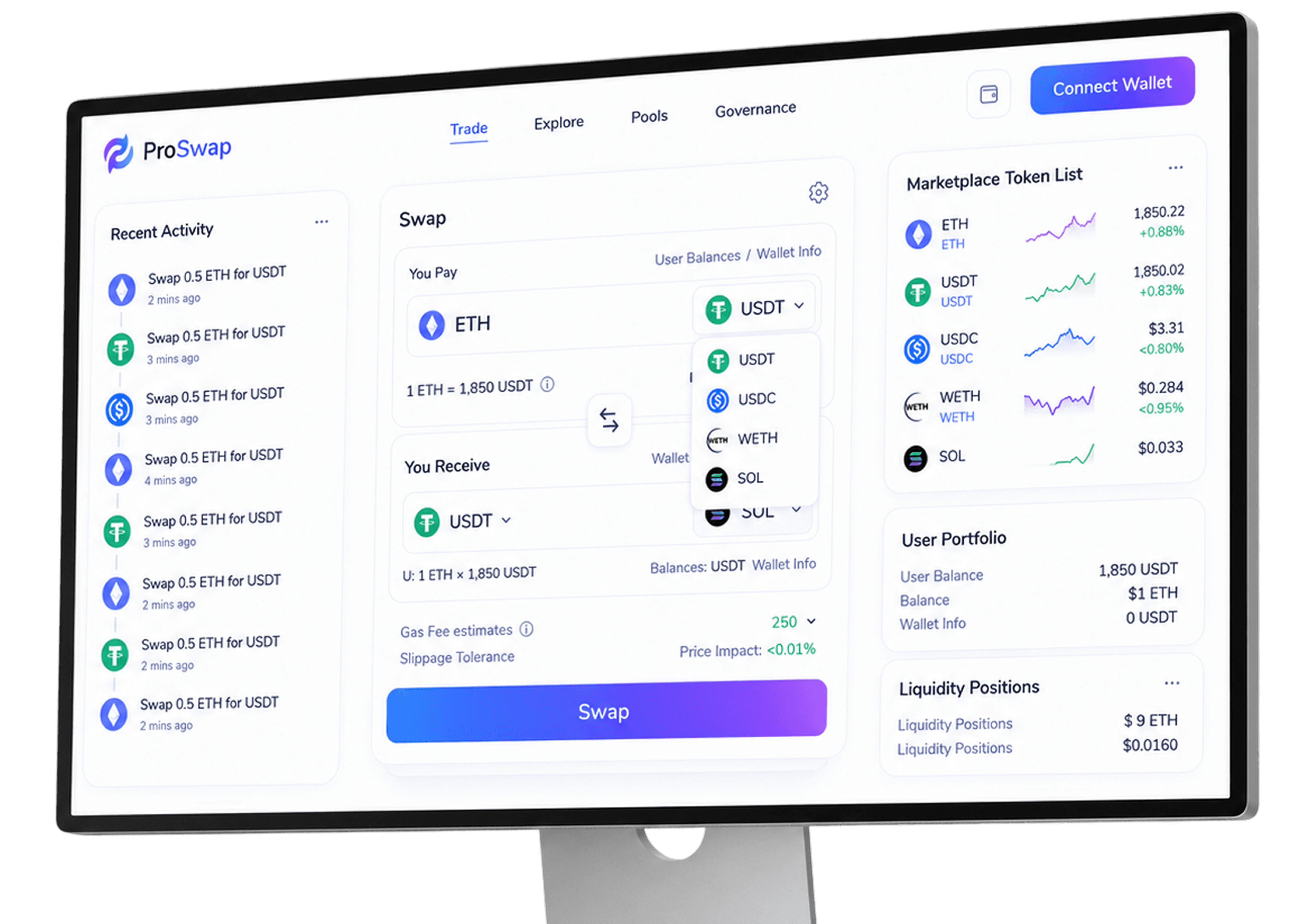
DeFiUniswap-style AMM DEX development - constant-product and stable pools, swap router, and liquidity analytics on MERN + Solidity
ProSwap
ProSwap is a custom decentralized exchange (DEX) we built in the Uniswap tradition: an automated market maker with constant-product and stable-style pools, configurable slippage controls, and a swap router the client could brand and deploy to their target chain. Bitronix delivered the full AMM stack - Solidity pool and router contracts, a trader-facing swap app, pool analytics, and an operator panel - engineered for a controlled mainnet launch.
Read case studyTech stack
- MongoDB
- Express
- React
- Node.js
- Solidity
- Ethereum
- TypeScript
 DeFi
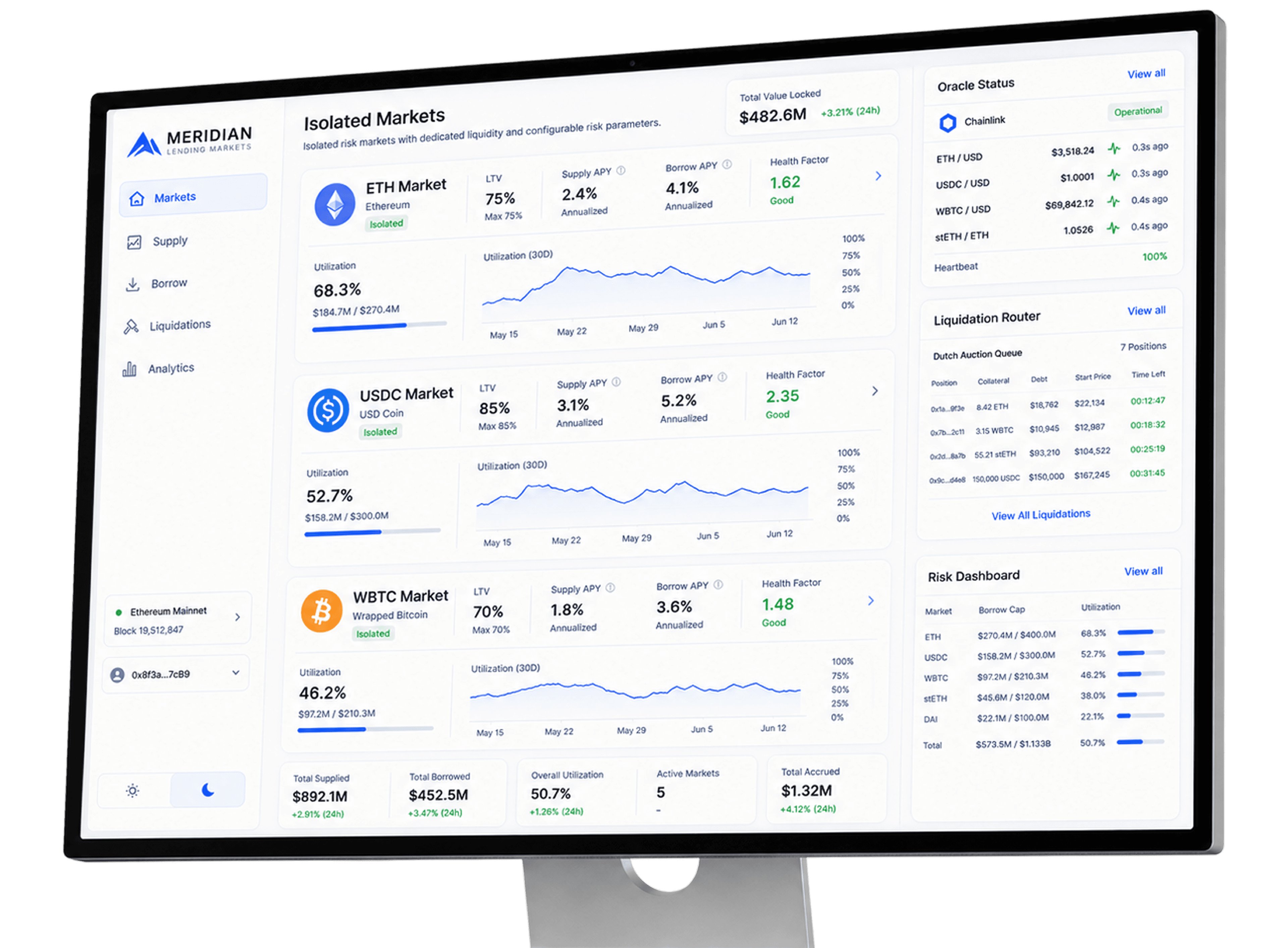
DeFiDeFi lending protocol development - isolated pools, configurable LTV, risk-bounded liquidations, and Chainlink oracle safeguards
Meridian Lending Markets
Meridian is an isolated-pool DeFi lending protocol we engineered for institutional desks. It pairs aggressive capital efficiency with conservative risk controls: per-asset silos, configurable loan-to-value (LTV) and liquidation bonuses, and predictable auction paths that keep solvency provable under stress. Bitronix delivered the full lending-protocol surface - Solidity markets, oracle safeguards, and a composable liquidation router - built audit-ready from day one.
Read case studyTech stack
- Solidity
- Foundry
- Chainlink
- TypeScript
- Ethereum