Smart contract audit readiness: what actually accelerates review

By Tausif AhmedFounder and CTO
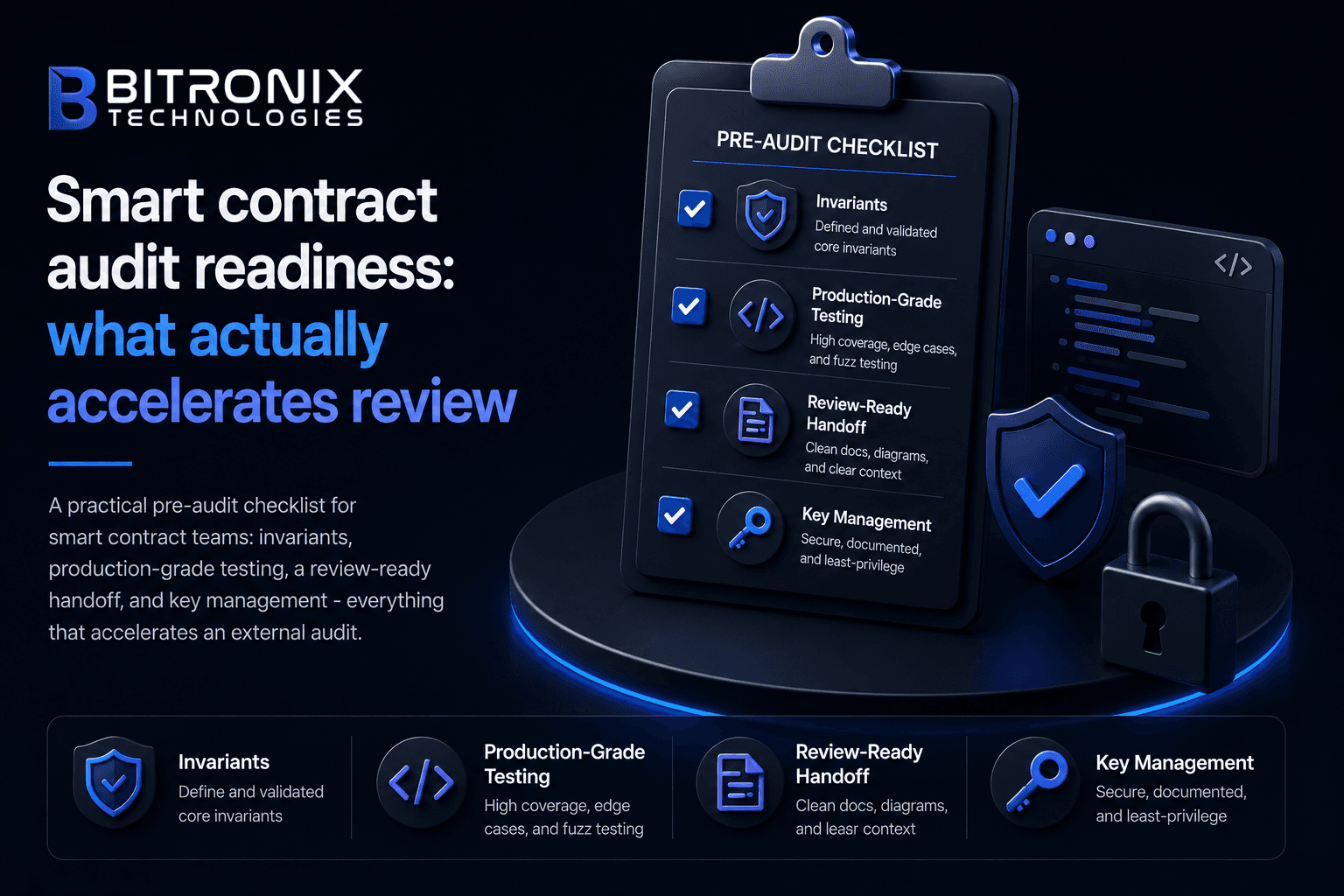
Auditors move faster when invariants are explicit and tests encode the threat model. The goal is not perfect code on day one - it is a coherent narrative backed by evidence. A sprawling repository without a single architecture note often burns the first week of an engagement on reverse engineering intent and since audits are billed by the hour or by lines of code, that week is real money spent on questions you could have answered in advance. At Bitronix Technologies, smart contract audit readiness is the discipline of removing that guesswork before the engagement starts, so reviewers spend their time finding bugs instead of inferring what your system was supposed to do.
Key takeaways
- Readiness is about evidence, not perfection: a clear architecture note and explicit invariants let auditors start finding issues on day one instead of reverse engineering intent.
- Document economic assumptions, privileged roles and emergency procedures in one place and link each invariant from NatSpec through tests to runtime assertions.
- Production-grade testing - fuzzing, differential testing and mainnet-fork scenarios - catches classes of bugs unit tests miss; pair it with deployment rehearsals and rollback criteria.
- Package a review-ready drop: a tagged release candidate, frozen dependencies, reproducible builds and a change log that flags anything touching funds, access control, or external calls.
- Expect hard questions about admin keys and incident response - who holds them, how they rotate and what on-chain safeguards exist if one is compromised.
- Preparation directly reduces audit cost and time: the cleaner the handoff, the fewer billable hours spent on discovery and the faster you reach a clean report.
What slows down a smart contract audit?
Most audit delays are not caused by complex bugs - they are caused by ambiguity. When a reviewer cannot tell whether a behavior is intentional, they have to ask, wait and re-test and every round trip costs hours. A repository with no architecture overview, undocumented privileged roles and tests that only cover the happy path forces the auditor to reconstruct your design from the code itself. That reconstruction is the single largest source of wasted engagement time and it happens before a single vulnerability has been written up.
The fix is to give reviewers a coherent narrative backed by evidence. When the intended behavior is written down, tied to tests and traceable to runtime checks, findings become about genuine gaps in reasoning rather than guesswork about author intent. That shift - from discovery to verification - is what actually accelerates review and it is almost entirely within your control before the audit begins.
How do you document state invariants for an audit?
Document economic assumptions, privileged roles and emergency procedures in one place rather than scattering them across commit messages and chat threads. Then link each invariant to the tests and monitoring signals that enforce it. When reviewers can trace a claim like no user balance may exceed total supply from NatSpec comments through a test that exercises it to a runtime assertion that guards it, they can verify the property in minutes instead of debating whether it holds at all.
This traceability is the highest-leverage preparation you can do. An invariant that exists only in someone's head is invisible to an auditor; an invariant that is documented, tested and asserted is a property they can confirm and move on from. The more of your system's guarantees you can express this way, the more of the audit becomes confirmation rather than investigation.
- Centralize economic assumptions, privileged roles and emergency procedures in one document
- State each invariant in plain language, then link it to its test and its runtime check
- Use NatSpec so intent lives next to the code, not in a separate wiki that drifts out of date
- Tie invariants to monitoring signals so the same properties are watched in production
What testing actually mirrors production?
Unit tests prove that the paths you thought of work. Fuzzing, differential testing and mainnet-fork scenarios catch the classes of issues you did not think of - unexpected input combinations, divergence from a reference implementation and failures that only appear against real on-chain state. Property-based and invariant fuzzing (with tools like Foundry's invariant testing or Echidna) is especially valuable here, because it attacks the exact properties you documented rather than a fixed list of cases.
Pair this with deployment rehearsals that include explicit rollback criteria, so the team has practiced the failure path before it matters. Capture execution traces and expected event payloads for important scenarios, so an auditor can replay a failing case deterministically without depending on your particular laptop configuration. A test suite an auditor can run and reproduce is worth far more than one they have to take on faith.
- Fuzz the documented invariants, not just hand-written cases
- Use differential testing against a reference or previous version where one exists
- Run mainnet-fork scenarios so behavior is validated against real state
- Rehearse deployment with rollback criteria defined in advance
- Capture traces and expected event payloads so failing cases replay deterministically
How do you package a review-ready drop?
Tag a clean release candidate, freeze dependencies with lockfiles and supply build reproducibility instructions so the auditor reviews exactly the bytecode you intend to deploy. Include a change log that explicitly calls out anything touching funds movement, access control, or external calls - the three areas where most critical findings live. If you use proxies or modules, diagram the initialization sequence and upgrade hooks so reviewers do not have to infer control flow from bytecode alone, which is slow and error-prone even for experienced auditors.
- Tag a frozen release candidate and pin every dependency with lockfiles
- Provide reproducible build instructions so the audited artifact matches what ships
- Write a change log that flags funds movement, access control and external calls
- Diagram proxy or module initialization and upgrade hooks explicitly
- Include a threat model summary tied to concrete test cases
- Share prior internal review notes - even rough bullets save duplicate discovery
- List external dependencies with pinned versions and stated trust assumptions
What will auditors ask about admin keys and incident response?
Expect direct questions about admin keys and incident response: who holds them, how they are rotated and what on-chain safeguards exist if a key is suspected compromised. Be ready to describe multisig thresholds, timelocks, pause mechanisms and the exact sequence you would follow during an emergency. Answers that live only in Slack are answers you will end up re-typing under time pressure mid-audit - and improvising an incident response plan during a live review is exactly the wrong moment to discover a gap in it.
How do you keep an audit on schedule once it starts?
If you iterate mid-review, isolate the deltas: show reviewers exactly which files changed, why and what risk surface moved. Nothing slows an audit like an unlabeled force-push to main that mixes formatting churn with logic changes, because the auditor has to re-diff the entire scope to find the real change. Keep logic changes separate from cosmetic ones and annotate every mid-review change with its rationale and its blast radius.
Close readiness gaps early by running an internal tabletop: pretend a critical finding blocks launch and walk through how you would patch, test and communicate to partners. The teams that finish audits on schedule treat readiness as a rehearsal, not a paperwork exercise. Budget a short stabilization window after fixes land so auditors can re-verify without stacking new changes on the same day you tag the release. And nominate a single technical point of contact who can authorize scope questions, because conflicting answers from engineering and product are a common and avoidable source of review churn.
- Isolate mid-review deltas and never mix formatting with logic changes
- Run an internal tabletop on a hypothetical critical finding before the audit
- Reserve a stabilization window so re-verification is not stacked on fresh changes
- Designate one technical point of contact to authorize scope decisions
Audit readiness is ultimately about respect for the reviewer's time, which is also your budget and your launch date. Explicit invariants, tests that mirror production, a reproducible handoff and a rehearsed incident plan turn an audit from open-ended investigation into focused verification. For a concrete engineering checklist Bitronix Technologies uses before handoff to firms like Hacken and CertiK, see Five things we fix before the audit firm sees the code. If you are preparing a high-stakes contract system for external review, our smart contract development team helps you reach a review-ready state and works alongside auditors through remediation - so the engagement finishes on time and on budget.
Frequently asked questions
What is smart contract audit readiness?
Smart contract audit readiness is the state of a codebase and its documentation that lets an external auditor begin finding issues immediately, without first reverse engineering your design. It means explicit invariants, production-grade tests, a reproducible release candidate, clear documentation of privileged roles and a defined incident response plan.
How do you prepare for a smart contract audit?
Document your invariants, economic assumptions and privileged roles in one place; build a test suite that includes fuzzing, differential testing and mainnet-fork scenarios; tag a frozen release candidate with pinned dependencies and reproducible builds; and prepare clear answers about admin keys and emergency procedures. Sharing prior internal review notes and a threat model summary further reduces discovery time.
What documentation do auditors need most?
A short architecture overview, a list of state invariants linked to tests and runtime assertions, a map of privileged roles and admin keys, a change log highlighting funds movement and access control and a diagram of any proxy initialization and upgrade hooks. Documentation that lets a reviewer trace intent from comment to test to runtime check is the most valuable.
What kind of testing do auditors expect?
Beyond unit tests, auditors expect property-based fuzzing of your documented invariants, differential testing against a reference where one exists and mainnet-fork scenarios that validate behavior against real on-chain state. They also value captured traces and expected event payloads so failing cases can be replayed deterministically.
Does audit preparation reduce cost?
Yes. Audits are typically billed by time or lines of code, so the hours an auditor would otherwise spend reconstructing your design are billable hours you can eliminate with good documentation and reproducible tests. A clean handoff also reduces the number of clarifying round trips, which shortens the calendar time to a final report.
What should you do if you change code mid-audit?
Isolate the change. Show reviewers exactly which files moved, why and what risk surface changed and keep logic edits separate from formatting. Avoid unlabeled force-pushes that force the auditor to re-diff the whole scope and budget a short stabilization window so fixes can be re-verified without stacking new changes on top.

Founder and CTO
Founder and CTO of Bitronix Technologies. Leads delivery of audit-ready smart contract systems for enterprise and regulated industries.
Related Posts
 Security
May 21, 20266 min read
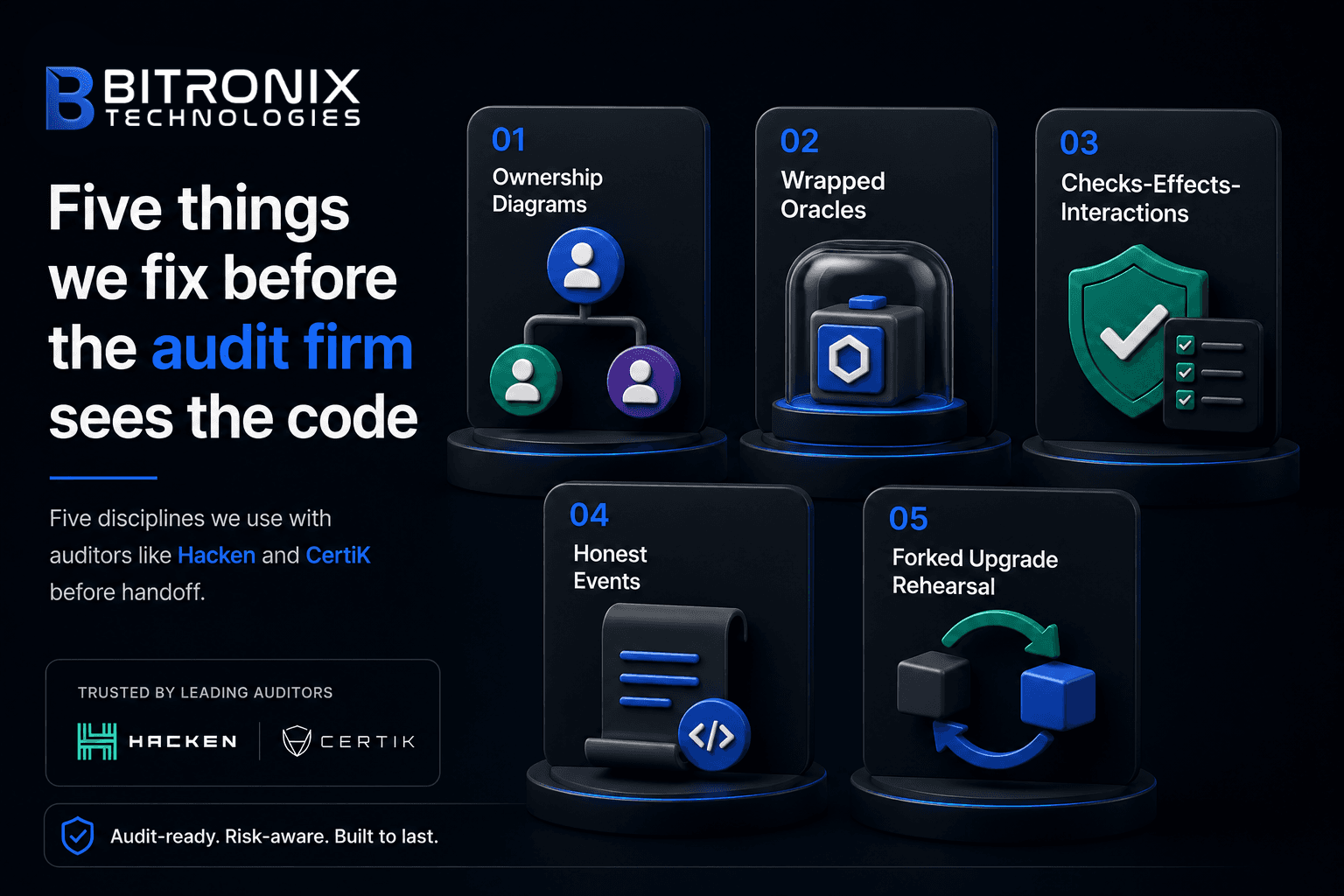
Five things we fix before the audit firm sees the code
Ownership diagrams, wrapped oracles, checks-effects-interactions, honest events and forked upgrade rehearsal - five disciplines we use with auditors like Hacken and CertiK before handoff.
Read article Blockchain
October 23, 202619 min read
DEX Clone Script: Features, Development Cost & How to Build a Decentralized Exchange
Explore DEX clone script features, development costs, smart contracts, liquidity pools, security, and the steps to build a decentralized exchange.
Read article Blockchain
October 21, 202613 min read
Agricultural Commodity Tokenization in 2027: Benefits, Process & Cost
Learn how agricultural commodity tokenization works, its benefits, development process, costs, use cases, and key regulatory considerations.
Read article