Harbor RWA Settlement: On-Chain Rails for Tokenized Real-World Assets
RWA tokenization development - policy-gated minting, NAV oracle quorum, and qualified-custodian segregation on Ethereum
Tech stack
- Solidity
- Hardhat
- IPFS
- TypeScript
- Ethereum
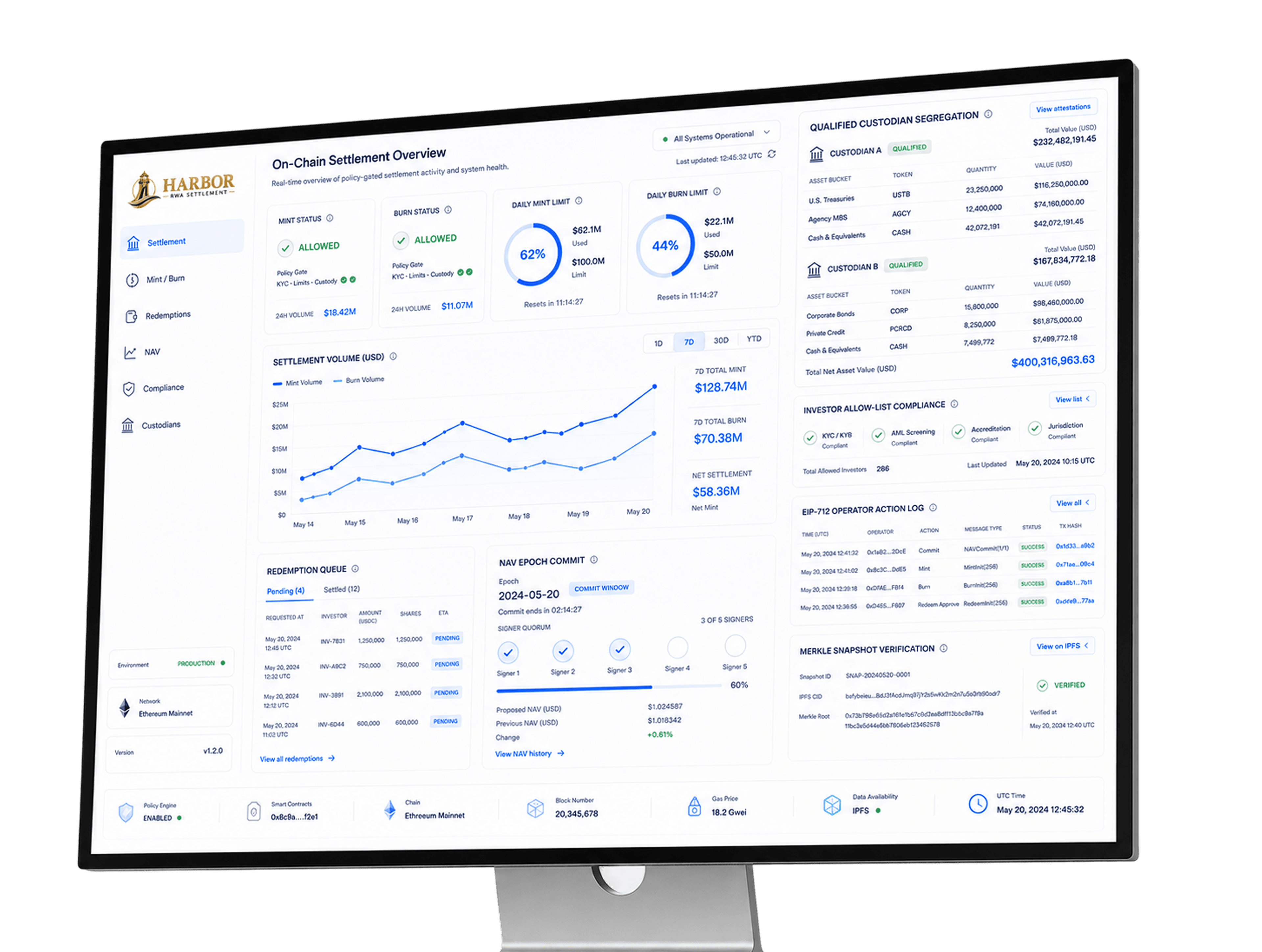
Project snapshot
| Industry | RWA & Tokenisation / Institutional |
|---|---|
| Service line | RWA tokenization development |
| Settlement model | On-chain reference tokens with off-chain custody and attestations |
| Stack | Solidity, Hardhat, IPFS, TypeScript, Ethereum |
| Compliance | Allow-lists, policy-gated mint/burn, freeze and seizure flows |
| Outcome | Production-oriented settlement rails issuers can extend with new asset types without touching the audited settlement core |
The challenge: fund rules on-chain without PII on-chain
Tokenizing regulated assets means encoding fund rules into smart contracts without ever leaking personally identifiable information (PII) on-chain. RWA tokenization development for institutional issuers is not a generic ERC-20 mint - it is compliant asset tokenization where every state transition must reflect real compliance obligations.
Four constraints shaped Harbor:
- Asset eligibility - only approved asset references enter the settlement system.
- Investor allow-lists - transfers and mints gated by verified eligibility, without storing identity on-chain.
- Freeze and seizure flows - regulatory actions executable through defined contract paths.
- Deterministic custodian settlement - predictable behavior when qualified custodians disagree, rotate, or fail over.
Getting redemption and settlement to behave predictably under custodian failover - without exposing investor identity - was the core engineering constraint.
Our approach: upgrade-minimal core + compliance peripherals
We designed Harbor as a small, auditable settlement core surrounded by flexible compliance modules - so issuers can evolve rules without re-auditing the entire system for every policy change.
1. Upgrade-minimal core contracts (Solidity)
The trusted core handles on-chain settlement rails for reference tokens: policy-gated mint and burn, redemption queue state, and NAV commit hooks. Keeping this surface minimal reduces audit scope and long-term upgrade risk.
2. Compliance and attestation modules
- Investor allow-list smart contracts and eligibility checks before mint or transfer.
- Attestation verification linking off-chain custodian and issuer signals to on-chain actions.
- Epoch-based NAV commits bound to a signer quorum before values propagate to settlement logic.
- Qualified custodian segregation so asset references respect custodian boundaries.
3. Operator authorization and verification tooling
EIP-712 operator actions back authorized operations with structured, verifiable signatures. On-chain events plus Merkle snapshot verification let third parties independently confirm state without trusting a single operator dashboard.
4. Stress-scenario integration testing
Integration tests simulated custodian failover, delayed redemptions, and partial asset substitutions - the scenarios where tokenized fund infrastructure typically breaks in production if not designed upfront.
Key features delivered
- Policy-gated mint and burn paths encoding fund rules at the contract layer.
- Signer-quorum NAV updates with epoch-based commits.
- Qualified-custodian segregation across settlement paths.
- Transparent redemption queues observable to issuers and investors.
- Investor allow-lists without on-chain PII.
- Freeze and seizure flows for regulatory action paths.
- EIP-712 structured operator authorization and Merkle snapshot verification.
- IPFS-backed attestation artifacts where off-chain evidence must stay content-addressed and verifiable.
The outcome: settlement rails issuers can extend without re-auditing the core
We delivered production-oriented settlement rails for regulated asset references, with policy-gated mint and burn paths, signer-quorum NAV updates, qualified-custodian segregation, and transparent redemption queues for issuers and investors alike. The modular design lets issuers extend compliance rules and onboard new asset types without touching the audited settlement core.
Why this matters for RWA tokenization projects
If you're evaluating real-world asset tokenization, the gap between a demo token and institutional infrastructure is policy-gated settlement, custodian segregation, off-chain PII discipline, and verifiable operator actions - not just a mint button. Harbor was engineered around those realities from day one. Regulated issuers also need the same governance and evidence discipline described in our permissioned chain design guide and smart contract audit readiness playbooks before external review.
If you are scoping tokenized fund infrastructure or on-chain settlement for regulated assets, our RWA tokenization and smart contract development teams build to this standard.
Frequently asked questions
How long does RWA tokenization development take?
Timelines depend on asset class, jurisdiction, the number of compliance modules required, and how many custodian and oracle integrations you need. A single-asset reference token with standard allow-lists ships faster than a multi-custodian fund platform with custom redemption queues - we scope each engagement to your regulatory and launch goals.
How do you keep investor PII off-chain while tokenizing assets?
Investor identity and eligibility live in off-chain systems and compliance modules. On-chain contracts reference allow-list proofs and policy checks without storing personal data - so settlement remains verifiable while PII stays in systems designed for privacy and regulatory retention.
What are policy-gated mint and burn paths?
Mint and burn operations execute only when predefined policy checks pass - asset eligibility, investor allow-list status, custodian attestation, and NAV bounds. This encodes fund rules in contract logic rather than relying on manual operator discretion alone.
What is NAV oracle quorum integration?
Net asset value updates require a defined quorum of authorized signers before committing on-chain. That binds NAV changes to your governance model and creates an auditable record of who approved each epoch commit.
How does qualified custodian segregation work on-chain?
Settlement logic separates asset references by custodian and policy scope, so mint, burn, and redemption paths respect which qualified custodian holds which assets. Failover and rotation scenarios are modeled in integration tests so settlement stays deterministic when custodians change.
Ready to Build Something Similar?
We design and ship production Web3 systems - marketplaces, DeFi protocols, and enterprise blockchain platforms - with audit-ready engineering from day one.
More Case Studies
 Gaming & Metaverse
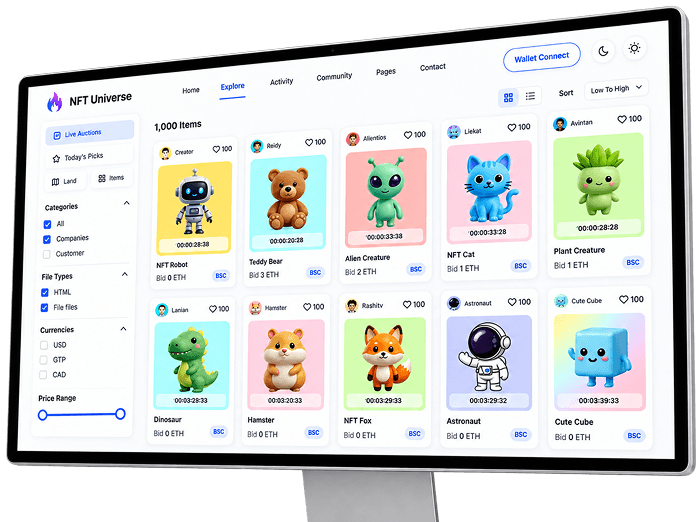
Custom NFT marketplace development - minting, auctions, royalties, and collection discovery on MERN + Solidity
NFT Universe
NFT Universe is a full-featured, production-grade NFT marketplace Bitronix Technologies designed and built for creators and collectors. Rather than reskinning a generic white-label template, we engineered a marketplace with the trading flows users expect from leading venues - wallet onboarding, gas-aware minting, on-chain royalties, live auctions, and an indexer-backed explorer that stays accurate under load.
Read case studyTech stack
- MongoDB
- Express
- React
- Node.js
- Solidity
- Ethereum
- IPFS
 FinTech
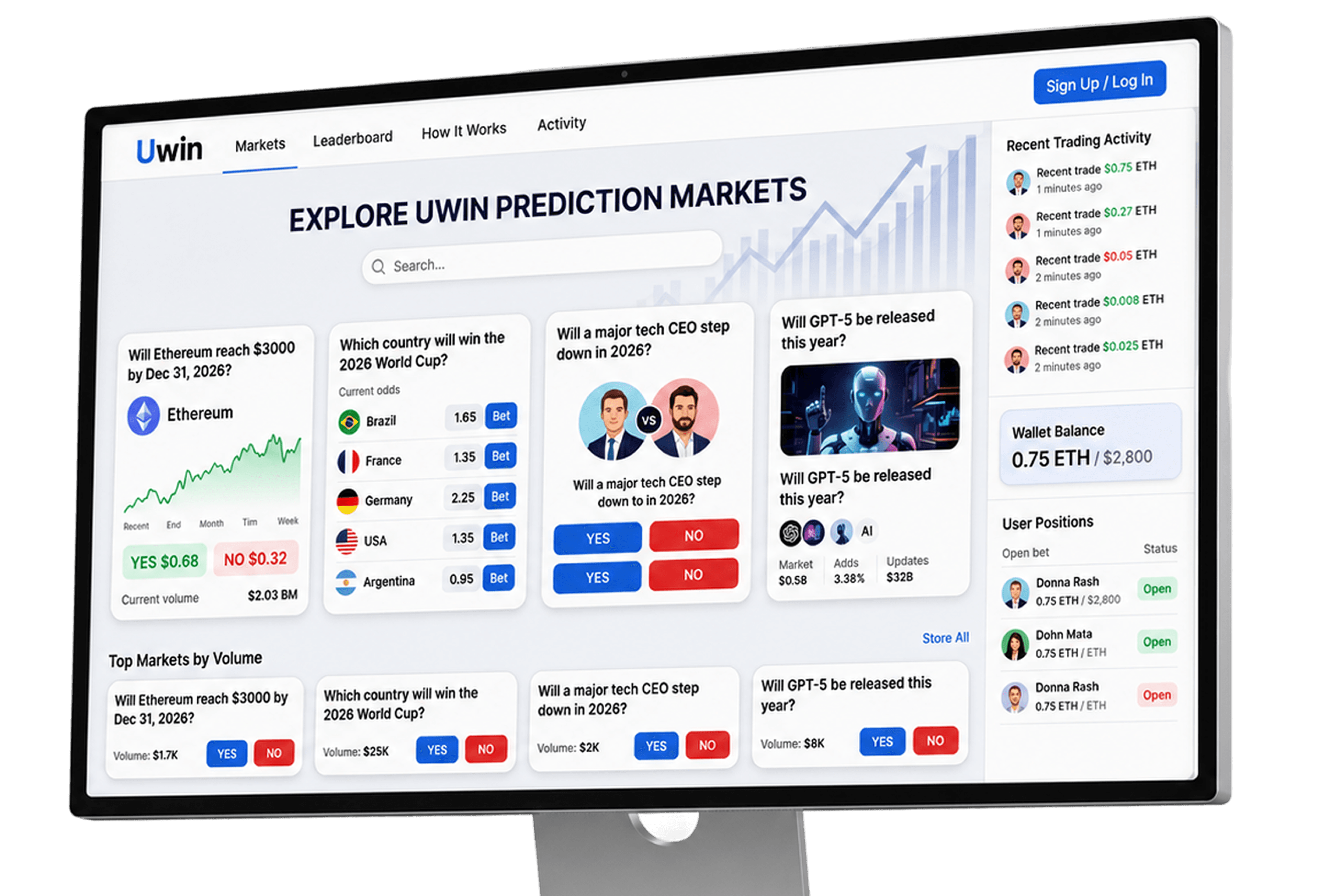
Polymarket-style prediction market development - outcome-share trading, Chainlink resolution, and collateral accounting on MEAN/MERN + Solidity
Uwin
Uwin is a custom prediction market platform we built end-to-end, inspired by Polymarket: traders buy and sell outcome shares on real-world events, with transparent resolution rules and deep liquidity across binary and multi-outcome markets. Bitronix delivered the full surface - trader app, operator console, smart contracts, and oracle-backed settlement - rather than skinning a generic template.
Read case studyTech stack
- MongoDB
- Express
- React
- Angular
- Node.js
- Solidity
- Chainlink
 DeFi
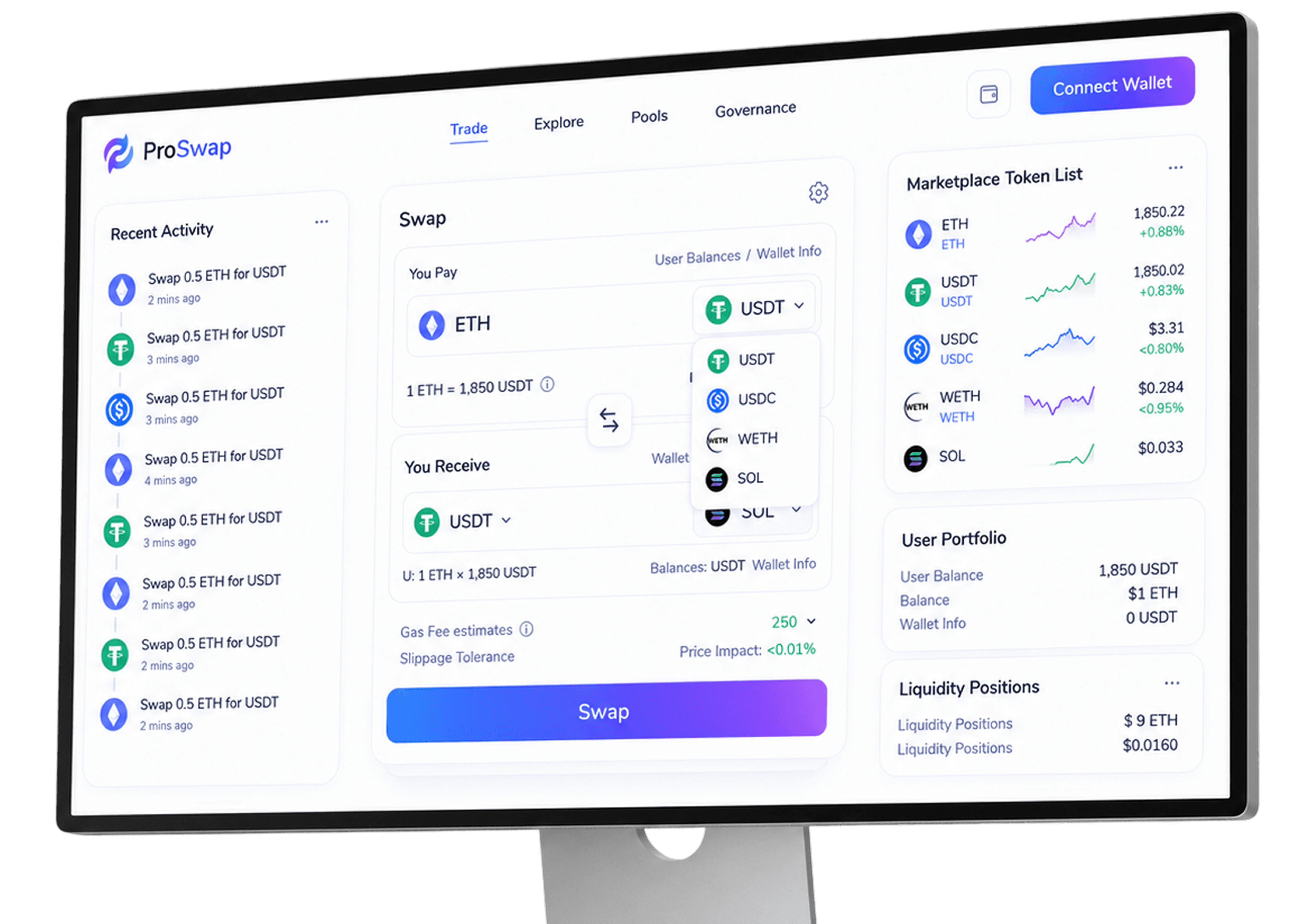
DeFiUniswap-style AMM DEX development - constant-product and stable pools, swap router, and liquidity analytics on MERN + Solidity
ProSwap
ProSwap is a custom decentralized exchange (DEX) we built in the Uniswap tradition: an automated market maker with constant-product and stable-style pools, configurable slippage controls, and a swap router the client could brand and deploy to their target chain. Bitronix delivered the full AMM stack - Solidity pool and router contracts, a trader-facing swap app, pool analytics, and an operator panel - engineered for a controlled mainnet launch.
Read case studyTech stack
- MongoDB
- Express
- React
- Node.js
- Solidity
- Ethereum
- TypeScript