Designing permissioned chains for regulated enterprises in 2026

By Tausif AhmedFounder and CTO
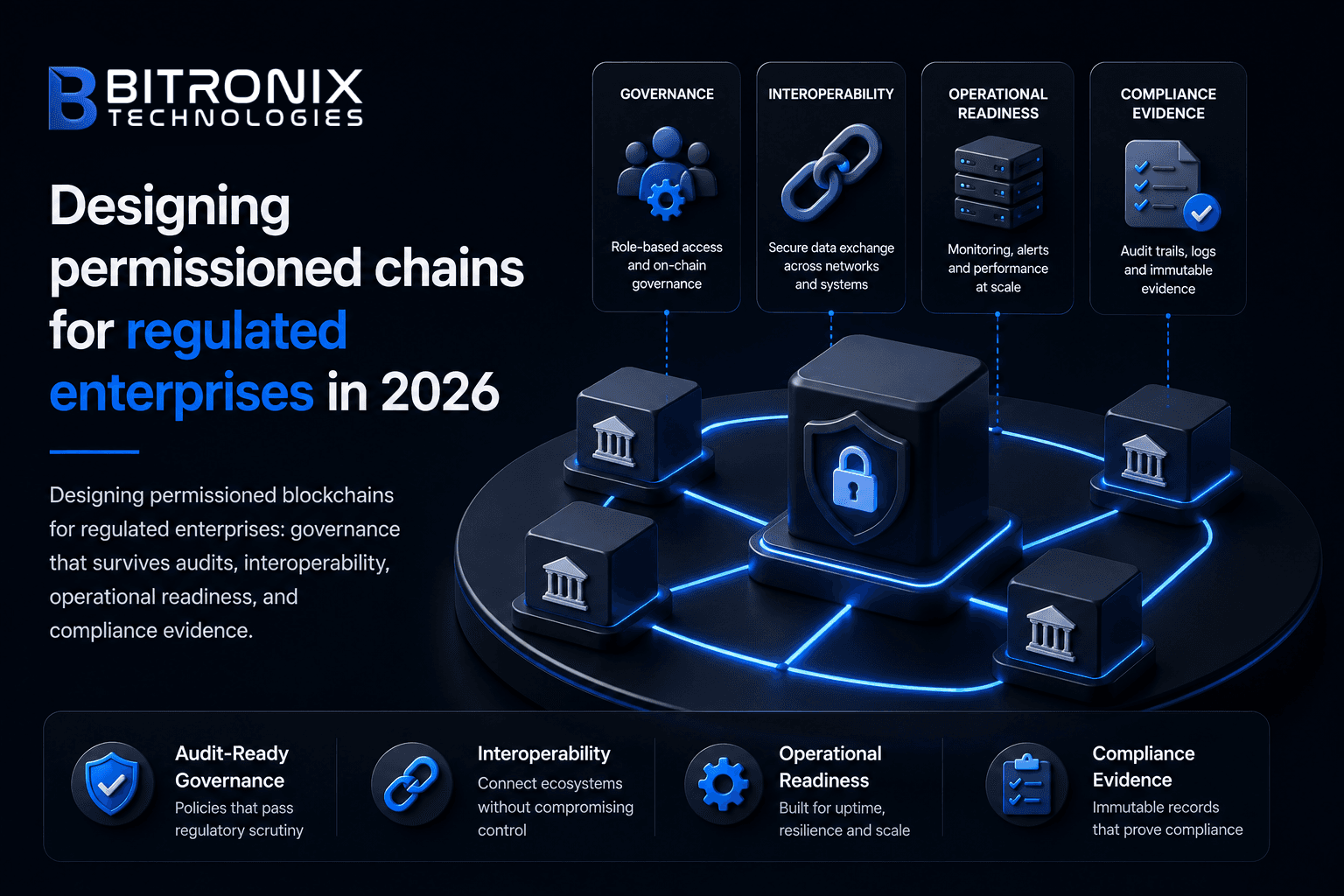
Enterprise teams are no longer asking whether distributed ledgers belong in the stack. The conversation has shifted to how finality, privacy and upgrade paths behave under real operational load - and to whether a permissioned chain can stand up to the same audit scrutiny as core banking or cloud infrastructure. For regulated organizations, that is the bar a permissioned blockchain for regulated enterprises has to clear in 2026: not a proof of concept that demos well, but a production network with governance, interoperability and operational discipline that a risk team and a regulator can both verify. Bitronix Technologies designs these networks for teams that need evidence-first delivery, not pilot theatre.
Key takeaways
- The enterprise question has moved from whether to use a permissioned chain to how it behaves under load and audit - regulators now expect the same rigor applied to chain operations as to banking and cloud controls.
- Governance that survives audits separates policy definition from execution, with explicit operator roles, defined upgrade windows and evidence packs mapping on-chain events to control objectives.
- Treat key management as a compromise model: HSM-backed signing, quorum policies and deterministic deployment pipelines limit incident blast radius and trust anchors must be documented end to end.
- Interoperability is a set of invariants, not a single bridge component - document message formats, failure modes and reconciliation playbooks before writing the first integration test.
- Operational readiness continues past launch: quarterly access reviews, disaster-recovery drills with chain replay, regression testing on consensus or execution upgrades and a published compatibility matrix.
- Exportable evidence beats screenshots - hashed transaction bundles, configuration snapshots and signed attestations let you answer compliance questions in minutes, not days.
What changed in enterprise blockchain adoption?
The maturity shift is the headline. A few years ago the debate was conceptual - whether a distributed ledger added anything over a well-run database. That argument is largely settled for the use cases where it fits and the remaining questions are operational. How fast does the network reach finality under peak load? How is private data partitioned between participants? What happens when a dependency needs upgrading, or a validator has to be rotated out? These are the questions that determine whether a permissioned chain is production infrastructure or an expensive experiment.
The second change is who is asking. Regulators and internal risk teams increasingly expect the same rigor applied to chain operations as to core banking or cloud controls. That means a permissioned blockchain is no longer evaluated only on its cryptography or throughput - it is evaluated on its governance, its auditability and its disaster-recovery posture, exactly like any other system of record. Designing for that expectation from the start is far cheaper than retrofitting it ahead of an inspection.
How do you design permissioned chain governance that survives audits?
Separate policy definition from execution. Who is allowed to authorize a change is a different question from how that change is carried out and conflating them is what makes governance impossible to audit. Define explicit roles for network operators, set clear upgrade windows rather than ad hoc deployments and maintain evidence packs that map on-chain events to control objectives. When an auditor can see that a given upgrade followed a named policy, executed within a scheduled window and produced a verifiable on-chain record, the control is demonstrably working rather than merely asserted.
Key management and custody boundaries
Custody integrations should assume compromise models at the API boundary - design as if any single interface could be breached and ensure no single point can move assets or authorize an upgrade alone. HSM-backed signing, quorum policies and deterministic deployment pipelines reduce incident blast radius by removing the single keys and manual steps that incidents exploit. Document trust anchors end to end, so that when an auditor asks who can authorize a contract upgrade, the answer is a named procedure with defined approvers - not an informal chat thread reconstructed after the fact. For on-chain logic that sits on top of the network, smart contract audit readiness applies the same discipline at the code layer.
- Assume compromise at every API boundary and design for no single point of authority
- Use HSM-backed signing and quorum approval for high-impact actions
- Make deployments deterministic and reproducible, not manual
- Document trust anchors and approvers as named procedures
How do you handle interoperability without ambiguity?
Bridges are not a single component - they are a set of invariants. The integrations that fail in production usually fail because nobody wrote down what was supposed to be true across the boundary. Document message formats, failure modes and reconciliation playbooks before writing the first integration test, because the test should verify a specification, not substitute for one. Ambiguity in the ownership of stalled transfers is precisely where a routine production incident turns into a multi-week forensic exercise, with each team assuming the other holds the authoritative record.
- Define the source of truth for asset references across the boundary
- Specify replay and ordering guarantees explicitly
- Write reconciliation playbooks for stalled or partial transfers before launch
- Instrument cross-chain flows the way you would instrument payment rails
What does operational readiness look like beyond launch?
Permissioned networks age like any other platform: dependencies drift, validators rotate and business rules evolve. Schedule quarterly reviews of access matrices and supported client versions and run disaster-recovery drills that include chain replay from snapshots - a backup you have never restored is a hope, not a plan. Budget time for regression testing whenever you bump consensus or execution-layer dependencies, because silent performance regressions often surface only under peak batch windows, long after the change shipped and far from the commit that caused it.
Align product roadmaps with chain upgrade cadence. Hard deadlines from external vendors collide with your own release trains more often than teams expect and the collision usually surfaces as a scramble. A published compatibility matrix - supported node versions, RPC semantics and migration windows - keeps application teams from building against interfaces you planned to deprecate and turns upgrade planning into a shared schedule rather than a series of surprises.
- Review access matrices and supported client versions quarterly
- Run disaster-recovery drills that include chain replay from snapshots
- Regression-test performance when bumping consensus or execution dependencies
- Publish a compatibility matrix of node versions, RPC semantics and migration windows
How do you build evidence packs stakeholders actually read?
Exportable reports beat screenshots. Hash transaction bundles, capture configuration snapshots and produce signed attestations where your control framework requires them, so the evidence is verifiable rather than merely visual. When legal or compliance asks what happened on a given date, answering quickly and definitively builds trust that carries through the rest of an engagement. Automate collection wherever possible, because the worst time to discover your operators are manually stitching CSVs together is during a live incident with a regulator waiting.
Treat your chain like any production data store: backups tested for restore, monitored head lag and capacity forecasts for storage growth. Enterprises that skip these basics tend to discover them at the worst possible moment - during a merger integration or a regulatory inspection with fixed deadlines. Finally, publish a concise network charter covering participants, data classification and retirement criteria. It lets new sponsors onboard without renegotiating fundamentals every quarter and it gives auditors a single authoritative description of what the network is and who is accountable for it.
- Export hashed transaction bundles, config snapshots and signed attestations
- Automate evidence collection so it is not improvised during incidents
- Test backups for restore, monitor head lag and forecast storage capacity
- Publish a network charter: participants, data classification, retirement criteria
Designing a permissioned chain for a regulated enterprise is less about consensus algorithms and more about whether the network can prove, on demand, that it is doing what its operators claim. Auditable governance, unambiguous interoperability, operational discipline that outlasts the launch and evidence you can export are what move a permissioned blockchain from pilot to production of record. If you are planning or operating an enterprise network under regulatory constraints, Bitronix Technologies enterprise blockchain team designs and runs systems to exactly this standard.
Frequently asked questions
What is a permissioned blockchain?
A permissioned blockchain is a distributed ledger where participation - who can read, write and validate - is restricted to known, authorized parties. For regulated enterprises this matters because identity, access control and data privacy can be enforced at the protocol level, which is rarely acceptable on a fully public chain.
Why do regulated enterprises choose permissioned chains over public ones?
Control and compliance. Permissioned networks let organizations restrict participants, partition private data between them, meet data-residency and confidentiality requirements and apply governance and audit controls comparable to banking or cloud systems - while still gaining shared, tamper-evident records across counterparties.
How do you make permissioned chain governance auditable?
Separate policy definition from execution, define explicit operator roles and scheduled upgrade windows and maintain evidence packs that map on-chain events to your control objectives. The aim is that any change can be traced to a named policy, an approved window and a verifiable on-chain record.
How should keys be managed in an enterprise blockchain?
Assume compromise at the API boundary and remove single points of authority. Use HSM-backed signing, quorum approval for high-impact actions and deterministic deployment pipelines and document trust anchors and approvers as named procedures so authority is always traceable.
What does operational readiness involve after launch?
Treating the chain as production infrastructure: quarterly reviews of access and supported client versions, disaster-recovery drills that replay the chain from snapshots, regression testing when consensus or execution dependencies change and a published compatibility matrix that aligns application teams with the upgrade cadence.
What goes into a blockchain evidence pack for compliance?
Exportable, verifiable artifacts: hashed transaction bundles, configuration snapshots and signed attestations where required, collected automatically so they are available on demand. Paired with tested backups, monitored head lag and a network charter, this lets you answer regulatory questions quickly and definitively.

Founder and CTO
Founder and CTO of Bitronix Technologies. Leads design and delivery of permissioned blockchain networks for regulated enterprises.
Related Posts
 Blockchain
October 23, 202619 min read
DEX Clone Script: Features, Development Cost & How to Build a Decentralized Exchange
Explore DEX clone script features, development costs, smart contracts, liquidity pools, security, and the steps to build a decentralized exchange.
Read article Blockchain
October 21, 202613 min read
Agricultural Commodity Tokenization in 2027: Benefits, Process & Cost
Learn how agricultural commodity tokenization works, its benefits, development process, costs, use cases, and key regulatory considerations.
Read article Blockchain
October 21, 202618 min read
CoinMarketCap Clone Script: Features, Cost, and How to Build a Crypto Price Tracking Platform
Explore CoinMarketCap clone script features, development costs, APIs, revenue models, and how to build a cryptocurrency market data platform.
Read article