DeFi Development Company in the USA: How to Choose the Right Partner (Guide 2026)

By Tausif AhmedFounder and CTO

If you've spent any time researching "DeFi development company," you've probably noticed the same problem everyone else runs into: dozens of agencies claiming to be blockchain experts, nearly identical service pages and no real way to tell which one can actually ship a secure, compliant, working protocol versus which one is going to hand you a half-finished smart contract and disappear after the invoice clears.
That gap is exactly why this guide exists. DeFi development isn't like building a normal web app. A single smart contract bug can drain millions of dollars in hours and unlike traditional software, you often can't just push a patch once it's live on-chain. Choosing the wrong decentralized finance development partner isn't just a bad hire. It's a direct financial and reputational risk. This guide walks through exactly what to look for, what it costs, what features actually matter and how to avoid the mistakes that sink most DeFi projects before they even launch.
Why DeFi Development Is Different From Regular Software Development?
Before getting into how to choose a partner, it's worth understanding why this decision carries more weight than a typical software vendor selection.
Smart contracts are immutable, or close to it. Once deployed, most smart contracts can't simply be edited the way you'd push a bug fix to a web app. Mistakes get baked into the protocol permanently unless the team specifically designed for upgradeability from the start, which itself introduces tradeoffs around decentralization and trust.
A bug in a normal app might cause a bad user experience. A bug in a DeFi smart contract can mean funds are drained instantly, publicly and irreversibly. This is why security auditing isn't optional in this space, the way QA testing sometimes gets deprioritized elsewhere.
Regulatory uncertainty adds real complexity. US regulation around DeFi, crypto tokens and digital assets has continued to evolve and a DeFi development partner who doesn't understand the compliance landscape can build you a protocol that works technically but creates serious legal exposure.
The tech stack moves fast. Layer 2 blockchain solutions, cross-chain bridges and new token standards evolve quickly. A development company that hasn't kept pace can leave you building on infrastructure that's already outdated by the time you launch.
Given all that, picking a DeFi development company isn't just about who has the most polished portfolio. It's about who has genuinely shipped secure, working protocols and who understands the specific risks this space carries.
What Does a DeFi Development Company Actually Do?
A full-service DeFi development company typically covers the entire lifecycle of a project, not just writing code. That includes:
- Discovery and Architecture Planning: Mapping out the protocol's mechanics, tokenomics and technical requirements before any code is written
- Smart Contract Development: Building the core logic that governs lending, staking, swapping, or whatever the protocol's function is
- Front-End and Back-End Development: The user-facing application and any off-chain infrastructure needed to support it
- Security Auditing: Both internal review and, ideally, coordination with third-party audit firms
- Tokenomics Design: Structuring token supply, distribution and incentive mechanisms so the economic model actually holds up under real usage
- Testnet Deployment and QA: Rigorous testing in a simulated environment before anything touches mainnet
- Mainnet Launch Support: Managing the actual deployment process, which carries its own risks if handled carelessly
- Post-Launch Maintenance & Monitoring: Ongoing support, bug monitoring and upgrades as the protocol matures
A company that only offers one or two pieces of this list, say, smart contract coding with no security auditing or tokenomics support, isn't equipped to take a project from idea to a safe, functioning launch on its own.
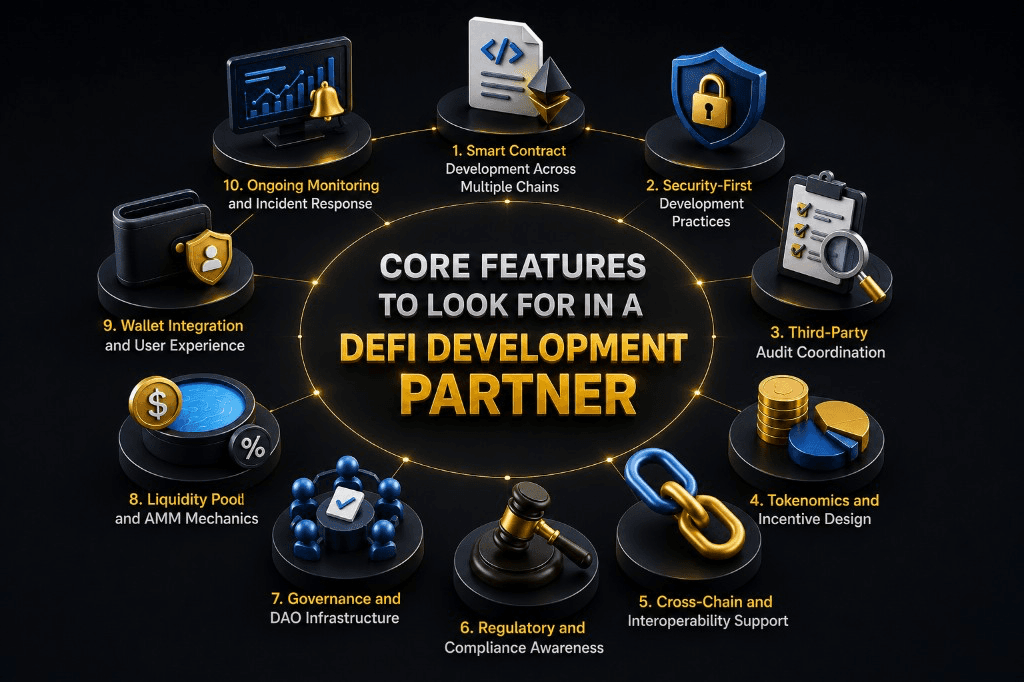
Core Features to Look For in a DeFi Development Partner
Not every project needs every feature below, but understanding what's available helps you evaluate whether an agency's capabilities actually match your project's needs.
1. Smart Contract Development Across Multiple Chains
Ethereum remains the dominant chain for DeFi, but a lot of activity has moved toward Layer 2 networks and alternative chains for lower gas fees and faster transactions. A strong development partner should be comfortable working across Ethereum, Layer 2 solutions and other major chains relevant to your use case, rather than being locked into a single ecosystem.
2. Security-First Development Practices
This should show up throughout the entire build process, not just as a final audit before launch. Look for practices like following established security standards, using well-tested code libraries rather than writing everything from scratch and running internal security reviews at multiple stages of development.
3. Third-Party Audit Coordination
Even the best internal team benefits from an independent security audit before mainnet launch. A development company should either have an in-house audit function separate from the build team or a clear process for coordinating with reputable third-party audit firms.
4. Tokenomics and Incentive Design
A protocol can be technically flawless and still fail if the token economics don't hold up, incentives that get gamed, inflation that isn't sustainable, or governance structures that concentrate power in ways that undermine trust. This requires genuine economic modeling expertise, not just development skills.
5. Cross-Chain and Interoperability Support
If your protocol needs to interact with assets or users across multiple blockchains, cross-chain bridge development and interoperability protocols become critical. This is a specialized skill set that not every agency genuinely has, despite what a service page might claim.
6. Regulatory and Compliance Awareness
Given the evolving US regulatory landscape around digital assets, a development partner who understands how to build compliance considerations, like KYC/AML integration where appropriate, into the architecture without completely undermining the protocol's decentralized nature is a significant advantage.
7. Governance and DAO Infrastructure
Many DeFi protocols incorporate decentralized governance, allowing token holders to vote on protocol changes. Building DAO solutions correctly requires careful thought around voting mechanisms, proposal thresholds and protection against governance attacks.
8. Liquidity Pool and AMM Mechanics
For DEX and yield-focused protocols specifically, deep expertise in automated market maker (AMM) design, liquidity pool mechanics and impermanent loss mitigation strategies is essential.
9. Wallet Integration and User Experience
A technically sound protocol still needs a front-end that non-technical users can actually navigate. Seamless wallet connection, clear transaction flows and intuitive interfaces matter enormously for adoption, even in a space built around decentralized infrastructure.
10. Ongoing Monitoring and Incident Response
Post-launch, protocols need continuous monitoring for unusual activity and a plan for rapid response if a vulnerability is discovered after deployment. This is often the most overlooked feature when companies are evaluating development partners and it's one of the most important.
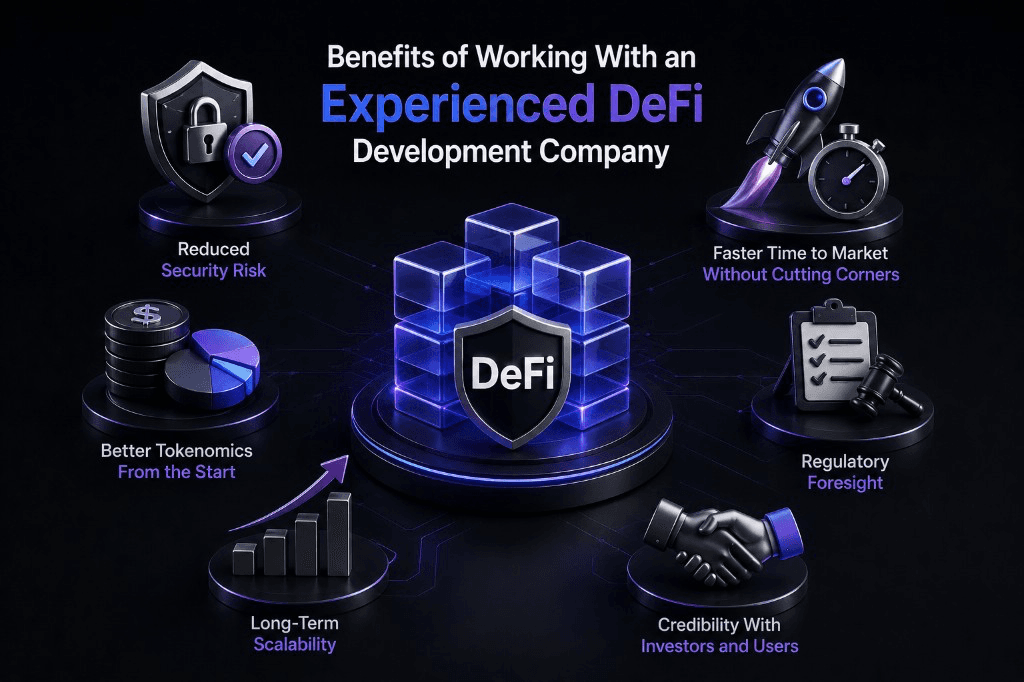
Benefits of Working With an Experienced DeFi Development Company
Reduced Security Risk
This is the single biggest benefit and it's worth repeating: an experienced team that's shipped multiple secure protocols brings pattern recognition around vulnerabilities that a less experienced team simply hasn't developed yet. This alone can be the difference between a successful launch and a project that gets exploited within its first month.
Faster Time to Market Without Cutting Corners
Experienced teams have reusable frameworks, tested code libraries and established processes that let them move faster without skipping the steps that actually matter, like security review and testnet validation.
Better Tokenomics From the Start
Getting token economics wrong is one of the most common reasons DeFi projects fail, even when the underlying technology works fine. A development partner with genuine economic modeling experience can catch design flaws before they become expensive problems after launch.
Regulatory Foresight
A development company that stays current on the US regulatory environment can help you avoid building yourself into a legal corner, something that's much harder and more expensive to fix retroactively than to plan for upfront.
Long-Term Scalability
Protocols that are built with scalability in mind from the start, proper architecture, upgrade paths where appropriate and cross-chain flexibility, avoid the costly rebuilds that come from outgrowing an initial technical foundation.
Credibility With Investors and Users
Working with a development partner that has a genuine track record and can point to audited, live protocols gives your project credibility that matters enormously when you're trying to attract liquidity, users, or investment.
How Much Does DeFi Development Cost in 2026?
Cost is one of the most common questions and also one of the hardest to answer with a single number, because DeFi projects vary enormously in scope. That said, here's a realistic breakdown by project type.
1. Simple DeFi Applications (Basic Staking or Single-Purpose Protocol)
A straightforward staking contract or a simple single-purpose DeFi tool, without complex cross-chain functionality or elaborate tokenomics, tends to sit at the lower end of the cost spectrum. This typically includes core smart contract development, a basic front-end and standard security review, but may not include a full third-party audit.
2. Mid-Complexity Protocols (Lending Platforms, Basic DEX)
Lending and borrowing platforms, or a decentralized exchange with standard AMM functionality, require significantly more development work: more complex smart contract logic, more thorough security auditing, tokenomics design if a native token is involved and a more polished front-end experience. This tier represents the most common range for serious, funded DeFi startups.
3. Advanced Protocols (Cross-Chain, Complex Tokenomics, DAO Governance)
Protocols involving cross-chain interoperability, sophisticated tokenomics with multiple incentive layers, DAO governance infrastructure and comprehensive multi-firm security audits sit at the highest end. These projects often involve months of development, extensive testnet phases and multiple rounds of auditing before mainnet launch.
What Affects Cost Beyond Complexity
- Number of blockchains supported. Multi-chain deployment multiplies both development and testing effort.
- Depth of security auditing. A single internal review costs far less than multiple rounds with independent third-party audit firms, but the latter significantly reduces risk.
- Custom vs. framework-based development. Building everything from scratch costs more than adapting well-audited, existing frameworks where appropriate, though full customization sometimes gives you the tokenomics flexibility a project genuinely needs.
- Ongoing maintenance and monitoring. Many companies underestimate this cost, which is separate from the initial build and should be budgeted for as an ongoing operational expense, not a one-time fee.
- Regulatory and compliance work. Projects requiring KYC/AML integration or specific compliance features add both development time and, often, third-party legal or compliance consulting costs.
The single biggest cost mistake companies make is choosing the cheapest quote without factoring in security audit depth. A protocol that skips or minimizes third-party auditing to save money is taking on a risk that, if realized, would cost far more than the audit would have.
Red Flags to Watch For When Choosing a DeFi Development Company
- No mention of security audits in the initial proposal. If a development company's pitch doesn't proactively bring up security auditing as a core part of the process, that's a serious warning sign, not a minor oversight.
- Vague or missing portfolio of live, audited protocols. Ask specifically for protocols they've built that are currently live on mainnet, with audit reports you can actually review. A portfolio full of "concept" projects or testnet-only deployments doesn't demonstrate real production experience.
- No clear tokenomics expertise. If the team can talk fluently about smart contract code but struggles to explain incentive design or token supply mechanics, they may be strong developers without the economic modeling background a serious protocol needs.
- Overpromising on timeline. Secure, well-tested DeFi development takes time. An agency promising a complex protocol in a matter of weeks is likely planning to cut corners somewhere, usually in testing or auditing.
- No discussion of regulatory considerations. Given the current US regulatory landscape, a development partner who treats compliance as entirely your problem to solve separately is leaving you exposed to risks that should be part of the architecture conversation from day one.
- Pressure to sign a large contract immediately. Reputable development companies are usually comfortable starting with a smaller discovery or scoping phase before committing to a full build, which also gives you a low-risk way to evaluate how they actually work.
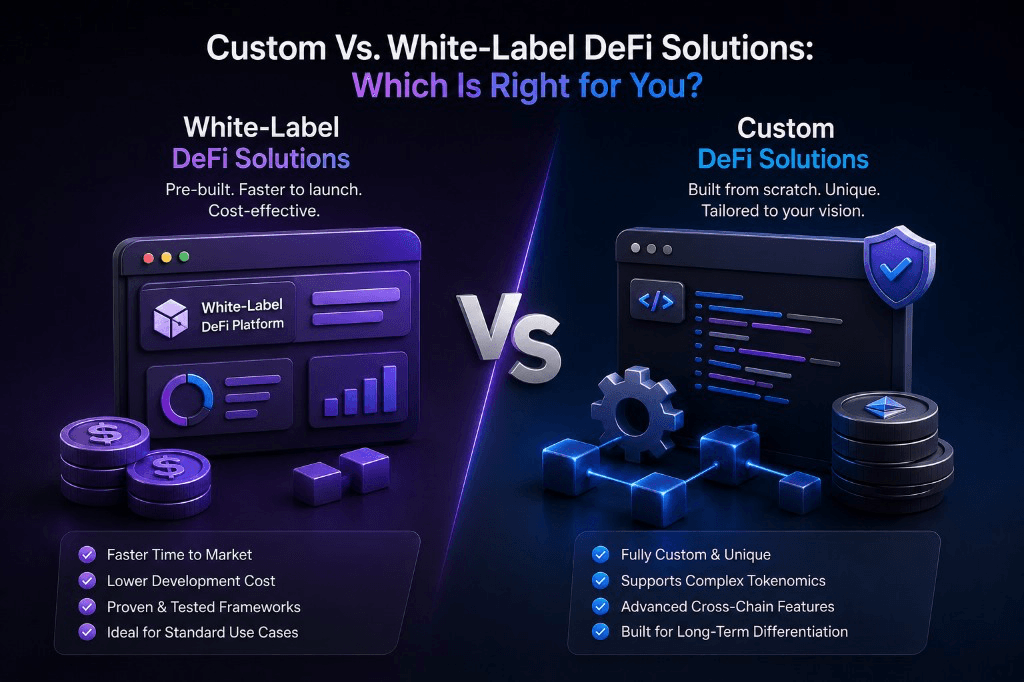
Custom Vs. White-Label DeFi Solutions: Which Is Right for You?
One decision worth making early is whether you need fully custom development or whether a white-label solution fits your needs.
White-label DeFi Development Solutions: These platforms are pre-built protocol frameworks that can be customized and deployed faster and at lower cost. These work well for straightforward use cases, like a standard staking platform or a basic DEX, where your differentiation comes from branding, user experience, or a specific market niche rather than novel protocol mechanics.
Custom DeFi Development Solutions: These solutions are helpful when your project involves genuinely novel tokenomics, unique protocol mechanics, or specific cross-chain functionality that existing frameworks don't support. This costs more and takes longer, but it's the only path if your competitive advantage depends on something a template can't replicate.
A good development partner will be honest about which approach actually fits your project, rather than pushing custom development on every client because it's a larger contract, or pushing white-label solutions on every client because it's faster to deliver.
| Factor | White-Label DeFi Development Solutions | Custom DeFi Development Solutions |
|---|---|---|
| What's It | Pre-built platform with customizable business features. | Fully tailored platform built from scratch. |
| Best For | Startups seeking faster, affordable market entry. | Businesses creating innovative DeFi ecosystems independently. |
| Development Time | Faster deployment with minimal development effort. | Longer timelines due to custom engineering. |
| Development Cost | Lower investment through reusable development frameworks. | Higher investment for personalized platform creation. |
| Customization Level | Moderate flexibility with configurable platform features. | Unlimited flexibility across every platform component. |
| Scalability | Supports business growth with certain limitations. | Built specifically for unlimited future expansion. |
| Tokenomics Support | Standard staking, rewards and governance mechanisms. | Custom token economics supporting unique incentives. |
| Security Approach | Relies on previously audited protocol frameworks. | Security designed specifically for project requirements. |
| Blockchain Support | Supports predefined compatible blockchain networks only. | Integrates any required blockchain ecosystem seamlessly. |
| Competitive Advantage | Branding and experience drive business differentiation. | Proprietary technology creates sustainable competitive advantage. |
| Ownership & Control | Own platform with framework-based limitations remaining. | Complete ownership |
A Practical Roadmap: How to Choose Your DeFi Development Partner
1. Define your protocol's core mechanics before shopping for a developer. Know whether you're building a lending platform, DEX, staking protocol, or something else entirely, along with a rough sense of your tokenomics, before you start evaluating agencies. Vague requirements lead to vague quotes and mismatched expectations.
2. Shortlist companies with a genuine track record. Look specifically for live, audited protocols currently running on mainnet, not just conceptual case studies or testnet demos.
3. Ask detailed security questions in the first conversation. How do they approach internal security review? Do they coordinate with third-party auditors? What's their process if a vulnerability is found post-launch?
4. Get a clear, itemized quote. Make sure the quote separates smart contract development, front-end work, security auditing and ongoing maintenance, so you understand exactly what you're paying for and what isn't included.
5. Start with a scoped discovery phase. Before committing to a full build, a discovery or architecture phase lets you evaluate how the team thinks through problems and communicates, with a much smaller financial commitment.
6. Confirm the audit plan explicitly. Know exactly which firm (or internal process) will audit your smart contracts before mainnet and make sure this is built into the timeline and budget from the start, not treated as an optional add-on.
7. Plan for post-launch support from day one. Ask what ongoing monitoring and maintenance looks like after launch and make sure this is part of your budget, not an afterthought once the protocol is already live and something goes wrong.
Why Bitronix for DeFi Development
Bitronix approaches DeFi development the way a regulated FinTech project should be approached, even when the underlying protocol is decentralized: security-first architecture, compliance-aware design where relevant and a genuine focus on shipping production-grade, audited protocols rather than proof-of-concept builds that look good in a pitch but haven't been stress-tested against real-world conditions.
That matters because the DeFi space has no shortage of agencies willing to write smart contract code quickly and cheaply. What's harder to find is a partner that treats tokenomics design, security auditing and regulatory awareness as core parts of the process from day one, not afterthoughts bolted on once a client asks about them. For companies building anything from a lending protocol to a cross-chain DEX, that difference in approach is usually what separates a protocol that launches safely from one that becomes a cautionary headline.
A Realistic Example: How a DeFi Lending Platform Project Typically Unfolds
To make this less abstract, here's roughly how a mid-complexity project, say, a DeFi lending and borrowing platform, tends to move through a competent development partner's process.
Discovery phase (2-4 weeks). The team works with you to map out core mechanics: collateralization ratios, interest rate models, liquidation logic and which assets the platform will support initially. This phase often reveals gaps in the original concept that are far cheaper to fix on paper than after code is written.
Architecture and tokenomics design (2-3 weeks). If the platform involves a native governance or incentive token, this is where supply mechanics, distribution schedules and incentive structures get modeled and stress-tested against different usage scenarios, including adversarial ones, like what happens if a large holder tries to manipulate governance votes.
Smart contract development (6-10 weeks). Core lending pool logic, collateral management, liquidation mechanisms and interest rate calculations get built and internally tested against the architecture plan. This phase typically includes multiple internal code reviews, not just a single write-and-ship pass.
Front-end development (runs in parallel, 6-8 weeks). The user-facing application gets built alongside the smart contract work, including wallet integration, transaction flows and dashboards for tracking positions and collateral health.
Testnet deployment and QA (3-4 weeks). The full platform gets deployed to a testnet environment where the team and ideally a small group of real users, can interact with it under conditions that simulate mainnet usage, surfacing edge cases that internal testing alone tends to miss.
Third-party security audit (3-6 weeks, often overlapping with testnet QA). An independent audit firm reviews the smart contract code specifically for vulnerabilities, with findings addressed and, ideally, re-reviewed before mainnet deployment.
Mainnet launch and monitoring setup (1-2 weeks). The actual deployment, along with setting up monitoring infrastructure to catch unusual activity in the critical early period after launch, when a protocol is most likely to be probed for weaknesses.
Altogether, a project like this realistically spans four to six months from initial discovery to a secure mainnet launch. Any agency quoting significantly less time for a project of comparable complexity is very likely planning to compress or skip steps in this process, most commonly the security audit and testnet QA phases, which are exactly the steps you don't want compressed.
Smart Contract Security: What "Secure Development" Actually Involves
Because this is the single highest-stakes part of any DeFi project, it's worth going a level deeper on what genuinely security-conscious development looks like in practice, so you can recognize it when evaluating a partner.
Following established design patterns. Experienced teams rely on well-tested patterns for common functionality, like reentrancy guards, safe math operations and access control structures, rather than writing custom logic for problems that already have proven solutions.
Using audited base libraries. Rather than writing every piece of functionality from scratch, mature development teams build on top of widely used, previously audited code libraries wherever possible, reducing the surface area of custom, unproven code.
Internal code review as a continuous process. Security review shouldn't be a single event right before launch. It should happen at multiple checkpoints throughout development, so issues get caught and fixed while they're still cheap to address.
Formal verification for critical logic. For particularly high-risk components, like liquidation logic or price oracle integrations, some teams use formal verification methods that mathematically prove certain properties of the code hold under all conditions, not just the scenarios a human tester thought to check.
Economic attack modeling, not just code review. Some of the most damaging DeFi exploits haven't come from bugs in the traditional sense, they've come from economically sound but exploitable incentive structures, like flash loan attacks that manipulate price oracles. A genuinely security-conscious team models these economic attack vectors, not just line-by-line code vulnerabilities.
A clear incident response plan before launch, not after. Even well-audited protocols can face unexpected issues post-launch. Knowing in advance who's monitoring the protocol, what triggers an alert and what the response process looks like, is something that should be established before mainnet deployment, not improvised after something goes wrong.
Building a Long-Term Relationship, Not Just a One-Time Launch
Most companies approaching DeFi development think of it as a single project with a clear endpoint: mainnet launch. In practice, the launch is closer to the beginning of the relationship than the end of it. Protocols need ongoing monitoring, periodic re-audits as new features get added, adjustments to tokenomics as real usage data comes in and continued development as the competitive landscape shifts.
This is worth factoring into how you evaluate a development partner from the start. A company that's genuinely equipped to support a protocol long-term will ask questions during the initial engagement about your post-launch plans, not just your launch requirements. They'll also be upfront about what ongoing support costs, rather than leaving that conversation until after you're already locked into their platform and dependent on their institutional knowledge of your codebase.
If you do end up switching development partners after launch, for cost reasons, capability gaps, or any other reason, make sure your contract includes clear ownership of code, documentation and audit history, so the transition doesn't leave you starting from scratch with a new team that has to reverse-engineer decisions made by the last one.
Final Thoughts
Choosing a DeFi development company in the USA comes down to a smaller set of questions than the crowded market might suggest: Can they show real, audited, live protocols, not just concepts? Do they treat security and tokenomics as core to the process, not optional extras? Are they transparent about cost, timeline and what happens after launch? And do they understand the regulatory environment your protocol will actually operate in?
Get clear answers to those four questions from any agency you're evaluating and you'll filter out the vast majority of options that aren't equipped to take a DeFi project from concept to a secure mainnet launch. The agencies that pass that filter are the ones worth having a deeper conversation with.
Frequently Asked Questions
How much does it cost to build a DeFi platform in 2026?
Costs vary significantly based on complexity, ranging from simpler single-purpose protocols on the lower end to sophisticated cross-chain platforms with complex tokenomics and multiple security audits on the higher end. Getting a detailed, itemized quote based on your specific protocol mechanics is the only reliable way to estimate cost accurately.
How long does it take to build a DeFi protocol?
A straightforward protocol can take a few months from discovery through mainnet launch, while more complex platforms involving cross-chain functionality, DAO governance, or extensive tokenomics design can take six months to a year or more, largely due to the additional testing and security auditing required.
Do I need a smart contract security audit before launching?
Yes, essentially without exception. Given that smart contract vulnerabilities can lead to immediate, irreversible loss of funds, skipping a third-party security audit to save time or money is one of the highest-risk decisions a DeFi project can make.
What's the difference between custom DeFi development and white-label solutions?
Custom development builds a protocol from scratch around your specific mechanics and tokenomics, offering full flexibility but at higher cost and longer timelines. White-label solutions use pre-built, customizable frameworks, which are faster and cheaper but less suited to projects with genuinely novel protocol mechanics.
Which blockchain should I build my DeFi protocol on?
This depends on your target users, transaction cost sensitivity and need for interoperability. Ethereum remains dominant for liquidity and developer tooling, while Layer 2 networks offer lower fees and faster transactions. A development partner should help you evaluate this based on your specific use case rather than defaulting to whichever chain they're most familiar with.
How do I know if a DeFi development company is legitimate and experienced?
Ask for specific, verifiable examples of protocols they've built that are currently live on mainnet, along with audit reports for those protocols. A company that can only point to testnet deployments or conceptual portfolio pieces hasn't demonstrated real production experience.
Is DeFi development regulated in the USA?
The regulatory landscape around digital assets and DeFi in the US has continued to evolve and requirements can vary depending on your protocol's specific functionality. A development partner with genuine regulatory awareness can help you understand relevant considerations, though it's also worth consulting directly with legal counsel familiar with digital asset regulation for your specific project.
What ongoing costs should I expect after a DeFi protocol launches?
Beyond the initial development cost, budget for ongoing security monitoring, periodic re-audits as the protocol evolves, infrastructure costs and continued development for feature updates or bug fixes. Treating post-launch maintenance as a one-time cost rather than an ongoing operational expense is a common and costly planning mistake.

Founder and CTO
Founder and CTO of Bitronix Technologies. Helps US startups and enterprises ship audit-ready DeFi protocols, smart contracts and production-grade Web3 infrastructure.
Related Posts
 Blockchain
October 23, 202619 min read
DEX Clone Script: Features, Development Cost & How to Build a Decentralized Exchange
Explore DEX clone script features, development costs, smart contracts, liquidity pools, security, and the steps to build a decentralized exchange.
Read article Blockchain
October 21, 202613 min read
Agricultural Commodity Tokenization in 2027: Benefits, Process & Cost
Learn how agricultural commodity tokenization works, its benefits, development process, costs, use cases, and key regulatory considerations.
Read article Blockchain
October 21, 202618 min read
CoinMarketCap Clone Script: Features, Cost, and How to Build a Crypto Price Tracking Platform
Explore CoinMarketCap clone script features, development costs, APIs, revenue models, and how to build a cryptocurrency market data platform.
Read article