AI Automation for Ecommerce: The Complete 2026 Guide

By Tausif AhmedFounder and CTO
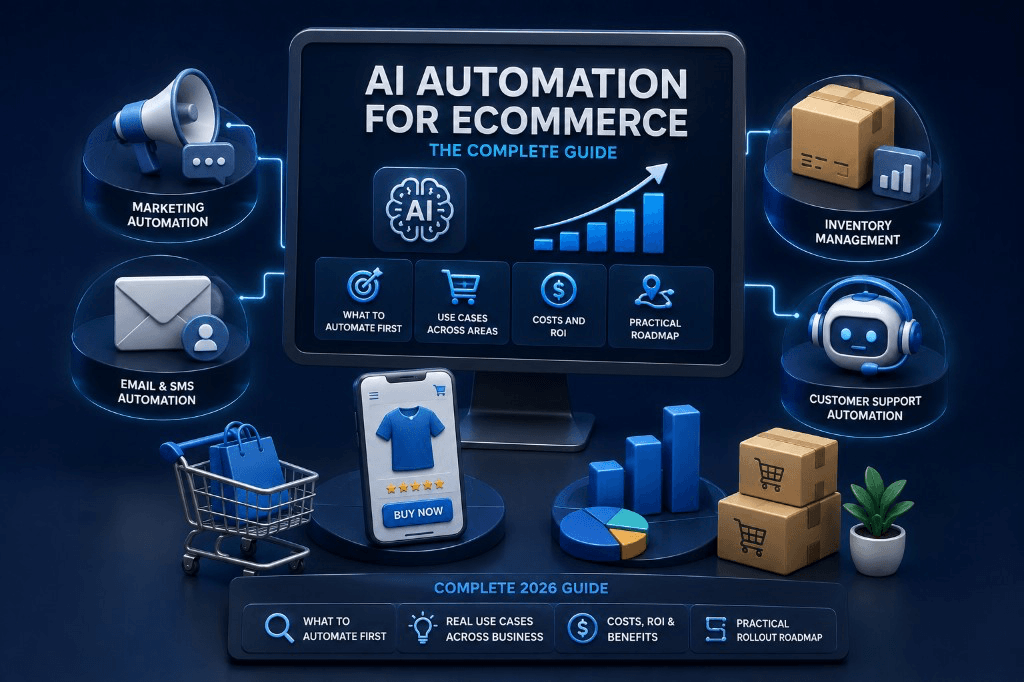
A mid-size fashion retailer once lost roughly seven figures a year to a problem hiding in plain sight: shoppers filling carts, getting distracted and never coming back. The team already knew the number. What they didn't have was a fast enough way to act on it, because catching an abandoned cart within the window where a shopper is still likely to return meant watching behavior in real time something no human team can do at scale across thousands of simultaneous sessions.
That's the actual promise behind AI automation in ecommerce and it's a narrower, more useful promise than the buzzword suggests. It isn't about replacing your team with robots. It's about closing the gap between "we noticed a problem" and "we did something about it," on the exact timescale where ecommerce decisions actually matter.
Ecommerce has become one of the fastest AI-adopting industries for exactly this reason. This guide breaks down what AI automation for ecommerce actually covers, where it creates the most value first, what it costs to implement and how to roll it out without disrupting the operation you're trying to improve.
What Is AI Automation for Ecommerce?
AI automation for ecommerce is the use of artificial intelligence to monitor, decide and act on routine operational tasks across your store, without a person manually triggering each step. It connects data that normally sits in separate systems storefront, CRM, inventory and support desk into a single flow where decisions get made and executed automatically.
- A shopper abandons a cart and the system sends a personalized recovery offer within minutes, not the next business day.
- Inventory for a fast-moving SKU drops below a set threshold and a reorder gets triggered automatically before the item goes out of stock.
- A support ticket comes in from a high-value repeat customer and it gets flagged and routed to a senior agent instead of sitting in a general queue.
- A fraud pattern shows up in a transaction and it gets held for review before it clears, rather than being caught after the chargeback.
What ties all of these together is speed and consistency. A human team catches some of these signals, eventually. AI automation catches nearly all of them, immediately, every time.
Why Ecommerce Businesses Need This Now
- Data Lives in Silos: Marketing, sales and inventory systems that don't talk to each other mean a signal in one system doesn't reach the system that needs to act until someone manually connects the dots.
- Repetitive Tasks Eat Real Time: Updating inventory, processing routine returns and logging CRM interactions collectively consume hours that don't need a human judgment call.
- Customers Expect Personalization at Scale: Delivering relevant recommendations for every visitor isn't something a marketing team can do by hand.
- Operational Costs Climb With Manual Processes: Every manual step is a place where labor cost and error rates creep in.
Where AI Automation Creates the Most Impact
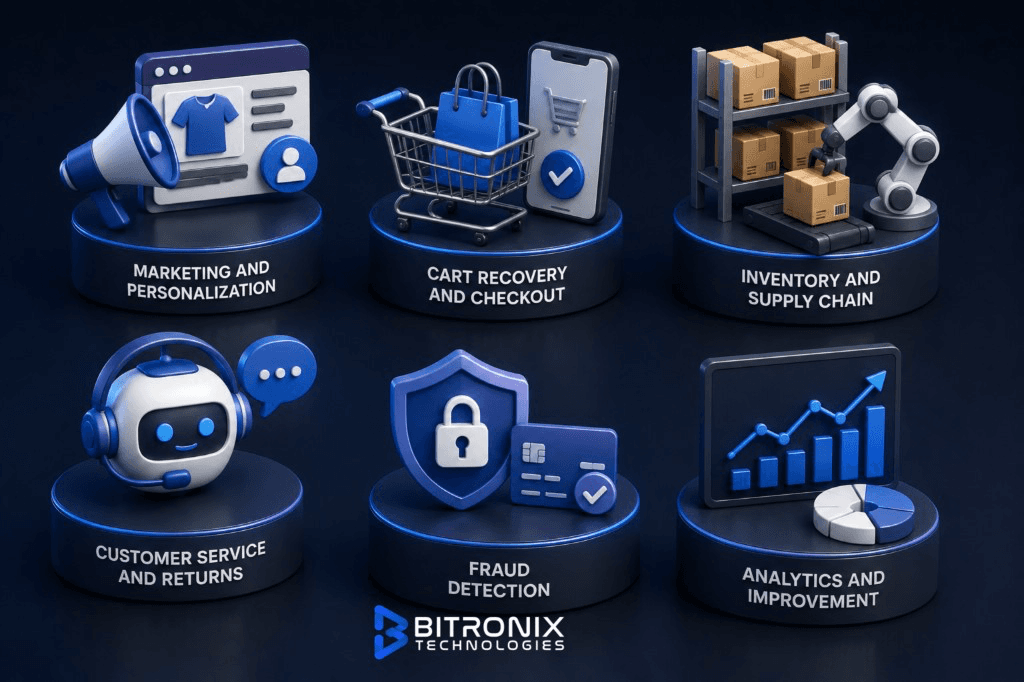
- Marketing and Personalization: Track browsing and purchase history to deliver individually relevant offers in real time.
- Cart Recovery and Checkout Optimization: Detect abandonment the moment it happens and trigger a tailored offer, chat prompt, or reminder.
- Inventory and Supply Chain: Demand forecasting models predict spikes or slowdowns and trigger reordering or pricing adjustments automatically.
- Customer Service and Returns: Read sentiment, assess urgency, route tickets and resolve routine returns without a human opening every case.
- Fraud Detection: Pattern-based fraud detection catches unusual behavior before a chargeback.
- Analytics and Continuous Improvement: Feed results back into the model so recommendations get more accurate over time.
What to Automate First
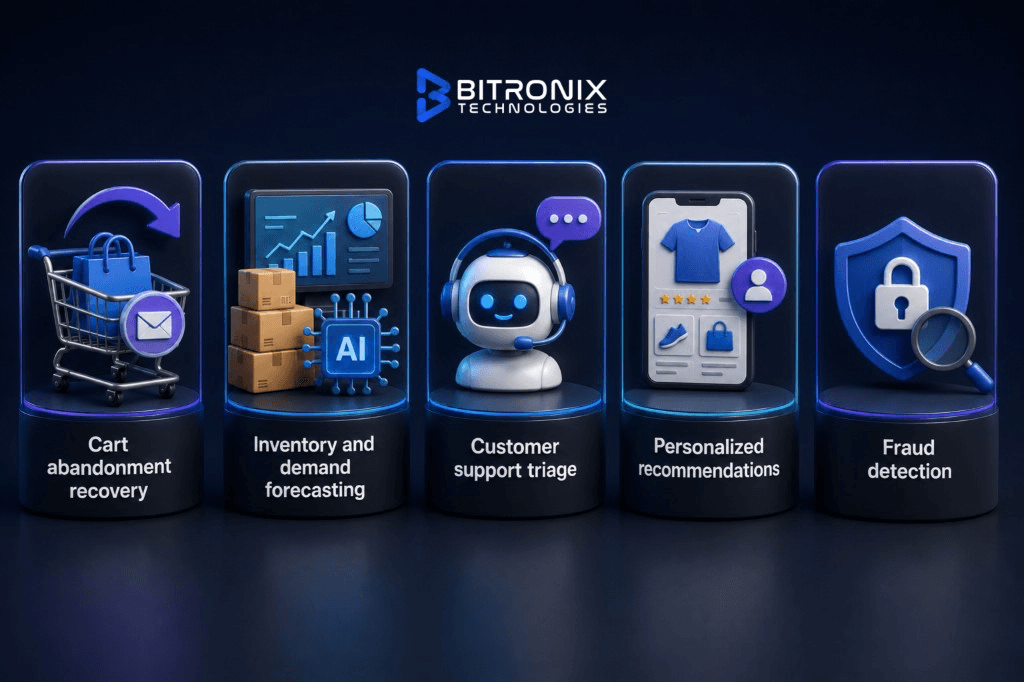
Not every workflow deserves equal priority. A practical order:
What AI Automation for Ecommerce Costs
| Project Type | Estimated Cost | Estimated Timeline |
|---|---|---|
| Single-workflow automation (e.g., cart recovery only) | $8,000 – $25,000 | 4-8 weeks |
| Multi-workflow integration (2-4 systems connected) | $25,000 – $75,000 | 2-4 months |
| Full operational automation platform | $75,000 – $200,000+ | 4-8 months |
| Ongoing monitoring and model refinement | $1,500 – $5,000/month | Continuous |
The single biggest driver of cost isn't the AI model itself it's how many existing systems need to be connected and how messy that underlying data currently is.
Common Mistakes That Stall Ecommerce AI Projects
- Trying to Automate Everything at Once: Start with one narrow workflow, prove ROI, then expand.
- Ignoring Data Quality: Inconsistent data produces inconsistent decisions.
- No Human Fallback for Edge Cases: High-value disputes and legal/financial edge cases need a human checkpoint.
- Treating Launch as the Finish Line: Models drift as customer behavior and seasons change monitor continuously.
A 90-Day Rollout Roadmap
Days 1–30: Plan and Prioritize Identify your highest-friction workflow, map systems and data and define success metrics.
Days 31–60: Build and Test Build the pilot, connect systems and run it against real traffic and orders.
Days 61–90: Measure and Expand Review against metrics, refine, then move to the next workflow. One proven automation beats five half-finished ones.
Build vs. Buy: Off-the-Shelf Tools vs. Custom AI Automation
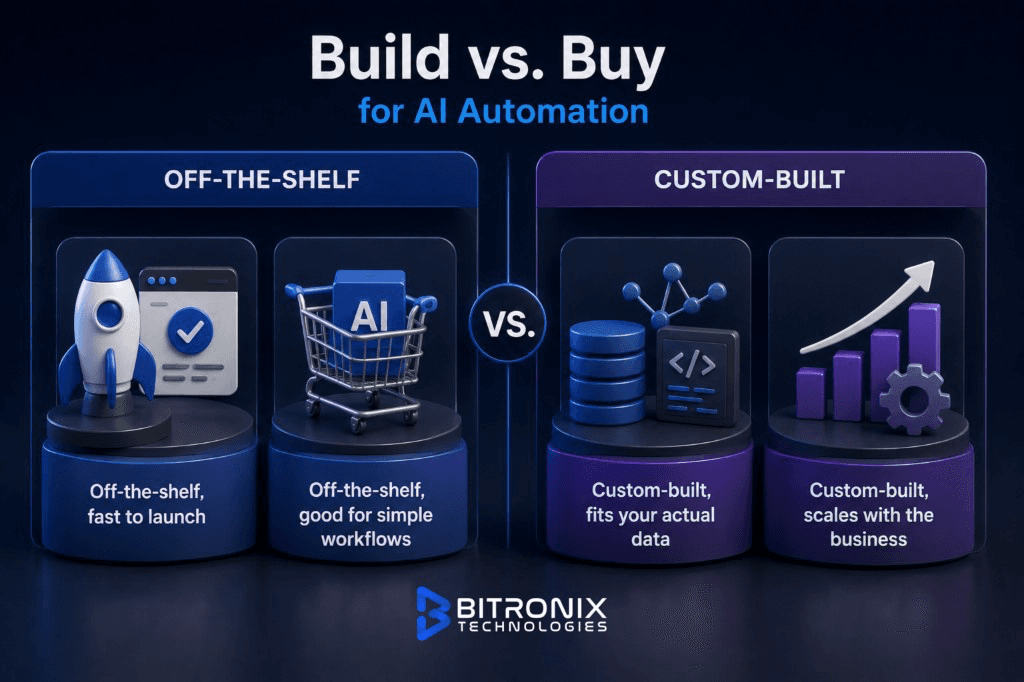
Off-the-shelf AI tools are right when your workflow is simple, your stack is standard and you need something running in days. They're cheap to start but you'll hit a ceiling when you need custom fraud rules, tier-aware routing, or logic the tool wasn't designed for.
Custom AI automation costs more upfront and takes longer, but it's built around your data, systems and decisions. Start with off-the-shelf to prove a workflow matters, then move to custom once you've outgrown the generic version.
Conclusion
AI automation for ecommerce isn't a single product you buy it's a set of decisions about where speed and consistency matter more than a human touch. The businesses getting real value in 2026 picked the highest-friction problem first, measured whether it worked and built out from there.
If you're scoping an AI automation project for your ecommerce operation, talk to our team about what your specific systems and data actually support.
Frequently Asked Questions
Is AI automation only worth it for large ecommerce businesses?
No. A mid-sized or growing store often sees faster, more visible ROI than an enterprise operation, since a single well-targeted automation can meaningfully move revenue.
What should I automate first?
Start with a high-volume, clearly measurable workflow like cart abandonment recovery or inventory reordering.
How long does it take to see results from ecommerce AI automation?
A focused, single-workflow automation typically shows measurable results within 4 to 8 weeks of going live.
Do I need a big tech team to implement this?
No. Most ecommerce AI automation is implemented by an outside partner and handed off with dashboards your existing team can use.
Can AI automation integrate with my existing ecommerce platform?
Yes. Shopify, WooCommerce, Magento and custom storefronts typically connect through existing APIs without a platform migration.

Founder and CTO
Founder and CTO of Bitronix Technologies. Helps ecommerce brands design and ship AI automation that connects storefront, CRM, inventory and support into measurable workflows.
Related Posts
 AI
AISeptember 12, 202627 min read
AI Workflow Automation: How It Works, Benefits & Use Cases
Learn how AI workflow automation works, its benefits, use cases, implementation process, costs and how businesses can automate repetitive workflows.
Read article AI
AIJuly 24, 202621 min read
AI App Development Cost by Industry: Healthcare, FinTech, Retail & More (2026 Guide)
Learn AI app development costs across Healthcare, FinTech, Retail, Education, Logistics, & more. Explore pricing, cost factors, & budgeting tips for 2026.
Read article AI
AIJuly 21, 202613 min read
AI App Development in USA: The Complete Guide for 2026 (Costs, Process, & Technologies)
Learn everything about AI app development in the USA, including costs, technologies, development process, AI agents, trends, & business strategies for 2026.
Read article