AI App Development in USA: The Complete Guide for 2026 (Costs, Process, & Technologies)

By Tausif AhmedFounder and CTO
Artificial Intelligence has moved beyond being a futuristic concept. In 2026, it has become a competitive necessity for businesses of all sizes. From intelligent virtual assistants and AI-powered healthcare applications to predictive analytics platforms and autonomous enterprise solutions, AI is transforming how organizations operate, engage customers, and generate revenue.
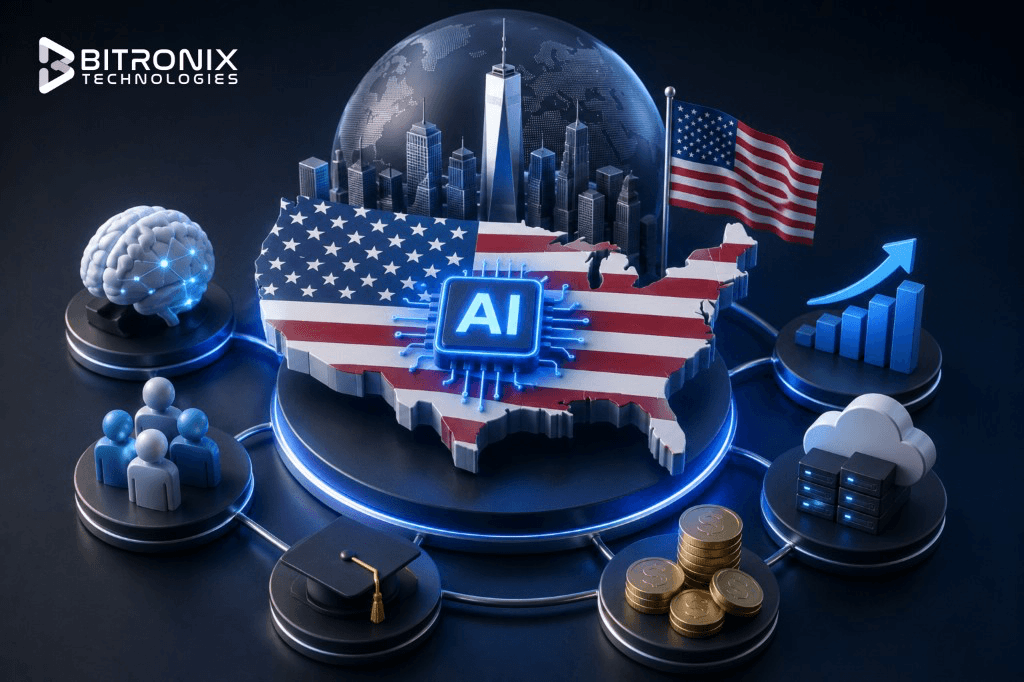
World-class research institutions along with advanced cloud infrastructure, innovative startups, technology giants, and venture capital investments empower the United States to lead the global AI movement.
Every sector devotes considerable time and money to developing enterprise software and mobile apps empowered by AI. Efficiency and automation are goals to improve the customer experience, eliminate repetitive tasks, and discover new avenues for business investment.
An understanding of the development of AI applications is crucial for the founder of an AI-targeted startup, the leader of an enterprise making the transition from an outdated corporate system, and the business director whose company is considering the use of AI.
This guide provides details on every aspect of the development of AI applications, from the technological state of advancement, strategies and methods for development, costs and timeframes, and legal requirements and regulations, to use case examples for every sector, predicted outcomes, and trends for the future in the USA for the year 2026.
What is AI App Development?
AI app development is the process of making applications that use AI to perform tasks that would otherwise require human effort to think or act. Unlike traditional apps, AI applications are a step further because they continuously analyze data and interactions from users, recognize patterns, and boost their workflows.
Machine Learning, large language models, Natural Language Processing, computer vision, speech recognition, as well as recommendation systems and automation engines are all technologies AI apps integrate to understand and analyze context, to predict, to create content, to answer questions, and to automate complex processes.
An example of an AI customer support app would be one that is able to understand a support case or user question that has been asked in Natural Language. The app is able to automatically retrieve the necessary answers to the question from the company's knowledge database using RAG (retrieval-augmented generation) and portray the answer in a context that recognizes the case, all without a human being physically present.
An example of an AI imaging app would be an app able to view and analyze medical imaging to assist a doctor/specialist in support of a diagnosis. AI apps are increasingly flexible since the use of Cloud, enterprise systems, and IoT within the app integrations is a common practice.
Why the USA Leads AI App Development in 2026?
The US dominates AI innovation with unique competitive advantages. Here are some reasons.
Strong Technology Ecosystem
The US has the largest tech giants such as OpenAI, Google, Microsoft, Amazon, Meta, NVIDIA, and Anthropic. These companies plow billions into AI R&D and infrastructure to build cutting-edge AI Tools and Models.
World-Class Research Institutions
MIT, Stanford, Carnegie Mellon, and UC Berkeley's world-renowned cutting-edge AI research and graduate students foster innovation in both academia and industry.
Venture Capital Investment
The US has the most venture capital for AI startups around the world. This allows the greatest playground for developing and scaling AI-enabled ideas and products.
Advanced Cloud Infrastructure
AI services, GPU infrastructure, and ML services from AWS, Microsoft Azure, and Google Cloud facilitate and lower the cost for businesses to build AI.
Mature Enterprise Market
AI adoption from large enterprises to gain Operational Efficiency and Competitive Advantage is pervasive across Healthcare, Finance, Retail, Logistics, and Manufacturing.
AI App Market Size & Revenue Opportunities States
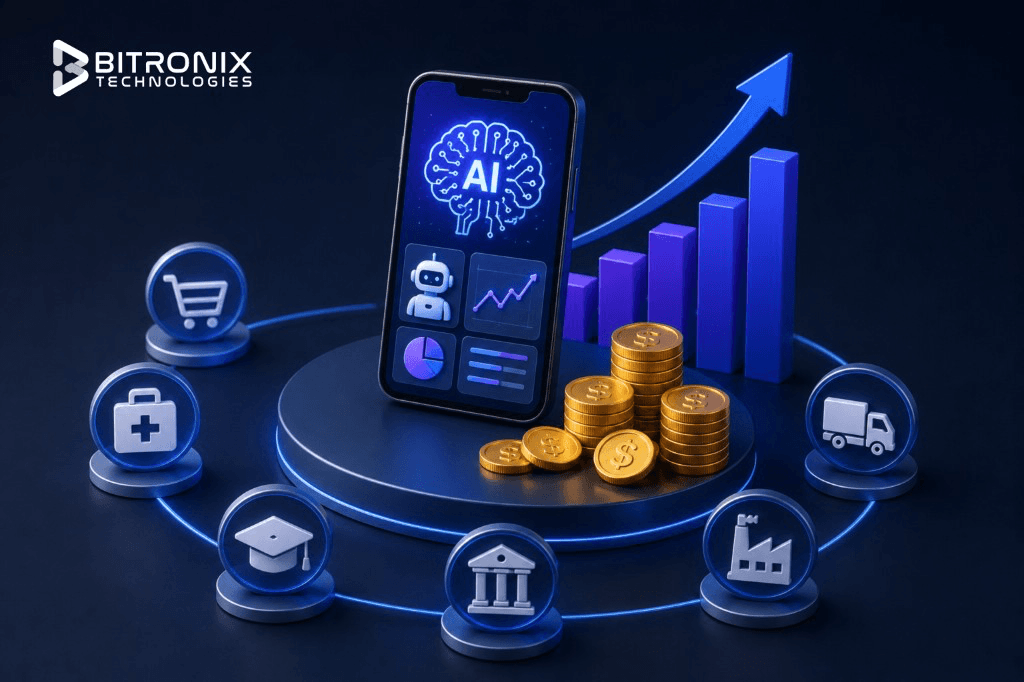
AI apps are generating even more revenue since the market is diversifying at a fast pace. AI-powered apps help businesses create personalized experiences for their customers to streamline operations and generate additional revenue.
| Metric | 2026 Estimate |
|---|---|
| Global AI Market Size | $700+ Billion |
| Enterprise AI Adoption | 80%+ |
| Generative AI Spending | Rapid Growth |
| AI Software CAGR | 35%+ |
| AI Mobile App Downloads | Billions Annually |
These figures highlight the increasing demand for AI-powered applications across industries and underscore the importance of adopting AI strategies early.
Key Benefits of Building AI-Powered Mobile Apps
More ubiquitous AI technologies will create the opportunity for more intelligent and personalized recommendations, design, conversations, and more. Diverse advantages of AI-driven apps are defined below.
Enhanced Customer Experience
Discovering and developing new AI technologies should be centered around their value to the consumer. The growing personalization that AI brings to the customer experience will be driven by the new technologies hitting the market. Well-designed and implemented technologies will lead to more engaged clients and a higher level of customer satisfaction.
Increased Operational Efficiency
A big driver of the operational transformation that AI brings will be the reduction of manual work. AI offers the ability to complete repetitive and mundane tasks, giving time back to employees. AI apps are able to automate workflows and processes employed in customer service, finance, human resources, and operations.
Better Decision-Making
AI automation in mobile apps gives businesses the ability to process and analyze data that they would have never been able to before. These apps assist companies in forecasting, analytics, and operational reporting.
Cost Reduction
The more a business employs AI technologies, the more opportunity there is to reduce costs and optimize the processes they offer. AI has the power to reshape workflow paradigms and resource implications.
Scalability
AI-powered applications would be able to grow and scale at the rate a business would grow without the need to staff at the same rate or re-architect the infrastructure.
Types of AI Applications Startups & Enterprises Can Build
AI is pertinent in nearly every conceivable sphere of commerce. Here are some of the most relevant examples:
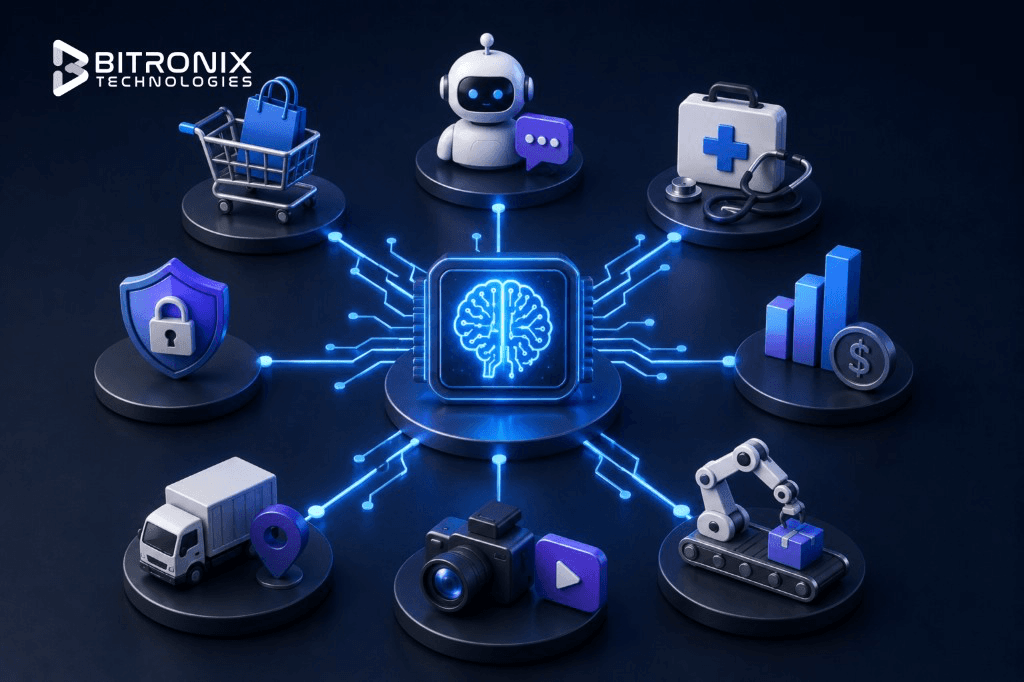
- AI Chatbots, Conversational automation whose function is to respond to customer inquiries, provide customer service, and automate customer interactions.
- AI Agents, Autonomous systems that function with the ability to plan, reason, and perform tasks that stretch beyond the capabilities of a single step and require minimal human oversight to operate.
- Prediction Systems, Systems employed in e-commerce, streaming, and content sharing to provide users with personalized recommendations.
- Predictive Analytic Apps, Systems that utilize historical data alongside real-time data to project future scenarios.
- Computer Vision Systems, Systems that can inspect the quality and recognition of faces and provide medical imaging by interpreting and analyzing data in the form of still and moving pictures.
- Voice AI Systems, Systems that are able to produce and perceive human speech to create voice automation, to automate call functions, and to provide transcription services.
- AI-Powered Healthcare Apps, AI-focused applications that perform tasks such as patient monitoring, drug discovery, diagnostics, and the creation of personalized healthcare plans.
- AI-Driven Finance Apps, Systems that provide services such as credit scoring, algorithmic trading, fraud detection, and risk assessment.
Industries That Can Unlock New Opportunities With AI-Driven Mobile Apps
AI-driven apps upgrade traditional mobile applications to serve smarter, more personalized features. They quickly make decisions and enhance customer relations through intelligent automation. Across industries AI built mobile solutions help improve business operations, engage customers, and generate additional sources of revenue. Here is how different industries are implementing AI mobile solutions:
- Healthcare, AI mobile solutions are being used for multiple applications in hospitals and clinics, including assistance for diagnosis, patient engagement, analysis of medical images, remote patient monitoring, and analytics of future health events.
- Finance & Banking, AI drives mobile solutions for support and engagement of customers, analysis of investments, automation of compliance and assessment of risk, and detection of fraud.
- Retail and E-commerce, Businesses use AI-based mobile apps to customize customer shopping experiences, make product recommendations, and help with stock control. AI-based mobile apps also help retail businesses to understand shopping trends.
- Manufacturing, AI drives mobile solutions in the manufacturing industry to optimize supply chains, monitor processes, and manage quality control and maintenance.
- Logistics, Businesses in the logistics industry utilize AI to optimize the routes for delivery, improve operations in warehouses, manage fleets, and anticipate disruptions in supply chain networks.
- Education, Mobile Apps that offer educational services use AI to customize the learning experience, provide automated personal tutors, grade assessments, analyze student performance, and provide personalized recommendations for courses.
- Real Estate, Apps powered by AI for the real estate industry assist mobile users in property valuations, qualifying leads, personalized property recommendations, virtual property tours, and analysis of real estate market trends.
- Travel and Hospitality, Mobile applications for the travel and hospitality industry help to tailor guest experiences, automate customer service, assist with dynamic pricing, and enhance itinerary recommendations.
Core AI Technologies Behind Modern AI Application Development
Machine Learning (ML)
ML-powered apps learn from data without explicit programming. Common applications include demand forecasting, recommendation systems, and predictive maintenance.
Deep Learning
It involves neural networks with multiple layers, so complex data like images, audio, and text is processed. It powers technologies like image recognition and speech synthesis.
Natural Language Processing (NLP)
NLP allows applications to understand, interpret, and generate human language. It is essential for chatbots, virtual assistants, and document analysis.
Large Language Models (LLMs)
LLMs such as GPT, Claude, and Gemini can generate human-like text, summarize information, answer questions, and assist with coding, content creation, and customer support.
Retrieval-Augmented Generation (RAG)
RAG combines LLMs with external knowledge sources, enabling AI systems to retrieve up-to-date information and generate more accurate, context-aware responses.
Computer Vision
It enables machines to analyze visual information and assist in detecting objects, recognizing faces, and enhancing automated inspections.
Speech Recognition
Speech recognition converts spoken language into text, powering voice assistants, transcription services, and voice-controlled applications.
AI Agents Vs Chatbots: What's The Difference And Which Is Better?
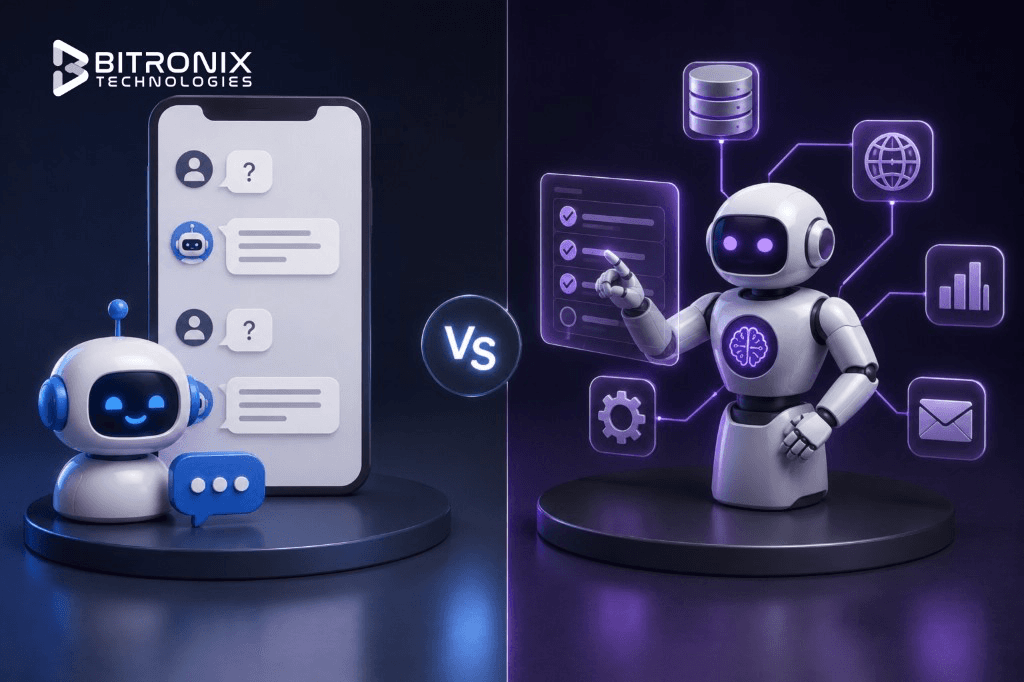
AI agents and traditional chatbots differ mainly in their ability to act: traditional chatbots respond to user queries based on predefined rules or programmed responses, while AI agents can understand goals, make decisions, use tools, and take actions to complete tasks. Chatbots are generally designed for simple, repetitive interactions such as answering FAQs, guiding users, or providing basic customer support. On the contrary, AI agents can handle more complex workflows by reasoning through problems, accessing business data, interacting with other systems, and completing multi-step tasks with less human intervention.
| Factor | AI Agents | Traditional Chatbots |
|---|---|---|
| Primary purpose | Complete tasks and achieve specific goals | Answer questions and handle conversations |
| How they work | Reason, plan, and take actions | Follow predefined rules or scripted flows |
| Decision-making | Can make context-based decisions | Limited to programmed responses |
| Task complexity | Suitable for multi-step and complex workflows | Best for simple and repetitive queries |
| System integration | Can interact with APIs, databases, and business tools | Usually offers limited integrations |
| User experience | More dynamic and personalized | More predictable and structured |
| Automation level | Can automate complete workflows | Primarily automates conversations |
| Human involvement | Can operate with minimal intervention | Often requires human handoff for complex issues |
| Use cases | Workflow automation, customer service, sales, research, operations | FAQs, basic customer support, lead qualification, and navigation |
| Best suited for | Businesses seeking advanced automation and intelligent task execution | Businesses needing simple, cost-effective conversational support |
So, which is better? The answer depends on your business needs. If you need a simple, predictable solution for answering common questions, a traditional chatbot may be the more cost-effective choice. However, if your business needs intelligent automation, personalized interactions, and the ability to complete complex tasks, AI agents offer greater flexibility and potential. For enterprises looking to automate sophisticated workflows and improve operational efficiency, AI agents are generally the stronger long-term option.
Choosing the Right Artificial Intelligence (AI) Partner To Build Smart Apps
Selecting an experienced AI development company is critical to the success of your project. Consider the following factors:
- Proven expertise in AI technologies
- Industry-specific experience
- Strong portfolio of AI applications
- Skilled data scientists and AI engineers
- Transparent development process
- Robust security practices
- Post-launch support and maintenance
- Scalable architecture design
- Compliance with industry regulations
A reliable partner should also provide strategic guidance, helping you identify high-impact AI use cases and align technology choices with your business objectives.
Final Thoughts
AI app development is transforming how businesses innovate, automate operations, and deliver exceptional customer experiences. As AI adoption increases in the USA, investing in a scalable, secure, and future-ready AI solution can provide a significant competitive advantage.
Whether you're building an AI-powered mobile app, enterprise platform, or intelligent AI agent, choosing the right technology stack and development partner is essential for long-term success. By leveraging the latest AI technologies and hiring the best AI development partner, businesses can create innovative applications that scale with demand and stay competitive in 2026 and beyond.
Bitronix Technologies helps US startups and enterprises design and ship production AI automation and intelligent applications, with architecture, evaluation, and post-launch ownership built in from day one.
Frequently Asked Questions
What is AI app development?
AI app development is the process of building applications that use artificial intelligence to perform tasks that would otherwise require human judgment or action. Unlike traditional apps, AI applications continuously analyze data and user interactions, recognize patterns, and improve their workflows over time.
Why does the USA lead AI app development in 2026?
The USA leads because of a strong technology ecosystem (OpenAI, Google, Microsoft, Amazon, Meta, NVIDIA, Anthropic), world-class research institutions, deep venture capital for AI startups, advanced cloud and GPU infrastructure, and mature enterprise demand across healthcare, finance, retail, logistics, and manufacturing.
What is the difference between AI agents and traditional chatbots?
Traditional chatbots respond to queries using predefined rules or scripted flows and are best for FAQs and simple support. AI agents can reason, plan, use tools, and complete multi-step tasks with less human intervention, making them better for workflow automation and complex operational use cases.
Which industries benefit most from AI-driven mobile apps?
Healthcare, finance and banking, retail and e-commerce, manufacturing, logistics, education, real estate, and travel and hospitality are among the industries unlocking the most value from AI-powered mobile applications.
What should businesses look for in an AI development partner?
Look for proven AI expertise, industry-specific experience, a strong portfolio, skilled AI engineers and data scientists, transparent process, robust security, post-launch support, scalable architecture, regulatory compliance, and strategic guidance on high-impact use cases.

Founder and CTO
Founder and CTO of Bitronix Technologies. Builds production AI applications, agentic systems, and enterprise AI platforms for teams across the USA.
Related Posts
 AI
AIAugust 6, 20267 min read
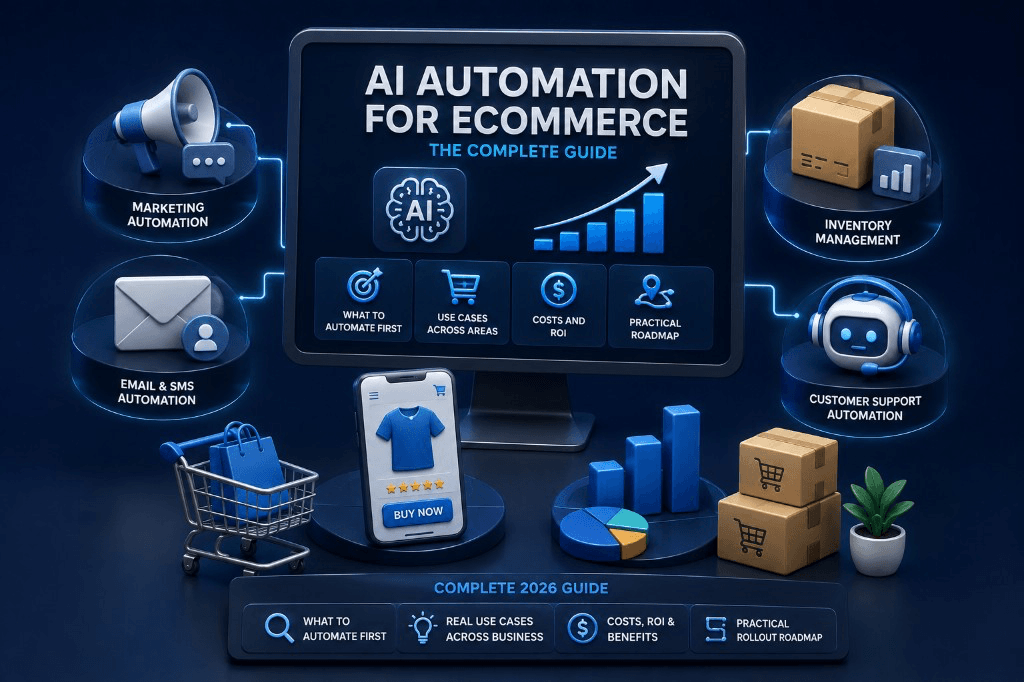
AI Automation for Ecommerce: The Complete 2026 Guide
A complete 2026 guide to AI automation for ecommerce: what to automate first, real use cases across marketing, inventory, and support, costs, and a practical rollout roadmap.
Read article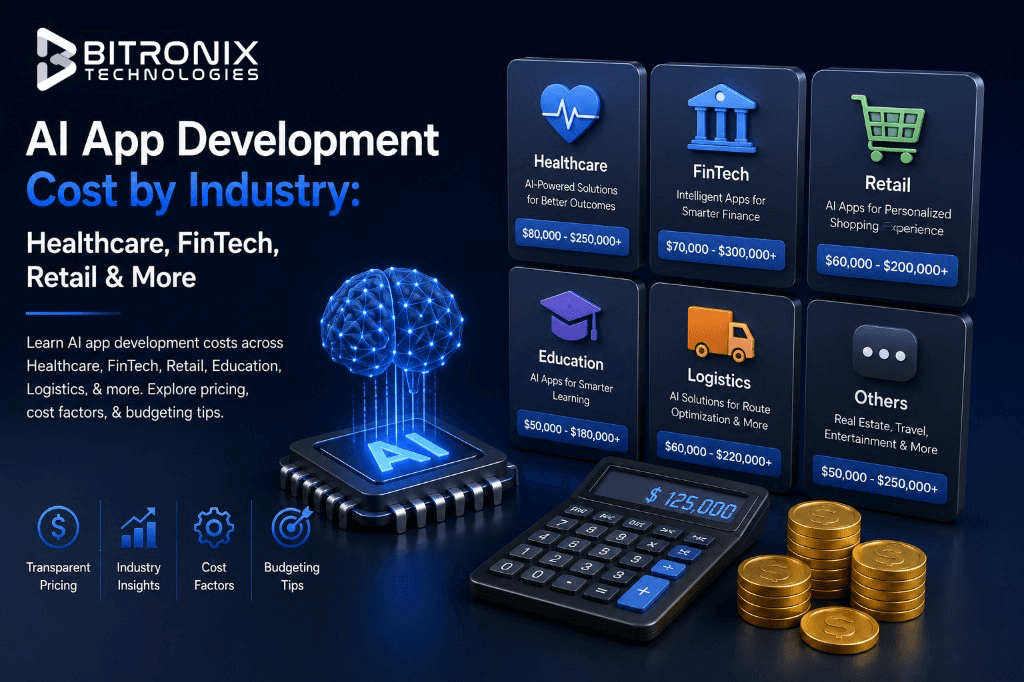 AI
AIJuly 24, 202621 min read
AI App Development Cost by Industry: Healthcare, FinTech, Retail & More (2026 Guide)
Learn AI app development costs across Healthcare, FinTech, Retail, Education, Logistics, & more. Explore pricing, cost factors, & budgeting tips for 2026.
Read article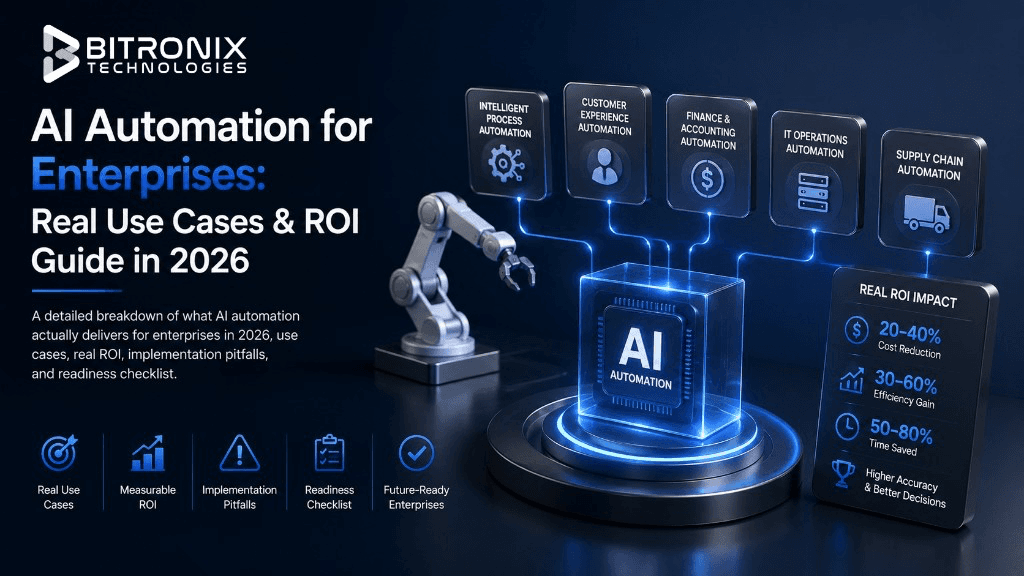 AI
AIJuly 20, 202625 min read
AI Automation for Enterprises: Real Use Cases & ROI Guide in 2026
A detailed breakdown of what AI automation actually delivers for enterprises in 2026, use cases, real ROI, implementation pitfalls, and readiness checklist.
Read article