AI App Development Cost by Industry: Healthcare, FinTech, Retail & More (2026 Guide)

By Tausif AhmedFounder and CTO
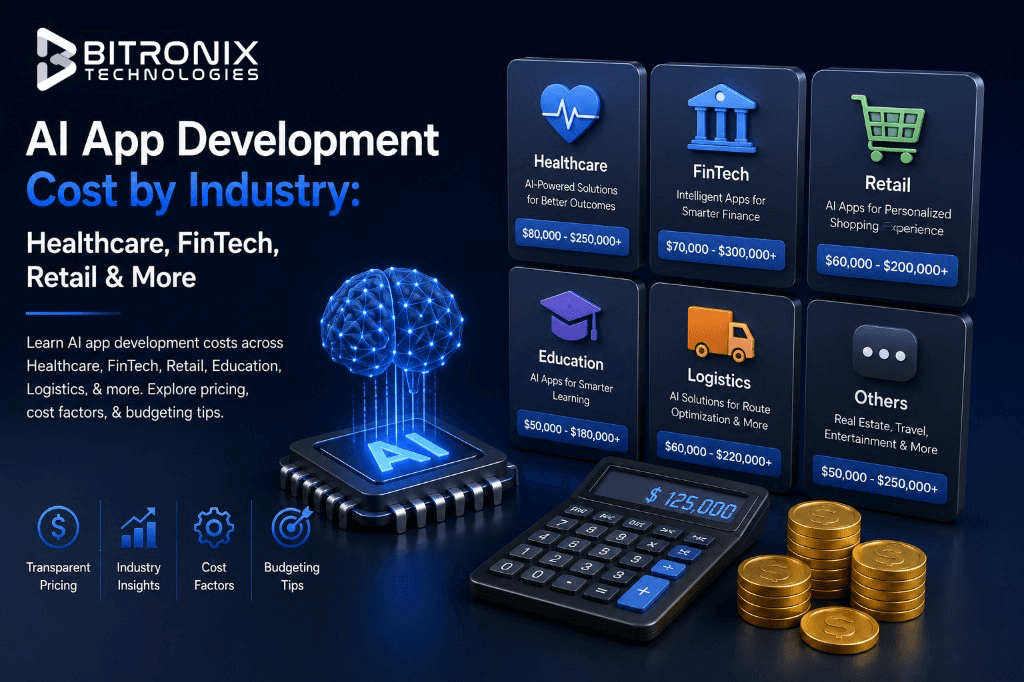
AI app development has become one of the most strategic investments businesses make in 2026. From intelligent chatbots and predictive analytics platforms to computer vision systems and autonomous AI agents, organizations across every industry are building AI-powered applications to automate operations, personalize customer experiences, and unlock new revenue streams.
But here's the challenge most founders and enterprise leaders face: AI app development costs vary dramatically depending on your industry, the AI features you need, compliance requirements, and where your development team is located. A basic healthcare chatbot might cost $5,000, while an enterprise FinTech fraud detection platform can exceed $250,000.
Understanding these cost differences before you scope a project is the difference between a realistic budget and a six-month overrun. This guide breaks down AI app development costs by industry, feature type, complexity level, and geographic region so you can plan your 2026 AI investment with confidence.
Whether you're a healthcare startup building a telemedicine platform, a FinTech company launching fraud detection, or a retailer investing in AI-powered recommendations, the numbers below reflect what production-grade AI apps actually cost in 2026.
What is AI App Development?
AI app development is the process of building software applications that use artificial intelligence to perform tasks that traditionally required human judgment, analysis, or decision-making. Unlike conventional apps that follow fixed logic, AI applications learn from data, recognize patterns, and improve their performance over time.
Modern AI apps integrate technologies such as machine learning, natural language processing (NLP), large language models (LLMs), computer vision, speech recognition, recommendation engines, and predictive analytics. These capabilities enable applications to understand context, generate content, detect anomalies, personalize experiences, and automate complex workflows.
Examples include a healthcare app that analyzes medical images to assist diagnosis, a FinTech platform that detects fraudulent transactions in real time, a retail app that recommends products based on browsing behavior, or an enterprise AI agent that automates multi-step business processes across CRM, ERP, and ticketing systems.
At Bitronix Technologies, we build production AI automation systems for teams that need more than a demo, applications designed for security, compliance, and long-term scalability from day one.
Why Businesses Invest in AI Apps
Organizations across every sector are investing in AI app development because the return on investment extends far beyond cost savings. Here are the primary drivers behind AI adoption in 2026.
- Operational efficiency, AI automates repetitive tasks in customer service, finance, HR, and operations, freeing teams to focus on high-value work.
- Enhanced customer experience, Personalization engines, intelligent chatbots, and recommendation systems deliver tailored experiences that increase engagement and retention.
- Better decision-making, Predictive analytics and real-time data processing help leaders forecast demand, assess risk, and respond to market changes faster.
- Competitive advantage, Early AI adopters differentiate through intelligent features that competitors without AI infrastructure cannot match.
- Revenue growth, AI-powered products open new monetization paths through premium features, automation services, and data-driven insights.
- Risk reduction, Fraud detection, compliance monitoring, and quality control systems reduce financial and reputational exposure.
- Scalability, AI applications handle growing data volumes and user bases without proportional increases in headcount.
The cost of building an AI app is an upfront investment. The cost of not building one, in lost efficiency, customer churn, and competitive lag, compounds every quarter.
AI App Development Cost Overview (2026)
Before diving into industry-specific pricing, here is a general overview of what AI app development costs in 2026 across common application types and complexity levels.
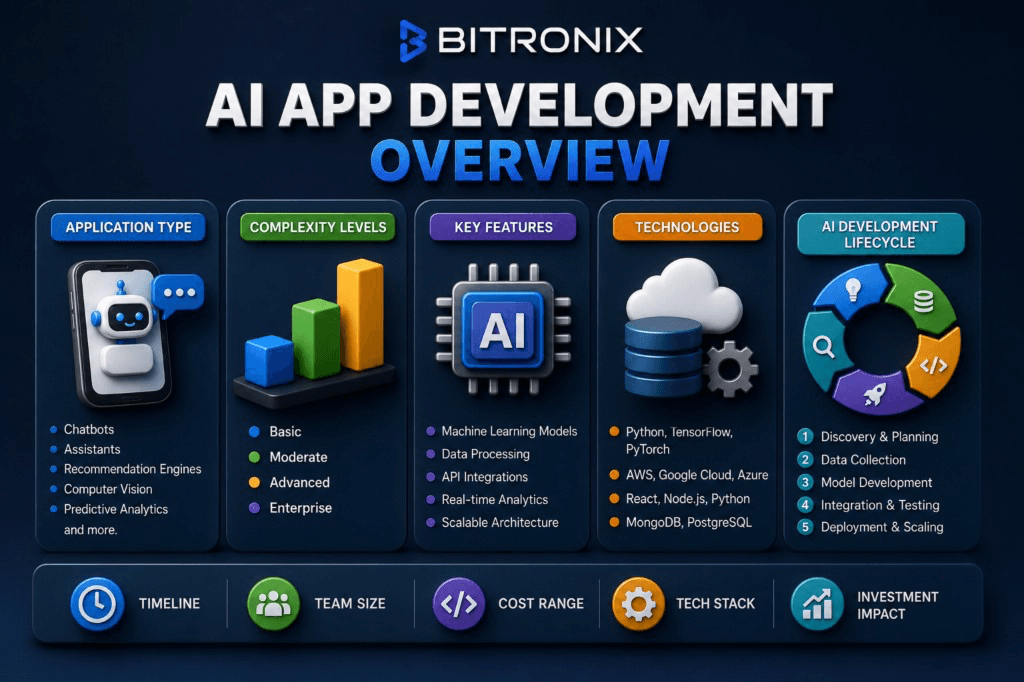
| AI App Type | Estimated Cost Range |
|---|---|
| Basic AI Chatbot | $5,000–$20,000 |
| AI Mobile App | $20,000–$60,000 |
| AI SaaS Platform | $50,000–$150,000 |
| AI Marketplace | $60,000–$180,000 |
| Healthcare AI App | $80,000–$250,000+ |
| FinTech AI App | $100,000–$300,000+ |
| Enterprise AI Platform | $150,000–$500,000+ |
These ranges reflect production-grade builds with proper security, testing, and deployment, not proof-of-concept prototypes. Industry-specific compliance, custom model training, and deep enterprise integrations push costs toward the upper end.
AI App Development Cost by Complexity
Complexity is one of the strongest predictors of total project cost. Here is how budgets typically scale by scope.
| Complexity Level | Estimated Cost Range | Typical Scope |
|---|---|---|
| Simple | $8,000–$30,000 | Single AI feature, API-based models, limited integrations, basic UI |
| Medium | $30,000–$80,000 | Multiple AI features, custom workflows, moderate integrations, mobile or web app |
| Enterprise | $80,000–$500,000+ | Custom models, deep integrations, compliance, multi-platform, advanced analytics |
Key Factors That Affect AI App Development Cost
Every AI app quote boils down to a handful of variables. Understanding these factors helps you control scope and avoid budget surprises.
1. App Complexity and Scope
The number of AI features, user roles, screens, and workflows directly drives development hours. A single-feature chatbot is fundamentally cheaper than a multi-module enterprise platform with dashboards, admin panels, and role-based access.
2. AI Model Type and Architecture
Using pre-trained models via APIs (OpenAI, Anthropic, Google) is significantly cheaper than training custom models from scratch. RAG (retrieval-augmented generation) is the default for most enterprise use cases; fine-tuning adds cost but may be necessary at very high query volumes.
3. Data Requirements and Preparation
Data cleaning, structuring, labeling, and pipeline setup typically account for 25–40% of total project cost. If your data is messy, incomplete, or siloed across systems, budget accordingly, this is the most commonly underestimated line item.
4. Integrations with Existing Systems
Each integration with CRM, ERP, EHR, payment gateways, or identity systems typically costs $5,000–$25,000 to design, build, and secure. Enterprise AI apps often require four to twelve integrations, which can exceed the AI logic cost itself.
5. Compliance and Security Requirements
Regulated industries add significant cost. HIPAA for healthcare, PCI-DSS and FINRA for FinTech, and GDPR for EU-facing products each require dedicated security architecture, audit trails, encryption, and documentation that can add 20–40% over baseline.
6. Team Location and Hiring Model
Developer hourly rates vary dramatically by region, from $25–$60/hr in India to $120–$250/hr in the USA. In-house teams offer control but carry full overhead; agencies provide speed and expertise; freelancers suit narrow scopes but may lack compliance experience.
7. Platform and UI/UX Requirements
Building for iOS, Android, and web simultaneously increases cost. Custom UI/UX design, accessibility compliance, and responsive layouts add development time. Enterprise dashboards with real-time analytics and role-based views cost more than consumer-facing single-purpose apps.
How AI Features Impact Development Cost
Not all AI features cost the same to build. The table below shows the relative cost impact of common AI capabilities integrated into modern applications.
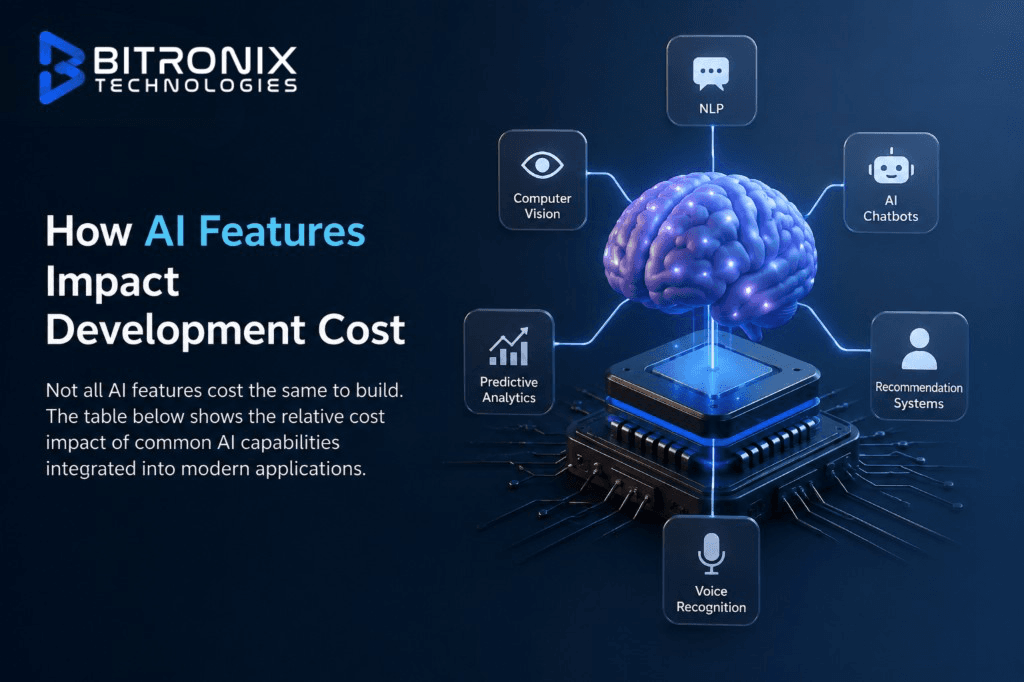
| AI Feature | Cost Impact | Notes |
|---|---|---|
| AI Chatbot | Low | API-based LLMs with RAG; fastest to deploy |
| Voice AI | Medium | Speech-to-text, text-to-speech, and voice UX add complexity |
| Image Recognition | High | Computer vision models, training data, and GPU infrastructure |
| NLP / Text Analysis | Medium | Document processing, sentiment analysis, entity extraction |
| Predictive Analytics | High | Custom ML models, feature engineering, and validation |
| Recommendation Engine | Medium | Collaborative filtering or content-based systems |
| Fraud Detection | High | Real-time scoring, model tuning, and compliance requirements |
| Generative AI | High | Content generation, image synthesis, or code generation at scale |
Why AI App Development Costs Vary by Industry
Two businesses building "an AI app" can receive quotes that differ by 10x or more. Industry is one of the biggest reasons. Here is why costs diverge across sectors.
- Regulatory burden, Healthcare (HIPAA), finance (PCI-DSS, FINRA), and government sectors require compliance architecture that consumer apps do not.
- Data sensitivity, Industries handling PHI, financial records, or PII need encryption, access controls, and audit logging that add engineering effort.
- Integration depth, Enterprise systems in healthcare (EHR), FinTech (core banking), and logistics (WMS/TMS) require deep, secure integrations.
- Accuracy requirements, Clinical diagnostics, fraud detection, and safety-critical manufacturing systems demand higher validation standards and testing cycles.
- User base and scale, Consumer retail apps may prioritize speed and UX; enterprise platforms prioritize reliability, uptime, and multi-tenant architecture.
- Domain expertise, Specialized knowledge in clinical workflows, financial regulations, or supply chain operations affects both scoping accuracy and development speed.
Healthcare AI App Development Cost
Healthcare AI apps are among the most expensive to build due to HIPAA compliance, clinical validation requirements, and the sensitivity of patient data. Costs range from simple patient-facing chatbots to complex diagnostic and predictive analytics platforms.
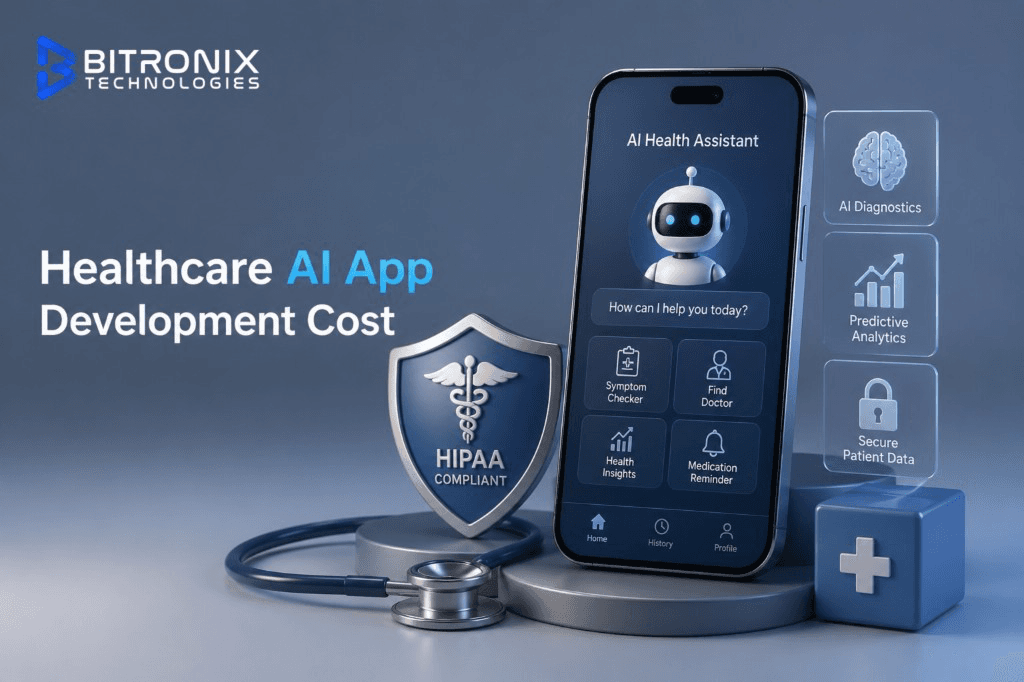
| Healthcare AI App Type | Estimated Cost Range |
|---|---|
| AI Chatbot (Patient Support) | $5,000–$35,000 |
| Appointment Scheduling AI | $20,000–$45,000 |
| Patient Management System | $40,000–$90,000 |
| Medical Image Analysis | $80,000–$180,000 |
| Telemedicine Platform | $70,000–$160,000 |
| Predictive Health Analytics | $100,000–$250,000+ |
Healthcare AI projects also require longer timelines (typically 6–12 months) due to compliance reviews, clinical workflow integration, and rigorous testing. Partner with a team experienced in HIPAA-compliant AI automation to avoid costly rework.
FinTech AI App Development Cost
FinTech AI applications face stringent regulatory requirements, real-time processing demands, and high stakes for accuracy in fraud detection and financial decision-making. These factors push budgets above most other industries.

| FinTech AI App Type | Estimated Cost Range |
|---|---|
| Banking Chatbot | $5,000–$45,000 |
| Expense Management AI | $30,000–$70,000 |
| Loan Processing System | $50,000–$120,000 |
| Fraud Detection Platform | $100,000–$250,000 |
| Investment AI Platform | $120,000–$300,000+ |
| Enterprise Banking AI | $150,000–$500,000+ |
FinTech builds typically take 7–14 months due to security audits, regulatory compliance (PCI-DSS, KYC/AML), and integration with core banking or payment infrastructure.
Retail AI App Development Cost
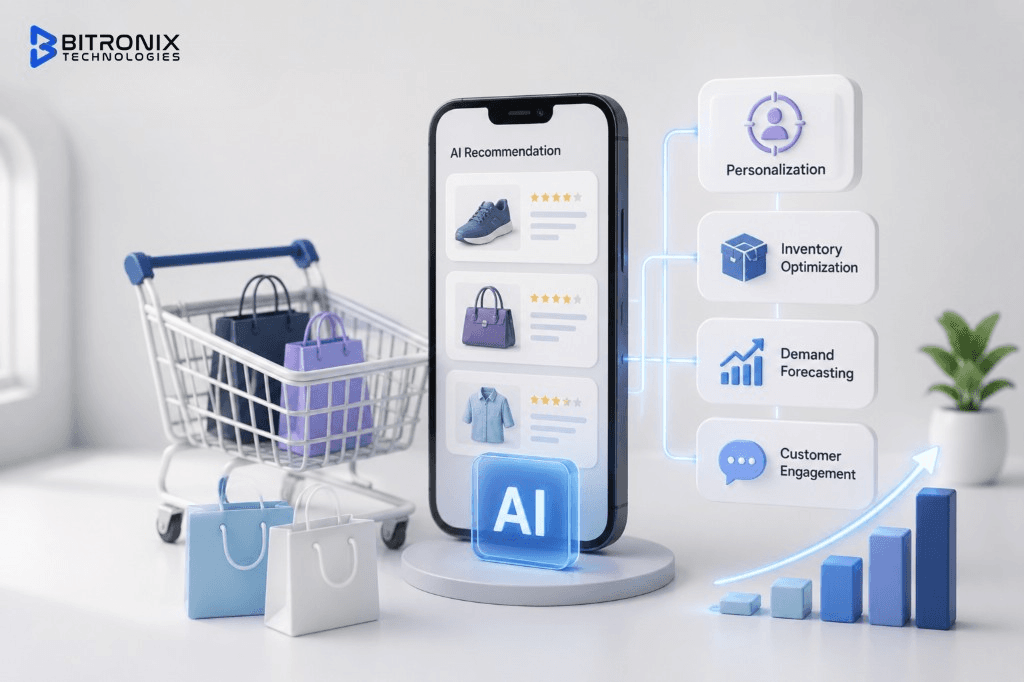
Retail and e-commerce AI apps focus on personalization, inventory optimization, and customer engagement. Compliance overhead is lower than healthcare or FinTech, but data volume and real-time recommendation performance drive engineering complexity.
| Retail AI App Type | Estimated Cost Range |
|---|---|
| Product Recommendation Engine | $20,000–$50,000 |
| AI Shopping Assistant | $25,000–$60,000 |
| Inventory Management AI | $40,000–$90,000 |
| AI Marketing Automation | $50,000–$120,000 |
| Complete AI E-Commerce Platform | $80,000–$180,000 |
Retail AI projects typically complete in 4–8 months, faster than regulated industries, making them attractive entry points for businesses new to AI investment.
AI App Development Timeline by Industry
Budget planning requires both cost and timeline estimates. Development duration varies significantly by industry due to compliance, integration depth, and testing requirements.
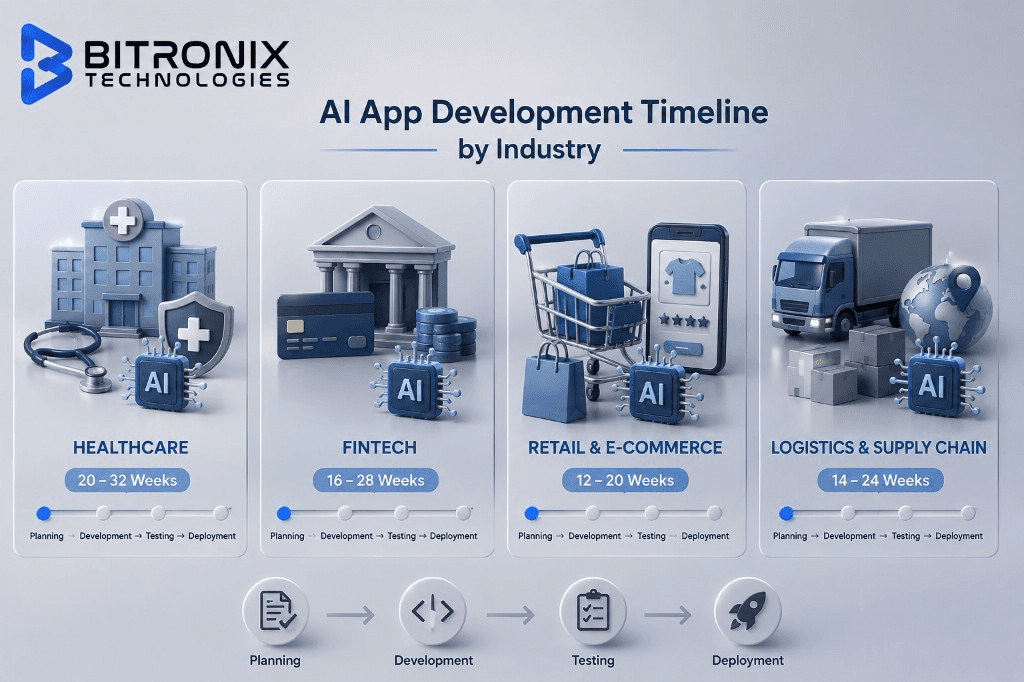
| Industry | Typical Timeline |
|---|---|
| Healthcare | 6–12 months |
| FinTech | 7–14 months |
| Retail & E-Commerce | 4–8 months |
| Education | 4–10 months |
| Real Estate | 4–9 months |
| Logistics | 5–10 months |
| Manufacturing | 5–12 months |
Simple AI chatbot MVPs can launch in 2–6 weeks across any industry. Enterprise platforms with custom models, multiple integrations, and compliance reviews require the longer timelines shown above.
Education AI App Development Cost
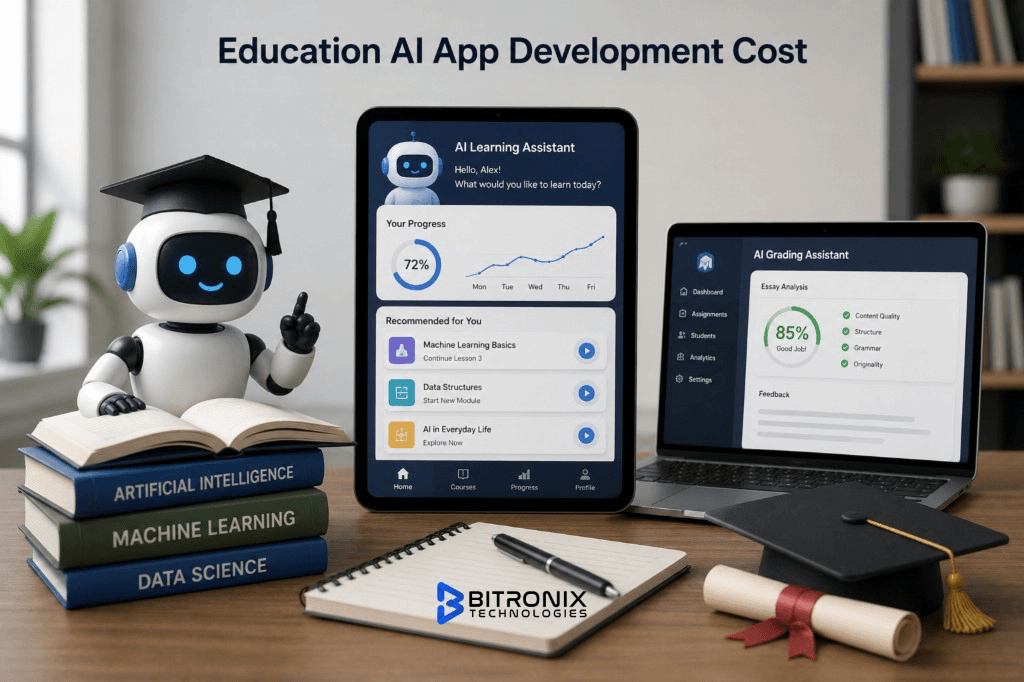
Education technology AI apps personalize learning, automate grading, and power intelligent tutoring systems. Costs scale from simple student support chatbots to full learning management platforms with adaptive curricula.
| Education AI App Type | Estimated Cost Range |
|---|---|
| AI Chatbot (Student Support) | $5,000–$35,000 |
| Course Recommendation Engine | $25,000–$60,000 |
| AI-Powered LMS | $50,000–$120,000 |
| Online Learning Platform | $70,000–$180,000 |
| Enterprise Education AI | $120,000–$300,000+ |
Real Estate AI App Development Cost
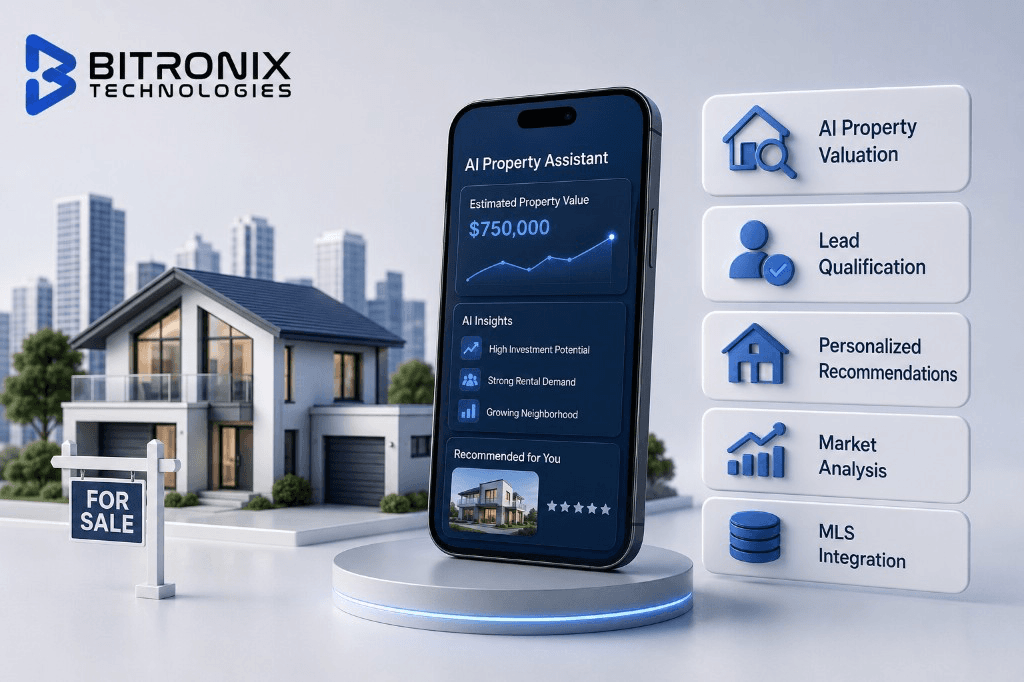
Real estate AI applications assist with property valuations, lead qualification, personalized recommendations, and market analysis. Data quality and MLS integration are common cost drivers in this sector.
| Real Estate AI App Type | Estimated Cost Range |
|---|---|
| AI Chatbot (Lead Qualification) | $15,000–$35,000 |
| Property Recommendation Engine | $30,000–$70,000 |
| AI-Powered CRM | $50,000–$120,000 |
| Property Valuation AI | $80,000–$180,000 |
| Enterprise Real Estate AI | $120,000–$250,000+ |
Logistics AI App Development Cost
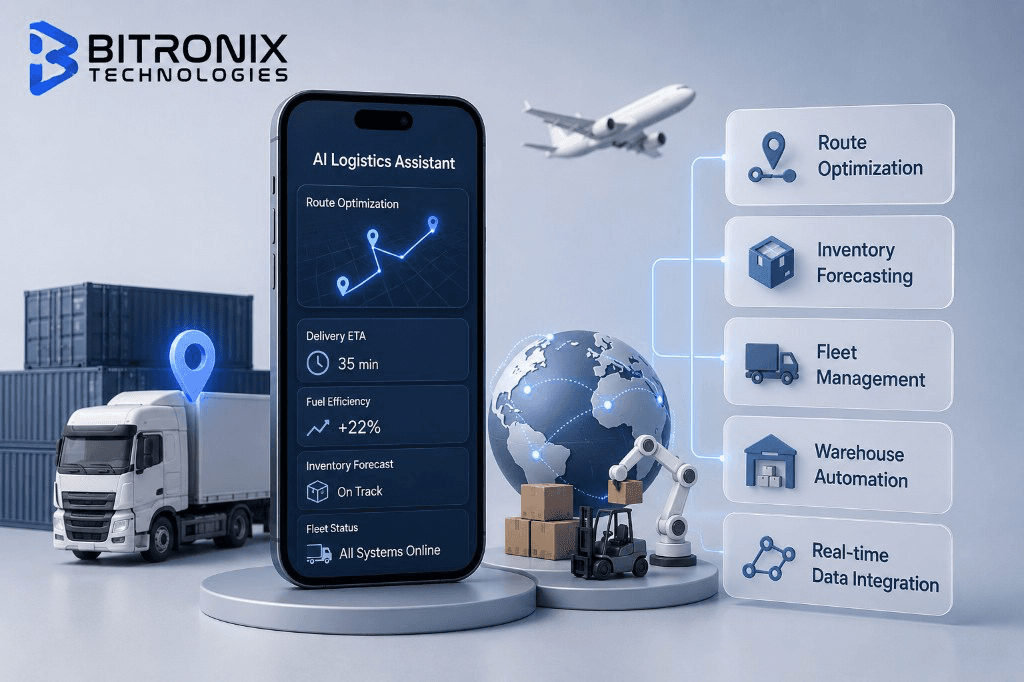
Logistics and supply chain AI apps optimize routes, forecast inventory, manage fleets, and automate warehouse operations. Real-time data from GPS, sensors, and ERP systems adds integration complexity.
| Logistics AI App Type | Estimated Cost Range |
|---|---|
| Route Optimization AI | $25,000–$60,000 |
| Inventory Forecasting | $40,000–$90,000 |
| Fleet Management AI | $60,000–$150,000 |
| Warehouse Automation AI | $80,000–$200,000 |
| Enterprise Supply Chain AI | $150,000–$350,000+ |
Manufacturing AI App Development Cost
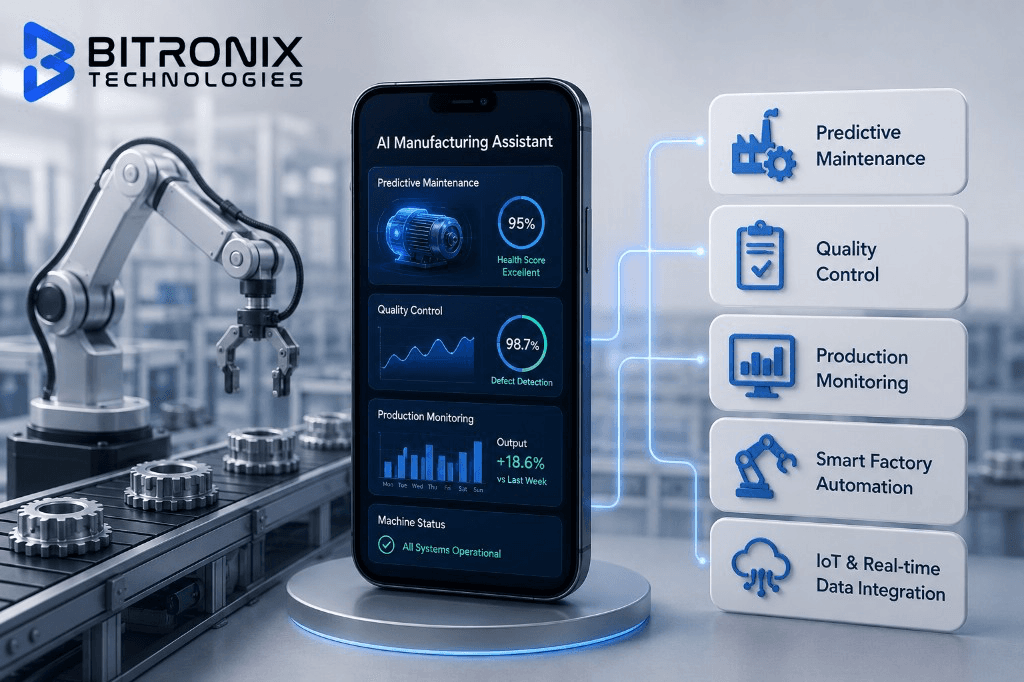
Manufacturing AI applications focus on predictive maintenance, quality control, production monitoring, and smart factory automation. IoT sensor integration and real-time edge processing often increase scope.
| Manufacturing AI App Type | Estimated Cost Range |
|---|---|
| Predictive Maintenance AI | $20,000–$90,000 |
| Quality Control AI | $70,000–$150,000 |
| Production Monitoring | $60,000–$140,000 |
| Smart Factory Platform | $80,000–$180,000 |
| Enterprise Manufacturing AI | $150,000–$400,000+ |
AI App Development Cost Comparison by Industry
This side-by-side comparison summarizes the full cost range across major industries, helping you benchmark your budget against sector norms.
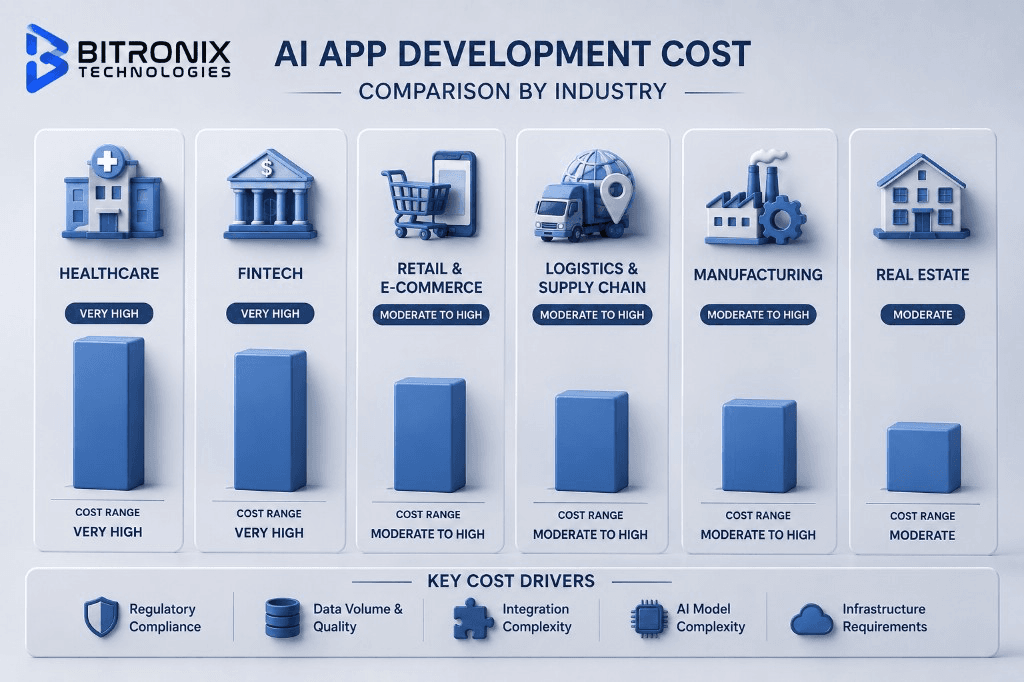
| Industry | Cost Range |
|---|---|
| Healthcare | $10,000–$250,000+ |
| FinTech | $100,000–$300,000+ |
| Retail & E-Commerce | $50,000–$180,000 |
| Education | $50,000–$180,000 |
| Real Estate | $50,000–$250,000 |
| Logistics | $80,000–$350,000 |
| Manufacturing | $80,000–$400,000+ |
AI App Development Cost by Region / Country
Where your development team is located significantly affects both hourly rates and total project cost. The table below compares developer rates and typical project budgets across key regions in 2026.
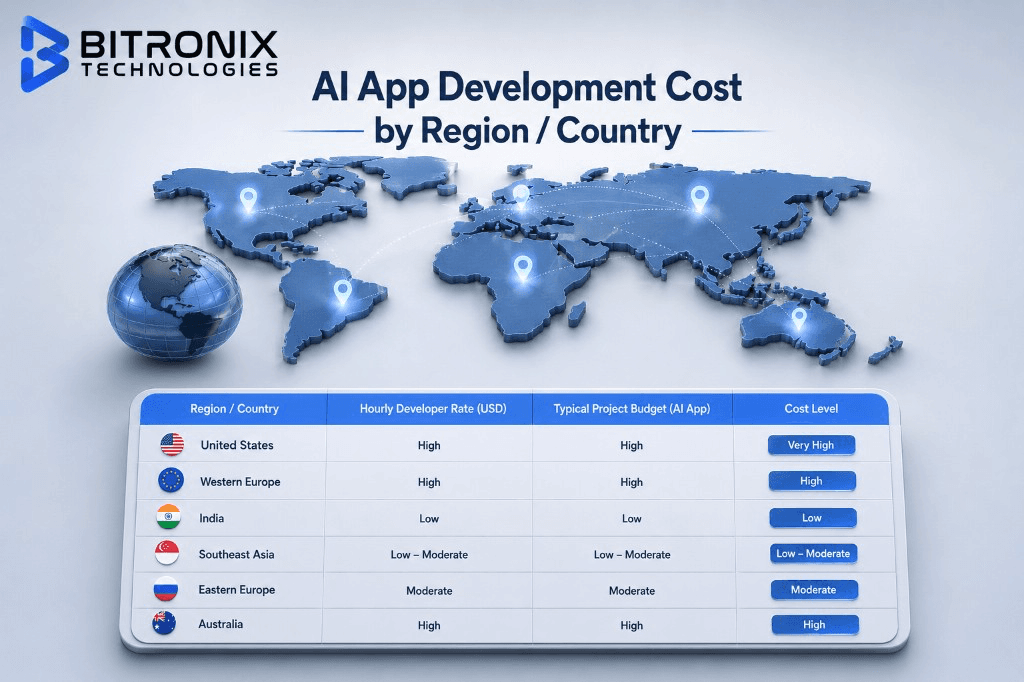
| Region / Country | Hourly Rate | Typical Project Cost |
|---|---|---|
| USA | $120–$250/hr | $120,000–$500,000+ |
| Canada | $100–$180/hr | $100,000–$350,000 |
| UK | $90–$180/hr | $90,000–$300,000 |
| UAE | $70–$150/hr | $60,000–$250,000 |
| Australia | $90–$170/hr | $90,000–$300,000 |
| Germany | $90–$180/hr | $100,000–$350,000 |
| Eastern Europe | $40–$80/hr | $40,000–$180,000 |
| India | $25–$60/hr | $20,000–$150,000 |
Lower hourly rates do not always mean lower total cost. Communication overhead, timezone gaps, compliance expertise, and rework from domain knowledge gaps can offset rate savings, especially in regulated industries.
Real-World Examples of AI Apps by Industry
Understanding cost ranges is easier with concrete examples of what businesses are actually building in each sector.
Healthcare: AI-Powered Diagnostic Assistant
A mid-size hospital network builds an AI app that analyzes radiology images and flags potential abnormalities for physician review. Scope includes HIPAA-compliant data pipelines, EHR integration, and a clinician dashboard. Estimated cost: $120,000–$180,000 over 8–10 months.
FinTech: Real-Time Fraud Detection
A digital bank deploys an AI system that scores transactions in real time, blocks suspicious activity, and generates compliance reports. Scope includes PCI-DSS architecture, core banking API integration, and model monitoring. Estimated cost: $150,000–$250,000 over 10–14 months.
Retail: Personalized Shopping Experience
An e-commerce brand launches an AI app with product recommendations, a conversational shopping assistant, and dynamic pricing. Scope includes catalog integration, A/B testing infrastructure, and mobile app. Estimated cost: $60,000–$120,000 over 5–7 months.
Logistics: Route Optimization Platform
A last-mile delivery company builds an AI system that optimizes driver routes in real time based on traffic, weather, and delivery windows. Scope includes GPS integration, fleet management API, and driver mobile app. Estimated cost: $40,000–$80,000 over 4–6 months.
Manufacturing: Predictive Maintenance System
A factory operator deploys AI that monitors equipment sensor data, predicts failures before they occur, and schedules maintenance automatically. Scope includes IoT integration, alerting dashboards, and ERP connectivity. Estimated cost: $50,000–$100,000 over 5–8 months.
ROI of AI App Development
The return on investment from AI apps extends across multiple dimensions. Organizations that measure ROI rigorously tend to justify their AI budgets faster and scale investment with confidence.
- Cost savings, Automation reduces manual labor in customer support, data entry, compliance checks, and quality inspection. Many teams report 30–60% reduction in handling time for automated workflows.
- Revenue uplift, Personalization and recommendation engines increase average order value, conversion rates, and customer lifetime value.
- Risk mitigation, Fraud detection, predictive maintenance, and compliance monitoring prevent losses that far exceed development costs.
- Speed to market, AI-powered internal tools accelerate product development, content creation, and decision cycles.
- Customer retention, Intelligent, responsive experiences reduce churn and increase Net Promoter Score.
A practical ROI framework: estimate the annual cost of the problem your AI app solves (manual hours × hourly rate, fraud losses, downtime costs), compare it to total build cost plus 20% annual operating cost, and target payback within 12–24 months for most mid-complexity projects.
Outsourcing AI App Development
Most businesses outsource at least part of their AI app development. Here is how the three common models compare for industry-specific projects.
| Model | Best For | Cost Profile | Trade-offs |
|---|---|---|---|
| In-House Team | Large enterprises with ongoing AI roadmaps | Highest long-term cost (salaries, benefits, infrastructure) | Full control, slower to scale, requires hiring AI talent |
| Freelancers | Narrow scopes (single chatbot, one ML model) | Lowest hourly rates, variable total cost | Limited compliance expertise, coordination overhead |
| AI Development Agency | Startups and enterprises shipping production apps | Mid-to-high project cost, predictable delivery | Best balance of speed, expertise, and accountability |
For regulated industries like healthcare and FinTech, an agency with proven compliance experience often delivers lower total cost than assembling freelancers, even at higher hourly rates, because rework and audit failures are expensive.
Bitronix Technologies works with USA teams across healthcare, FinTech, retail, and enterprise AI automation, from scoped MVPs through production deployment and post-launch monitoring.
Hidden Costs of AI App Development
The build quote is rarely the full picture. These six hidden costs catch unprepared teams off guard and should be budgeted from the start.
1. Data Preparation and Labeling
Cleaning, structuring, and labeling training data typically consumes 25–40% of total project budget. If your data lives in spreadsheets, legacy databases, or unstructured documents, this line item grows fast.
2. AI Inference and Cloud Hosting
Every AI API call costs money. A conversational AI handling hundreds of thousands of monthly requests can run $3,000–$15,000/month in inference and infrastructure alone, costs that scale with usage, not flat licensing.
3. Model Monitoring and Retraining
AI models degrade as real-world data shifts (model drift). Ongoing monitoring, evaluation, and periodic retraining are essential for production systems and typically add 10–15% annually to operating costs.
4. Compliance Audits and Certifications
HIPAA risk assessments, SOC 2 audits, PCI-DSS validation, and penetration testing are not one-time events. Budget for initial certification and annual renewals, especially in healthcare and FinTech.
5. Ongoing Maintenance and Bug Fixes
Standard software maintenance applies, plus AI-specific QA as models update and usage patterns change. Plan for 15–20% of the original build cost annually for maintenance alone.
6. Integration Maintenance and API Changes
Third-party APIs, EHR systems, and payment gateways change over time. Each integration requires ongoing maintenance, version updates, and security patches that add to long-term cost.
Total hidden and ongoing costs typically add 15–25% of the original build cost annually. A $150,000 AI app should budget roughly $25,000–$40,000/year to keep it running well.
How to Reduce AI App Development Costs
Reducing AI app costs does not mean cutting corners on security or compliance. These strategies lower total spend while preserving production quality.
- Start with an MVP, not the full vision. Build the smallest version that proves AI delivers value in your industry, then expand based on measured results.
- Use pre-trained models and APIs first. Default to OpenAI, Anthropic, or Google APIs until you hit a measured limitation, not a hypothetical one.
- Choose RAG over fine-tuning. RAG handles frequently changing data at roughly 60% of the year-one cost of fine-tuning for comparable enterprise use cases.
- Audit your data before scoping. Know how messy your data is upfront. Data surprises are the number-one source of budget overruns.
- Sequence integrations by priority. Launch with the two or three systems that matter most; add the rest as you prove ROI.
- Pick a partner with industry experience. Domain expertise in healthcare, FinTech, or logistics prevents costly rework from misunderstood workflows.
- Define success metrics before development. Clear KPIs prevent scope creep and keep the team focused on features that drive ROI.
Is AI App Development Worth the Investment?
For most businesses with a clearly defined use case, yes. AI app development is worth the investment when the problem you are solving has measurable cost, manual labor, fraud losses, downtime, customer churn, or missed revenue from poor personalization.
The businesses that struggle with AI ROI are those that build technology without a business case: impressive demos that never connect to operational workflows, or features users do not adopt because the UX was an afterthought.
The businesses that succeed treat AI as infrastructure, scoped to a specific workflow, measured against clear KPIs, and built with compliance and post-launch operations planned from discovery, not bolted on at the end.
In 2026, the competitive cost of *not* investing in AI often exceeds the cost of building. Organizations that delay while competitors automate customer service, personalize experiences, and optimize operations fall behind in efficiency and customer expectations.
Final Thoughts
AI app development costs in 2026 range from $5,000 for a basic chatbot to $500,000+ for enterprise platforms in regulated industries. The industry you operate in, the AI features you need, your compliance requirements, and your team's location all shape the final number.
Healthcare and FinTech carry the highest budgets. Retail, education, and real estate offer faster paths to production at lower cost. Logistics and manufacturing sit in the middle, driven by IoT integration and real-time data requirements.
The most important step is not finding the cheapest quote, it is scoping your project accurately, planning for hidden costs, and choosing a development partner who understands your industry's compliance and workflow requirements.
Bitronix Technologies helps USA startups and enterprises design, scope, and ship production AI automation with realistic industry-aware budgeting from discovery through post-launch.
Frequently Asked Questions
What is the average cost of AI app development in 2026?
Most AI apps in 2026 fall between $30,000 and $150,000 for mid-complexity builds. Basic AI chatbots start around $5,000–$20,000, while enterprise AI platforms in regulated industries often exceed $150,000–$500,000+ depending on compliance, integrations, and custom model requirements.
Which industry has the highest AI app development costs?
FinTech and healthcare typically carry the highest budgets. FinTech AI apps range from $100,000–$300,000+ and enterprise banking platforms can reach $150,000–$500,000+. Healthcare AI apps range from $80,000–$250,000+ due to HIPAA compliance, clinical validation, and sensitive data handling.
How much does a healthcare AI app cost?
Healthcare AI app costs vary by use case: chatbots $5,000–$35,000, appointment systems $20,000–$45,000, patient management $40,000–$90,000, image analysis $80,000–$180,000, telemedicine $70,000–$160,000, and predictive analytics $100,000–$250,000+. Full healthcare AI platforms typically start at $80,000–$250,000+.
How much does a FinTech AI app cost?
FinTech AI apps range from $5,000–$45,000 for banking chatbots to $100,000–$250,000 for fraud detection and $120,000–$300,000+ for investment platforms. Enterprise banking AI solutions often reach $150,000–$500,000+ due to regulatory compliance, security audits, and deep system integrations.
What factors affect AI app development cost the most?
The biggest cost drivers are app complexity, AI feature type (chatbot vs predictive vs computer vision), data preparation requirements, number of integrations, compliance and security needs, team location, and platform scope (mobile, web, or enterprise SaaS). Regulated industries add 20–40% over baseline for compliance work.
How long does it take to build an AI app by industry?
Timelines vary by industry and scope. Retail AI apps typically take 4–8 months, healthcare 6–12 months, and FinTech 7–14 months. Simple chatbot MVPs can launch in weeks, while enterprise platforms with custom models and compliance reviews require significantly longer development cycles.
Is outsourcing AI app development cheaper?
Outsourcing to regions like Eastern Europe ($40–$80/hr) or India ($25–$60/hr) can reduce hourly rates compared to USA teams ($120–$250/hr). However, total project cost depends on scope, communication overhead, and compliance needs. USA-based teams often deliver faster iteration for regulated industries where domain expertise matters.
What are the hidden costs of AI app development?
Common hidden costs include data preparation and labeling (25–40% of budget), ongoing AI inference and cloud hosting, model monitoring and retraining, compliance audits, integration maintenance, and post-launch QA. Plan for 15–25% of the original build cost annually for ongoing operations.
How can businesses reduce AI app development costs?
Start with an MVP focused on one high-value use case, use pre-trained models and APIs before custom training, default to RAG over fine-tuning, audit data readiness before scoping, sequence integrations by priority, and choose a development partner with industry-specific experience to avoid costly rework.
Is AI app development worth the investment in 2026?
Yes, for most businesses with a clear use case. AI apps deliver measurable ROI through automation, personalization, fraud prevention, and operational efficiency. Organizations that invest in scalable AI architecture early gain competitive advantage, though success depends on choosing the right use case, realistic budgeting, and a partner who plans for compliance and post-launch operations.

Founder and CTO
Founder and CTO of Bitronix Technologies. Helps USA startups and enterprises scope, budget, and ship production AI applications with realistic cost planning across regulated industries.
Related Posts
 AI
AIAugust 6, 20267 min read
AI Automation for Ecommerce: The Complete 2026 Guide
A complete 2026 guide to AI automation for ecommerce: what to automate first, real use cases across marketing, inventory, and support, costs, and a practical rollout roadmap.
Read article AI
AIJuly 21, 202613 min read
AI App Development in USA: The Complete Guide for 2026 (Costs, Process, & Technologies)
Learn everything about AI app development in the USA, including costs, technologies, development process, AI agents, trends, & business strategies for 2026.
Read article AI
AIJuly 20, 202625 min read
AI Automation for Enterprises: Real Use Cases & ROI Guide in 2026
A detailed breakdown of what AI automation actually delivers for enterprises in 2026, use cases, real ROI, implementation pitfalls, and readiness checklist.
Read article