Bitcoin Payment Gateway Development: Features, Cost & Integration Guide

Written by Saquib FrazTechnically reviewed by Tausif Ahmed
Published 12 min read
A Bitcoin payment gateway is software that lets a business accept Bitcoin, check that the payment arrived and pass the result to the store or app. It sits between the customer’s wallet and the merchant’s system.
Bitcoin payments are final once confirmed, so there are no chargebacks. Card chargebacks cost merchants an estimated 0.5% to 1.5% of revenue each year, which is one reason more businesses look at Bitcoin.
The harder question is what a gateway costs to build and how to connect it to your systems. This guide covers features, price ranges, integration steps and the choices that change your budget.
What Is a Bitcoin Payment Gateway and How Does It Work?
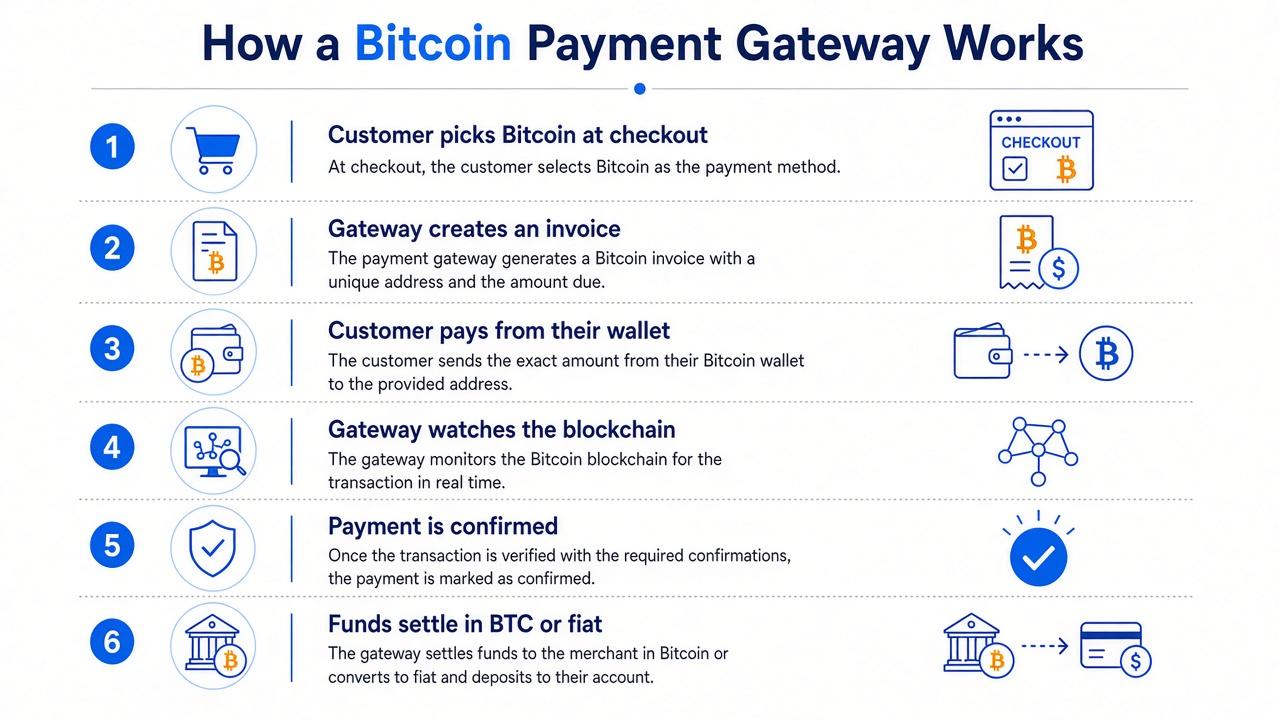
A Bitcoin payment gateway creates a payment request, watches the blockchain for the payment and tells your store when it is done. It works like a traditional gateway: it generates invoices, monitors blockchain confirmations and notifies the merchant when the payment has settled.
Here is the flow in simple steps:
The customer picks Bitcoin at checkout.
The gateway creates an invoice with the exact BTC amount and a unique address or Lightning invoice.
The customer pays from their wallet by scanning a QR code or tapping a link.
The gateway watches the network for the payment.
After enough confirmations, it marks the order as paid.
The funds go to your wallet or are converted to fiat.
Speed depends on the network. A small purchase might need 1 to 2 confirmations, about 10 to 20 minutes, while a high-value sale can wait for 6 confirmations, about an hour. The gateway lets you set this rule for each order size.
What Features Does a Bitcoin Payment Gateway Need?
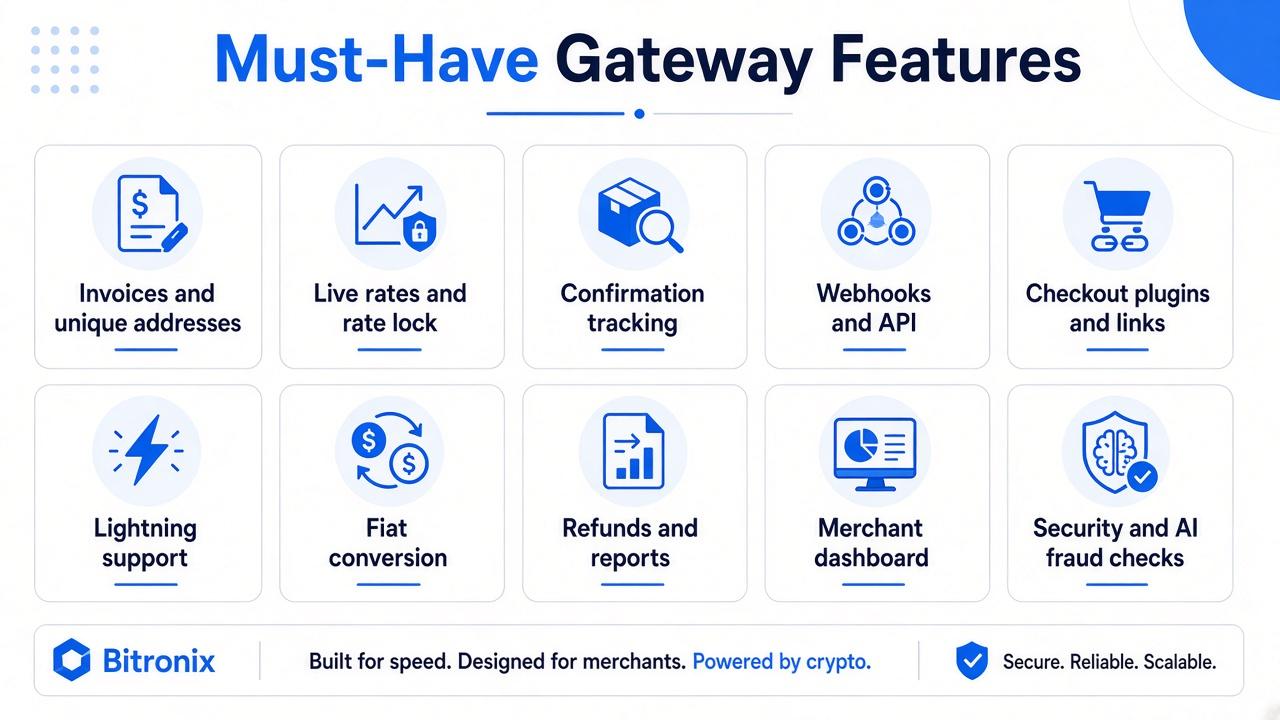
A good gateway handles the full payment lifecycle, from checkout to settlement. These are the features we plan for in most builds.
1. Invoice and Address Generation
Each order gets its own invoice with a fixed BTC amount and a fresh address. This keeps payments easy to match to orders.
2. Live Exchange Rates and Rate Locking
Products are priced in fiat. The gateway turns that into a BTC amount and locks the rate for a short time, so customers know what to pay.
3. Confirmation Tracking
The gateway watches the blockchain and updates the order as the payment moves from pending to confirmed. You choose how many confirmations to wait for.
4. Underpayment and Overpayment Rules
Customers sometimes send too little, too much or pay after the time runs out. Clear rules for each case save your support team hours.
5. Webhooks and API
Your store needs instant notice when a payment lands. Slow or missed webhooks mean merchants do not get confirmations, and under load even a short delay can turn into support tickets. A reliable webhook system is a must-have.
6. Checkout Page, Plugins and Payment Links
A hosted checkout page, plugins for Shopify, WooCommerce and Magento, and payment links and QR codes make the gateway easy to use.
7. Lightning Network Support
Lightning payments settle in seconds with very low fees. It suits small orders and fast checkout.
8. Fiat Conversion and Settlement
Get paid in USD, EUR or stablecoins at the moment of sale, so you avoid price swings and keep your books simple.
9. Refunds and Reporting
Refunds, payout reports and exports help your finance team close the books.
10. Merchant Dashboard
One place to see payments, payouts, refunds and settings.
11. Security and Compliance Tools
Wallet protection, KYC/AML options, transaction monitoring and audit logs.
12. AI Fraud and Risk Checks
AI can score wallets and payments, spot unusual patterns and flag risky orders for review before goods ship.
On-Chain or Lightning: Which Should You Build?
Many gateways support both. On-chain payments suit larger orders, and Lightning suits fast, small ones.
| Factor | On-chain Bitcoin | Lightning Network |
|---|---|---|
| Speed | Minutes to an hour | Seconds |
| Fees | Vary with network demand | Very low |
| Best for | Larger payments and invoices | Small orders, retail and checkout |
| Setup work | Simpler | Needs nodes and channel liquidity |
| Refunds | Sent as a new transaction | Sent through a new invoice |
On-chain costs can swing. On-chain transactions can take 10 to 30 minutes during congestion and cost anywhere from $1 to $12 in fees. Lightning, by comparison, is described as settling in under a second for less than a cent.
Our advice for most merchants is to launch with on-chain payments, then add Lightning once volume justifies the extra node work.
How Much Does Bitcoin Payment Gateway Development Cost?
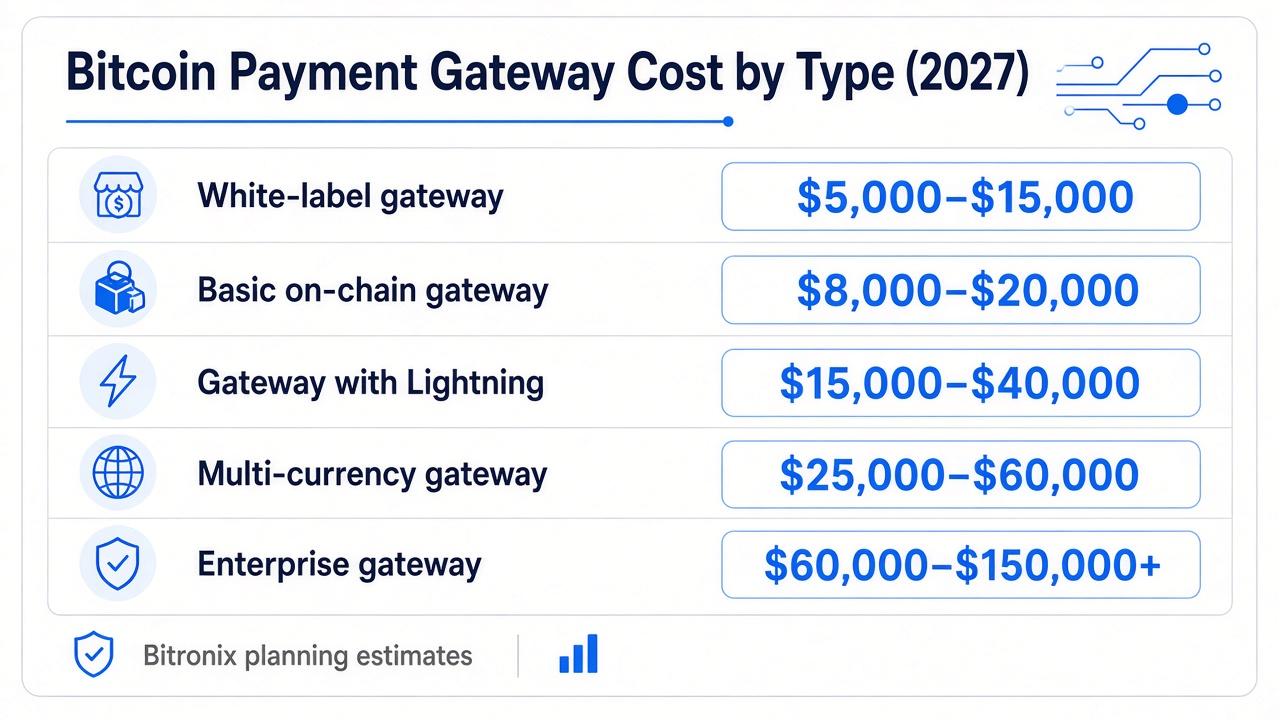
A Bitcoin payment gateway costs between $5,000 and $150,000+ in 2027. The range is wide because gateways differ a lot in scope.
Here are Bitronix planning estimates:
| Gateway type | Estimated cost (USD) | Typical timeline |
|---|---|---|
| White-label Bitcoin gateway | $5,000 – $15,000 | 3 to 6 weeks |
| Basic on-chain gateway | $8,000 – $20,000 | 6 to 10 weeks |
| Gateway with Lightning support | $15,000 – $40,000 | 2 to 4 months |
| Multi-currency gateway (BTC and stablecoins, fiat conversion) | $25,000 – $60,000 | 3 to 5 months |
| Enterprise gateway (multi-merchant, KYC/AML, high availability) | $60,000 – $150,000+ | 5 to 8 months |
These are planning ranges, not fixed quotes. Your final price depends on features, networks and compliance needs.
What Factors Change the Cost?
1. On-Chain Only or With Lightning
Lightning needs node setup, channel management and liquidity planning, which adds time and cost.
2. Custodial or Non-Custodial Design
In a non-custodial design, merchants control their own keys and funds go straight to their wallet. That lowers risk for the gateway owner. A custodial design, where you hold funds, needs stronger security and more compliance work.
3. Number of Currencies
Adding stablecoins and other coins means more networks to monitor and test.
4. Fiat Conversion
Connecting exchanges or liquidity partners adds integrations and rate handling.
5. Integrations
Store plugins, ERP and accounting links and POS support each add scope.
6. Security Depth
Multi-signature wallets, cold storage and external audits raise the price, and they are the last place to cut.
7. Compliance
KYC/AML, sanctions screening and reporting tools depend on the markets you serve.
8. Scale
A gateway for one store is far simpler than one that serves many merchants at high volume.
How Do You Integrate a Bitcoin Payment Gateway?
Integration means connecting the gateway to your store, your back office and your wallets. These six steps cover most projects.
Step 1: Pick Your Integration Type
Choose between a ready plugin, a hosted checkout link or a direct API. Plugins are fastest, and an API gives you full control over the checkout.
Step 2: Connect Your Store or App
Install the plugin or call the API to create invoices from your order system. Match each invoice to an order ID.
Step 3: Set Up Webhooks
Your store should receive a signed webhook when a payment is detected, confirmed or expired. Add retries so a missed message does not leave an order stuck.
Step 4: Configure Confirmation and Rate Rules
Set how many confirmations you need for each order size, how long the rate stays locked and what happens with underpayments.
Step 5: Link Accounting and Settlement
Send payment data to your accounting tool or ERP, and set up fiat conversion or payouts to your wallet.
Step 6: Test, Then Go Live
Test with small payments on a test network first. Check late payments, partial payments, refunds and webhook retries before real money moves.
Build Custom or Use an Existing Gateway?
Existing gateways are quick to start with. A custom gateway fits businesses that need control, special flows or lower long-term fees.
| Question | Existing gateway | Custom gateway |
|---|---|---|
| Upfront cost | Low | Higher |
| Launch time | Days | Weeks to months |
| Control over flows | Limited | Full |
| Ongoing fees | A share of each payment | Your own running costs |
| Best for | Testing Bitcoin payments | High volume, special needs, white-label products |
A custom gateway turns a recurring fee into a one-time, though large, development cost, but the road to your own gateway has real obstacles, starting with the upfront price. A good rule is to start with an existing gateway if you are still testing, and build custom once your volume or needs are clear.
What Are the Hidden and Ongoing Costs?
1. Node and Infrastructure
Bitcoin and Lightning nodes need servers, backups and monitoring. Lightning nodes should be treated as production systems, with high availability and geographic redundancy.
2. Lightning Liquidity
Channels need enough funds to route payments, and managing them takes time.
3. Exchange and Liquidity Partners
Fiat conversion usually comes with partner fees.
4. KYC and Compliance Tools
Identity checks and screening are often priced per check.
5. Security Audits
External reviews are a one-time cost at launch, and again after big changes.
6. Hosting and Monitoring
Servers, alerts and logging run every month.
7. Maintenance and Support
Plan on 15% to 20% of the build cost each year for updates, patches and new features.
What Security and Compliance Steps Matter?
Payments touch money and customer data, so plan these early.
- Wallet security: cold storage, multi-signature approval and key protection
- Webhook safety: signed requests and replay protection
- Fraud checks: wallet risk scoring and unusual pattern alerts
- KYC/AML: identity and sanctions checks where your markets require them
- Audit logs: clear records of payments, refunds and admin actions
- Legal review: rules differ by country and by whether you hold customer funds
Speak to a legal advisor before launch, especially if your gateway will hold funds for others.
How Long Does Development Take?
A white-label gateway takes 3 to 6 weeks, a basic gateway takes 6 to 10 weeks, and an enterprise platform takes 5 to 8 months.
Delays often come from changing the scope midway, waiting for exchange or KYC partners and fixes found during security testing. A clear scope at the start saves the most time.
How Can Bitronix Help You Build It?
Bitronix Technologies is a crypto payment gateway development company that builds gateways for stores, fintech firms, exchanges and payment providers.
- Bitcoin and multi-currency gateways with checkout, invoices and webhooks
- Lightning integration for fast, low-fee payments
- Store plugins and APIs for Shopify, WooCommerce and custom systems
- Fiat conversion and settlement in USD, EUR or stablecoins
- AI fraud and risk tools that flag unusual payments
- Audits, deployment and support after launch
We start with a short call, agree on the scope and share a fixed quote and timeline. You own the code and the gateway.
Is Bitcoin Payment Gateway Development Worth It?
It is worth it when Bitcoin payments fit your customers and your growth plans. You get faster settlement, no chargebacks and access to a global base of crypto holders.
The cost is easy to manage when you plan it. Start with the features you need, pick on-chain or Lightning based on your orders, budget for running costs and choose a team that is clear about what the price includes.
FAQs
What is a Bitcoin payment gateway?
It is software that lets a business accept Bitcoin, confirm the payment on the blockchain and update the order. It can also convert the funds to fiat.
How much does Bitcoin payment gateway development cost?
Bitronix planning estimates range from about $5,000 for a white-label gateway to $150,000+ for an enterprise platform. Most custom gateways cost between $8,000 and $60,000.
How long does it take to build one?
A white-label gateway takes 3 to 6 weeks, a basic gateway takes 6 to 10 weeks, and a gateway with Lightning or many currencies takes 2 to 5 months.
Should I support Lightning?
Lightning suits small orders and fast checkout, because it settles in seconds with low fees. Many businesses launch on-chain first and add Lightning later.
How many confirmations should I wait for?
It depends on order size. Small orders can use 1 to 2 confirmations, and large orders often wait for 6. The gateway lets you set a rule for each order size.
Can I get paid in fiat instead of Bitcoin?
Yes. The gateway can convert Bitcoin to USD, EUR or stablecoins at the moment of sale, so you avoid price swings.
Are there chargebacks with Bitcoin payments?
No. Bitcoin payments are final once confirmed, and refunds are sent by you as a new payment.
Can the gateway connect to my store?
Yes. We build plugins for Shopify, WooCommerce and Magento, and an API with webhooks for custom stores and apps.
Do I need a license to accept Bitcoin payments?
It depends on your country and on whether you hold customer funds. We build KYC/AML and reporting tools into the gateway, and we suggest speaking to a legal advisor before launch.
Let’s Talk About Your Gateway Project
Free consultation with our payments experts
Technically Reviewed By

Founder & CTO
Founder & CTO of Bitronix Technologies with 10+ years in enterprise software, blockchain and AI. Leads enterprise AI, blockchain and automation programmes from architecture through production delivery.
Related Posts
Saquib Fraz19 min read
Carbon Credit Tokenization: How It Works, Benefits, Process & Cost in 2027
Explore carbon credit tokenization, how it works, key benefits, development process, blockchain use cases, & platform costs starting at $5,000.
Read articleSaquib Fraz15 min read
Gold Tokenization Development: How to Build a Gold-Backed Digital Asset Platform
Learn how gold tokenization development works and how to build a gold-backed digital asset platform, from custody and smart contracts to compliance and cost.
Read articleSaquib Fraz13 min read
Crypto Wallet Development Cost in 2027: Complete Business Pricing Guide
How much does crypto wallet development cost in 2027? See prices by wallet type, cost factors, hidden fees, timelines and ways to save.
Read article