ERC-20 Token Development Company: Build & Launch Your Custom Token

By Tausif AhmedFounder and CTO
Launching a crypto project often starts with a simple question: What kind of token do you need, and how will it work inside your product?
For many Ethereum-based projects, ERC-20 is a practical starting point. It is a standard for fungible tokens, meaning each unit of the same token is interchangeable with another unit. The standard defines common functions for transferring tokens, checking balances, approving spending, and tracking the total supply.
But creating an ERC-20 token is more than writing a smart contract and deploying it. Token supply, distribution, permissions, wallet compatibility, contract security, and the purpose of the token all need to be considered before launch.
Bitronix provides custom ERC-20 token development services for businesses, startups, Web3 projects, and organizations that need a token designed around their specific use case.
What Is ERC-20 Token Development?
ERC-20 token development is the process of designing, coding, testing, and deploying a fungible token on Ethereum or an EVM-compatible network.
ERC-20 provides a common interface that helps tokens interact with other applications across the Ethereum ecosystem. This standardization is one reason ERC-20 tokens can be integrated with wallets, decentralized exchanges, and other blockchain applications.
A typical ERC-20 token contract defines important properties such as:
- Token name
- Token symbol
- Total supply
- Decimal places
- Token balances
- Transfer rules
- Spending approvals
- Allowances
Additional functionality can be added depending on the project's requirements.
Why Choose ERC-20 for Your Token?
ERC-20 is widely used because it gives developers a common structure for fungible tokens. Instead of creating an entirely new token interface, a project can follow an established standard and build its business logic around it.
Wallet Compatibility
ERC-20 tokens can be designed to work with wallets and applications that support the standard.
Easier Integration
Following a recognized token interface can simplify integration with other Ethereum-based applications.
Flexible Token Design
The contract can be customized according to the project's requirements.
Suitable for Different Use Cases
ERC-20 can be used for utility tokens, governance tokens, rewards, in-app assets, DeFi applications, and other fungible digital assets.
Ethereum Ecosystem Access
The standard is designed to make token contracts interoperable with other products and services within the Ethereum ecosystem.
ERC-20 Token Features We Can Develop
A token doesn't have to use the same feature set as every other project. The contract can be structured around what the token actually needs.
Fixed Supply Token
A fixed-supply token has a predefined maximum supply. Once the complete supply has been created, additional tokens cannot be minted if the contract is designed without a minting function. This model can be useful when predictable token supply is an important part of the project.
Mintable ERC-20 Token
A mintable token allows additional tokens to be created according to predefined permissions and rules. For example, minting may be controlled by:
- Owner
- Admin
- Governance contract
- Treasury
- Authorized smart contract
Minting permissions should be carefully designed because they directly affect token supply.
Burnable ERC-20 Token
Burn functionality allows tokens to be permanently removed from circulation. Burning can be used for:
- Supply reduction
- Token utility models
- Fee mechanisms
- Buyback systems
- Reward ecosystems
Pausable Token
A pausable token can include an emergency mechanism that temporarily stops certain token operations. This can be useful when a project needs a controlled response to a security incident or unexpected contract behavior.
Tax or Fee-Based Token
Some projects require transaction-related fees. Depending on the intended design, a portion of a transaction may be directed toward:
- Treasury
- Liquidity
- Rewards
- Development
- Community programs
However, these mechanisms should be clearly defined and tested because additional transfer logic can make a contract more complex.
Governance Token
An ERC-20 token can be used as part of a governance system where token ownership provides voting rights. The governance logic itself can be built separately or integrated with other smart contracts.
ERC-20 Token Development Services by Bitronix
At Bitronix, we can cover the development lifecycle from token planning to deployment.
Token Architecture
We define how the token should operate before development begins. This can include:
- Supply model
- Distribution structure
- Token permissions
- Transfer rules
- Minting rules
- Burning rules
- Administrative controls
Smart Contract Development
The ERC-20 smart contract is developed according to the agreed specifications. The contract can be kept simple or extended with additional functionality depending on the product requirements. Learn more about our smart contract development services.
Tokenomics Development
Tokenomics defines how the token fits into the wider project. Areas can include:
- Total supply
- Initial distribution
- Team allocation
- Community allocation
- Treasury
- Rewards
- Vesting
- Token utility
- Circulating supply
Good tokenomics should connect the token to a real purpose instead of adding features simply because they are available.
Smart Contract Testing
Before deployment, the contract should be tested against different scenarios. Testing can cover:
- Token transfers
- Approvals
- Allowances
- Minting
- Burning
- Access controls
- Supply calculations
- Edge cases
- Failure conditions
Smart Contract Security Review
Security review is an important part of token development. The review can focus on:
- Access control
- Integer and arithmetic issues
- Reentrancy risks where applicable
- Ownership controls
- Minting permissions
- Token transfer logic
- Approval-related behavior
- Unexpected contract interactions
Token Deployment
Once the contract has passed testing and the required review, it can be deployed to the selected blockchain network.
Wallet Integration
The token can be integrated with compatible wallets and applications based on the selected network and token architecture.
DEX Integration Support
If your business plans to create a trading market for the token, the required liquidity-pool and decentralized exchange integrations can be planned as a separate part of the project.
How Does ERC-20 Token Development Work?
A typical project can follow these stages.
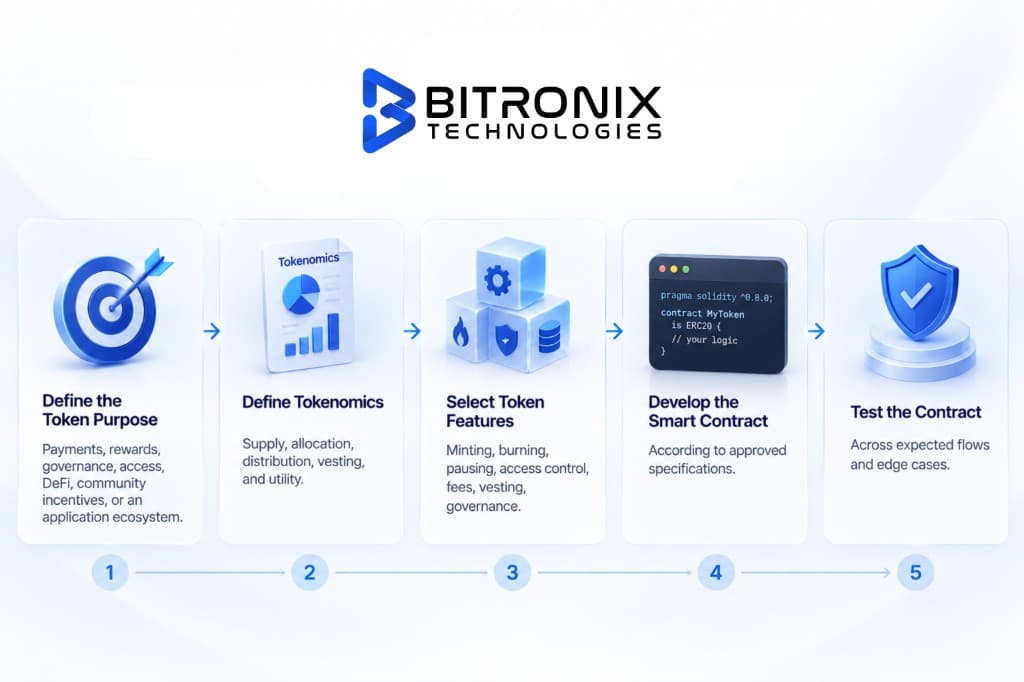
After testing, most launches continue with:
- Security review or independent audit where required
- Deploy the final contract to the selected network
- Integrate with wallets, applications, exchanges, or DeFi protocols
ERC-20 Token Development Process at Bitronix
We keep the development process focused on the actual product rather than adding unnecessary blockchain features.
- Business Consultation We understand the project, target users, token purpose, and business requirements.
- Token Planning The token model, supply, distribution, utility, and required smart contract features are defined.
- UI & Ecosystem Planning If the token is part of a larger product, we map how users will interact with it.
- Smart Contract Development The ERC-20 contract is developed according to the approved specifications.
- Testing The contract is tested across expected user flows and edge cases.
- Security Review The code is reviewed for vulnerabilities and access-control issues.
- Deployment The final contract is deployed to the selected blockchain.
- Integration & Support Wallets, applications, exchanges, dashboards, and other required components can be integrated.
ERC-20 Token Development Use Cases
ERC-20 tokens can serve different purposes depending on the project.
Utility Tokens
Give users access to products, features, services, or platform benefits.
Governance Tokens
Allow token holders to participate in governance systems.
DeFi Tokens
ERC-20 tokens can be used across different decentralized finance applications.
Reward Tokens
Businesses can use tokens to create loyalty, rewards, or incentive programs.
Gaming Tokens
Fungible tokens can support in-game economies and player rewards.
Community Tokens
Projects can create tokens for community participation and ecosystem incentives.
Payment Tokens
Tokens can be designed for payment or settlement within a specific ecosystem.
ERC-20 Token vs Other Ethereum Token Standards
ERC-20 is designed for fungible tokens, where units are interchangeable. Other standards serve different purposes.
| Standard | Common Purpose |
|---|---|
| ERC-20 | Fungible tokens |
| ERC-721 | Unique NFTs |
| ERC-1155 | Multiple fungible and non-fungible assets |
| ERC-4626 | Tokenized vaults |
Ethereum's documentation identifies ERC-20 as the standard interface for fungible tokens, while ERC-721 is used for non-fungible tokens and ERC-1155 can represent both fungible and non-fungible assets. Choosing the standard should therefore depend on what the asset needs to represent.
What Makes a Good ERC-20 Token Contract?
A token contract should not be judged only by whether it successfully deploys. A well-planned contract should have:
- Clear Token Rules Users should be able to understand how supply, transfers, and permissions work.
- Controlled Permissions Administrative functions should have clearly defined access controls.
- Tested Logic The contract should be tested before it handles real assets.
- Appropriate Complexity Only features that serve a real business requirement should be added.
- Transparent Supply The token's supply and minting rules should be clear.
- Security Review The contract should undergo appropriate security testing before launch.
How Much Does ERC-20 Token Development Cost?
There is no single development price for every ERC-20 token. The total cost depends on the scope of the project. Factors include:
- Smart contract complexity
- Tokenomics requirements
- Minting and burning features
- Governance functionality
- Vesting contracts
- Wallet integration
- DEX integration
- Security testing
- Independent audit
- Token dashboard
- Admin panel
- Deployment requirements
- Post-launch support
A simple ERC-20 contract will naturally require less development than a complete token ecosystem with vesting, staking, governance, liquidity, dashboards, and multiple integrations. For a broader cost breakdown, see our guide on crypto token launch cost in 2026.
How Long Does It Take to Develop an ERC-20 Token?
The timeline depends on the token's complexity. A straightforward token contract may require significantly less work than a complete token ecosystem. The development schedule can include:
- Requirement planning
- Tokenomics
- Contract architecture
- Development
- Testing
- Security review
- Deployment
- Integration
For a reliable estimate, the token features and complete project scope should be finalized first.
Why Choose Bitronix for ERC-20 Token Development?
At Bitronix, we focus on building blockchain products around the business requirement rather than treating token development as a one-size-fits-all service. Our ERC-20 development approach can cover:
- Token architecture
- ERC-20 smart contracts
- Tokenomics
- Custom token features
- Smart contract testing
- Security review
- Wallet integration
- DEX integration
- Token dashboards
- Vesting contracts
- Staking integration
- Governance integration
- Deployment
- Post-launch support
The result is a token that is designed to fit into your broader product or Web3 ecosystem. Explore our coin & token development services for related capabilities.
Final Thoughts
Creating an ERC-20 token is technically accessible, but building a token that fits into a real product requires more planning than simply deploying a smart contract.
The token's purpose, supply model, permissions, distribution, security, and integrations should all be considered before launch.
With the right architecture, an ERC-20 token can become part of a larger ecosystem involving wallets, DeFi applications, governance systems, marketplaces, exchanges, or Web3 products.
Bitronix helps businesses design and develop customized ERC-20 token solutions based on their product requirements, token model, and long-term blockchain roadmap.
Frequently Asked Questions
What is an ERC-20 token?
ERC-20 is a standard interface for fungible tokens on Ethereum. It defines common functions that allow tokens to be transferred, balances to be checked, and spending permissions to be managed.
Can I create a custom ERC-20 token?
Yes. The token name, symbol, supply, decimals, and additional contract functionality can be designed according to the project's requirements.
Can an ERC-20 token be mintable?
Yes. A token contract can include controlled minting functionality if the project requires additional token creation.
Can ERC-20 tokens be burned?
Yes. Burn functionality can be included to permanently remove tokens from circulation.
Can an ERC-20 token be used for governance?
Yes. ERC-20 tokens can be integrated with governance systems where token ownership is used as part of voting or participation rules.
Can my ERC-20 token be listed on an exchange?
A token can potentially be integrated with centralized or decentralized exchanges, but listing is subject to the requirements and approval processes of the particular platform.
Do ERC-20 tokens work with wallets?
ERC-20 tokens are designed around a standard interface that allows compatible wallets and applications to interact with them.
Is an ERC-20 smart contract audit necessary?
For projects handling meaningful value, an independent security review or audit can be an important risk-control step. The appropriate level of review depends on the contract's complexity and intended use.

Founder and CTO
Founder and CTO of Bitronix Technologies. Helps businesses design, audit, and launch secure, production-ready ERC-20 tokens and EVM smart contracts.
Related Posts
 Blockchain
September 18, 202616 min read
Bybit Clone Script: How to Build a Crypto Exchange Like Bybit
Build a Bybit-style crypto exchange with spot, futures, copy trading, trading bots, wallets, APIs, risk management, & customized trading features.
Read article Blockchain
September 17, 202613 min read
Why Are Crypto Exchanges Shutting Down in 2026? What CoinEx and BitMart Tell Us About the Future of Crypto Exchanges
Why are crypto exchanges shutting down in 2026? Explore CoinEx, BitMart, rising compliance costs, security, liquidity & the future of crypto exchange development.
Read article Blockchain
September 15, 202614 min read
CoinPayments Clone Script: Build Your Own Crypto Payment Gateway
Build a CoinPayments clone script with crypto payments, wallets, invoices, APIs, merchant tools, payouts, and multi-chain payment gateway features.
Read article