Bybit Clone Script: How to Build a Crypto Exchange Like Bybit

By Tausif AhmedFounder and CTO
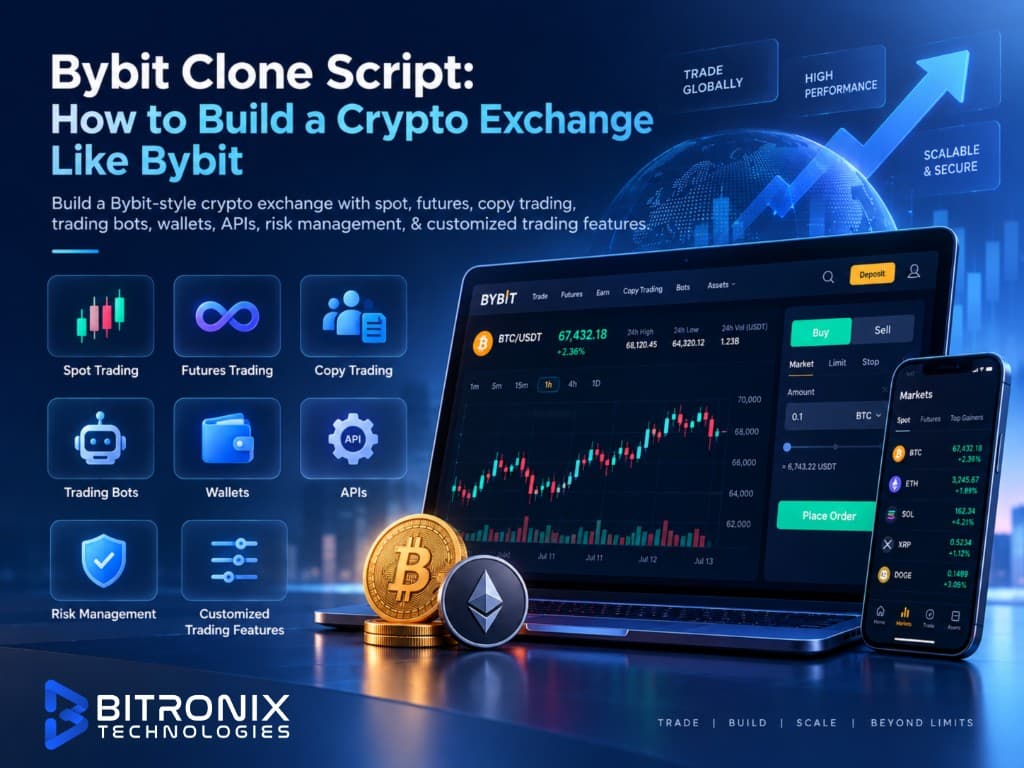
The cryptocurrency exchange market has moved far beyond simple buy-and-sell platforms.
Today's traders expect advanced order types, derivatives, automated trading, copy trading, portfolio tools, wallets, APIs, and a smooth experience across web and mobile. Bybit is one example of an exchange that has built its platform around advanced trading products, including derivatives and copy trading. Bybit's current documentation describes copy trading as a system where users can follow trades made by other traders, while its broader platform supports different trading and automation tools.
For businesses looking to enter this market, building everything from scratch can be a major undertaking.
A Bybit clone script can provide a starting point for developing an independent crypto exchange with similar types of trading functionality. The software can be customized with your own branding, supported assets, trading products, fee model, user interface, security controls, and business requirements.
At Bitronix, we help businesses plan and develop customized cryptocurrency exchange platforms based on the type of users they want to serve and the products they want to offer.
What Is a Bybit Clone Script?
A Bybit clone script is a customizable cryptocurrency exchange software solution inspired by the functionality of platforms such as Bybit.
It provides a foundation for developing your own crypto exchange rather than requiring every exchange component to be developed from the beginning.
The exact functionality can vary from one implementation to another, but a Bybit-style exchange may include:
- Spot trading
- Futures trading
- Perpetual contracts
- Margin trading
- Copy trading
- Trading bots
- Crypto wallets
- Advanced order types
- API trading
- Risk management
- Admin controls
- Liquidity integration
- Mobile applications
The important distinction is that a clone script should be treated as a starting point for an independent platform, not as a copy of another company's proprietary software, branding, or user experience.
Your exchange can have its own:
- Brand
- Domain
- Trading pairs
- Fee structure
- Supported markets
- User interface
- Business model
- Compliance approach
- Security architecture
Why Build a Crypto Exchange Like Bybit?
The main attraction of the Bybit-style model is its focus on active traders and advanced trading products.
A basic crypto exchange may only allow users to buy and sell assets.
A more advanced platform can provide a wider range of trading tools.
For example, Bybit currently offers copy trading where users can follow the trades of other traders, while its developer resources also describe derivatives, trading bots, APIs, risk-management tools, and other trading functionality.
This type of platform can be useful for businesses targeting:
- Professional traders
- Retail crypto traders
- Algorithmic traders
- High-frequency trading users
- Web3 communities
- Digital-asset investors
- Institutional or professional market participants
However, advanced trading products also bring greater technical and operational complexity.
That should be considered before development starts.
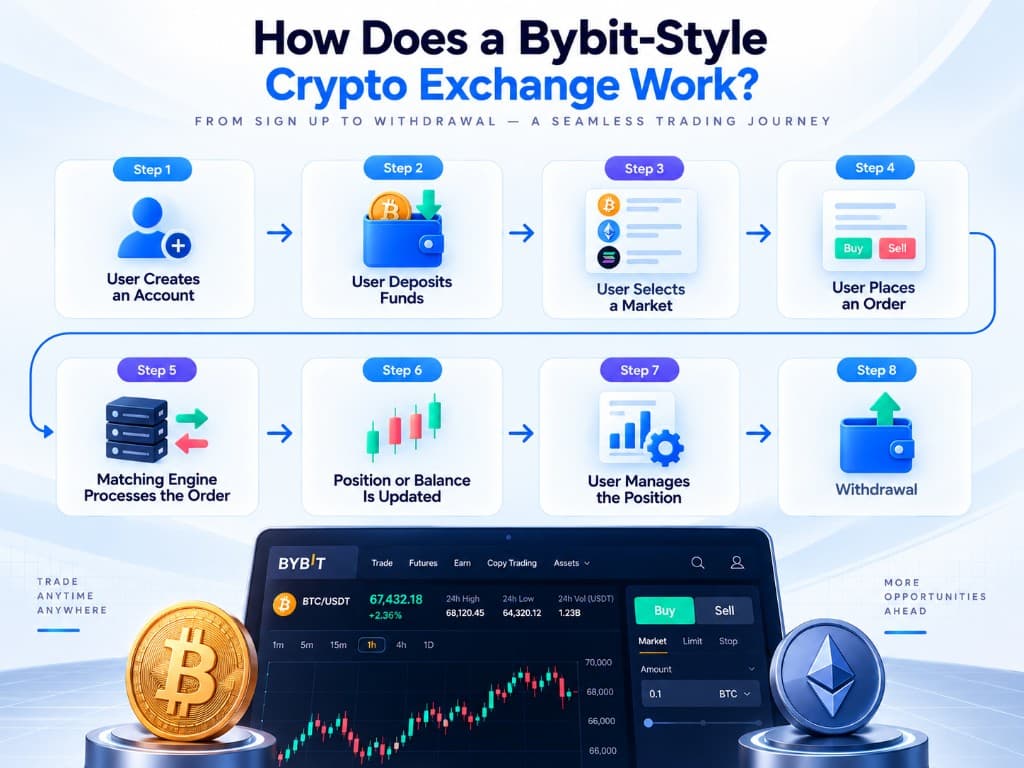
How Does a Bybit-Style Crypto Exchange Work?
The basic trading process is relatively simple from the user's perspective.
Step 1: User Creates an Account
The trader registers on the exchange and completes the required verification process.
Step 2: User Deposits Funds
The user deposits cryptocurrency or another supported asset into their exchange account.
Step 3: User Selects a Market
The trader chooses a trading pair or contract.
For example:
BTC/USDT
or a supported perpetual contract.
Step 4: User Places an Order
The trader can choose an order type such as:
- Market order
- Limit order
- Stop order
- Conditional order
depending on the products supported by the exchange.
Step 5: Matching Engine Processes the Order
The exchange's matching engine checks available buy and sell orders and matches compatible orders.
Step 6: Position or Balance Is Updated
After execution, the user's balance or trading position is updated.
Step 7: User Manages the Position
For derivatives, users may manage leverage, margin, stop-loss, take-profit, and other risk settings depending on the product.
Step 8: Withdrawal
The user can withdraw eligible assets to an external wallet according to the platform's rules and security controls.
Behind this simple user journey is a much larger infrastructure involving wallets, databases, order books, risk systems, blockchain nodes, APIs, security controls, and monitoring.
Key Features of a Bybit Clone Script
1. Spot Trading
Spot trading allows users to buy and sell cryptocurrencies at current market prices.
The exchange can provide:
- Trading pairs
- Order book
- Market orders
- Limit orders
- Trade history
- Charts
- Open orders
- Order history
Spot trading is often the starting point for a crypto exchange.
2. Futures and Perpetual Trading
Derivatives are a more advanced part of exchange development.
A futures or perpetual trading platform needs more than a normal order book.
The infrastructure may need to handle:
- Margin
- Leverage
- Position management
- Funding calculations
- Liquidation
- Risk limits
- Mark prices
- Position P&L
- Insurance mechanisms
This is one reason derivatives exchange development requires careful technical planning.
3. Copy Trading
Copy trading allows users to follow the trading activity of selected traders.
A typical system has two sides:
Master Trader → Follower
The master trader executes a trade, and the follower's account can replicate the trade according to the follower's selected parameters.
Bybit's current copy-trading documentation describes followers copying trades from master traders and notes that actual results can differ because of factors such as slippage and different execution points.
A custom copy-trading system can include:
- Trader profiles
- Performance history
- Follower management
- Copy allocation
- Risk settings
- Profit-sharing rules
- Trader rankings
- Copy history
- Stop-copy controls
Copy trading should not be presented to users as guaranteed or risk-free. Trading performance can change, and copied trades can produce different results from the original trader.
4. Trading Bots
Trading bots allow users to automate predefined trading strategies.
Depending on the exchange, the platform can support strategies such as:
- Grid trading
- DCA
- Rebalancing
- Algorithmic orders
- Strategy-based automation
Bybit's current developer resources list several automated trading approaches, including spot and futures grid bots, DCA bots, and other strategy tools.
For your own exchange, bots can be developed as an optional module rather than making them part of the initial MVP.
5. API Trading
Professional traders often want to connect external software to an exchange.
An API can allow users to:
- Read market data
- Check balances
- Submit orders
- Cancel orders
- Monitor positions
- Receive market updates
API access needs careful permission management.
For example, trading permissions can be separated from withdrawal permissions so that a compromised API key does not automatically provide unrestricted access to user funds.
6. Advanced Order Types
A professional trading platform can support different order types.
Common examples include:
Market Order
Executes against available market liquidity.
Limit Order
Allows a trader to specify the maximum or minimum price at which they want to trade.
Stop-Loss
Can be used to automatically exit a position when a defined condition is reached.
Take-Profit
Can automatically close a position after a target condition is met.
Conditional Orders
Can execute when a specific trigger condition occurs.
The exact order types should depend on the trading products your exchange offers.
7. Crypto Wallet
The wallet system is one of the most important components of an exchange.
It can support:
- Deposits
- Withdrawals
- Internal transfers
- Wallet balances
- Deposit addresses
- Transaction history
- Blockchain confirmations
A multi-chain exchange needs to account for the technical differences between supported networks.
Wallet infrastructure should also include appropriate security controls for private keys and transaction authorization.
8. Risk Management System
Risk management becomes especially important when an exchange offers margin or derivatives.
The system may monitor:
- Available margin
- Used margin
- Leverage
- Position size
- Unrealized P&L
- Liquidation price
- Maintenance margin
- Risk limits
The purpose is to prevent positions from creating losses that exceed the platform's defined risk parameters.
9. Liquidation Engine
A derivatives exchange needs logic for handling positions that no longer meet the required margin conditions.
The liquidation engine can monitor positions and initiate the appropriate process when predefined thresholds are reached.
This system needs to work closely with:
- Margin calculations
- Mark prices
- Risk limits
- Order execution
- Insurance mechanisms
Because liquidation affects customer positions and exchange risk, it should be thoroughly tested before production use.
10. Matching Engine
The matching engine is at the heart of an order-book exchange.
Its job is to match compatible buy and sell orders according to the exchange's trading rules.
A production exchange needs to consider:
- Low latency
- Order sequencing
- High throughput
- Market data updates
- Fault tolerance
- Recovery
- Scalability
The matching engine should be designed around the expected trading volume rather than simply adding hardware after the exchange becomes busy.
11. Liquidity Integration
An exchange needs sufficient liquidity for users to trade efficiently.
Liquidity can come from different sources depending on the business model, such as:
- Market makers
- External liquidity providers
- Internal liquidity
- Liquidity aggregation
- Strategic partnerships
Liquidity planning should happen alongside exchange development rather than being treated as a launch-day task.
12. Security Features
A crypto exchange handles valuable assets and sensitive user information, so security should be built into the architecture.
Possible security measures include:
- Two-factor authentication
- Multi-signature wallet controls
- Cold storage strategies
- Withdrawal restrictions
- IP controls
- Device monitoring
- Encryption
- Role-based access
- API permission controls
- Suspicious activity monitoring
- Audit logs
- DDoS protection
The appropriate security model depends on whether the exchange is custodial, non-custodial, or uses a hybrid architecture.
Admin Panel for a Bybit-Style Exchange
The admin dashboard gives the exchange operator control over the platform.
A comprehensive admin panel can include:
User Management
View users, verification status, account activity, and restrictions.
KYC Management
Review verification status and manage compliance workflows.
Trading Management
Manage trading pairs, markets, fees, and trading parameters.
Wallet Management
Monitor deposits, withdrawals, balances, and wallet activity.
Liquidity Management
Connect and monitor liquidity sources.
Risk Management
Monitor positions, margin, liquidation activity, and risk limits.
Fee Management
Configure trading, withdrawal, listing, and other applicable fees.
Content Management
Manage:
- Announcements
- Blog content
- FAQs
- Help pages
- Banners
- Platform notifications
Reporting
Generate reports for:
- Trading activity
- Deposits
- Withdrawals
- Revenue
- Users
- Compliance
- Transactions
Mobile App for a Bybit-Style Exchange
Traders increasingly expect to manage their positions from mobile devices.
A mobile exchange application can provide:
- Login and registration
- KYC
- Wallet
- Market prices
- Charts
- Trading
- Open orders
- Positions
- Copy trading
- Trading bots
- Notifications
- Deposit and withdrawal
- Account settings
The mobile experience should not simply be a smaller version of the desktop website.
Trading screens need to be designed specifically for smaller displays so that users can quickly see prices, positions, orders, and risk information.
Bybit Clone Script vs Custom Crypto Exchange Development
Businesses generally have two broad approaches.
| Factor | Bybit-Style Clone Foundation | Custom Exchange Development |
|---|---|---|
| Starting Point | Existing exchange framework | Built around requirements |
| Development Work | Can reduce initial work | More development from the beginning |
| Customization | High | Very high |
| Launch Approach | Faster depending on scope | Usually longer |
| Business-Specific Features | Can be added | Designed from the start |
| Initial Planning | Focuses on adapting existing modules | Requires detailed architecture |
| Suitable For | Startups and businesses testing an exchange model | Complex or highly specialized platforms |
A clone-based foundation can be useful when the goal is to avoid rebuilding common exchange modules from zero.
But it still needs customization, testing, security review, integrations, and deployment work before becoming a production platform.
How Much Does a Bybit Clone Script Cost?
There is no fixed cost for a Bybit-style crypto exchange.
The final development budget depends on what you actually want to launch.
Important cost factors include:
- Spot trading
- Futures trading
- Perpetual contracts
- Copy trading
- Trading bots
- Matching engine
- Wallet infrastructure
- Number of blockchain networks
- Liquidity integration
- KYC/AML integration
- Mobile apps
- API infrastructure
- Admin panel
- Security architecture
- Compliance requirements
- Third-party services
A basic spot exchange will have a very different development scope from a multi-product platform offering spot, derivatives, copy trading, automated trading, and mobile applications.
For this reason, feature scope should be defined before giving a final development estimate.
How Long Does It Take to Build a Bybit-Style Exchange?
The timeline depends on the platform's complexity.
A simple MVP with basic spot trading can be developed differently from an exchange with:
- Spot
- Futures
- Perpetuals
- Copy trading
- Trading bots
- Multi-chain wallets
- Liquidity integrations
- Mobile applications
- Advanced risk management
The development process usually includes:
Trying to rush an exchange into production without properly testing wallet transactions, order execution, risk calculations, and security controls can create serious problems later.
Revenue Models for a Bybit-Style Crypto Exchange
An exchange needs a clear business model in addition to good technology.
Trading Fees
Charge a fee when users execute trades.
Withdrawal Fees
Apply applicable fees to withdrawals.
Listing Fees
Projects can potentially pay for token listing services, subject to the exchange's policies and applicable requirements.
Derivatives Fees
Charge trading fees for futures or perpetual products where legally permitted.
API Plans
Offer different API access or professional trading packages.
Premium Services
Additional services can include advanced analytics, institutional tools, dedicated support, or custom integrations.
The fee model should be transparent and designed around the actual operating costs of the exchange.
Compliance Considerations for a Crypto Exchange
This is one area where a clone script alone is not enough.
Depending on the country and business model, an exchange may need to address:
- KYC
- AML
- Customer screening
- Transaction monitoring
- Regulatory reporting
- Data protection
- Tax requirements
- Licensing
- Travel Rule requirements where applicable
- Record keeping
The exact requirements vary by jurisdiction.
Businesses should therefore obtain appropriate legal and compliance advice before launching or offering regulated crypto services in a particular market.
How Bitronix Can Help With Bybit-Style Exchange Development
At Bitronix, we focus on building crypto exchange infrastructure around the business rather than simply reproducing another exchange's interface.
Our development scope can include:
- Crypto exchange development
- Bybit-style exchange development
- Spot exchange development
- Derivatives exchange development
- Futures and perpetual trading
- Copy trading
- Trading bots
- Matching engine
- Crypto wallet integration
- Liquidity integration
- API development
- Risk management
- Admin dashboard
- KYC/AML integration
- Mobile applications
- Security implementation
- Testing and deployment
- Post-launch support
We can also help separate the project into an MVP and future phases, so you don't have to launch every advanced feature on day one.
Bybit Clone Development Process at Bitronix
1. Business Requirement Analysis
We first understand your target users, market, trading products, supported assets, and business model.
2. Exchange Architecture
The trading engine, wallet infrastructure, database, APIs, blockchain connectivity, and security architecture are planned.
3. UI/UX Design
The trading interface, dashboard, wallet screens, mobile experience, and admin panel are designed around the intended users.
4. Core Development
The required exchange modules are developed and connected.
5. Blockchain & Liquidity Integration
The platform is connected with the required blockchain networks, wallets, liquidity providers, and third-party services.
6. Security & Testing
The exchange is tested for:
- Trading flows
- Wallet transactions
- API access
- User permissions
- Risk calculations
- Performance
- Security issues
7. Deployment
After testing, the exchange can be deployed to the selected infrastructure.
8. Ongoing Development
Additional markets, trading products, integrations, mobile features, and platform improvements can be introduced as the business grows.
Who Can Build a Bybit-Style Exchange?
A Bybit-style model may be relevant to:
Crypto Startups
Start with a focused exchange product and expand over time.
Fintech Businesses
Add digital-asset trading to an existing financial technology ecosystem where permitted.
Web3 Companies
Provide trading infrastructure for a broader blockchain product.
Investment Platforms
Build digital-asset trading functionality for an appropriate target market.
Entrepreneurs Entering the Crypto Market
Use a customizable exchange foundation rather than developing every component from scratch.
What Should You Build First?
One of the biggest mistakes in exchange development is trying to launch everything at once.
A more practical approach is to define the MVP.
For example:
Phase 1
- User registration
- KYC
- Wallets
- Spot trading
- Basic order types
- Deposits and withdrawals
- Admin panel
- Security controls
Phase 2
- Futures
- Perpetual contracts
- Advanced risk management
- Liquidity expansion
- API trading
Phase 3
- Copy trading
- Trading bots
- Mobile applications
- Advanced analytics
- Additional trading products
This phased approach lets the business validate the core exchange before adding more complex products.
Final Thoughts
Building a crypto exchange like Bybit is not simply about creating a trading screen that looks professional.
The real work happens underneath it.
A serious exchange needs a reliable matching engine, secure wallet infrastructure, liquidity, risk controls, APIs, monitoring, user management, and—when applicable—derivatives infrastructure capable of handling margin and liquidation.
Advanced features such as copy trading and trading bots can make an exchange more useful to active traders, but they also add another layer of development and risk management. Bybit's current documentation shows how copy trading itself involves master traders, followers, configurable copy parameters, and risks such as slippage.
That is why the best approach is not to copy every feature available on an established exchange.
Instead, build the exchange your customers actually need.
Start with the core trading experience. Build the security and operational foundation properly. Then add derivatives, copy trading, automation, mobile apps, and other features as the business grows.
Bitronix can help you plan and develop a customized crypto exchange platform around your business model, target market, and technical requirements.
Build Your Crypto Exchange With Bitronix
Talk to Bitronix about your exchange requirements and get a clear development roadmap for your project.
Talk to Bitronix about your exchange requirements and get a clear development roadmap for your project.
Frequently Asked Questions
What is a Bybit clone script?
A Bybit clone script is a customizable crypto exchange software foundation inspired by the functionality of Bybit. It can be adapted with your own branding, trading products, features, integrations, and business rules.
Can I build a crypto exchange like Bybit?
Yes. A Bybit-style exchange can be developed with features such as spot trading, derivatives, perpetual contracts, copy trading, trading bots, wallets, APIs, and risk-management systems, depending on the project scope.
Can I customize the Bybit clone script?
Yes. The user interface, branding, trading pairs, fees, supported assets, wallet structure, trading features, admin panel, and other components can be customized.
Can a Bybit clone support futures trading?
Yes. Futures and perpetual trading can be developed, but these products require additional infrastructure for margin, risk management, funding calculations, liquidation, and position management.
Can I add copy trading?
Yes. A custom copy-trading module can connect master traders and followers and allow followers to configure how trades are replicated. Bybit currently uses a similar master-trader/follower model.
Can I add trading bots?
Yes. Automated trading modules such as grid or DCA strategies can be developed depending on the exchange's requirements.
Can the exchange have a mobile app?
Yes. iOS and Android applications can be developed alongside the web exchange.
How much does a Bybit clone script cost?
The cost depends on the exchange model, trading products, wallet infrastructure, number of blockchains, liquidity, security, compliance, mobile apps, and integrations required.
Is a Bybit clone legal?
A software clone is not automatically a license to operate a cryptocurrency exchange. The legality and regulatory requirements depend on the jurisdiction, services offered, custody model, customer base, and applicable laws. Obtain appropriate legal and compliance advice before launch.

Founder and CTO
Founder and CTO of Bitronix Technologies. Helps founders scope Bybit-style exchanges around matching engines, derivatives risk, wallets, and phased MVP delivery.
Related Posts
 Blockchain
September 17, 202613 min read
Why Are Crypto Exchanges Shutting Down in 2026? What CoinEx and BitMart Tell Us About the Future of Crypto Exchanges
Why are crypto exchanges shutting down in 2026? Explore CoinEx, BitMart, rising compliance costs, security, liquidity & the future of crypto exchange development.
Read article Blockchain
September 16, 202611 min read
ERC-20 Token Development Company: Build & Launch Your Custom Token
Build a custom ERC-20 token with Bitronix. Get smart contract development, tokenomics, testing, security review, wallet integration, and deployment support.
Read article Blockchain
September 15, 202614 min read
CoinPayments Clone Script: Build Your Own Crypto Payment Gateway
Build a CoinPayments clone script with crypto payments, wallets, invoices, APIs, merchant tools, payouts, and multi-chain payment gateway features.
Read article