Crypto Token Development Cost in 2027: Pricing, Features and Budget Breakdown

By Tausif AhmedFounder and CTO
If you are planning to create a cryptocurrency token, one of the first questions you will probably ask is, “How much will it cost?”
The answer depends on what you want your token to do. A basic token created on an existing blockchain requires less work than a project with staking, governance, custom transaction rules, or connections to a decentralized application.
The development budget also depends on security testing, tokenomics, integrations, and the support you need after deployment. These expenses are easy to overlook when you focus only on creating the token.
For businesses, startups, and founders planning a crypto project in 2027, understanding these costs before development begins can help avoid unexpected expenses.
In this guide, Bitronix Technologies explains the estimated cost of crypto token development, the factors that affect pricing, the features that increase the budget, and the expenses to consider before launching a token.
How Much Does Crypto Token Development Cost in 2027?
Crypto token development costs depend on the scope of the project rather than a single fixed price.
A token with a standard supply and basic transfer functionality requires less development work than one with complex financial rules, investor restrictions, or multiple smart contracts.
The following table provides indicative planning estimates for different project types. These are not fixed quotations or guaranteed market prices.
| Token project type | Estimated development cost |
|---|---|
| Basic token with standard features | $5,000-$15,000 |
| Custom utility token | $10,000-$25,000 |
| Token with vesting or advanced controls | $15,000-$35,000 |
| Governance or staking token | $20,000-$50,000+ |
| Multi-chain token project | $25,000-$60,000+ |
| RWA or compliance-focused token platform | $50,000-$150,000+ |
These estimates cover different levels of development work and should not be treated as directly comparable packages. For example, a basic token quote may exclude an independent audit, legal services, a website, exchange integrations, and marketing.
A regulated token platform may also require legal and compliance work beyond the technical development budget.
The final price depends on the features, selected blockchain, security requirements, and deliverables agreed upon with the development team.
What Is Included in Crypto Token Development?
Before comparing quotations, it helps to understand what a development company may actually build.
1. Token Planning and Requirements
The project starts with deciding why the token is needed, who will use it, and what it should do.
A business may want a utility token for platform access, a governance token for voting, or a digital token representing an eligible asset.
The development team uses these requirements to plan the token structure, technical approach, and development scope.
2. Blockchain and Token Standard Selection
The team selects a blockchain and the appropriate token standard based on the project's needs.
For example, an Ethereum-compatible project may use ERC-20 for a fungible token, while a Solana project may use the SPL token framework.
This decision affects the programming environment, wallet support, deployment process, integrations, and ongoing network fees.
3. Smart Contract Development
The smart contract defines how the token behaves.
Depending on the project, it may control token transfers, supply limits, minting, burning, access permissions, or other custom functions.
A simple contract requires less work than one with multiple interacting features. Every additional function should have a clear purpose because more complexity can increase testing and security requirements.
4. Testing and Security Review
The contract needs to be tested before deployment.
Testing can include checking token transfers, supply limits, permissions, unusual inputs, and interactions with other contracts. Projects that manage significant value may also need an independent security audit.
The cost of this work depends on the codebase, contract complexity, and level of assurance required.
5. Deployment and Documentation
After testing and approval, the token contract can be deployed to the selected network.
The project may also require verified source code, deployment documentation, wallet configuration, and instructions for the team responsible for operating the token.
A complete development quotation should explain which of these items are included.
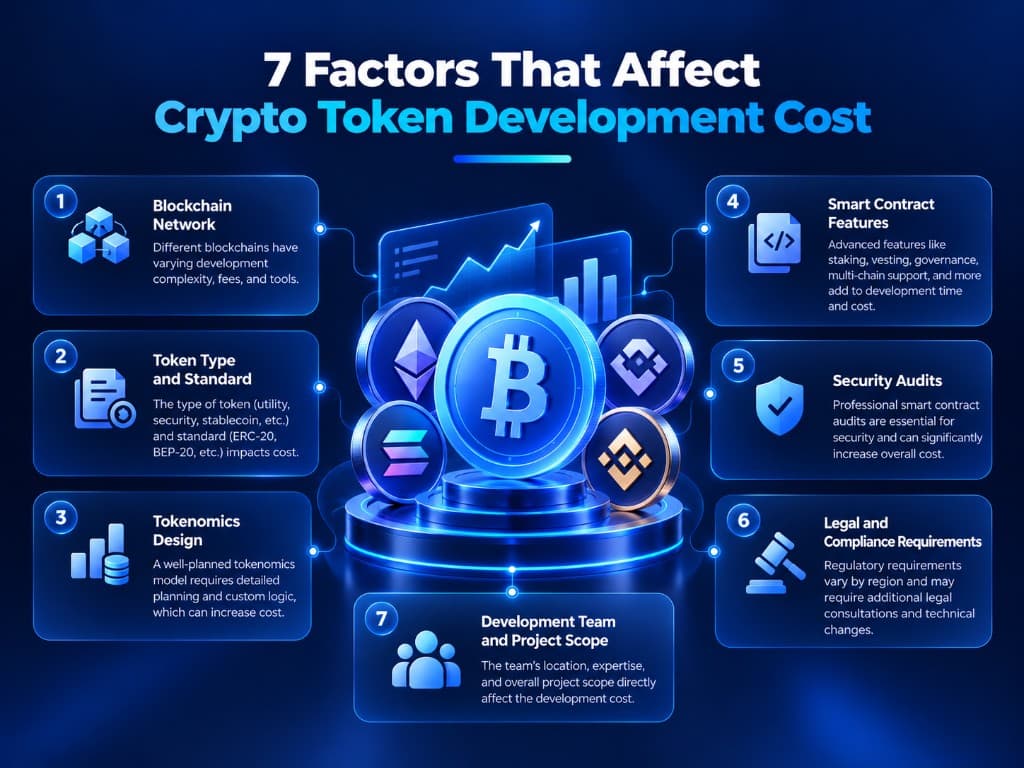
7 Factors That Affect Crypto Token Development Cost
Two token projects can use the same blockchain and still have very different budgets. The difference usually comes from their requirements and the work needed to implement them safely.
1. Blockchain Network
The blockchain you choose influences the technical work and operating costs.
Ethereum, BNB Smart Chain, Polygon, Base, and Solana have different ecosystems, tools, transaction fees, and integration requirements.
A team familiar with the chosen network may be able to work more efficiently. However, the cheapest network is not necessarily the best option for every project.
Before choosing a blockchain, consider:
- Where your target users already operate.
- Which wallets and applications need to support the token.
- Expected transaction volume and fees.
- Security and ecosystem maturity.
- Whether future integrations or multi-chain support are required.
2. Token Type and Standard
A basic utility token has different requirements from a governance token or a token designed to represent an eligible real-world asset.
For example, a standard fungible token may require relatively straightforward transfer and supply functions. A compliance-focused asset token may need additional eligibility checks, permission controls, and integrations.
Choose the token type based on its intended use, not simply because a particular standard is popular.
3. Tokenomics Design
Tokenomics describes the economic rules around a token, including its supply, distribution, utility, and incentives.
A project may need decisions about:
- Total token supply.
- Initial distribution.
- Team and investor vesting.
- Minting or burning rules.
- Staking rewards.
- Governance rights.
- Treasury allocation.
A simple token model can be relatively easy to implement. A model with complex rewards, changing supply, or multiple incentive mechanisms requires more planning and testing.
Good tokenomics cannot guarantee market demand, but unclear or poorly planned rules can create problems for users and the business.
4. Smart Contract Features
Features have a direct effect on the amount of development and testing required.
A token with standard transfer functions has a smaller scope than a contract that includes staking, governance, vesting, and transaction restrictions.
| Feature | Why it can increase cost |
|---|---|
| Minting and burning | Requires supply controls and permission testing |
| Vesting schedules | Requires release rules and time-based testing |
| Staking and rewards | Adds reward calculations and withdrawal logic |
| Governance | Requires voting rules and proposal management |
| Transaction fees or taxes | Adds transfer logic and additional edge cases |
| Multi-chain support | Requires network-specific implementation and testing |
| Upgrade mechanisms | Adds administration controls and upgrade risks |
Not every project needs these features. Start with what users genuinely need and add more functionality when there is a clear business reason.
5. Security Audits
Security should be part of the original project plan rather than an expense added at the last minute.
A token contract may contain errors in permission checks, supply management, transfer rules, or interactions with other contracts. These issues can expose the project to financial loss or operational problems.
Security work may include automated analysis, manual code review, internal testing, and an independent audit.
The amount depends on the complexity of the contracts and the potential consequences of a vulnerability. An audit also does not guarantee that a contract is completely secure.
6. Legal and Compliance Requirements
The intended use of a token and the countries in which it will be offered can affect the project budget.
A token used for access to a software platform may raise different legal questions from one that represents investment rights or interests in real-world assets.
Depending on the project, professional legal advice may be needed for token classification, disclosures, investor eligibility, identity verification, and other obligations.
These requirements should be assessed before the technical design is finalized. Technical controls can support compliance, but they do not replace legal advice.
7. Development Team and Project Scope
The total cost also depends on who builds the project and what the quotation includes.
A proposal covering only a token contract is not equivalent to one that includes tokenomics, testing, independent audits, a dashboard, wallet integration, documentation, and post-launch support.
When comparing providers, ask for an itemized estimate with clear deliverables, milestones, exclusions, and maintenance terms.
Crypto Token Development Cost by Project Example
Looking at practical examples can help you understand which budget range may fit your project.
Example 1: Utility Token for a Business Platform
Imagine a software company wants a token that users can spend on selected platform features.
The project may need a standard token contract, supply rules, wallet compatibility, basic testing, and deployment.
Indicative development budget: $5,000-$15,000.
This estimate assumes a relatively simple token and excludes major custom integrations, extensive legal work, independent audits, and marketing unless included in the agreed scope.
Example 2: Community Token With Vesting
A startup wants to issue a token for its community and manage the release of team or investor allocations over time.
The project may need token contracts, vesting schedules, administrative controls, testing, and deployment support.
Indicative development budget: $10,000-$30,000.
The actual price depends on the vesting design, the number of contracts, the required dashboard, and the security review.
Example 3: Governance or Staking Token
A blockchain project wants token holders to participate in governance or receive rewards through a staking mechanism.
This project requires more than token creation. The team must implement and test the relevant reward or voting rules, access controls, and interactions between contracts.
Indicative development budget: $20,000-$50,000+.
The budget can increase if the project includes a full decentralized application, treasury controls, complex reward calculations, or extensive independent security reviews.
Example 4: Real-World Asset Tokenization Platform
A business plans to represent eligible real-world assets through blockchain tokens.
In addition to token contracts, the platform may require investor onboarding, eligibility controls, an administrative portal, integrations, legal structuring, and security reviews.
Indicative technical development budget: $50,000-$150,000+.
This is a broad planning range, not a complete estimate of all costs. Legal, regulatory, custody, asset administration, and operational expenses may increase the overall investment substantially.
Hidden Costs to Consider Before Launching a Token
The development quotation is only one part of the budget. A token project may also have expenses before and after deployment.
Blockchain Transaction Fees
Deploying contracts and processing transactions may require network fees. These depend on the chosen blockchain, network conditions, and transaction activity.
Liquidity and Exchange Integrations
A token intended for trading may need liquidity arrangements or integrations with decentralized or centralized exchanges.
Exchange access is not guaranteed, and listing fees, liquidity requirements, and commercial terms vary. Treat these as separate budget items rather than assuming they are included in development.
Website and User Dashboard
Some projects need a website, token dashboard, wallet connection, administration panel, or investor portal.
These components may require separate frontend and backend development.
Marketing and Community Management
A token launch may involve content, community support, educational materials, and other marketing activities. These expenses depend on the project's audience and launch plan.
Marketing does not guarantee demand or token value.
Monitoring and Maintenance
After deployment, the project may need monitoring, infrastructure, incident response, integration updates, and support.
Some contracts cannot be modified directly once deployed. The team should plan for upgrades, migrations, or emergency procedures where applicable.
The best approach is to prepare separate budgets for development, launch, and ongoing operations.
How to Reduce Crypto Token Development Costs
Reducing costs does not mean skipping security or choosing a blockchain simply because it has lower fees. It means avoiding unnecessary work.
Start with a clear use case. Define what the token will do and why users need it before adding features.
Use an established token standard where suitable. A standard implementation may reduce unnecessary custom development, although it still needs proper configuration and testing.
Choose the blockchain carefully. Consider users, integrations, transaction costs, and security requirements together.
Build essential features first. Launch a focused first version instead of paying for every possible feature from the beginning.
Plan security early. Early reviews can identify design problems before they become expensive to fix.
Request itemized quotations. Compare deliverables, audit arrangements, deployment support, and maintenance rather than comparing headline prices alone.
A lower initial price is not always a lower total cost. Missing documentation, weak testing, or unclear ownership can create additional expenses later.
How Long Does Crypto Token Development Take?
Development time depends on the same factors that affect cost.
| Project type | Indicative development timeline |
|---|---|
| Basic token | 1-3 weeks |
| Custom utility token | 2-5 weeks |
| Token with vesting or governance | 4-8 weeks |
| Complex token application | 2-4 months or longer |
| RWA or compliance-focused platform | Several months or longer |
These timelines are planning estimates, not guaranteed delivery dates. They can change with project scope, testing results, third-party reviews, integrations, and legal requirements.
A simple contract may be completed relatively quickly, but a production-ready application needs more than code deployment. Testing, documentation, security review, and launch preparation should all be included in the schedule.
How to Choose the Right Crypto Token Development Company
The development partner you choose can affect the project's quality, cost, and long-term maintenance.
Before making a decision, ask these questions:
- 1. Has the company worked with the blockchain and token standard your project requires?
- 2. Does the team explain the proposed architecture and feature scope clearly?
- 3. What testing and security review processes are included?
- 4. Is an independent audit included, recommended, or quoted separately?
- 5. Who controls the deployment keys and administrative permissions?
- 6. What documentation and source code will you receive?
- 7. What support is available after deployment?
- 8. Which costs are excluded from the quotation?
Look for clear communication, realistic estimates, appropriate security practices, and a scope that matches your business requirements.
Avoid choosing a provider based only on promises of quick deployment or low prices. A token project needs a sound technical design and a realistic operating plan.
Final Conclusion
Crypto token development cost in 2027 depends on what you are building, how the token will be used, and how much security and infrastructure the project needs.
A basic token may fit within a budget of several thousand dollars, while a project with staking, governance, complex integrations, or real-world asset features can require a much larger investment. Legal work, audits, liquidity, and ongoing operations can add further costs.
Before starting development, define the token's purpose, choose a suitable blockchain, decide which features are essential, and prepare a budget for both development and post-launch support.
If you are planning a token for your business, Bitronix Technologies can help you assess the technical requirements and identify the development scope that fits your goals.
Explore our Crypto Token Development Services to discuss your project requirements and request a tailored estimate.
Frequently Asked Questions
1. How much does crypto token development cost in 2027?
A basic professionally developed token may cost around $5,000-$15,000. Custom tokens can cost $10,000-$35,000, while advanced governance, staking, multi-chain, or compliance-focused projects may cost $50,000 or more. Actual pricing depends on scope and deliverables.
2. What is the cheapest way to create a crypto token?
Using an established token standard on a suitable blockchain can reduce development work. However, the total budget should still account for configuration, testing, deployment, security requirements, and any legal obligations.
3. What factors affect crypto token development cost the most?
The biggest factors are project complexity, blockchain selection, tokenomics, custom smart contract features, security reviews, integrations, and regulatory requirements.
4. How much does it cost to create an ERC-20 token?
An ERC-20 token with standard functionality may fit within the basic token development range of approximately $5,000-$15,000 for a professionally scoped project. Custom features, audits, dashboards, and integrations can increase the price.
5. Is token development cheaper than creating a cryptocurrency coin?
Usually, yes. A token uses an existing blockchain, whereas a native coin generally requires building or adapting blockchain infrastructure. The actual cost depends on the network design, security, features, and project scope.
6. Does crypto token development include a smart contract audit?
Not always. Some quotations include security reviews, while others charge separately for an independent audit. Confirm the exact audit scope, provider, and deliverables before signing a development agreement.
7. How long does it take to develop a crypto token?
A basic token may take one to three weeks, while custom tokens can require several weeks. Complex token applications may take several months, especially when extensive testing, integrations, or compliance requirements are involved.
8. Are exchange listing fees included in token development costs?
Not necessarily. Exchange integrations, listing arrangements, liquidity, and market-making services are often separate expenses. Fees and requirements vary by exchange, and listing is never guaranteed.
9. What are the ongoing costs after a token launch?
Ongoing expenses may include infrastructure, monitoring, maintenance, security reviews, community support, legal advice, and liquidity management. The amount depends on the token's purpose and operating model.
10. How can I get an accurate crypto token development estimate?
Define your token's purpose, blockchain, required features, integrations, security needs, and launch requirements. A development company can then prepare an itemized estimate based on the actual scope.

Founder and CTO
Founder and CTO of Bitronix Technologies. Helps businesses scope, build and secure crypto tokens, from tokenomics and smart contracts to audits, deployment and post-launch support.
Related Posts
 Blockchain
October 1, 202613 min read
Top 10 Companies to Hire Blockchain Developers in India 2026-2027
Find the top 10 companies to hire blockchain developers in India. Compare blockchain services, expertise, use cases, & tips for choosing a development partner.
Read article Blockchain
September 25, 202616 min read
RWA Tokenization in Singapore: Regulations, Licensing & Complete Guide 2026
Learn about RWA tokenization in Singapore, including MAS regulations, licensing, compliance, use cases, costs and how to build an RWA platform in 2026.
Read article Blockchain
September 22, 202614 min read
Top 10 AI-Powered Blockchain Development Companies in 2026-2027
Explore the top AI and blockchain development companies in 2026, including Bitronix, Nihon Infotech, IBM, TCS, Infosys, Accenture and other technology providers.
Read article