RWA Tokenization in Singapore: Regulations, Licensing & Complete Guide 2026

By Tausif AhmedFounder and CTO

Singapore has become an important market for businesses exploring real-world asset tokenization. Financial institutions and technology companies are testing ways to represent assets such as funds, bonds, private credit and other financial instruments on blockchain networks. The Monetary Authority of Singapore (MAS) has supported this development through initiatives such as Project Guardian, which brings together financial institutions and technology providers to explore practical applications of tokenized assets.
But launching an RWA tokenization platform in Singapore is not simply a matter of creating a token and putting it on a blockchain. The legal rights attached to the token, the underlying asset, the services provided by the platform, the target investors, custody model and transaction flow can all affect the regulatory requirements.
In this guide, we explain how RWA tokenization in Singapore works, how MAS regulation can apply, the major licensing considerations, compliance requirements, use cases, development process, costs and what businesses should consider before building a tokenization platform.
What Is RWA Tokenization?
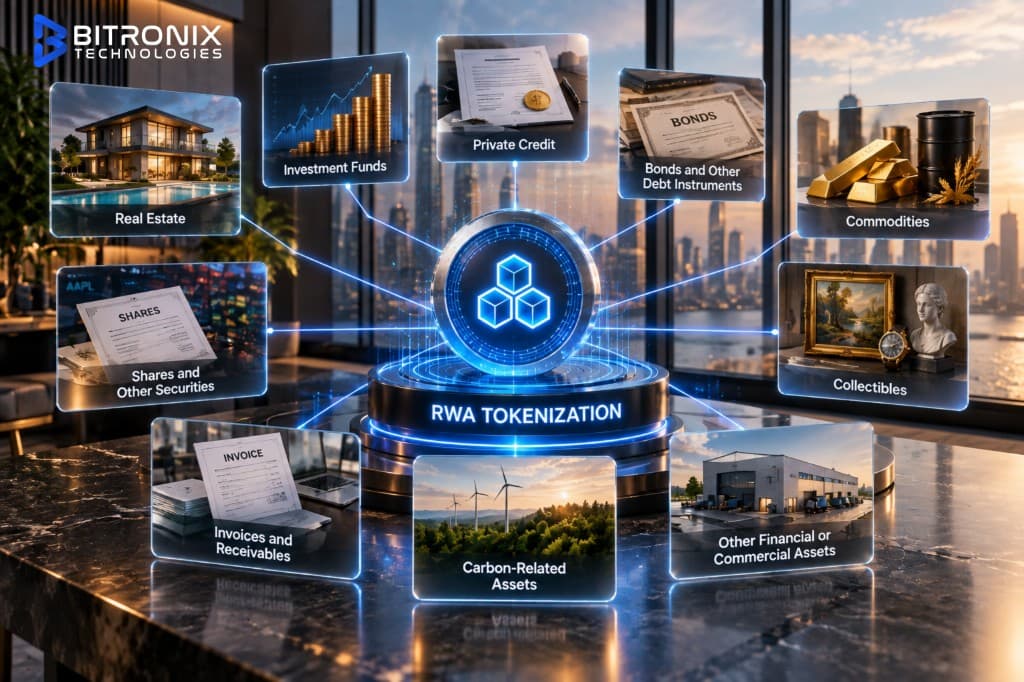
Real-world asset tokenization is the process of representing rights to an asset or financial product through digital tokens recorded on a blockchain.
Depending on the structure, the underlying asset may include:
- Real estate
- Investment funds
- Private credit
- Bonds and other debt instruments
- Commodities
- Shares and other securities
- Collectibles
- Invoices and receivables
- Carbon-related assets
- Other financial or commercial assets
The important point is that tokenization does not automatically change the legal nature of the underlying asset.
For example, if a token represents an investment interest with characteristics of a regulated capital markets product, the fact that it exists on a blockchain does not necessarily remove it from financial regulation.
That is why legal structure and token design should be considered before blockchain development begins.
Why Is Singapore Important for RWA Tokenization?
Singapore has developed a financial and technology ecosystem that supports experimentation with digital assets and tokenized financial products.
MAS launched Project Guardian to explore the potential of asset tokenization and decentralized finance applications. Its industry participants have worked on areas including tokenized funds, fixed income, foreign exchange and other financial-market applications.
The country also has established financial-market regulations covering areas such as securities, payments, fund management, financial crime controls and technology risk.
For businesses, this creates an environment where tokenization can be explored within existing financial and regulatory structures rather than treating blockchain as a completely separate financial system.
However, Singapore should not be viewed as a blanket approval for every type of RWA project. The applicable rules depend heavily on what the token represents and what the business actually does.
How Is RWA Tokenization Regulated in Singapore?
There is no single "RWA tokenization license" that applies to every project.
Instead, the regulatory treatment can depend on factors such as:
- What the token represents
- Whether it creates investment or ownership rights
- Whether it is a payment instrument
- Whether the platform facilitates trading
- Whether the business provides custody
- Whether assets are managed on behalf of investors
- Who the target customers are
- Whether the activity takes place in Singapore
This makes legal and regulatory classification one of the first steps in an RWA project.
1. Capital Markets Products
Some tokenized assets can fall within Singapore's capital markets regulatory framework when the token represents rights associated with securities or other regulated financial products.
Examples can include tokenized interests related to:
- Shares
- Bonds
- Funds
- Units
- Derivatives
- Other investment products
If the tokenized structure falls within the relevant capital markets regime, the business may need to consider requirements under the Securities and Futures Act and applicable MAS regulations.
The exact requirement depends on the product and the activity being performed.
2. Digital Payment Tokens
Singapore separately regulates certain digital payment token activities under the Payment Services Act.
This category is relevant when a business provides regulated payment services involving digital payment tokens.
It is important not to automatically classify every RWA token as a digital payment token. The economic function and use of the asset matter.
MAS maintains a Financial Institutions Directory showing entities licensed for regulated activities, including digital payment token services.
3. Utility-Oriented Tokens
Some tokens are created to provide access to a product, service, platform feature, or ecosystem rather than represent an investment interest.
Even in these cases, businesses should examine the actual rights and economic characteristics of the token rather than relying only on the label "utility token."
The name given to a token does not by itself determine its regulatory treatment.
Singapore RWA Tokenization Licensing Considerations
The licensing requirements depend on the business model.
A project should first identify the activities it plans to perform.
Capital Markets Services License
A CMS license may become relevant when a business performs regulated capital markets activities.
Depending on the structure, activities can include areas such as:
- Dealing in capital markets products
- Fund management
- Advising
- Arranging transactions
- Certain custody-related activities
The precise licensing position should be assessed against the actual business model.
Recognized Market Operator Considerations
If a business intends to operate a marketplace where regulated tokenized securities are traded, it may need to consider Singapore's regulatory framework for market operators.
The requirements can vary depending on the structure and activities of the marketplace.
Therefore, an RWA platform should determine whether it is:
- Only issuing tokens
- Providing a primary issuance platform
- Operating a secondary trading venue
- Matching buyers and sellers
- Providing custody
- Providing settlement services
These distinctions can materially change the regulatory analysis.
Payment Services Act Considerations
If the platform performs regulated payment services involving digital payment tokens, the Payment Services Act may become relevant.
Businesses should avoid assuming that an RWA platform automatically falls under the same licensing framework simply because blockchain or cryptocurrency is involved.
The actual service being provided matters.
Digital Token Service Provider Requirements
Singapore has also introduced a framework for certain digital token service providers with requirements relating to licensing and anti-money-laundering controls.
Businesses considering a Singapore-based RWA model should therefore review whether their planned activities fall within the applicable digital token service framework.
Because digital-asset regulation continues to develop, the licensing position should be confirmed against the latest MAS requirements before launch.
Key Compliance Requirements for RWA Platforms in Singapore
Regulatory compliance goes beyond obtaining a license.
A production-ready tokenization platform may need controls covering several areas.
KYC and Customer Due Diligence
The platform should have processes for identifying customers and understanding their risk profile where applicable.
AML and Transaction Monitoring
Transactions should be monitored according to the applicable anti-money-laundering and counter-financing-of-terrorism requirements.
Investor Eligibility
The platform should establish who can access particular tokenized products and whether restrictions apply.
Asset Verification
Businesses should establish how the underlying asset is verified and how the token relates to the legal ownership or economic rights attached to that asset.
Custody
The custody model should clearly define who controls the assets, how wallets are secured and how customer assets are separated and protected where applicable.
Smart Contract Security
Smart contracts should be tested and independently reviewed before they are used to control valuable assets or investor transactions.
Data Protection
The platform should consider privacy, access controls, data storage and protection of sensitive customer information.
Technology Risk Management
Technology and cybersecurity controls are also important for financial and digital asset businesses. MAS has published technology risk management requirements and notices covering relevant regulated entities.
How Does RWA Tokenization Work in Singapore?
A typical tokenization project can be divided into several stages.
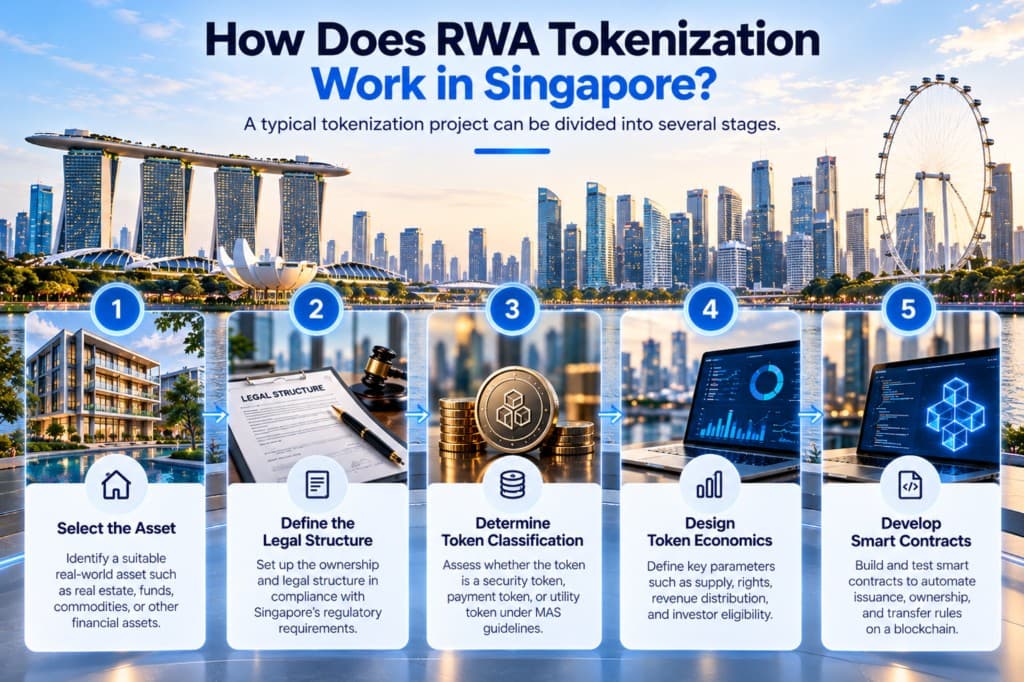
Step 1: Select the Asset
The first step is identifying the asset that will be represented on-chain.
For example:
Property → Fund → Private Credit → Bond → Commodity → Receivable
The asset needs to have clearly defined ownership and economic rights.
Step 2: Define the Legal Structure
The business then determines how token holders will obtain rights to the underlying asset.
This can involve:
- Direct ownership
- SPV structures
- Fund interests
- Contractual rights
- Revenue-sharing arrangements
The appropriate structure depends on the asset and business model.
Step 3: Determine Token Classification
The next step is understanding whether the token falls within an existing regulatory category.
This is one of the most important stages because the classification can influence licensing, investor access, disclosure, custody and trading requirements.
Step 4: Design Token Economics
The development team defines:
- Token supply
- Ownership structure
- Transfer rules
- Investor limits
- Redemption mechanisms
- Distribution logic
- Voting rights where applicable
Step 5: Develop Smart Contracts
Smart contracts can automate functions such as:
- Token issuance
- Investor whitelisting
- Transfers
- Distribution
- Redemption
- Corporate actions
Step 6: Build the Investor Platform
A complete RWA platform may include:
- Investor registration
- KYC/AML workflows
- Wallet management
- Asset dashboards
- Token purchase
- Portfolio tracking
- Reporting
- Distribution management
Step 7: Integrate Compliance Controls
Compliance should be built into the platform rather than added after development.
For example, smart contracts can include transfer restrictions based on approved wallet addresses and eligibility rules.
Step 8: Audit and Test
Before launch, the platform should undergo:
- Smart contract audits
- Penetration testing
- Infrastructure testing
- Access-control testing
- Transaction testing
- Compliance workflow testing
Step 9: Launch and Monitor
After deployment, the platform still requires monitoring, maintenance, security updates, compliance reviews and operational support.
RWA Tokenization Use Cases in Singapore
Singapore's financial ecosystem provides several potential applications for tokenization.
Tokenized Funds
Investment funds can use tokenization to create digital representations of fund interests and improve certain aspects of distribution, servicing and record management.
MAS Project Guardian participants have explored digital issuance and tokenization of fund structures.
Tokenized Bonds
Bonds and other fixed-income products are another major area of institutional experimentation.
Project Guardian participants have explored native digital bond issuance and tokenized bond transactions.
Private Credit
Private credit can potentially be represented through tokenized structures that improve administration, transfer processes and investor access where legally permitted.
Real Estate
Property tokenization can represent economic or ownership interests through blockchain-based records.
However, tokenizing property does not automatically transfer legal title to token holders. The legal structure needs to clearly establish the relationship between the property and the token.
Trade Finance
Tokenization can also support trade finance instruments, receivables and other commercial assets by creating programmable digital representations.
Commodities
Businesses can explore tokenized representations of commodities where the underlying ownership, custody, redemption and transfer mechanisms are clearly defined.
Benefits of RWA Tokenization for Businesses
When designed correctly, tokenization can provide several operational benefits.
Greater Transparency
Blockchain can create an auditable transaction record and make relevant ownership or transfer information easier to track.
Programmable Transactions
Smart contracts can automate selected processes such as transfers, distributions and compliance checks.
Faster Settlement
Blockchain-based settlement can reduce manual steps in some transaction flows.
Fractional Ownership
Certain assets can be divided into smaller digital units, subject to legal and regulatory requirements.
Better Record Management
Tokenized systems can reduce reliance on fragmented records and manual reconciliation.
Improved Market Access
Depending on the product and applicable regulations, digital infrastructure may support access to a wider group of eligible participants.
These benefits are not automatic. They depend on the legal structure, technology architecture, market design and operational model.
RWA Tokenization Platform Architecture
A production-grade RWA platform generally requires more than a smart contract.
A typical architecture can include:
Asset Layer — Underlying property, fund, bond, credit, commodity, or other asset.
Legal & Compliance Layer — SPV structure, investor eligibility, KYC/AML, legal agreements and regulatory controls.
Blockchain Layer — Network infrastructure, wallets, smart contracts, token standards and transaction processing.
Application Layer — Investor dashboard, asset management, token issuance, trading, reporting and administration.
Integration Layer — Banks, custodians, payment providers, identity systems, oracles and external APIs.
Security Layer — Access management, encryption, monitoring, smart contract audits and incident response.
This layered approach helps separate the legal, financial, technical and operational components of the platform.
Singapore RWA Tokenization Compliance Checklist
| Area | What to Review |
|---|---|
| Asset classification | Identify the legal and economic nature of the underlying asset |
| Token classification | Determine whether the token falls within a regulated category |
| Licensing | Identify licenses required for the activities being performed |
| KYC/AML | Establish customer verification and financial crime controls |
| Investor access | Define eligible investor categories and restrictions |
| Custody | Establish how assets and private keys are held and protected |
| Smart contracts | Test and audit contracts before production use |
| Transfer rules | Build applicable restrictions into the platform |
| Data security | Protect customer and transaction information |
| Technology risk | Establish cybersecurity and operational resilience controls |
| Reporting | Maintain appropriate records and transaction histories |
| Legal documentation | Clearly define token-holder rights and obligations |
What Does RWA Tokenization Cost in Singapore?
The cost depends on the complexity of the platform rather than simply the number of tokens being created.
Major cost factors include:
- Legal and regulatory structuring
- Smart contract development
- Blockchain selection
- Investor portal development
- KYC/AML integration
- Custody infrastructure
- Payment integration
- Oracle integration
- Security audits
- Backend development
- Compliance systems
- Mobile application development
- Ongoing maintenance
A basic proof of concept may require a relatively limited development budget, while an institutional-grade platform with compliance, custody, trading, integrations and security infrastructure can require substantially more investment.
For this reason, businesses should define the legal and technical scope before requesting a final development estimate.
How to Choose an RWA Tokenization Development Company
Choosing a development partner should involve more than comparing quoted prices.
Look for a team that can understand both the business model and technical architecture.
Important questions include:
- Have they worked with tokenization or financial applications?
- Can they develop secure smart contracts?
- Can they integrate KYC and AML workflows?
- Can they build investor and administrator dashboards?
- Can they integrate wallets and custody solutions?
- Can they work with the required blockchain network?
- How do they approach smart contract security?
- Can they support integrations with external financial systems?
- What happens after the platform goes live?
- Can they work alongside your legal and compliance advisors?
For an RWA project, development and regulatory planning should work together from the beginning.
Why Businesses Should Plan Compliance Before Development
One of the biggest mistakes in tokenization projects is starting with the blockchain architecture before understanding the legal structure.
For example, a development team may create a token with unrestricted transfers and later discover that the product requires investor eligibility controls.
That can result in expensive changes to:
- Smart contracts
- Investor onboarding
- Wallet architecture
- Marketplace logic
- Token economics
- Backend systems
A better approach is to define the asset, rights, investors, jurisdictions and business activities first. The technology architecture can then be designed around those requirements.
Singapore RWA Tokenization in 2026
Singapore's tokenization ecosystem continues to develop through institutional experiments and regulatory initiatives. MAS has reported Project Guardian activity involving multiple financial institutions and asset classes, including fixed income, foreign exchange and asset management.
At the same time, businesses should avoid treating participation in tokenization initiatives as automatic regulatory approval. The applicable requirements still depend on the specific product, activity, structure and customers involved.
For companies entering the Singapore market, the opportunity is therefore closely connected to compliance-ready infrastructure rather than token creation alone.
Final Thoughts
RWA tokenization in Singapore offers businesses a practical way to explore blockchain-based financial infrastructure, but the technology should be designed around the legal and regulatory structure from the beginning. MAS initiatives such as Project Guardian demonstrate continued institutional work around tokenized funds, bonds, foreign exchange and other financial assets.
For businesses planning to enter this space, the goal should not be simply to launch a token. A sustainable RWA platform needs clearly defined asset rights, appropriate compliance controls, secure smart contracts, reliable infrastructure and a practical investor experience. Bitronix Technologies can help turn an RWA concept into a customized blockchain platform designed around your business and technical requirements.
Plan Your RWA Tokenization Project With Bitronix
Have an asset tokenization idea for Singapore or another market? Discuss your business model, token structure, blockchain requirements and platform features with our team.
Bitronix Technologies helps businesses develop customized RWA tokenization platforms, smart contracts, blockchain infrastructure, investor portals, token management systems and Web3 applications.
Frequently Asked Questions
What is RWA tokenization in Singapore?
RWA tokenization in Singapore is the process of representing real-world assets or related economic rights through blockchain-based tokens. The regulatory treatment depends on the underlying asset, token structure and activities performed by the business.
Is RWA tokenization legal in Singapore?
Tokenization itself is not automatically prohibited or approved as one category. The relevant financial and digital-asset regulations depend on the asset, rights represented by the token, business activities and target customers.
Does an RWA tokenization platform need a license in Singapore?
A license may be required depending on the activities performed. For example, certain capital markets, payment, custody, fund management, or digital token activities can fall under MAS-regulated frameworks.
What assets can be tokenized in Singapore?
Potential assets include real estate, investment funds, bonds, private credit, commodities, receivables and other assets or financial products where the legal structure supports tokenization.
What is Project Guardian?
Project Guardian is a MAS-led initiative exploring the potential of asset tokenization and decentralized finance in financial markets. Its industry work has included areas such as funds, fixed income, foreign exchange and other tokenized financial applications.
What are the main compliance requirements for an RWA platform?
Depending on the project, important areas can include KYC, AML/CFT controls, investor eligibility, licensing, custody, asset verification, transaction monitoring, cybersecurity, technology risk management and appropriate disclosures.
How long does it take to develop an RWA tokenization platform?
The timeline depends on the platform's scope. A basic proof of concept can be developed faster than an institutional platform involving compliance workflows, custody, trading, integrations, smart contracts and security testing.
How much does RWA tokenization platform development cost?
There is no fixed cost. Legal structuring, blockchain selection, smart contracts, compliance systems, investor portals, custody, integrations, security audits and platform complexity all influence the final development budget.
Can real estate be tokenized in Singapore?
Real estate can be considered for tokenization, but the token structure must clearly define what rights investors receive and how those rights relate to the underlying property. Legal and regulatory requirements should be assessed before development.
How can Bitronix help with RWA tokenization?
Bitronix Technologies can support businesses with RWA platform architecture, blockchain development, smart contracts, tokenization infrastructure, investor-facing applications, integrations and compliance-oriented technical features.
Founder and CTO
Founder and CTO of Bitronix Technologies. Builds RWA tokenization platforms, permissioned token standards and compliance-ready digital asset infrastructure for regulated markets.
Related Posts
 Blockchain
October 1, 202613 min read
Top 10 Companies to Hire Blockchain Developers in India 2026-2027
Find the top 10 companies to hire blockchain developers in India. Compare blockchain services, expertise, use cases, & tips for choosing a development partner.
Read article Blockchain
September 22, 202614 min read
Top 10 AI-Powered Blockchain Development Companies in 2026-2027
Explore the top AI and blockchain development companies in 2026, including Bitronix, Nihon Infotech, IBM, TCS, Infosys, Accenture and other technology providers.
Read article Blockchain
September 21, 202617 min read
RWA Tokenization Regulations 2026: USA, Dubai, Saudi Arabia & Hong Kong Guide
Explore RWA tokenization regulations in 2026 across the USA, Dubai, Saudi Arabia and Hong Kong, including compliance, licensing, KYC and tokenized assets.
Read article