RWA Tokenization Regulations 2026: USA, Dubai, Saudi Arabia & Hong Kong Guide

By Tausif AhmedFounder and CTO

Real-world asset tokenization is moving beyond experiments. Real estate, investment funds, bonds, commodities, private credit and other traditionally difficult-to-trade assets are increasingly being represented through blockchain-based tokens.
But putting an asset on a blockchain does not automatically make it free from financial regulation.
The legal treatment of an RWA token usually depends on what the underlying asset represents, what rights the token gives its holder, how it is issued, who can purchase it and where the activity takes place.
That is why businesses planning an RWA tokenization platform in 2026 need to look at regulation before finalizing the token model or smart-contract architecture.
The regulatory picture also differs considerably between markets.
In the USA, tokenized securities can fall within existing federal securities laws. In Dubai, the regulatory route depends partly on whether the activity falls under VARA or the DIFC/DFSA framework. Saudi Arabia uses existing financial-sector regulation alongside controlled fintech experimentation through regulatory sandboxes. Hong Kong has continued to develop specific frameworks for tokenized investment products and their secondary trading.
This guide explains the major RWA tokenization regulatory considerations across these four markets and what businesses should consider before launching.
What Is RWA Tokenization?
RWA tokenization is the process of representing rights or interests in a real-world asset through blockchain-based tokens.
The underlying asset could include:
- Real estate
- Gold and other commodities
- Government or corporate bonds
- Investment funds
- Private credit
- Carbon credits
- Art and collectibles
- Infrastructure assets
- Company shares
- Other financial or physical assets
For example, a property could be placed into a suitable legal structure and the economic or ownership interests connected to that structure could be represented through blockchain tokens.
The important point is that the token and the underlying legal asset are not necessarily the same thing.
A token may represent ownership, an economic interest, a debt claim, fund participation, revenue rights, or another contractual entitlement.
That distinction becomes extremely important when determining which regulations apply.
Why RWA Tokenization Regulation Matters in 2026
The technology behind tokenization can be developed relatively quickly. The difficult part is making sure the legal, financial and operational structure works in the markets where the platform will operate.
A compliant RWA project may need to address:
- Token classification
- Securities regulations
- Licensing
- Investor eligibility
- KYC and AML
- Custody
- Asset ownership verification
- Transfer restrictions
- Investor disclosures
- Tax considerations
- Data protection
- Smart contract controls
- Secondary-market trading
- Transaction monitoring
- Record keeping
Regulators are also paying greater attention to tokenized securities and investment products.
For example, the U.S. SEC issued a January 2026 statement addressing tokenized securities, while Hong Kong's SFC introduced an April 2026 framework for secondary trading of certain tokenized SFC-authorized investment products.
So, in 2026, RWA tokenization should be approached as a regulated financial and technology project, rather than simply a blockchain development project.
RWA Tokenization Regulations in the USA
The United States does not have one single "RWA tokenization law."
Instead, the regulatory treatment can depend on the characteristics of the asset and token, the rights attached to the token, the transaction structure and the activities performed by the business.
Tokenized Securities
If an RWA token represents a security, existing U.S. securities laws may apply.
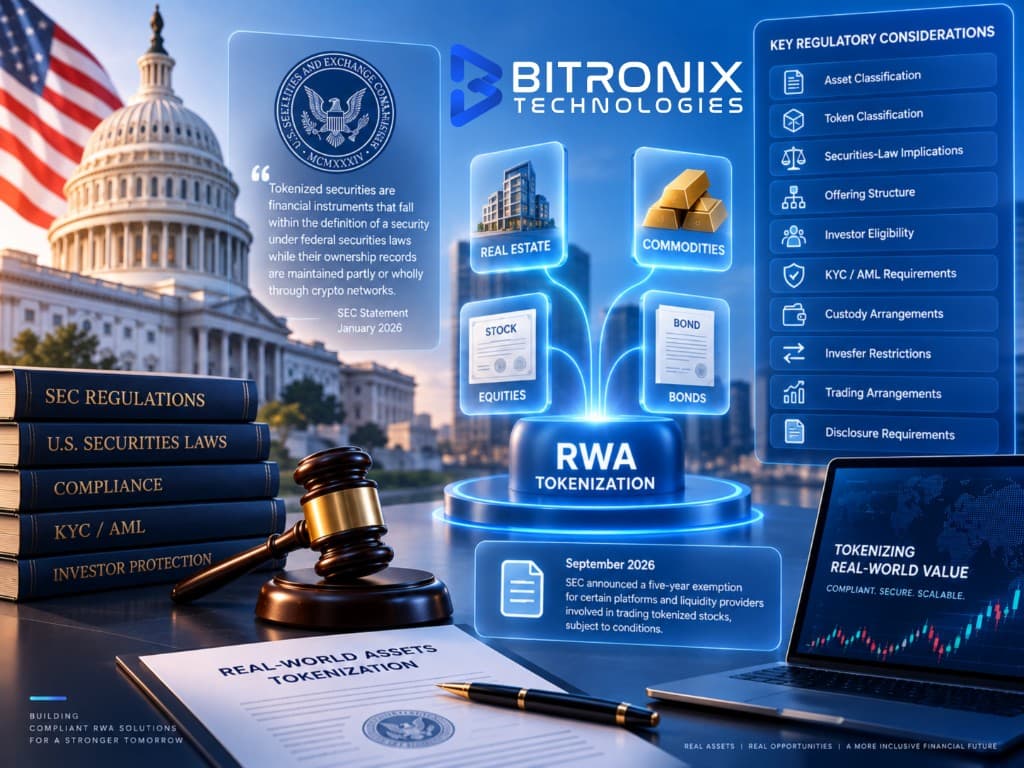
The SEC's January 2026 statement describes tokenized securities as financial instruments that fall within the definition of a security under federal securities laws while their ownership records are maintained partly or wholly through crypto networks.
This means blockchain does not automatically change the legal nature of the underlying financial instrument.
For an RWA project, businesses may therefore need to examine:
- Whether the token represents a security
- Who is issuing the token
- How the asset is offered
- Who can purchase it
- Whether registration or an exemption is available
- How transfers are handled
- What disclosures investors receive
- Who provides custody and trading services
Tokenized Stocks and Other Securities
The regulatory environment is also evolving quickly.
In September 2026, the SEC announced a five-year exemption for certain platforms and liquidity providers involved in trading tokenized stocks, subject to conditions. The announcement also emphasized that qualifying tokenized stocks must preserve the same shareholder rights as traditional shares.
This is an important development for businesses exploring tokenized equities, but it should not be interpreted as a blanket exemption for every type of RWA token.
U.S. Compliance Considerations
A U.S.-focused RWA platform should typically assess:
- Asset classification
- Token classification
- Securities-law implications
- Offering structure
- Investor eligibility
- KYC/AML requirements
- Custody arrangements
- Transfer restrictions
- Trading arrangements
- Disclosure requirements
The technical architecture should then reflect those requirements.
For example, if a token can only be transferred between eligible investors, that restriction can potentially be incorporated into the token and platform design rather than being handled manually after transactions occur.
RWA Tokenization Regulations in Dubai
Dubai has become an important market for digital assets and tokenization, but businesses need to distinguish between different regulatory jurisdictions within Dubai.
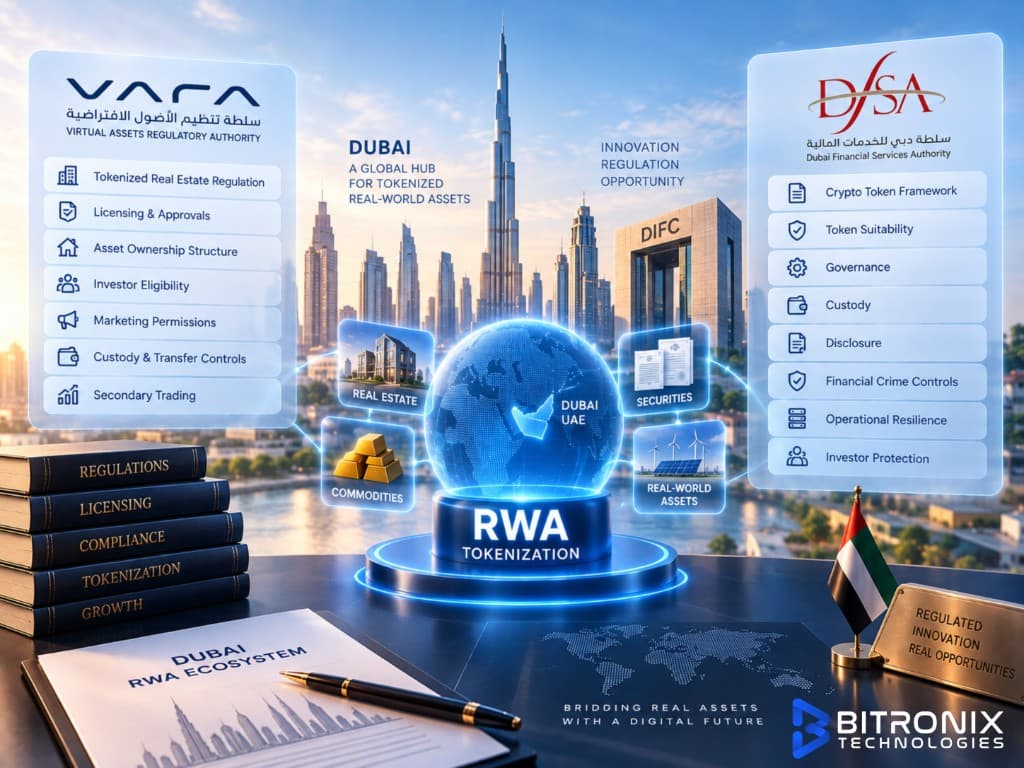
A project operating in Dubai outside the DIFC may fall within the regulatory perimeter of the Virtual Assets Regulatory Authority (VARA) depending on its activities.
The DIFC, meanwhile, has its own financial regulator, the Dubai Financial Services Authority (DFSA).
This distinction is important when designing an RWA platform.
Dubai and VARA
VARA has specifically addressed tokenized real estate activity.
In February 2026, VARA stated that the initial phase of Dubai's Real Estate Tokenisation Pilot had been completed and that the initiative had moved into a controlled second phase focused on additional functionality, including secondary-market mechanisms. VARA also stated that entities offering, marketing, or facilitating tokenized real estate products in or from Dubai require the appropriate licence or approval.
For businesses considering Dubai-based real estate tokenization, this means the regulatory analysis should happen before marketing the investment product or opening it to investors.
Key areas can include:
- Asset ownership structure
- Real estate rights
- Token structure
- Investor eligibility
- Licensing
- Marketing permissions
- Custody
- Transfer controls
- Secondary trading
Dubai DIFC and DFSA
The DIFC follows a separate regulatory framework.
The DFSA's Crypto Token framework applies to financial-services activities involving crypto tokens in or from the DIFC. The DFSA's updated Crypto Token rules became effective on 12 January 2026.
The framework includes requirements around:
- Token suitability
- Governance
- Custody
- Disclosure
- Financial crime controls
- Operational resilience
- Investor protection
The DFSA also moved away from maintaining a prescribed list of recognised crypto tokens, placing greater responsibility on firms to assess whether tokens are suitable under its requirements.
Therefore, companies targeting Dubai should first establish which regulatory jurisdiction their business actually falls under.
RWA Tokenization Regulations in Saudi Arabia
Saudi Arabia presents a different regulatory environment.
Rather than assuming that an RWA token can operate under a standalone crypto framework, businesses need to consider the existing regulatory structure applicable to the underlying financial activity.
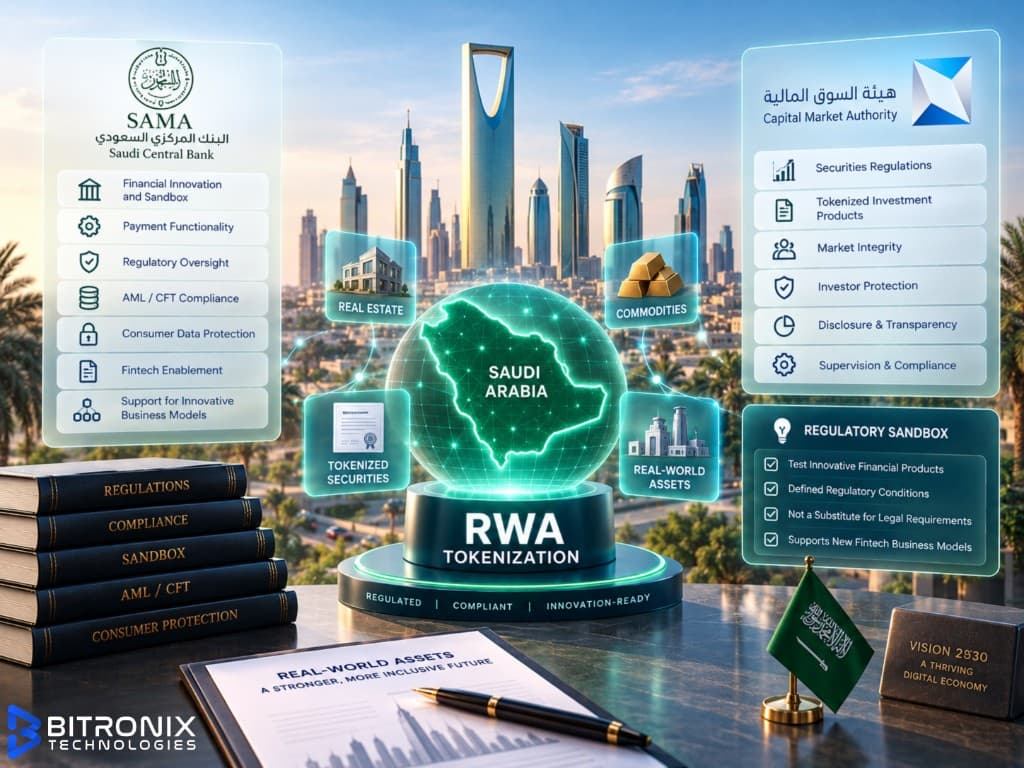
Relevant authorities can include the Saudi Central Bank (SAMA) and the Capital Market Authority (CMA), depending on the nature of the activity.
Saudi Arabia also operates a regulatory sandbox through SAMA that allows eligible fintech businesses to test innovative financial products and services under defined conditions.
Why the Sandbox Matters
For innovative financial models where the regulatory route is not immediately clear, the sandbox can provide a controlled environment for testing.
SAMA states that its sandbox can accommodate innovative digital business models and technologies that are not currently covered by existing SAMA regulations, but it cannot be used to circumvent legal or regulatory requirements.
This makes regulatory planning particularly important for tokenization projects involving:
- Digital investment products
- Payment functionality
- Financial services
- Tokenized claims
- Digital ownership structures
- New fintech business models
AML and Consumer Protection
Compliance cannot be treated as an optional layer.
SAMA's sandbox framework indicates that certain requirements, including consumer data protection, AML/CFT, consumer disclosures, cybersecurity and national or international laws, are not generally areas that can simply be waived for experimentation.
For an RWA platform, this reinforces the importance of designing KYC, AML, identity, transaction monitoring and data controls into the platform from the beginning.
RWA Tokenization Regulations in Hong Kong
Hong Kong has developed one of the more clearly defined regulatory approaches to tokenized financial products.
The Securities and Futures Commission (SFC) has established requirements for tokenization of SFC-authorized investment products.
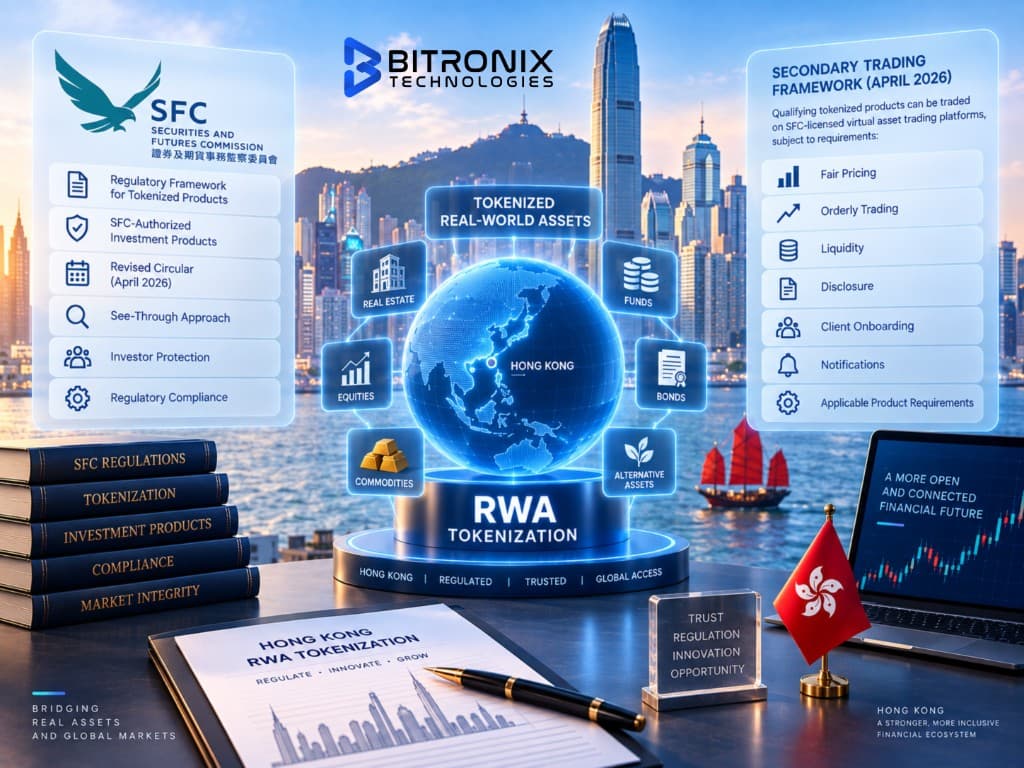
In April 2026, the SFC published a revised circular setting out requirements for tokenization of SFC-authorized investment products offered to the public in Hong Kong.
The SFC takes a "see-through" approach, meaning the underlying investment product still needs to satisfy the applicable product requirements.
Secondary Trading of Tokenized Products
Hong Kong also made an important move in April 2026 by introducing a framework for secondary trading of certain tokenized SFC-authorized investment products.
The framework allows qualifying tokenized products to be traded on SFC-licensed virtual asset trading platforms, subject to requirements concerning:
- Fair pricing
- Orderly trading
- Liquidity
- Disclosure
- Client onboarding
- Notifications
- Applicable product requirements
This is particularly relevant for businesses developing RWA platforms because token issuance and secondary trading are not necessarily governed by the same requirements.
USA vs Dubai vs Saudi Arabia vs Hong Kong
| Market | Key Regulatory Focus | Important Consideration for RWA Projects |
|---|---|---|
| USA | Securities and financial-market regulation | Determine whether the token represents a security and structure issuance/trading accordingly |
| Dubai | VARA / DFSA depending on jurisdiction and activity | Establish the correct regulatory perimeter before offering or marketing tokenized assets |
| Saudi Arabia | SAMA, CMA and applicable financial regulations | Assess the underlying financial activity and potential licensing route; sandbox options may be relevant |
| Hong Kong | SFC framework for tokenized investment products | Tokenized products remain subject to underlying product requirements and additional tokenization controls |
The key takeaway is that there is no universal RWA tokenization compliance model.
The same real-world asset can potentially require different legal and technical treatment depending on where it is issued, marketed, held and traded.
What Assets Can Be Tokenized?
Almost any asset can technically be represented digitally.
The regulatory question is more important than the technical question.
Real Estate
Real estate is one of the most discussed RWA use cases.
Tokenization can potentially represent:
- Property ownership interests
- Fund interests
- Rental income rights
- Fractional interests
- Real estate debt
However, the token structure needs to match the legal ownership arrangement.
Bonds
Tokenized bonds can represent debt instruments through blockchain-based infrastructure.
The project may need to address:
- Issuer requirements
- Investor eligibility
- Interest payments
- Redemption
- Transfer restrictions
- Disclosure
Investment Funds
Funds are another significant tokenization use case.
Hong Kong's 2026 SFC framework specifically demonstrates how regulators can apply existing fund requirements alongside additional safeguards for tokenization.
Commodities
Gold, precious metals and other commodities can also be tokenized.
The platform must establish how the token relates to the underlying asset, including:
- Custody
- Proof of reserves
- Redemption
- Ownership
- Valuation
- Transfer
Key Compliance Requirements for an RWA Tokenization Platform
Building an RWA platform requires more than deploying an ERC-20 or another token standard.
The compliance layer should be considered part of the product architecture.
1. Asset Verification
Before issuing tokens, the platform should establish what asset is being represented and how its existence and ownership can be verified.
2. Legal Structure
The relationship between the physical asset and digital token needs to be clearly documented.
Investors should understand exactly what rights the token provides.
3. Token Classification
Determine whether the token could be treated as:
- Security
- Fund interest
- Debt instrument
- Payment-related asset
- Other regulated financial product
- Non-regulated digital asset
Classification should be established before development decisions are finalized.
4. KYC and AML
Investor onboarding should include appropriate identity verification and financial-crime controls.
5. Investor Eligibility
Some tokenized products may only be available to specific investor categories or under particular conditions.
The platform should be able to enforce those restrictions.
6. Transfer Restrictions
Smart contracts can potentially prevent transfers that do not meet predefined requirements.
This is particularly useful for regulated tokenized securities and other restricted assets.
7. Custody
The platform needs a clear approach to both:
- Digital token custody
- Underlying asset custody
These should not be treated as the same problem.
8. Disclosure
Investors need clear information about:
- The underlying asset
- Token rights
- Fees
- Risks
- Redemption
- Liquidity
- Transfer restrictions
- Legal structure
9. Transaction Monitoring
The platform should maintain appropriate monitoring and audit records.
10. Secondary Market Controls
If the platform supports trading, additional requirements may apply.
Hong Kong's 2026 framework is a good example of how secondary trading can involve specific requirements around pricing, liquidity, disclosure and investor onboarding.
How Compliance Should Influence RWA Platform Development
A common mistake is to develop the entire platform first and think about compliance later.
For RWA projects, the better approach is to connect legal requirements with technical requirements from the beginning.
For example:
Legal requirement: Only eligible investors can hold the token.
Technical implementation: Whitelisted wallets and transfer-control logic.
Legal requirement: Investors must complete identity verification.
Technical implementation: KYC status connected to wallet onboarding.
Legal requirement: Certain jurisdictions cannot participate.
Technical implementation: Geographic and jurisdiction-level restrictions.
Legal requirement: Transactions need to be auditable.
Technical implementation: Immutable transaction records combined with appropriate reporting systems.
This is what compliance-by-design looks like in a tokenization platform.
RWA Tokenization Compliance Checklist for 2026
Before launching an RWA tokenization project, businesses should review:
Legal & Regulatory
- Identify the underlying asset
- Define the rights represented by the token
- Determine token classification
- Identify relevant regulators
- Determine licensing requirements
- Review offering restrictions
- Review investor eligibility
Compliance
- KYC
- AML/CFT
- Sanctions screening
- Investor verification
- Transaction monitoring
- Data protection
- Regulatory reporting
Technical
- Token standard
- Smart contract controls
- Wallet management
- Permission management
- Transfer restrictions
- Identity integration
- Compliance engine
- Audit logs
- Custody integration
Business
- Asset valuation
- Asset custody
- Investor onboarding
- Issuance process
- Redemption
- Secondary trading
- Fee structure
- Disclosures
What Businesses Should Know Before Launching an RWA Platform
There is no single compliance checklist that works for every RWA project.
A token representing a real estate interest can have a different regulatory profile from a token representing a bond, fund, commodity, or equity.
The target market also changes the analysis.
A project intended for the USA may require a very different legal structure from one designed for Dubai, Saudi Arabia, or Hong Kong.
That is why businesses should answer these questions before development begins:
- What exactly is being tokenized?
- What rights does the token provide?
- Who legally owns the underlying asset?
- Who can purchase the token?
- Where are the investors located?
- Where is the asset located?
- Will the token be traded after issuance?
- Who will provide custody?
- Which entities require licensing?
- How will KYC, AML and transfer restrictions be enforced?
The answers should influence the platform architecture, smart contracts, user onboarding and marketplace functionality.
Future of RWA Tokenization Regulations
The regulatory direction in 2026 is moving toward bringing tokenized assets into existing financial frameworks rather than creating a completely separate system for every blockchain-based product.
Several areas are likely to remain important:
Tokenized Securities
Regulators are continuing to clarify how traditional securities interact with blockchain-based ownership and trading systems.
Regulated Secondary Markets
As tokenized assets become more established, regulators are paying greater attention to how they can be traded after issuance. Hong Kong's 2026 framework is a clear example.
Institutional Custody
Safeguarding digital tokens and verifying the underlying assets will remain central to institutional adoption.
Programmable Compliance
KYC, eligibility checks, transfer restrictions and transaction monitoring can increasingly become embedded into tokenization infrastructure.
Cross-Border Regulation
RWA platforms serving multiple countries will need to account for differences between jurisdictions instead of assuming that one compliance model works globally.
Build an RWA Tokenization Platform With Compliance in Mind
RWA tokenization can connect traditional assets with blockchain infrastructure, but the technology is only one part of the project.
The legal structure, asset ownership, token rights, investor onboarding, compliance controls, custody, smart contracts and trading infrastructure all need to work together.
For businesses targeting the USA, Dubai, Saudi Arabia, or Hong Kong, regulatory planning should happen before token economics and platform architecture are finalized.
At Bitronix, we help businesses plan and develop blockchain and RWA tokenization solutions around their business model, asset type, platform requirements and target market.
Final Thoughts
RWA tokenization is opening new ways to bring traditional assets into blockchain-based markets, but the technology is only one part of the process. The regulatory requirements can change depending on the asset, token structure, investor type and target market.
The USA, Dubai, Saudi Arabia and Hong Kong each follow different regulatory approaches, making it important to understand the applicable rules before launching an RWA platform. Businesses also need to consider KYC/AML, asset ownership, custody, investor eligibility, disclosures, transfer controls and secondary-market requirements from the beginning.
A well-planned RWA project brings together legal structure, compliance, smart contracts, blockchain infrastructure and user experience rather than treating regulation as an afterthought.
Bitronix Technologies helps businesses turn RWA concepts into customized blockchain solutions, from tokenization architecture and smart contracts to platform development and compliance-focused features.
Frequently Asked Questions
What are RWA tokenization regulations?
RWA tokenization regulations are the legal and regulatory requirements that may apply when real-world assets are represented through blockchain-based tokens. Requirements can cover securities laws, licensing, KYC/AML, custody, investor protection, disclosures and trading.
Is RWA tokenization legal in 2026?
RWA tokenization can be permitted, but the applicable requirements depend on the asset, token structure, jurisdiction and activities performed by the business.
Are RWA tokens securities in the USA?
Some RWA tokens can represent securities. The classification depends on the characteristics and rights associated with the token and underlying instrument. The SEC issued a statement on tokenized securities in January 2026.
Is RWA tokenization regulated in Dubai?
Yes. The applicable regulatory framework depends on the activity and jurisdiction. VARA regulates virtual asset activities in Dubai outside the DIFC, while the DIFC has a separate DFSA framework.
Does Saudi Arabia allow RWA tokenization?
Businesses considering RWA or other innovative financial models in Saudi Arabia need to assess the applicable financial regulations and authorities. SAMA operates a regulatory sandbox for eligible innovative financial products and services.
Does Hong Kong allow tokenized investment products?
Hong Kong permits tokenization of certain SFC-authorized investment products subject to applicable requirements. In April 2026, the SFC also introduced a framework covering secondary trading of certain tokenized products on licensed virtual asset trading platforms.
What compliance is required for an RWA tokenization platform?
Depending on the project, compliance can involve token classification, licensing, KYC/AML, investor eligibility, custody, asset verification, transfer restrictions, disclosures, transaction monitoring and regulatory reporting.
Can an RWA tokenization platform operate across multiple countries?
Potentially, but a multi-jurisdiction platform needs to account for the regulatory requirements of each target market. A compliance model designed for one country should not automatically be applied to another.

Founder and CTO
Founder and CTO of Bitronix Technologies. Builds RWA tokenization platforms, permissioned token standards and compliance-ready digital asset infrastructure for regulated markets.
Related Posts
 Blockchain
October 1, 202613 min read
Top 10 Companies to Hire Blockchain Developers in India 2026-2027
Find the top 10 companies to hire blockchain developers in India. Compare blockchain services, expertise, use cases, & tips for choosing a development partner.
Read article Blockchain
September 25, 202616 min read
RWA Tokenization in Singapore: Regulations, Licensing & Complete Guide 2026
Learn about RWA tokenization in Singapore, including MAS regulations, licensing, compliance, use cases, costs and how to build an RWA platform in 2026.
Read article Blockchain
September 22, 202614 min read
Top 10 AI-Powered Blockchain Development Companies in 2026-2027
Explore the top AI and blockchain development companies in 2026, including Bitronix, Nihon Infotech, IBM, TCS, Infosys, Accenture and other technology providers.
Read article