How to Build Blockchain in 2026: A Practical Guide for U.S. Startups and Enterprises

By Tausif AhmedFounder and CTO

Building a blockchain in 2026 is simultaneously easier and harder than it was three years ago. Easier because tooling, frameworks and audited contract libraries have matured to the point where a competent team can ship a working prototype in weeks. Harder because the bar for security, user experience and regulatory compliance has risen sharply and the consequences of getting any of those wrong are more visible and more expensive than ever.
If you're a U.S. startup founder or enterprise leader trying to figure out how to actually build blockchain infrastructure, not just whether you should, this guide walks through the full journey: from validating the business idea through architecture decisions, development process, cost planning, team selection and the regulatory landscape you'll need to navigate.
This isn't written for blockchain engineers who already know what a Merkle tree is. It's written for the person who has to make the business decision, allocate the budget and explain the plan to investors or a board.
What Does It Actually Mean to Build a Blockchain?
Before anything else, clarify what you're actually building. "Building a blockchain" can mean two very different things and conflating them is one of the most expensive mistakes founders make.
Building a new blockchain network means creating the underlying infrastructure: consensus mechanism, node software, validator set and the economic model that keeps the network secure. This is what Ethereum, Solana and Hyperledger Fabric are. It's a massive undertaking, typically 12–24 months and seven figures, reserved for organizations with a compelling reason no existing network can serve their needs.
Building a blockchain application means creating a product that runs on top of an existing network, smart contracts, a user interface, off-chain infrastructure and integrations. This is what most startups and enterprises actually need. A tokenization platform on Ethereum, a supply chain traceability system on a permissioned network, or a DeFi protocol on a Layer 2, all of these are blockchain applications, not new blockchains.
For the vast majority of U.S. startups and enterprises reading this guide, you're building an application. The sections below apply to both paths, but we'll be direct about when launching your own chain is and isn't, justified.
The First Question Is Not Which Chain to Use
Founders often start blockchain conversations by asking "Should we use Ethereum or Solana?" That's the wrong opening question. The right one is: Does this problem actually need blockchain's specific properties?
Blockchain solves a narrow but valuable set of problems: shared records that multiple parties can trust without a central authority, tamper-resistant audit trails and programmable settlement of digital assets. If your use case doesn't involve multi-party trust, doesn't benefit from immutability and doesn't need trustless execution, you probably don't need blockchain. A well-designed database will be faster, cheaper and easier to maintain.
A credible blockchain development partner should tell you when blockchain isn't the right fit. If every conversation leads to "yes, you need blockchain," regardless of your use case, that's a red flag worth taking seriously.
When Blockchain Actually Makes Sense
Blockchain earns its complexity in four situations. If none of these apply, think carefully before proceeding.
- Multiple parties need to trust shared data without a central authority. Supply chains with competing vendors, inter-bank settlement, or consortium industries where no single company should control the ledger.
- Tamper-proof records carry real business or regulatory value. Provenance tracking in pharmaceuticals, audit trails in financial services, or credential verification where forgery has serious consequences.
- Programmable settlement reduces cost or delay. Cross-border payments, tokenized asset transfers, or parametric insurance where smart contracts can replace manual intermediary processing.
- Digital ownership or access rights need to be portable and verifiable. Tokenized real estate, fractional ownership platforms, or decentralized identity systems where users control their credentials.
The Three Layers of a Successful Blockchain Product
Every production blockchain product, whether a DApp or an enterprise consortium, sits on three layers. Weakness in any one of them sinks the project.
- Business layer, The value proposition, tokenomics (if applicable), go-to-market strategy and regulatory positioning. This is what investors and enterprise sponsors evaluate first.
- Architecture layer, Network selection, on-chain vs off-chain data decisions, security model and integration with existing systems. This is where most costly mistakes are made before a line of code is written.
- Execution layer, Smart contract development, front-end and wallet UX, testing, auditing, deployment and ongoing monitoring. This is what users and auditors interact with directly.
Founders who skip straight to execution, hiring developers before validating the business layer or locking architecture, consistently end up rebuilding. The unglamorous planning work is what separates projects that ship from projects that stall at proof of concept.
Validate the Business Idea Before Writing Code
Blockchain projects fail more often from weak business validation than from technical incompetence. Before committing budget, answer these questions honestly:
- Who are the specific parties that need to trust shared data and do they actually want a shared system?
- What happens today without blockchain and what does it cost, in time, money, or risk?
- Would a central database operated by a trusted third party solve the same problem at lower cost?
- Is there a regulatory or compliance driver that makes tamper-proof records a requirement, not a nice-to-have?
- Can you articulate the value proposition in one sentence without using the word "decentralized"?
If you can't answer these clearly, you're not ready to hire a development team. Spend another month on customer discovery. It's cheaper than rebuilding a smart contract architecture.
Build an MVP First, Not the Full Vision
The instinct to build the complete product before launch is especially dangerous in blockchain, where every additional feature multiplies audit surface, gas costs and regulatory exposure.
A disciplined MVP focuses on one core use case, one user journey and one network. It proves the business hypothesis with real users, or real consortium partners, before you scale scope. Investors in 2026 are far more impressed by a working MVP with traction on testnet than a whitepaper describing a ten-feature platform that doesn't exist yet.
Scope your MVP around what you can validate in 8–12 weeks: a single smart contract flow, a functional front-end with wallet connection and enough off-chain infrastructure to support one real user scenario. Everything else goes on the roadmap.
The Right Way to Choose a Blockchain Network
Network selection should follow from your validated use case, not from industry hype or a developer's personal preference. The decision tree is straightforward once you've done the business validation work:
- If you need public transparency and broad interoperability → public network (Ethereum, Solana, etc.)
- If you need lower fees and faster transactions for a public app → Layer 2 on Ethereum or equivalent
- If you need controlled access among known business partners → permissioned network (Hyperledger Fabric, Corda, etc.)
- If you need a novel consensus model or tokenomics no existing chain supports → consider custom chain (rare)
Own Chain vs. Build on an Existing Network
Launching your own blockchain is one of the most over-requested and under-justified decisions in the space. You need a custom chain only if:
- Your consortium requires governance rules no existing permissioned framework supports
- You need a specific consensus mechanism for regulatory or performance reasons
- You're building infrastructure others will build on and you have the capital and timeline to support that
- Existing networks cannot meet your data residency, privacy, or throughput requirements at acceptable cost
If none of these apply, build on an existing network. You'll ship faster, inherit battle-tested security, tap into existing developer tooling and auditor expertise and avoid the ongoing operational burden of maintaining validator infrastructure.
The Bitronix Recommendation to Founders
After working with dozens of U.S. startups and enterprises on blockchain builds, our consistent advice is this: start on an existing network, scope ruthlessly and treat security and compliance as day-one requirements, not phase-two additions.
Bitronix Technologies has seen too many projects spend six months building custom infrastructure that an existing Layer 2 or permissioned framework would have delivered in six weeks. We've also seen projects rush to mainnet without audits because "we'll fix security later" and later never comes before something goes wrong.
The founders who succeed in 2026 are the ones who do the unglamorous work: validate the business case, design architecture before hiring developers, ship an MVP that proves one thing well and partner with teams who treat smart contract security as non-negotiable.
Public vs. Private vs. Permissioned Blockchains
Understanding these three categories and where consortium models fit, is essential before any architecture decision. The choice affects cost, compliance, who can participate and what you can realistically promise users or partners.
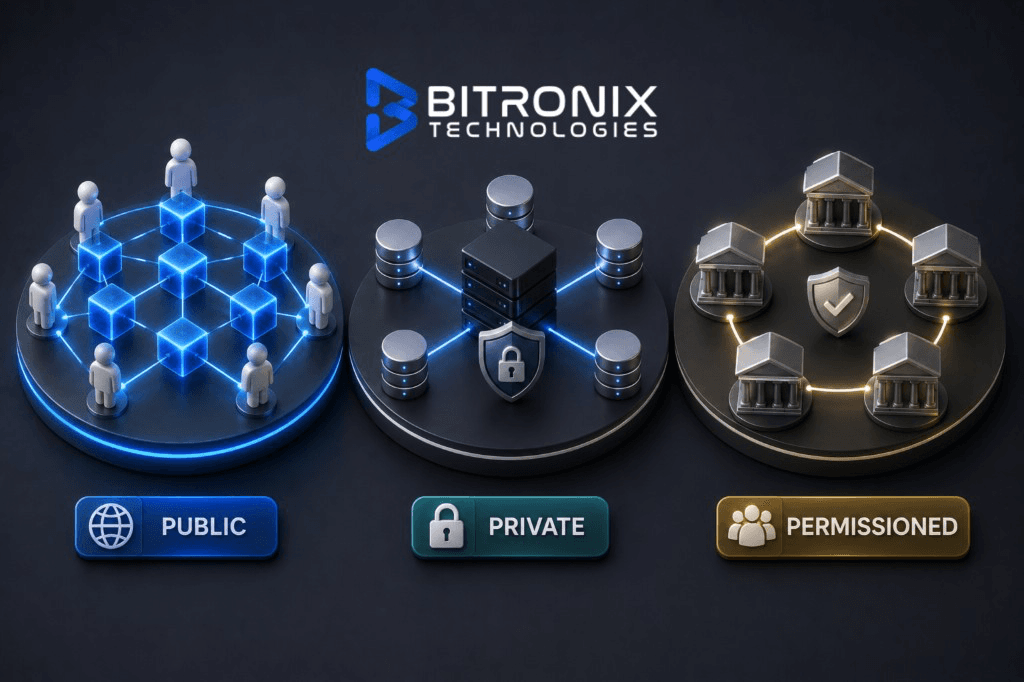
| Factor | Public | Private | Permissioned |
|---|---|---|---|
| Access | Open to anyone | Single organization only | Approved participants only |
| Control | Decentralized, community-governed | Full central control | Shared governance among known parties |
| Transparency | Fully public ledger | Internal visibility only | Configurable per participant |
| Consensus | Proof of stake, proof of work, etc. | Centralized or simplified | BFT, Raft, or custom among validators |
| Typical cost to launch | Low (deploy contracts) | Moderate (private infrastructure) | Moderate to high (consortium setup) |
| Regulatory complexity | Higher (public token exposure) | Lower (internal use) | Moderate (B2B, industry-specific) |
| Best for | DApps, DeFi, NFTs, open ecosystems | Internal enterprise records, pilot programs | Supply chain consortiums, inter-bank settlement, B2B networks |
Where Consortium Models Fit
A consortium blockchain is a permissioned network operated by a defined group of organizations, competing banks settling trades, pharmaceutical companies tracking drug provenance, or logistics partners sharing shipment data. Each member runs a node, participates in governance and shares the cost of infrastructure.
Consortium models work when the value of shared records exceeds the coordination cost of aligning multiple organizations on governance, data standards and upgrade procedures. They're harder to launch than a single-company private chain, but they solve the multi-party trust problem that public chains address through decentralization, without exposing sensitive business data to the public.
How Startups Choose the Right Blockchain Type
Use this decision framework before committing to a network category:
- Consumer-facing product with open participation? → Public network or Layer 2.
- B2B product among known partners who won't join a public chain? → Permissioned or consortium.
- Internal proof of concept or pilot with no external parties? → Private network or even testnet on a public chain.
- Token with potential securities implications? → Public or L2, but legal classification must be resolved first.
- Regulated industry with strict data privacy? → Permissioned, with PII kept off-chain.
Layer 1 vs. Layer 2: What Founders Need to Know
If you're building on a public network, you'll choose between deploying directly on a Layer 1 (Ethereum mainnet, Solana, etc.) or on a Layer 2 scaling solution (Arbitrum, Optimism, Base, Polygon zkEVM, etc.). This decision has major implications for cost, speed and security.
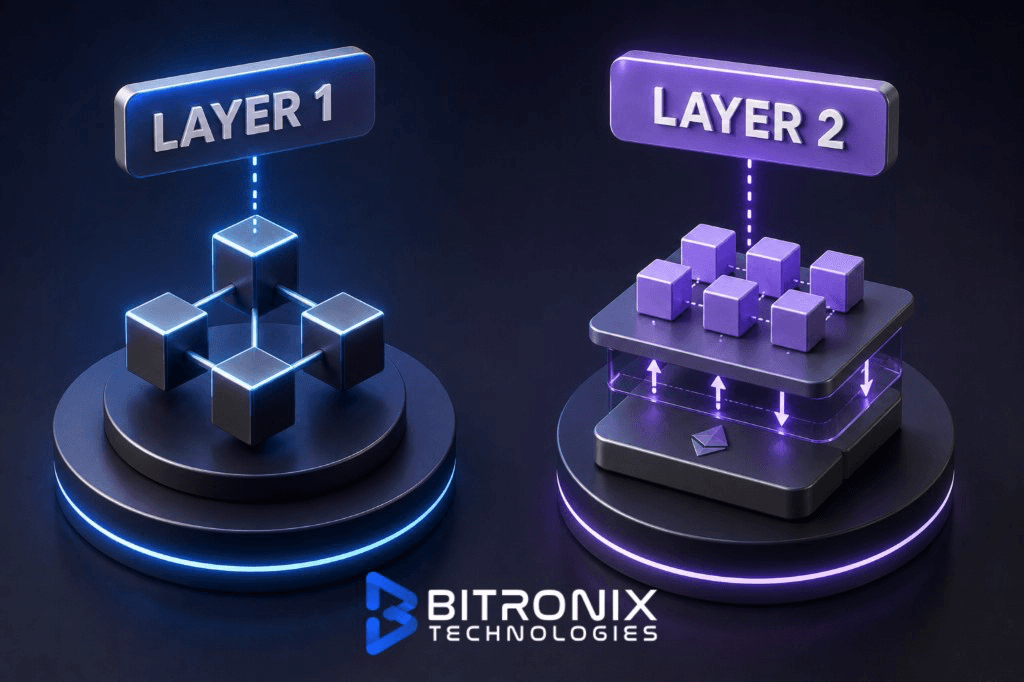
| Factor | Layer 1 | Layer 2 |
|---|---|---|
| Security | Highest, inherits directly from base consensus | Inherits from L1 with additional assumptions about rollup validity |
| Transaction speed | Slower (12–15 sec on Ethereum) | Faster (sub-second to a few seconds) |
| Transaction cost | Higher gas fees | Significantly lower fees |
| Liquidity & composability | Maximum, native ecosystem | High, growing, bridged assets and cross-L2 protocols |
| Finality | Strongest guarantees | Depends on withdrawal period for some rollup types |
| Complexity | Simpler deployment model | Additional bridge and sequencing considerations |
| Best for | High-value settlement, flagship deployments, maximum security | High-volume user-facing apps, gaming, social, micro-transactions |
Why Layer 2 Matters in 2026
Layer 2 adoption has reached the point where most new consumer-facing DApps launch on L2 by default. The user experience difference is stark: a transaction that costs $5–$15 on Ethereum mainnet might cost cents on Arbitrum or Base. For applications where users make frequent transactions, gaming, social, micro-payments, that cost difference determines whether the product is usable or not.
L2s also inherit Ethereum's security model and developer tooling, meaning your Solidity contracts and Hardhat/Foundry workflows transfer directly. The tradeoff is added complexity around bridging, withdrawal times for optimistic rollups and slightly less composability than native L1 deployment, but for most startup use cases, L2 is the right default in 2026.
How to Choose the Right Network: 8 Factors
When you've narrowed the category (public L1, L2, or permissioned), evaluate specific networks against these eight factors:
- Use case fit, Does the network support the transaction types, data structures and programmability your application requires?
- Developer ecosystem, Are there audited libraries, active tooling and available talent for this network?
- Cost at scale, What will transactions cost at your projected user volume, not just at launch?
- Security track record, Has the network experienced significant exploits or downtime? How were they handled?
- Regulatory posture, How do regulators view applications on this network? Any precedent relevant to your industry?
- Interoperability needs, Do you need to interact with assets or data on other chains?
- Enterprise adoption, Are your target partners or customers already using or accepting this network?
- Long-term viability, Is the network actively maintained, funded and growing, or stagnating?
On-Chain vs. Off-Chain Architecture
This is arguably the most consequential technical decision in any blockchain build and the one inexperienced teams get wrong most often. Putting too much on-chain makes your application expensive and slow. Putting too little on-chain undermines the trust guarantees that justified using blockchain in the first place.
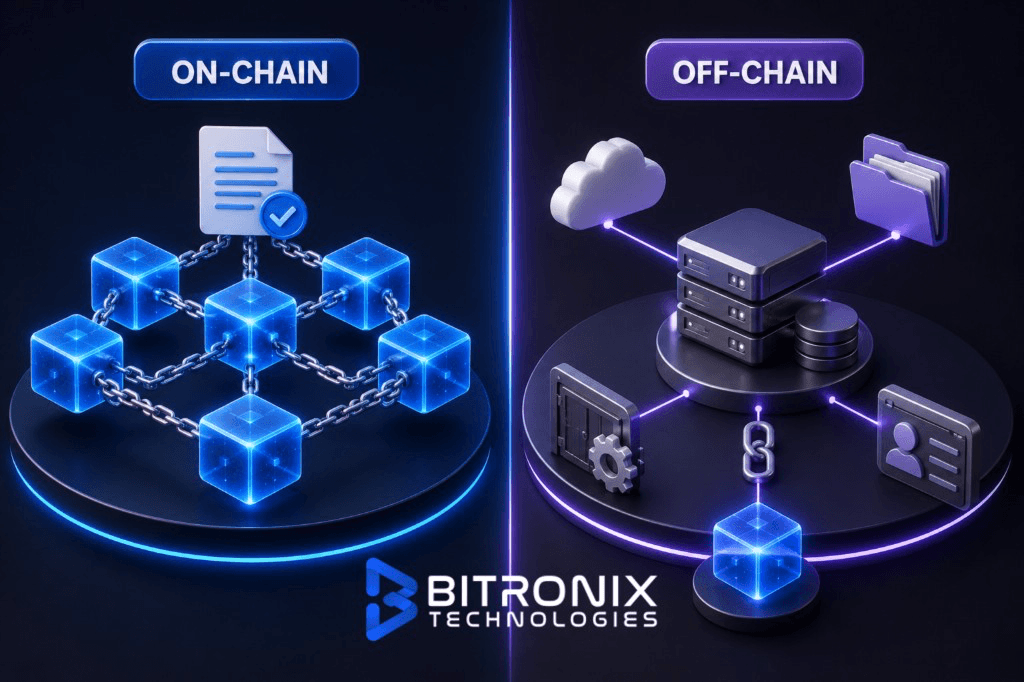
| Factor | On-Chain | Off-Chain |
|---|---|---|
| Data storage | Stored on blockchain | Stored in external databases or IPFS |
| Transparency | Publicly verifiable | Controlled by application access rules |
| Security model | Decentralized, tamper-resistant | Depends on infrastructure and access controls |
| Speed | Network-limited | Generally faster |
| Cost | Per-transaction gas fees | Standard cloud/database costs |
| Scalability | Constrained by block size and throughput | Easier to scale horizontally |
| Privacy | Poor fit for PII or sensitive business data | Appropriate for confidential data |
| Best for | Ownership records, settlement logic, audit-critical events | User profiles, analytics, large files, high-volume processing |
A Practical Example
Consider a tokenized real estate platform. On-chain: ownership token transfers, escrow release conditions and dividend distribution logic in smart contracts. Off-chain: property documents, KYC records, appraisal reports and user account data in encrypted databases with hashes anchored on-chain for verification.
This hybrid model gives you tamper-proof ownership records and programmable settlement while keeping sensitive personal and financial data where it belongs, off the public ledger, accessible only to authorized parties.
Oracles: Bridging Blockchain and the Real World
Blockchains can't natively access external data, price feeds, weather conditions, shipment confirmations, identity verification results. Oracle networks like Chainlink serve as the verified bridge between on-chain logic and off-chain reality.
Any application where smart contract behavior depends on external data needs a carefully designed oracle strategy. Oracle manipulation has caused some of the most expensive exploits in DeFi history. Your architecture should specify: which data sources feed which contracts, how staleness and outliers are handled and what happens when oracle data is unavailable.
For enterprise applications, private or permissioned oracle setups, where data is attested by known, trusted parties rather than decentralized feeds, are often more appropriate than public price oracles.
Design an MVP Investors Actually Understand
Investors in 2026 have seen enough blockchain pitches to spot vague architecture and inflated scope immediately. An MVP that resonates clearly demonstrates:
- One specific problem solved for one specific user segment
- A working product on testnet, not slides describing a future platform
- Clear on-chain vs off-chain boundaries with a defensible rationale
- A realistic regulatory position (or explicit plan to obtain legal clarity)
- Honest unit economics: what transactions cost, what you charge and when you break even
Planning the Journey Before You Hire
Before your first developer call, document: the core user journey (one paragraph), the data that must be on-chain and why, the network category you've narrowed to, your compliance constraints and your MVP scope boundary. Developers can move faster and quote more accurately, when founders arrive with this clarity.
Technical Requirements Before Development Starts
Lock these before writing code or signing a development contract:
- Functional requirements, User stories, transaction flows and acceptance criteria for the MVP
- Architecture document, Network choice, on-chain/off-chain data map, integration points with existing systems
- Security requirements, Threat model, audit scope, key management approach, upgrade strategy for contracts
- Compliance requirements, Applicable regulations, KYC/AML needs, data residency constraints, token classification status
- Non-functional requirements, Expected transaction volume, latency targets, uptime SLA, disaster recovery expectations
- Integration specifications, APIs, ERPs, CRMs, payment rails, or identity providers the system must connect to
Blockchain UX, Wallets and Smart Contracts
The technical stack gets most of the attention, but user experience determines whether anyone actually uses your product. In 2026, wallet friction remains the single biggest drop-off point in blockchain applications.
Wallet UX That Doesn't Terrify Users
- Support account abstraction and gasless transactions where possible, users shouldn't need ETH just to interact with your app
- Clear transaction previews: what they're signing, what it costs and what happens next
- Graceful handling of wrong network, insufficient funds and rejected signatures
- Social login or email-based onboarding for consumer apps, with progressive disclosure of wallet concepts
Smart Contract Design Principles
Smart contracts are the on-chain logic layer and the highest-risk code in your stack. Design principles that reduce exploit risk:
- Use established, audited patterns (OpenZeppelin libraries) rather than custom implementations of standard functionality
- Plan upgrade paths before deployment, proxy patterns or migration contracts, not "we'll redeploy if needed"
- Minimize contract complexity; move non-critical logic off-chain
- Implement access controls, pausability and rate limits for high-value operations
- Write tests before code, Foundry and Hardhat enable test-driven smart contract development
The Blockchain Development Process: 13 Steps
A production blockchain build follows a structured process. Skipping steps, especially security review and testnet validation, creates expensive problems later.
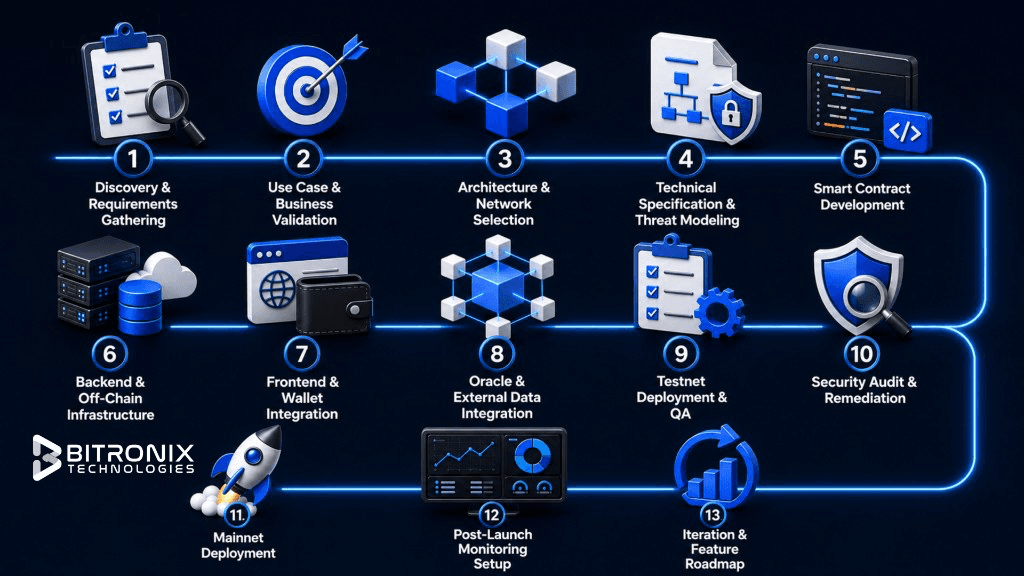
Step 1: Discovery & Requirements Gathering
Stakeholder interviews, use case documentation, regulatory constraint mapping and integration inventory. Output: a requirements document both business and technical teams can sign off on.
Step 2: Use Case & Business Validation
Confirm the problem needs blockchain, define MVP scope and align on success metrics. Output: validated business case and scoped MVP definition.
Step 3: Architecture & Network Selection
On-chain/off-chain data map, network choice, security model and integration architecture. Output: architecture decision record (ADR) documenting key choices and rationale.
Step 4: Technical Specification & Threat Modeling
Detailed smart contract specs, API designs, threat model identifying attack surfaces and audit scope definition. Output: technical specification document and threat model.
Step 5: Smart Contract Development
Write, unit test and internally review smart contract code. Use established patterns, implement access controls and maintain comprehensive test coverage before any external review.
Step 6: Backend & Off-Chain Infrastructure
APIs, databases, indexing (The Graph or equivalent) and integrations with existing enterprise systems. This layer handles everything that doesn't need blockchain-level trust guarantees.
Step 7: Frontend & Wallet Integration
User-facing application with wallet connectivity, transaction flows and dashboards. Invest here, poor UX kills adoption regardless of how sound the contracts are.
Step 8: Oracle & External Data Integration
Connect smart contracts to required external data sources with appropriate staleness handling, fallback logic and manipulation resistance.
Step 9: Testnet Deployment & QA
Deploy to testnet, run integration tests, stress test under simulated load and conduct user acceptance testing with real stakeholders before any mainnet activity.
Step 10: Security Audit & Remediation
Independent third-party review of smart contracts and application security. Address all critical and high findings, then undergo follow-up review before mainnet deployment.
Step 11: Mainnet Deployment
Careful, staged deployment to the live network. Use multi-sig controls, deployment checklists and rollback plans, mistakes at this stage can be irreversible.
Step 12: Post-Launch Monitoring Setup
On-chain activity monitoring, alerting for unusual transactions, performance dashboards and incident response procedures. Production blockchain applications need 24/7 monitoring from day one.
Step 13: Iteration & Feature Roadmap
Gather user feedback, prioritize roadmap features and plan upgrades within the constraints of deployed contract architecture. Budget for ongoing development, not just launch.
Testnet vs. Mainnet: Don't Rush the Transition
Testnet is where you find the bugs that internal testing misses, edge cases in transaction ordering, gas estimation failures, wallet compatibility issues and integration breaks under realistic load. Treat testnet as a mandatory gate, not a formality.
A reasonable testnet phase for a production application: minimum 4–6 weeks of active testing with real users or consortium partners, full integration test suite passing, security audit completed and remediated and a documented mainnet deployment runbook. Moving to mainnet before these criteria are met is how projects lose user funds and reputations in a single block.
What Drives the Cost of Building a Blockchain
Blockchain build costs vary enormously based on what you're actually building. These factors have the largest impact:
- Network type, Custom chain vs. application on existing network (10x+ cost difference)
- Smart contract complexity, Simple token vs. multi-contract DeFi protocol with economic attack surfaces
- On-chain data volume, More on-chain data means higher gas costs and more audit surface
- Integration depth, Connecting to legacy enterprise systems adds significant development time
- Compliance requirements, KYC/AML, securities compliance and industry-specific regulations multiply scope
- Audit depth, Single audit vs. multiple firms, formal verification, economic modeling
- Team model, In-house, freelancers, or specialized development company (see comparison below)
- Timeline pressure, Rushed timelines require larger teams and increase rework risk
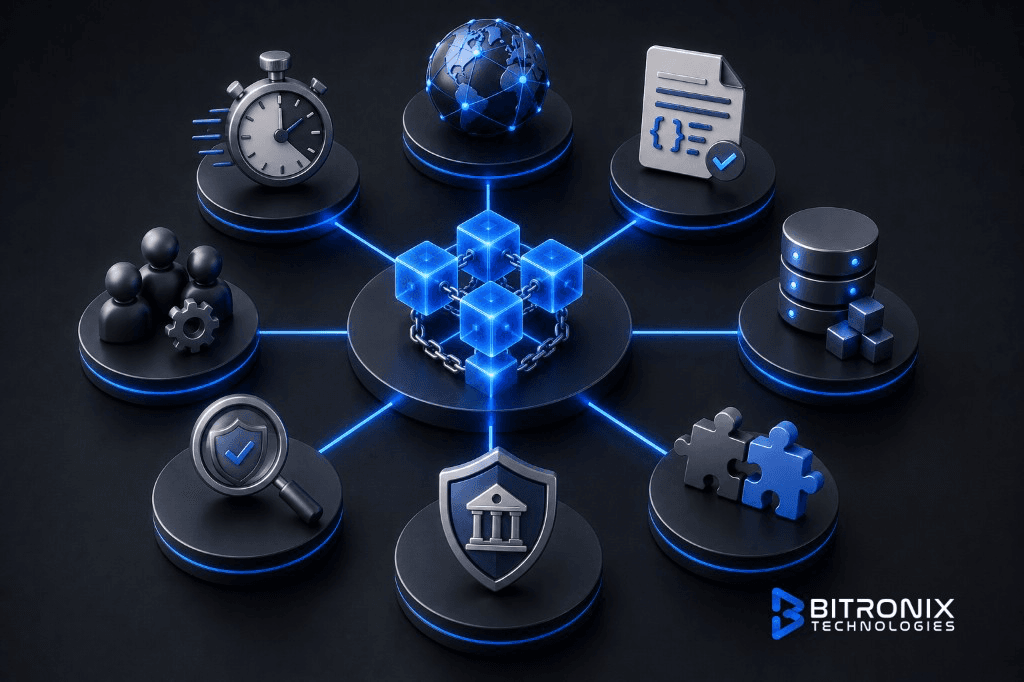
| Project | Approximate Development Range |
|---|---|
| Proof of concept | $10,000–$30,000 |
| Focused blockchain MVP | $25,000–$75,000 |
| Medium-complexity Web3 platform | $75,000–$200,000 |
| DeFi or financial application | $100,000–$400,000+ |
| Tokenization platform | $100,000–$400,000+ |
| Enterprise blockchain solution | $150,000–$500,000+ |
| New blockchain network | $300,000–$1M+ |
These figures should be treated as planning ranges, not quotes. The actual cost depends on the project. The right question is not "How cheap can we build this?" It is: what level of investment is appropriate for the risk, complexity and value of this product?
In-House vs. Freelancer vs. Blockchain Development Company: What To Choose
How you staff the build affects cost, speed, security and long-term maintainability. There is no universal winner, it depends on your stage, budget and whether blockchain will become a core internal capability.
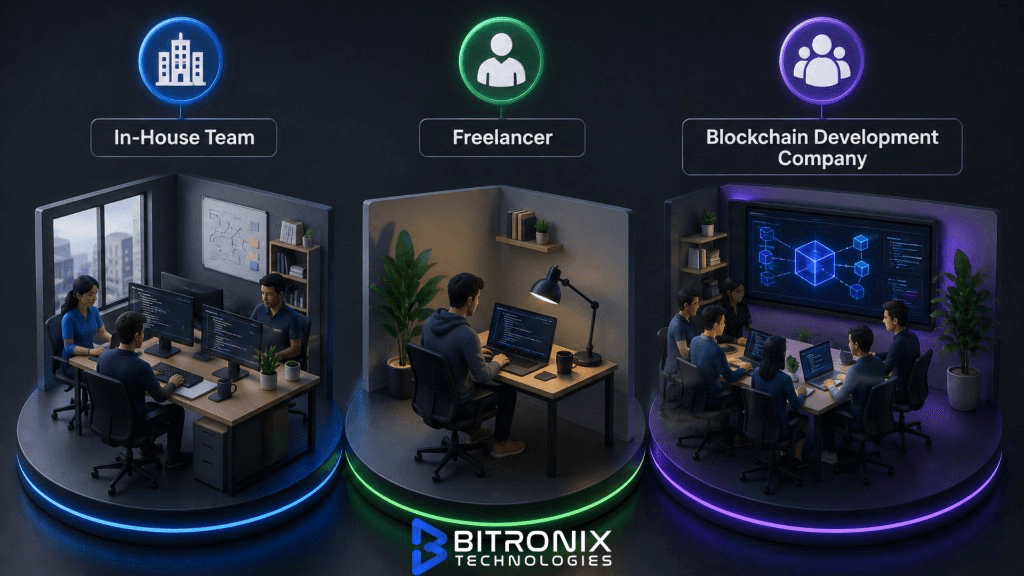
| Factor | In-House Team | Freelancers | Development Company |
|---|---|---|---|
| Initial cost | High | Low to medium | Medium to high |
| Hiring effort | High | Medium | Low |
| Long-term control | High | Medium | Medium |
| Access to specialists | Limited by hiring | Depends on freelancers | Usually broader |
| Project management | Internal | Internal | Shared |
| Scalability | Slower | Variable | Usually faster |
| Best for | Long-term product teams | Specific tasks | MVPs and complex products |
Team Cost: Hourly Rates vs. Total Project Cost
When evaluating proposals, understand whether you're comparing hourly rates or total project cost, they tell different stories.
- U.S.-based senior blockchain developers: $150–$250+/hour
- Specialized blockchain development companies: $100–$200/hour blended rate, but include project management, security review and architecture
- Offshore teams: $40–$80/hour, with variable quality and communication overhead
- Freelancers: $80–$180/hour depending on specialization and track record
A lower hourly rate with a team that takes twice as long, skips security review, or requires extensive rework is more expensive than a higher-rate specialist who ships correctly the first time. Evaluate total project cost, timeline and deliverables, not hourly rate alone.
How to Hire a Blockchain Development Team
Hiring for blockchain is different from hiring for web development. The irreversible nature of deployed smart contracts means a bad hire isn't just slow, it can be catastrophic. Use these ten questions on every evaluation call:
- "Show me a production application you've built that's live on mainnet, not testnet." Ask for the contract addresses and verify them. Portfolio pieces that never reached production don't count.
- "Walk me through your smart contract security process, not just 'we audit at the end.'" Look for threat modeling during design, internal review before external audit and established patterns over custom code.
- "How do you decide what goes on-chain vs off-chain?" The answer should reference your specific use case, not a generic template.
- "What's your experience with [your target network]?" Deep experience on one network beats shallow experience across five.
- "How do you handle contract upgrades after deployment?" Proxy patterns, migration contracts, or explicit immutability with thorough pre-deployment testing, vague answers are a red flag.
- "What regulatory considerations have you built for in [your industry]?" For FinTech, healthcare, or tokenization projects, regulatory awareness should be evident in their approach.
- "Who on your team will actually write the smart contracts?" Not the salesperson. Not the project manager. The actual developers.
- "What's included in your quote and what's explicitly excluded?" Audit costs, infrastructure, ongoing maintenance and compliance consulting are often excluded from low headline numbers.
- "What's your typical timeline for a project like ours and what causes delays?" Honest teams tell you where projects go wrong. Teams that promise everything on an aggressive timeline without caveats are overpromising.
- "Can you provide references from clients whose projects are in production?" Talk to those references. Ask about communication, scope changes, security incidents and post-launch support.
How to Evaluate Proposals and Red Flags to Walk Away From
A credible proposal should include: itemized scope by component (smart contracts, front-end, backend, audit, infrastructure), named team members with relevant experience, a realistic timeline with milestones, explicit assumptions and exclusions and a security review plan, not an afterthought.
Red flags that should end the conversation:
- Recommends the same blockchain platform for every project regardless of use case
- No production mainnet deployments in portfolio, only testnet or conceptual work
- Security audit listed as optional or "phase two"
- Fixed-price quote with no itemized breakdown or change-order process
- Can't explain on-chain vs off-chain tradeoffs for your specific application
- Promises token price appreciation or market-making as part of development scope
- No mention of key management, access controls, or incident response
- Unwilling to sign an NDA or share verifiable references
- Timeline significantly shorter than industry norms without clear justification
- Proposes launching a custom chain when an existing network clearly fits
A Practical Roadmap: Months 1 Through 7+
Here's what a realistic timeline looks like for a production blockchain application on an existing network, not a rushed proof of concept, not an enterprise consortium with twelve stakeholders.
- Month 1, Discovery & validation: Stakeholder interviews, use case validation, architecture decisions, regulatory scoping, team selection. Deliverable: signed requirements doc and architecture ADR.
- Month 2, Specification & design: Technical specs, threat model, smart contract design, UI/UX wireframes, integration mapping. Deliverable: technical specification and design approval.
- Months 3–4, Core development: Smart contract development and testing, backend infrastructure, front-end build, oracle integration. Deliverable: working testnet deployment.
- Month 5, Testnet QA & audit: Integration testing, user acceptance testing, security audit engagement, audit remediation. Deliverable: audit report with all critical findings resolved.
- Month 6, Mainnet launch: Staged mainnet deployment, monitoring setup, soft launch with limited users. Deliverable: live production application.
- Month 7+, Iteration & growth: User feedback incorporation, feature roadmap execution, ongoing monitoring, periodic security reviews. Deliverable: growing, maintained product.
Consortium builds, custom chains and applications with heavy compliance requirements should add 3–6 months to this timeline. Founders who budget 3 months for a production launch are setting up for disappointment, or dangerous shortcuts.
What to Prepare Before You Hire Anyone
Arriving prepared to your first development call saves weeks and produces better quotes:
- One-page problem statement: who has the problem, what it costs today, why blockchain might help
- Core user journey for the MVP (not the full vision)
- List of systems the blockchain app must integrate with
- Known regulatory constraints or open legal questions
- Budget range and target launch date (honest numbers, not aspirational ones)
- Decision-makers identified and available for weekly check-ins during development
U.S. Market Considerations and the Regulatory Landscape
Building blockchain in the U.S. means navigating a regulatory environment that has matured considerably but remains complex and use-case-specific. Treat compliance as an architecture input from day one, not a legal review scheduled for week before launch.
March 2026: SEC and CFTC Coordination
In March 2026, the SEC and CFTC issued coordinated guidance clarifying jurisdictional boundaries for digital asset classification, particularly around when tokens constitute securities versus commodities and how DeFi protocols may fall under existing derivatives oversight frameworks. While this guidance reduced some ambiguity that had paralyzed enterprise adoption, it did not eliminate the need for case-by-case legal analysis.
Practical implications for builders: token offerings still require securities law analysis; DeFi protocols with leveraged or derivative-like mechanics face heightened CFTC scrutiny; and "utility token" labels without genuine utility continue to attract enforcement attention. None of this replaces your legal counsel, it informs the questions you should be asking them.
Compliance-Ready Steps from Day One
- Engage legal counsel with digital asset expertise before finalizing tokenomics or public token distribution
- Keep personally identifiable information off-chain; anchor verification hashes on-chain where needed
- Implement KYC/AML flows for any application facilitating value transfer to or from U.S. persons
- Document your token classification rationale and regulatory analysis in writing
- Build transaction monitoring and reporting capabilities if your application handles financial flows
- Understand state-level money transmission licensing requirements, federal clarity doesn't preempt state rules
- Plan for data privacy: GDPR for EU users, CCPA for California residents and sector-specific rules (HIPAA, GLBA)
Building for the U.S. Market, Not Only U.S. Users
Many U.S.-based blockchain companies serve global users while maintaining U.S. regulatory compliance as their baseline. This means architecting for geo-restrictions where necessary, implementing jurisdiction-appropriate KYC tiers and designing token distribution to avoid inadvertent securities offerings in multiple jurisdictions.
If your product will have international users, factor in EU MiCA requirements, UAE VARA licensing for Middle East operations and varying token classification standards across jurisdictions. A U.S.-compliant architecture is a strong foundation, but it's not automatically sufficient for global deployment.
The Enterprise Perspective
Enterprise blockchain adoption in 2026 looks different from startup adoption. Enterprises typically prioritize:
- Integration with existing systems over greenfield architecture, your blockchain layer must connect to ERPs, CRMs and industry-specific platforms
- Permissioned or consortium models over public chains, for data privacy, governance control and regulatory predictability
- Internal pilot programs before customer-facing launches, validate technology and build organizational expertise with lower risk
- Change management as a parallel workstream, technology adoption fails as often from organizational resistance as from technical problems
- Audit-ready evidence from launch day, hashed transaction bundles, configuration snapshots and governance documentation regulators can review
Enterprises evaluating blockchain development partners should weight production experience in regulated industries, consortium delivery track record and compliance architecture expertise more heavily than raw development speed.
A Final Word on Legal
Nothing in this guide constitutes legal advice. Blockchain regulation in the U.S. is complex, evolving and highly fact-specific. The March 2026 SEC/CFTC guidance improved clarity in some areas but did not simplify the need for qualified legal counsel on your specific application.
A development partner with regulatory awareness can architect for compliance, keeping PII off-chain, building appropriate access controls, designing token mechanics with legal constraints in mind. But that architectural awareness complements legal counsel; it does not replace it. Budget for both.
Conclusion: Build Smart, Not Just Fast
Building blockchain in 2026 is more achievable than ever, for teams that do the planning work. The tooling is mature, the use cases are proven and the regulatory environment, while still complex, is clearer than it was even a year ago.
The founders and enterprises who succeed are the ones who validate the business case before writing code, choose architecture based on requirements rather than hype, scope ruthlessly around an MVP, hire teams with production experience and security discipline and treat U.S. regulatory compliance as a product requirement, not a post-launch checkbox.
Bitronix Technologies helps U.S. startups and enterprises design and ship production blockchain, smart contract and DApp systems, with security, architecture and compliance built in from day one.
Frequently Asked Questions
How Much Does It Cost To Build A Blockchain Application In 2026?
Costs vary by scope, but simple proofs of concept may start around $10,000. Focused MVPs and complex enterprise systems cost more because security, integrations and compliance increase effort.
How Long Does It Take To Build A Blockchain Application?
A proof of concept may take weeks, while an MVP often takes two to four months. Production systems usually need longer because testing, audits and integrations add time.
Do I Need To Create My Own Blockchain?
Usually no, because most startups can build faster on established networks. Create your own chain only when control over consensus, economics, or performance is essential for your product.
Which Blockchain Is Best For A Startup?
There is no universal best blockchain. Choose based on fees, speed, security, ecosystem and wallet support, then match those strengths to your product requirements carefully before launching anything.
Can I Build A Blockchain Application Without Creating A Token?
Yes, many useful blockchain products do not need a token. If the token adds no clear utility, it can create unnecessary complexity, cost and regulatory exposure later too.
How Do I Choose The Right Blockchain Development Company?
Look for relevant experience, security practices, clear communication and post-launch support. The best partner challenges assumptions, explains trade-offs and builds around your business goals from start to finish.

Founder and CTO
Founder and CTO of Bitronix Technologies. Builds production blockchain networks, smart contracts and enterprise Web3 systems for regulated industries.
Related Posts
 Blockchain
October 23, 202619 min read
DEX Clone Script: Features, Development Cost & How to Build a Decentralized Exchange
Explore DEX clone script features, development costs, smart contracts, liquidity pools, security, and the steps to build a decentralized exchange.
Read article Blockchain
October 21, 202613 min read
Agricultural Commodity Tokenization in 2027: Benefits, Process & Cost
Learn how agricultural commodity tokenization works, its benefits, development process, costs, use cases, and key regulatory considerations.
Read article Blockchain
October 21, 202618 min read
CoinMarketCap Clone Script: Features, Cost, and How to Build a Crypto Price Tracking Platform
Explore CoinMarketCap clone script features, development costs, APIs, revenue models, and how to build a cryptocurrency market data platform.
Read article