Blockchain App Development Guide 2026: Everything Businesses Need to Know

By Tausif AhmedFounder and CTO
A few years ago, blockchain was mostly a conversation about cryptocurrency speculation. That's no longer true. Walk into any conversation about supply chain traceability, cross-border payments, tokenized real estate, or healthcare data sharing and blockchain infrastructure is quietly sitting underneath a growing number of these systems.
The reason is that it solves specific problems: trust between parties who don't inherently trust each other, tamper-proof record-keeping and faster settlement, better than traditional systems can.
If you're a business leader trying to figure out whether blockchain app development actually makes sense for your company and if it does, how to approach it without wasting six months and a large budget on a project that never makes it past a proof of concept, this guide is built for exactly that.
We'll walk through what blockchain app development actually involves in 2026, the different types of applications businesses are building, what the process and timeline realistically look like and what it costs.
This isn't a technical whitepaper written for blockchain engineers. It's written for the person who has to make a business decision about whether and how, to invest in this.
Why Blockchain App Development Matters for Businesses in 2026
Before getting into the how, it's worth being honest about the why, because a lot of blockchain projects fail simply because nobody clearly answered this question before development started.
Blockchain solves a narrow but genuinely valuable set of problems: it creates a shared, tamper-resistant record that multiple parties can trust without relying on a single central authority to maintain it. It enables digital assets, tokens, currencies, ownership records, to move and settle without the delays and intermediary costs traditional financial rails require. And it allows for transparent, auditable processes in situations where trust between parties has traditionally been a bottleneck.
That's why the industries seeing the most genuine (not speculative) blockchain adoption in 2026 share a common thread: they involve multiple parties who need to trust shared data without a single party controlling it entirely. Financial services settling cross-border transactions. Supply chains verifying product origin across multiple vendors. Healthcare systems needing to share patient records securely across providers. Real estate and asset management moving toward tokenized ownership structures that settle faster and open up fractional investment.
If your business problem doesn't actually involve this kind of multi-party trust or asset-transfer challenge, blockchain might not be the right tool and a good development partner should tell you that honestly rather than selling you a blockchain solution for a problem a regular database would solve just as well, at a fraction of the cost. That said, for the businesses where it does fit, the operational and cost advantages can be substantial.
Common Misconceptions That Derail Blockchain Projects Before They Start
- "Blockchain means cryptocurrency." For a lot of business applications, the underlying blockchain infrastructure has nothing to do with a tradable cryptocurrency. Enterprise blockchain solutions, supply chain tracking, identity verification and many tokenization platforms use blockchain purely as a data and transaction infrastructure layer.
- "It has to be fully decentralized to be a real blockchain app." Many effective business blockchain applications use permissioned or hybrid architectures, where certain parties have elevated access or control, rather than the fully public, permissionless model associated with public cryptocurrency networks. This isn't a compromise, it's often the correct architecture for a business context with real accountability requirements.
- "Once we build it, it's basically free to run." Ongoing infrastructure costs, gas fees on public networks, node maintenance, security monitoring and periodic audits as the system evolves are real, ongoing costs that need to be budgeted for, not one-time expenses.
- "Smart contracts can just be updated like normal software if something's wrong." Once deployed, most smart contracts are difficult or impossible to modify directly. Architecture needs to plan for this reality from day one, either through upgradeable contract patterns or extremely thorough testing before deployment, since a live smart contract with a bug is a very different kind of problem than a bug in a normal web application.
Types of Blockchain Applications Businesses Are Building in 2026
Blockchain app development isn't a single category of product. Understanding which type fits your business goal is the first real decision point.
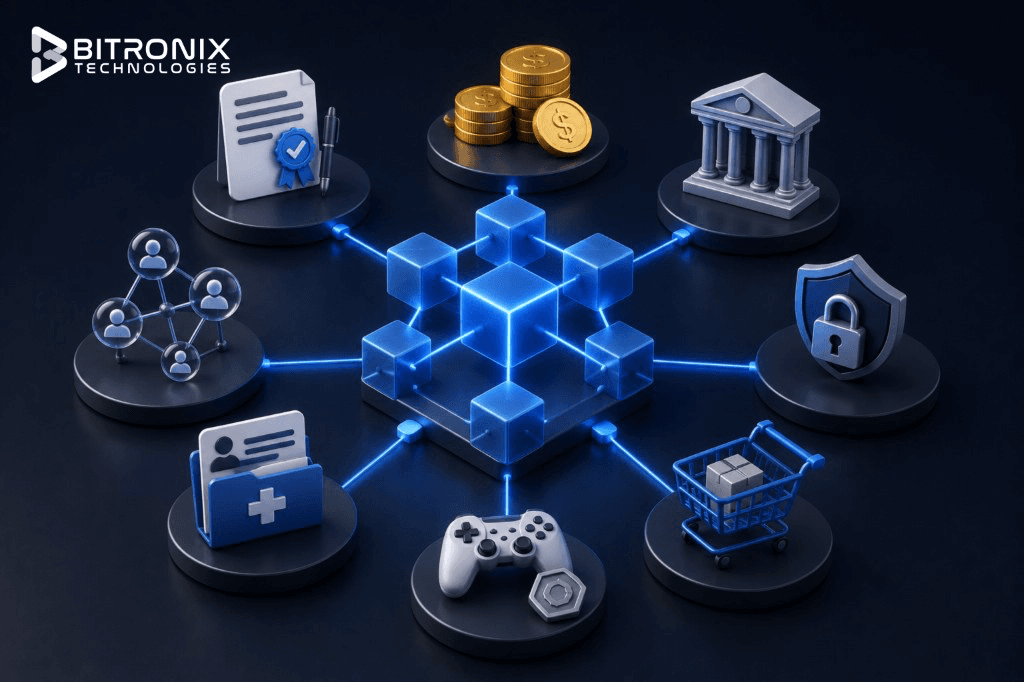
Decentralized Applications (DApps)
DApps are platforms built on a blockchain network rather than centralized servers, often incorporating smart contracts to handle core logic. These range from decentralized finance platforms to marketplaces and social applications. Businesses building DApps are typically aiming for a product where trust, transparency and censorship resistance are core to the value proposition.
Enterprise Blockchain Apps
Enterprise blockchain apps typically use permissioned blockchain networks internally or across a defined group of business partners. These apps are useful for supply chain management, inter-bank settlement and consortium-based industries where multiple known organizations need a shared, tamper-proof ledger without opening the network to the public.
Tokenization Platforms
Tokenization involves representing real-world or digital assets, real estate, securities, commodities, or intellectual property, as digital tokens on a blockchain. This is one of the fastest-growing categories heading into 2026, driven by institutional interest in faster settlement, fractional ownership and expanded access to previously illiquid asset classes.
Supply Chain and Traceability Applications
These applications track goods as they move through a supply chain, creating an immutable record of origin, handling and custody at each step. This is useful in industries like food safety, pharmaceuticals and luxury goods, where provenance and authenticity verification carry real regulatory and reputational weight.
Decentralized Finance (DeFi) Platforms
Lending platforms, decentralized exchanges, yield products and other financial applications built on blockchain infrastructure, typically without traditional financial intermediaries. This is its own specialized development category with distinct security and tokenomics considerations.
NFT and Digital Ownership Platforms
While the speculative NFT boom of a few years ago has cooled significantly, the underlying technology, representing unique digital ownership on-chain, has found more durable, practical applications in ticketing, digital collectibles tied to real products, membership systems and intellectual property licensing.
Blockchain-Based Identity Solutions
Self-sovereign identity systems, where individuals control their own verified identity credentials rather than relying on centralized databases held by individual institutions, are gaining real traction, particularly in financial services and healthcare, where identity verification is a recurring operational cost and friction point.
Blockchain Gaming and Metaverse Infrastructure
Applications incorporating true digital asset ownership, tradeable in-game items and interoperable assets across platforms. This category has matured considerably, with the strongest projects focusing on genuine gameplay value rather than speculative asset trading as the primary draw.
Choosing the Right Platform For Building Blockchain Mobile App
One of the most consequential early decisions in any blockchain app development project is which underlying blockchain platform to build on. This affects cost, speed, security assumptions and how easily your application can interoperate with other systems.
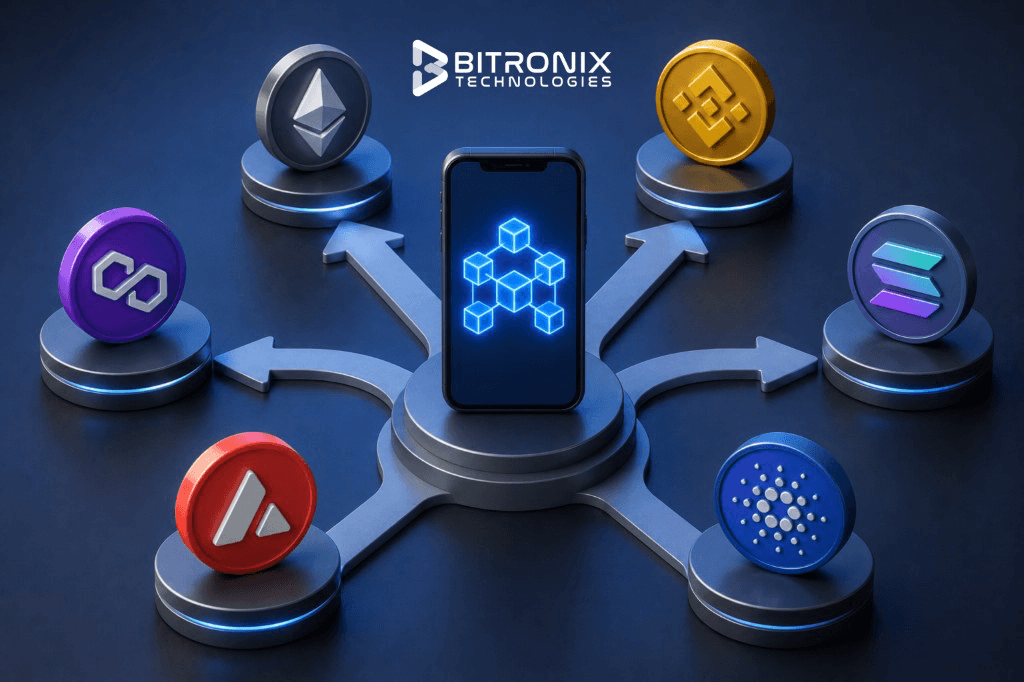
Ethereum
Ethereum remains the most established platform for smart contract development, with the deepest developer ecosystem, the most extensive security tooling and the widest network of existing DeFi and Web3 infrastructure to integrate with. The tradeoff has historically been higher transaction costs and slower throughput compared to newer alternatives, though Layer 2 solutions have significantly addressed this.
Layer 2 Solutions (Arbitrum, Optimism, Base and Others)
These networks process transactions off the main Ethereum chain while still inheriting its security guarantees, offering significantly lower fees and faster transactions. For most new consumer-facing blockchain applications in 2026, building directly on a Layer 2 rather than Ethereum mainnet has become the more practical default.
Solana
Known for high throughput and low transaction costs, Solana has become a popular choice for applications requiring fast, frequent transactions, like certain DeFi products, gaming applications and payment-focused use cases. Its architecture and developer tooling differ meaningfully from Ethereum's, which affects hiring and development approach.
Polygon
Positioned as a scalable, lower-cost alternative with strong Ethereum compatibility, Polygon has found particular traction in enterprise and tokenization use cases where cost predictability and sustainability considerations matter to business stakeholders.
Hyperledger Fabric
A permissioned blockchain framework specifically designed for enterprise and consortium use cases, where participants are known, identity-verified organizations rather than anonymous public participants. This is a common choice for supply chain consortiums and inter-institutional financial applications.
Avalanche
Offers high transaction speed with the flexibility to create customized subnets, appealing to enterprises and projects that want more control over their specific network's rules and validator requirements than a fully public chain allows.
Blockchain Platform Selection According To Your Use Case, Not Popularity
The right blockchain development platform depends on your specific requirements: does your application need public transparency, or is a permissioned network more appropriate? How transaction-heavy is your expected usage? Does your business need interoperability with existing DeFi infrastructure, or is it a closed system among known partners? A development partner should walk through these tradeoffs with you specifically, rather than defaulting to whichever platform they happen to have the most existing code templates for.
Complete Blockchain App Development Process: Step by Step
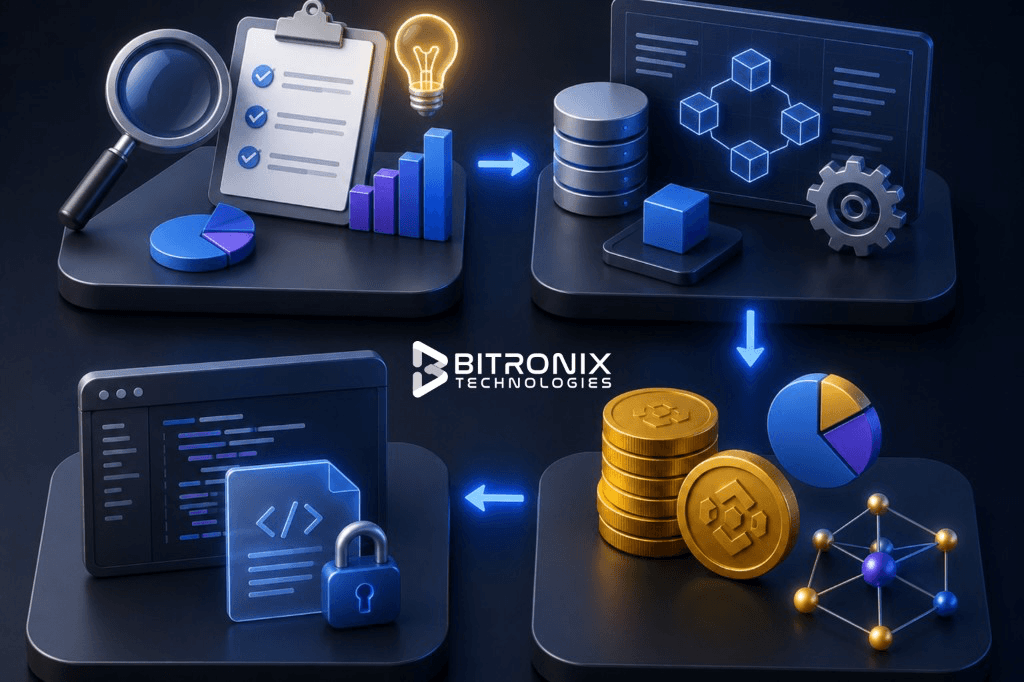
Step 1: Discovery and Feasibility Assessment
Before any development begins, this phase should honestly answer whether blockchain is actually the right solution for your problem and if so, what type of application and platform fits best. This includes mapping your business workflow, identifying which parties need access to what data and defining what successful blockchain actually looks like.
Step 2: Architecture and Technical Planning
This is where the specific technical approach gets defined: which blockchain platform, what data lives on-chain versus off-chain (a critical and often underestimated decision, since storing everything on-chain is usually neither necessary nor cost-effective), how the application will handle scalability and what the security model looks like.
Step 3: Tokenomics and Incentive Design (If Applicable)
For applications involving a native token, whether for governance, utility, or asset representation, this phase involves modeling supply, distribution and incentive mechanics to make sure the economic design actually holds up under real usage rather than just looking reasonable on paper.
Step 4: Smart Contract Development
The core logic governing the application's on-chain behavior gets built here. This tends to be the most security-sensitive phase of the entire project, since smart contract code, once deployed, is difficult to change and directly controls the movement of value or the enforcement of rules.
Step 5: Backend and Off-Chain Infrastructure Development
Most blockchain applications rely on significant off-chain infrastructure, APIs, databases and services that interact with the blockchain but don't need to live on it. This layer handles things like user data that doesn't need to be public, application logic that doesn't require blockchain-level trust guarantees and integrations with existing business systems.
Step 6: Front-End Development
The user-facing application, including wallet connectivity, transaction flows and dashboards. A common mistake in blockchain development is under-investing in this layer, resulting in technically sound applications that are genuinely difficult for non-technical users to actually use.
Step 7: Testnet Deployment and Quality Assurance
Before touching a live network with real value at stake, the application gets deployed to a testnet environment where it can be stress-tested under conditions simulating real usage, surfacing edge cases and issues that internal development testing alone tends to miss.
Step 8: Security Auditing
Independent, third-party review of the smart contract code and overall application security is a non-negotiable step for any application handling real value or sensitive data. This should happen before mainnet deployment, with enough buffer time in the project schedule to address findings and, ideally, undergo a follow-up review.
Step 9: Mainnet Deployment
The actual launch onto the live blockchain network, handled carefully given that mistakes at this stage can be difficult or impossible to fully reverse, depending on the platform and application design.
Step 10: Post-Launch Monitoring and Iteration
Ongoing monitoring for unusual activity, performance issues and opportunities for improvement, along with a plan for how future updates or feature additions will be handled given the constraints of working with deployed blockchain infrastructure.
Core Features Every Business Blockchain App Should Consider
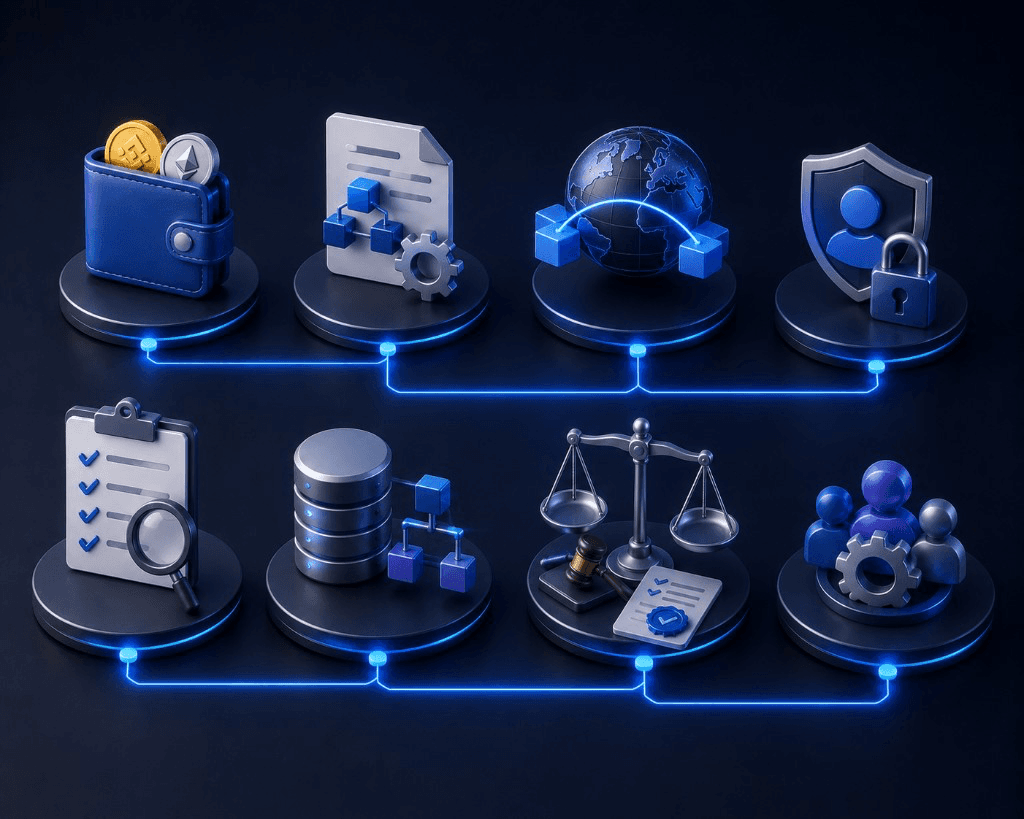
- Secure Wallet Integration, Seamless, secure connectivity with popular wallets is foundational to usability. This includes clear transaction confirmation flows that help users understand what they're actually approving, a surprisingly common point of both security risk and user confusion in poorly designed applications.
- Smart Contract Automation, The core logic that allows agreements, transactions, or processes to execute automatically once predefined conditions are met, removing the need for manual intermediary processing and reducing both cost and the potential for human error or dispute.
- Interoperability and Cross-Chain Functionality, For many applications, the ability to interact with assets or data across multiple blockchain networks has become an expectation rather than a nice-to-have, particularly for financial and asset management use cases.
- Robust Identity and Access Management, Especially critical for permissioned enterprise applications, controlling who can view, submit, or approve specific data or transactions, often layered with real-world identity verification requirements depending on the industry.
- Transparent Audit Trails, One of blockchain's core value propositions is the ability to trace the full history of a transaction or asset. Applications should make this transparency genuinely accessible and useful to stakeholders, not just theoretically available in raw blockchain data.
- Scalable Data Architecture, Deciding what data lives on-chain versus in traditional off-chain databases has a major impact on both cost and performance. Well-architected apps keep only what needs blockchain-level trust on-chain.
- Compliance and Regulatory Features, Depending on industry and jurisdiction, this can include KYC/AML integration, transaction monitoring and reporting capabilities built into the architecture from the start rather than retrofitted later.
- Governance Mechanisms, For applications involving decentralized decision-making, whether a DAO structure or simpler multi-signature approval processes, well-designed governance prevents both excessive centralization and vulnerability to coordinated manipulation.
Benefits of Blockchain App Development for Businesses
- Reduced Intermediary Costs, By enabling direct, trust-minimized transactions between parties, blockchain applications can reduce or eliminate fees traditionally paid to intermediaries handling verification, settlement, or record-keeping.
- Faster Settlement and Transaction Speed, Particularly relevant in financial services and cross-border transactions, blockchain-based settlement can reduce processes that traditionally take days down to minutes or hours.
- Enhanced Transparency and Trust, Shared, tamper-resistant records give all relevant parties confidence in data integrity without requiring them to trust a single central authority.
- Improved Security Through Decentralization, Distributing data across a network rather than a single centralized database reduces certain categories of risk, like a single point of failure, though this comes with its own distinct security considerations.
- New Business Models Through Tokenization, Fractional ownership of previously illiquid assets, programmable royalty structures and new forms of digital ownership open up models that weren't practically achievable with traditional infrastructure.
- Stronger Auditability and Compliance Support, Immutable transaction histories can significantly simplify compliance reporting and audit processes in regulated industries, when designed with these requirements from the start.
- Competitive Differentiation, In industries where blockchain adoption is still relatively early, businesses that successfully implement it, particularly in ways customers and partners notice and value, can establish a meaningful advantage around trust and transparency.
How Much Does Blockchain App Development Cost in 2026?
As with any software development, cost depends heavily on scope and complexity. Here's a realistic breakdown by project type.
| Project Type | Cost Range | Timeline |
|---|---|---|
| Simple Blockchain App | $15,000 – $50,000 | 2 to 4 months |
| Mid-Complexity Applications | $50,000 – $150,000+ | 5 to 8 months |
| Advanced, Enterprise-Grade | $150,000 – $500,000+ | 10–12+ months |
1. Simple Blockchain App
A straightforward application, a basic tokenization tool, a simple smart contract-based agreement system, or a limited-scope proof of concept, sits at the lower end of the cost spectrum. This typically covers core smart contract development, a functional but not extensively customized front-end and standard internal security review, though it may not include a comprehensive third-party audit.
Mid-Complexity Applications
Applications like a supply chain tracking system integrated with existing business software, a mid-scale tokenization platform, or a DeFi application with standard functionality require considerably more development effort: more complex smart contract logic, deeper integration work with existing enterprise systems, more thorough security auditing and a more polished, tested user interface. This tier represents the most common range for serious business applications moving beyond a pilot stage.
Advanced, Enterprise-Grade Applications
Projects involving cross-chain functionality, complex tokenomics, extensive regulatory compliance features, multi-party consortium architecture, or integration across numerous existing enterprise systems represent the highest end of the cost spectrum. These projects often involve many months of development, extensive testing phases and multiple rounds of independent security auditing.
What's The Cost To Build Blockchain App Based on Component?
| Component | Estimated Cost |
|---|---|
| Smart Contract Development & Business Logic | $10,000–$40,000 |
| Frontend & Backend Integration | $20,000–$50,000 |
| Security Audit | $5,000–$25,000 |
| Infrastructure & Data Indexing | $3,000–$10,000 |
Key Factors That Affect Cost To Create Blockchain-Powered App
- On-chain versus off-chain data architecture decisions. Poorly planned architecture that puts unnecessary data on-chain increases both development cost and ongoing transaction costs significantly.
- Number of blockchain networks supported. Multi-chain applications multiply both development complexity and testing requirements.
- Depth and number of security audits. More thorough, multi-firm auditing costs more upfront but substantially reduces the risk of costly post-launch exploits.
- Integration complexity with existing systems. Connecting to legacy enterprise software, particularly older systems without modern APIs, can add significant unplanned development time.
- Regulatory and compliance requirements. Applications requiring KYC/AML integration, specific reporting capabilities, or industry-specific compliance features add both development time and often separate legal or compliance consulting costs.
- Custom development versus adapting existing frameworks. Building fully custom smart contracts costs more than adapting well-tested, previously audited frameworks where the use case allows for it.
Ongoing Costs to Budget For
Beyond the initial build, businesses should plan for ongoing infrastructure costs (node hosting, gas fees for on-chain transactions), periodic security re-audits as the application evolves, continued development for feature updates and dedicated monitoring for unusual on-chain activity. Treating these as one-time costs rather than ongoing operational expenses is one of the most common budgeting mistakes companies make when planning blockchain projects.
Security: The Single Most Important Consideration
Given that blockchain applications frequently handle real value or sensitive data in an environment where mistakes are difficult to reverse, security deserves its own dedicated section rather than being treated as just another line item in the development process.
Why Blockchain Security Is Different
Unlike a traditional web application where a discovered vulnerability can typically be patched quickly, smart contract vulnerabilities on a live blockchain can be exploited immediately and, in many cases, irreversibly, before a fix can even be deployed. This fundamentally changes the risk calculus around cutting corners on security review.
Common Vulnerability Categories
Reentrancy attacks, where a malicious contract repeatedly calls back into a vulnerable function before the first execution completes, have caused some of the most well-known exploits in blockchain history. Integer overflow and underflow issues, oracle manipulation, where attackers exploit how a contract sources external price or data information and access control flaws that allow unauthorized parties to execute privileged functions are all recurring vulnerability categories that experienced development teams specifically test for.
What a Genuinely Security-Conscious Development Process Looks Like
Security review shouldn't be a single event right before launch. It should happen continuously throughout development, using established, previously tested code patterns rather than custom-writing solutions to problems that already have proven approaches and involving independent third-party auditors who weren't part of the original development team and can review the code with fresh eyes.
Economic Attack Modeling
Beyond traditional code vulnerabilities, blockchain applications, particularly those involving tokens or financial mechanics, need to be evaluated for economic attack vectors: scenarios where the code technically works exactly as written but the underlying incentive structure can be exploited, like flash loan attacks that manipulate price data within a single transaction. This requires a different kind of review than standard code auditing and is often overlooked by development teams without dedicated tokenomics and financial engineering expertise.
Regulatory and Compliance Considerations in the USA
The regulatory environment around blockchain, digital assets and tokenization in the United States has continued to evolve and businesses building blockchain applications need to factor this into their planning from the earliest stages, not as an afterthought once development is underway.
Depending on your specific application, relevant considerations can include securities regulations (particularly for tokenization platforms and any application involving investment-like token structures), money transmission licensing requirements for applications facilitating value transfer, KYC/AML obligations for financial applications and data privacy regulations where personal information intersects with on-chain data structures, which carries unique complications given blockchain's immutability.
A development partner with genuine regulatory awareness can help architect an application that accounts for these considerations from the start, for example, keeping personally identifiable information off-chain even when related transaction data lives on-chain, or building appropriate access controls into a permissioned network. That said, this should complement, not replace, direct legal counsel with specific expertise in digital asset regulation for your particular application and industry.
Industry Use Cases: Where Blockchain App Development Is Delivering Real Results
Blockchain in Financial Services
Beyond well-known DeFi applications, traditional financial institutions are increasingly using blockchain infrastructure for cross-border settlement, trade finance and tokenized securities, driven by the potential for faster settlement times and reduced reconciliation costs compared to legacy systems.
Blockchain in Healthcare
Blockchain-based systems for secure, patient-controlled health record sharing across providers and for verifying the authenticity and supply chain integrity of pharmaceuticals are addressing longstanding interoperability and counterfeiting problems in the industry.
Blockchain in Supply Chain & Logistics
Real-time, tamper-proof tracking of goods from origin to final delivery has become particularly valuable in food safety, luxury goods authentication and industries facing increased regulatory scrutiny around sourcing transparency.
Blockchain in Real Estate & RWA Tokenization
Representing real estate and other traditionally illiquid assets as digital tokens is opening up fractional ownership models and faster, more transparent transaction processes, an area seeing significant institutional interest heading into 2026.
Blockchain in Insurance
Smart contract-based parametric insurance products, which automatically trigger payouts based on verifiable on-chain or oracle-fed data (like weather conditions for crop insurance), are reducing claims processing time and disputes compared to traditional claims adjustment processes.
Blockchain in Digital Identity & Credentialing
Verifiable, portable digital credentials for professional licensing, educational qualifications, or identity verification are reducing the friction and cost businesses and institutions face in repeatedly verifying the same information for different purposes.
How to Choose the Right Blockchain Development Partner?
- Look for Genuine Production Experience, Ask specifically for examples of applications currently live and running on mainnet, not just conceptual designs or testnet-stage projects. A portfolio full of proof-of-concept work without real production deployments is a meaningful gap.
- Confirm Security Practices Upfront, A credible development partner should proactively discuss their security review process, internal and third-party, as a core part of their proposal, not something you have to specifically ask about.
- Evaluate Their Platform-Agnostic Judgment, Be cautious of any partner who recommends the same blockchain platform regardless of your specific use case. The right recommendation should follow from your actual requirements.
- Ask About Regulatory Awareness, Particularly important for financial services, healthcare, or tokenization projects, confirm the team understands the relevant compliance landscape and can architect accordingly, while being clear that this doesn't replace your own legal counsel.
- Get a Clear, Itemized Proposal, Understand exactly what's included, smart contract development, front-end, security auditing, ongoing maintenance and what isn't, before committing.
- Start With a Scoped Pilot, Rather than committing to a full-scale build immediately, a focused pilot addressing a single, well-defined use case lets you evaluate the partnership with substantially lower financial risk before scaling.
Common Mistakes Businesses Make in Blockchain App Development
- Choosing blockchain for a problem that doesn't actually need it. Not every data or transaction problem benefits from blockchain's specific tradeoffs. Forcing a use case onto blockchain when a traditional database would serve better wastes both budget and time.
- Underestimating the importance of off-chain architecture decisions. Businesses often focus entirely on the smart contract layer while underinvesting in the off-chain infrastructure and user experience most users will actually interact with.
- Skipping or minimizing security audits to save cost or time. Given the irreversible nature of many blockchain vulnerabilities, the savings from skipping an audit are almost always dwarfed by the cost of an exploit.
- Failing to plan for regulatory considerations early. Retrofitting compliance features into an already-built application is significantly more difficult and expensive than architecting for them from the start.
- Overlooking ongoing maintenance and monitoring costs. Treating the initial development as the full cost of the project leads to under-resourced applications once real usage begins.
- Choosing a platform based on hype rather than fit. The blockchain platform generating the most industry buzz isn't necessarily the right technical fit for your specific application requirements.
How Bitronix Helps You in Cost-Effective Blockchain App Development?
Bitronix Technologies approaches blockchain app development the way businesses in regulated, high-stakes industries need it approached. We focus on security-first architecture from the earliest planning stages. We also provide honest guidance on whether blockchain is actually the right fit for a given problem.
Our team has deep specialization across FinTech, healthcare, supply chain and real-world asset tokenization. We avoid a generic, one-size-fits-all development process that is applied regardless of the industry.
That specialization matters because a large share of blockchain projects fail due to decisions made before development even starts, choosing the wrong platform for the use case, inadequate planning for regulatory requirements, or an architecture that doesn't reflect how the business actually operates.
Bitronix's process is built specifically to identify and address these issues during the discovery stage. This helps prevent them from becoming expensive problems discovered midway through development or, worse, after the product has launched.
The Tech Stack Behind Modern Blockchain App Development
Understanding the actual tools and languages involved helps you have a more informed conversation with any development team and gives you a way to sanity-check whether a proposal reflects genuine expertise or surface-level familiarity.
Smart Contract Languages
- Solidity remains the dominant language for Ethereum and Ethereum-compatible chains, including most Layer 2 networks. It has the largest developer community, the most mature tooling and the most extensive library of previously audited code patterns.
- Rust has become the standard for Solana development and is increasingly used across other high-performance blockchain ecosystems. It offers strong memory safety guarantees, which matter significantly where code vulnerabilities can be directly exploited for financial gain.
- Vyper is a Python-inspired alternative to Solidity, designed with security and simplicity as primary goals, deliberately limiting some of the more complex language features that have historically contributed to smart contract vulnerabilities.
Blockchain Application Development Frameworks and Tooling
Hardhat and Foundry have become the two leading development environments for Ethereum-based smart contract development, offering testing frameworks, local blockchain simulation and deployment tooling. Foundry in particular has gained significant traction for its speed and Rust-based testing approach. Truffle, an earlier and once-dominant framework, has seen its usage decline as Hardhat and Foundry have matured, though some existing projects still maintain Truffle-based codebases.
Front-End Integration Libraries
Ethers.js and Web3.js remain the primary libraries for connecting front-end applications to blockchain networks, handling wallet connections, transaction signing and contract interactions. Wagmi, a more modern React-focused library built on top of these foundations, has become increasingly popular for its developer-friendly approach to building blockchain-connected user interfaces.
Oracles and External Data
Since blockchains can't natively access external, real-world data, oracle networks like Chainlink serve as the bridge that feeds verified external information, price feeds, weather data, sports results, into smart contracts in a way that's resistant to manipulation. Any application relying on external data for critical logic needs a carefully chosen and properly integrated oracle solution.
Decentralized Storage
IPFS (InterPlanetary File System) and similar decentralized storage solutions are commonly used to store larger data, images, documents and metadata, off the blockchain itself while still maintaining a verifiable, tamper-resistant link between the on-chain record and the off-chain content. This is critical for applications dealing with substantial content, like NFT metadata or document verification systems.
Node Infrastructure and Indexing
Running and maintaining blockchain nodes, or using managed node providers, is necessary infrastructure for any production application. Indexing solutions like The Graph allow applications to efficiently query blockchain data in ways that would otherwise be slow and expensive to retrieve directly from the chain.
On-Chain vs. Off-Chain Blockchain App Development: Getting the Architecture Decision Right
This might be the single most consequential technical decision in any blockchain application and it's one that inexperienced teams frequently get wrong in ways that aren't obvious until costs or performance problems show up after launch.
Data or logic that requires the specific guarantees blockchain provides, immutability, decentralized verification, transparent auditability, or trustless execution, belongs on-chain. This typically includes core transaction records, ownership records for tokenized assets and the specific logic that needs to execute without a trusted central party's involvement.
Large files, detailed user data that doesn't need public transparency, application logic that doesn't require blockchain-level trust guarantees and anything where storage or computation costs would be disproportionate to the value of putting it on-chain, all of this is typically better handled through traditional, off-chain infrastructure that references or anchors to on-chain records where necessary.
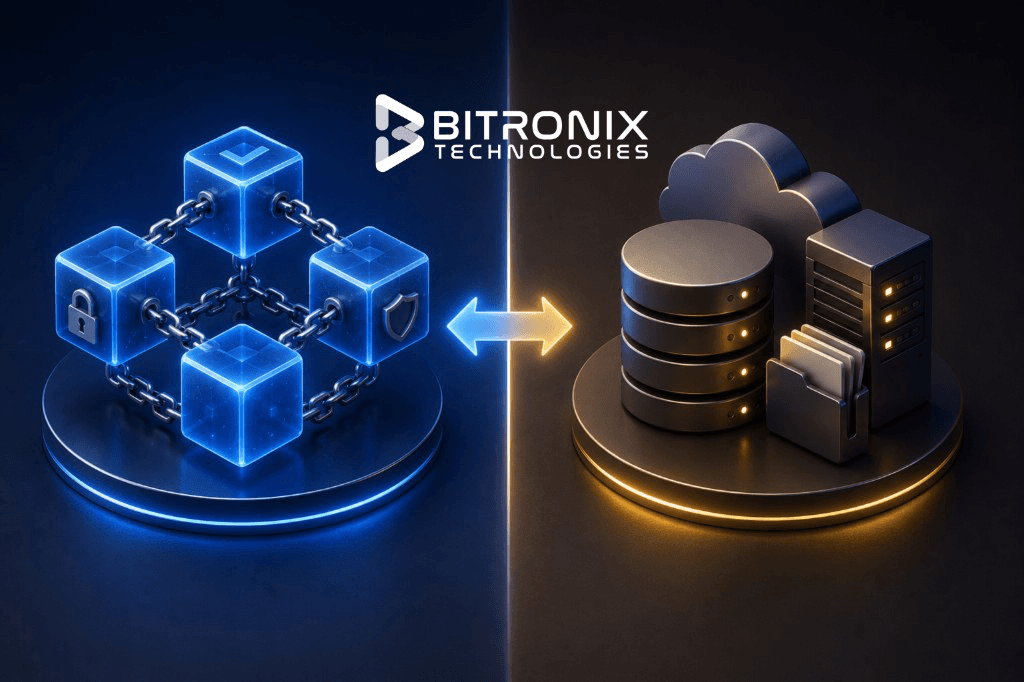
| Factor | On-Chain | Off-Chain |
|---|---|---|
| Data Storage | Stored on blockchain | Stored in external databases |
| Transparency | High | Depends on system access |
| Security | Decentralized security | Depends on infrastructure |
| Speed | Can be slower | Generally faster |
| Cost | Higher transaction fees | Usually more cost-effective |
| Scalability | Network-dependent | Easier to scale |
| Privacy | Less suitable for sensitive data | Better for private data |
| Best For | Smart contracts, tokens, verified transactions | Analytics, private data, high-volume processing |
Why This Balance of Both Approaches Matters So Much
Get this wrong in one direction, putting too much on-chain and you end up with an application that's needlessly expensive to operate and slow to use. Get it wrong in the other direction, putting too little on-chain and you undermine the actual trust and transparency benefits that justified using blockchain in the first place, ending up with what's sometimes called a "blockchain-washed" application. A genuinely experienced development team will walk through this tradeoff explicitly during the architecture phase.
Blockchain App Development for Startups Vs. Established Enterprises
For Startups
Speed to market and capital efficiency typically matter more than building every feature from scratch. This often means leaning more heavily on existing, well-audited frameworks and infrastructure rather than fully custom development, focusing initial development on the core differentiating functionality rather than building out every conceivable feature before launch and being realistic about how much can genuinely be validated with real users before committing to a larger, more expensive build.
For Established Enterprises
Integration with existing systems, internal stakeholder buy-in and regulatory and compliance considerations typically carry more weight than raw development speed. Enterprises often benefit from starting with a smaller, internal pilot, sometimes not even customer-facing, to validate the technology and build internal expertise before a larger rollout. Change management within the organization itself is frequently as significant a project component as the technical development itself.
Measuring Success: KPIs for a Blockchain App Development Project
Defining what success actually looks like before development starts makes an enormous difference in how effectively you can evaluate the project once it's live. Relevant metrics vary by application type, but common categories include:
- Transaction cost and speed, For applications where cost or settlement time was the core value proposition, actual on-chain transaction costs and confirmation times compared to the traditional process being replaced.
- User adoption and retention, Particularly for consumer-facing DApps: wallet connections, repeat usage and drop-off points in the transaction flow.
- Security incident rate, Ideally zero, but tracked and monitored regardless, along with response time if any issues are identified post-launch.
- Cost savings versus the previous process, For enterprise and supply chain applications: measurable reduction in reconciliation time, intermediary fees, or dispute resolution costs.
- Compliance and audit efficiency, For regulated industry applications: measurable improvement in how quickly and accurately compliance reporting or audit processes can be completed.
Agreeing on two or three of these that are most relevant to your specific project before development starts gives you an objective basis for evaluating whether the investment delivered real value.
The Future of Blockchain App Development: What's Changing Heading Into 2026 and Beyond
- Deeper integration with AI systems, A growing number of blockchain applications are incorporating AI-driven automation for fraud detection, smart contract risk assessment and dynamic pricing in DeFi and tokenization platforms.
- Continued growth in real-world asset tokenization, Institutional interest in tokenizing traditionally illiquid assets, real estate, private credit and commodities, has continued to accelerate.
- Maturing regulatory clarity, While still evolving, the regulatory environment around digital assets in the US has been moving toward greater clarity, gradually reducing hesitation for enterprises considering blockchain adoption.
- Increased focus on user experience, Much of the friction historically associated with blockchain applications, complex wallet setups, confusing transaction flows, is being addressed through better tooling and design practices.
- Growth in permissioned and hybrid architectures for enterprise use, More enterprise applications are adopting hybrid models that combine blockchain's transparency and trust benefits with the practical accountability and control structures businesses actually need.
Businesses evaluating blockchain app development in this environment are working with a considerably more mature ecosystem, in terms of tooling, regulatory clarity and proven use cases, than existed even a couple of years ago, which meaningfully reduces the execution risk compared to earlier waves of blockchain adoption.
What a Blockchain Development Team Actually Looks Like
Understanding the roles typically involved in a real project helps set expectations for who you'll actually be working with and helps you evaluate whether a proposed team has the right composition for your specific project.
- Blockchain architect, Overall technical design, platform selection and on-chain versus off-chain data decisions. Requires broad experience across multiple platforms and use cases.
- Smart contract developers, Write and test the core on-chain logic. For any project of real complexity, this should be more than one person so code can be reviewed before external audit.
- Front-end and back-end developers, Build the user-facing application and off-chain infrastructure. Effective blockchain front-end developers also need familiarity with wallet integration and transaction flow design.
- Security specialists, Either an internal security-focused role separate from the development team, or a structured process for coordinating with external audit firms.
- Tokenomics or economic design specialist, Relevant for any project involving a native token; models incentive structures and stress-tests them against adversarial scenarios.
- Project manager, Coordinates timeline, communicates progress and blockers and keeps technical workstreams aligned with business requirements from discovery.
- Compliance or regulatory advisor, For regulated industries, helps ensure architecture decisions account for legal requirements from the start.
A team missing several of these roles, particularly a dedicated security function separate from the core development team, is a meaningful gap worth asking about directly during your evaluation process.
Final Thoughts
Blockchain app development in 2026 sits in a genuinely different place than it did even a couple of years ago. The technology has matured, the tooling is considerably more developed, real use cases across finance, healthcare, supply chain and asset management have proven out and the regulatory environment, while still evolving, has become clearer than it once was.
That maturity means the businesses succeeding with blockchain today are less often the ones chasing hype and more often the ones that did the unglamorous work of correctly answering the two questions this guide keeps coming back to: does this problem genuinely need blockchain's specific properties and is the team building it treating security, architecture and compliance as core parts of the process rather than afterthoughts.
Get those two things right and the rest of the project, platform selection, feature scope and timeline, becomes a much more manageable set of decisions to work through with an experienced development partner.
Bitronix Technologies helps US startups and enterprises design and ship production blockchain, smart contract and enterprise blockchain systems, with security, architecture and compliance built in from day one.
Frequently Asked Questions
How Much Does It Cost To Build A Blockchain App In 2026?
Costs vary considerably based on complexity, ranging from simpler, single-purpose applications at the lower end to sophisticated, enterprise-grade platforms involving multi-chain support, extensive compliance features and comprehensive security auditing at the higher end. A detailed, itemized quote based on your specific requirements is the most reliable way to estimate actual project cost.
How Long Does Blockchain App Development Take?
A focused, single-use-case application can move from discovery to mainnet launch in a few months. More complex, enterprise-grade applications involving multiple integrations, extensive compliance requirements, or multi-chain functionality can reasonably take six months to a year or more, largely driven by the additional testing and security auditing such projects require.
Do I Need Blockchain For My Business, Or Would Traditional Software Work Just As Well?
Blockchain makes the most sense when your application genuinely involves multiple parties who need to trust shared data without relying on a single central authority, or when you need transparent, tamper-resistant transaction records. If your use case doesn't have this multi-party trust dimension, a traditional database-driven application is often faster, cheaper and equally effective.
Which Blockchain Platform Is Best For A Business Application?
This depends entirely on your specific use case. Public networks like Ethereum and its Layer 2 solutions suit applications needing broad interoperability and public transparency, while permissioned frameworks like Hyperledger Fabric are typically better suited to enterprise consortium applications among known, trusted parties. A development partner should evaluate this based on your requirements, not default to a single preferred platform.
Is A Smart Contract Security Audit Really Necessary For Every Project?
For any application handling real value or sensitive data, yes, essentially without exception. Given that smart contract vulnerabilities can result in immediate, often irreversible loss, skipping third-party security review to save time or cost is one of the highest-risk decisions in blockchain development.
How Do Businesses Stay Compliant With US Regulations When Building Blockchain Applications?
This depends on the specific application; financial applications may need to consider securities and money transmission regulations, while applications handling personal data need to carefully manage what information lives on-chain versus off-chain. Working with a development partner who has genuine regulatory awareness, alongside direct legal counsel, is the most reliable approach.
What's The Difference Between A Public And Permissioned Blockchain For Business Use?
Public blockchains are open to anyone and typically prioritize decentralization and transparency, while permissioned blockchains restrict participation to known, verified organizations, often preferred for enterprise use cases where accountability and controlled access matter more than full public transparency.
Can An Existing Business System Be Integrated With A New Blockchain Application?
In most cases, yes. Well-architected blockchain applications are typically designed to integrate with existing enterprise systems, ERPs, CRMs, or industry-specific software, through API layers, rather than requiring a business to replace its entire existing technology infrastructure.
What Ongoing Costs Should Businesses Expect After Launching A Blockchain Application?
Beyond initial development, expect ongoing infrastructure costs, ongoing security monitoring and periodic re-audits, continued development for feature updates and, for public blockchain applications, transaction or gas fees tied to actual usage. These should be budgeted as ongoing operational expenses, not one-time costs.
How Do I Know If A Blockchain Development Company Is Genuinely Experienced Versus Just Following Industry Trends?
Ask for specific, verifiable examples of applications they've built that are currently live in production, along with any available security audit reports for those projects. A company that can only point to conceptual portfolio pieces or testnet-stage deployments hasn't demonstrated genuine production experience.

Founder and CTO
Founder and CTO of Bitronix Technologies. Builds production blockchain applications, smart contracts and enterprise Web3 systems for regulated industries.
Related Posts
 Blockchain
October 23, 202619 min read
DEX Clone Script: Features, Development Cost & How to Build a Decentralized Exchange
Explore DEX clone script features, development costs, smart contracts, liquidity pools, security, and the steps to build a decentralized exchange.
Read article Blockchain
October 21, 202613 min read
Agricultural Commodity Tokenization in 2027: Benefits, Process & Cost
Learn how agricultural commodity tokenization works, its benefits, development process, costs, use cases, and key regulatory considerations.
Read article Blockchain
October 21, 202618 min read
CoinMarketCap Clone Script: Features, Cost, and How to Build a Crypto Price Tracking Platform
Explore CoinMarketCap clone script features, development costs, APIs, revenue models, and how to build a cryptocurrency market data platform.
Read article