Web3 Real Estate App Development: A Practical Guide for 2026

By Tausif AhmedFounder and CTO
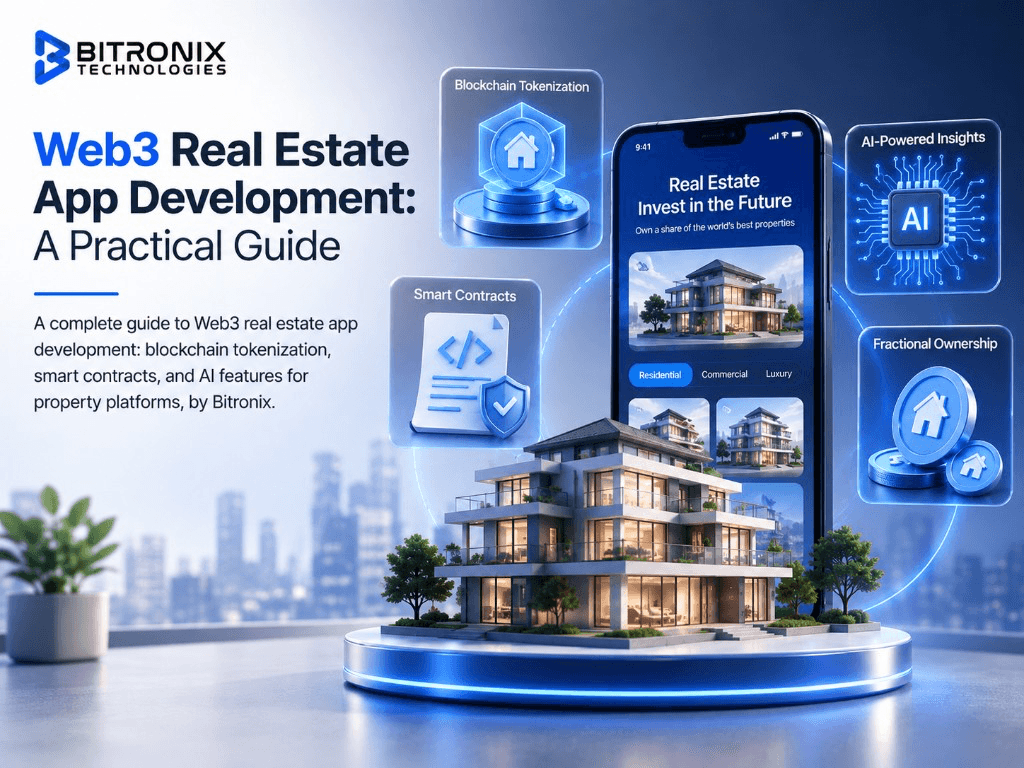
Property deals still run on paperwork, wire transfers that take days to clear and a chain of intermediaries who each take a cut. Web3 real estate app development replaces parts of that chain with code: ownership records that live on a blockchain, payments that settle in minutes and properties that can be split into tradable digital shares.
This guide walks through what these platforms are actually built from, how tokenization and smart contracts work in practice, where AI fits in and what to check before you hire a development partner.
What Web3 Real Estate App Development Actually Means
A Web3 real estate app is a property platform built on blockchain infrastructure instead of a traditional centralized database. The difference is not cosmetic. It changes who controls the data, how ownership is proven and how a transaction actually settles.
In a conventional real estate app, the company running the platform holds the database. They can edit records and users have to trust that the company is accurate and honest. In a Web3 app, ownership and transaction history are recorded on a blockchain. No single party can quietly alter a record after the fact and anyone with access can verify what happened.
This matters most in three areas: tokenization of real estate for fractional ownership, smart contracts that automate legal and financial steps and wallet-based identity that replaces some of the manual verification real estate has relied on for decades.
None of this removes the need for lawyers, title companies, or regulators. What it removes is the redundant manual verification that happens today because no one trusts the other party's paperwork. On a blockchain, the paperwork is not the source of truth. The chain is.
Why Real Estate Is Moving to Web3
Real estate has always had a liquidity problem. Buying property takes weeks or months. Selling a partial stake in a building is nearly impossible outside of REITs and private funds, both of which have their own entry barriers. Tokenization directly attacks this.
Market estimates for real estate tokenization vary depending on what a report actually measures. Some cover only platforms and services, others measure the total value of tokenized property on-chain. Recent industry reports place the current market in the range of roughly $3 billion to $4 billion, with most forecasts projecting compound annual growth in the 20 to 25 percent range through the early 2030s. The spread between estimates is wide, which is normal for a market this early, but the direction is consistent across every report: growth, not decline.
- Illiquidity. Traditional property sales take weeks to close. Tokenized shares can trade far faster once a secondary market exists.
- High entry cost. A $2 million property is out of reach for most individual investors. Split into 2,000 tokens at $1,000 each, it is not.
- Manual verification overhead. Title searches, ownership history and lien checks are slow because records are scattered across different registries and firms. A blockchain record consolidates that history in one verifiable place.
- Cross-border friction. International property investment usually means dealing with foreign banking rails, currency conversion and local intermediaries. Tokenized assets and crypto rails reduce some of that friction, though local property law still applies.
Core Components of a Web3 Real Estate Platform
A working platform is not just a listings site with a crypto wallet bolted on. Here is what actually needs to be built.
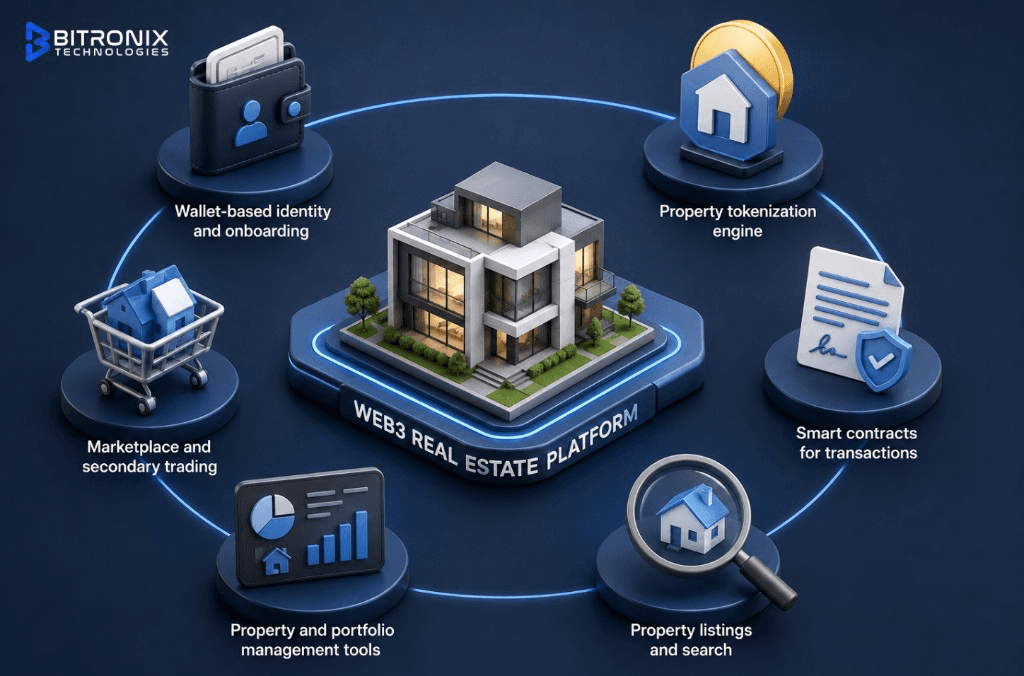
Wallet-Based Identity and Onboarding
Instead of a username and password, users connect a Web3 wallet to prove ownership of an address. This does not replace KYC for regulated offerings, it sits alongside it. For security token offerings or fractional ownership programs, identity verification is still required before a user can hold or transfer tokens, since securities regulations apply regardless of the underlying technology.
Property Tokenization Engine
This is the layer that converts a real-world property into on-chain tokens, typically following a security token standard so that transfer restrictions, whitelisting and compliance rules can be enforced at the contract level rather than trusted to a spreadsheet. Bitronix's RWA tokenization services cover exactly this: mint and burn logic gated by policy, NAV updates tied to a defined signer process and redemption flows that stay visible to both the issuer and the token holder.
Smart Contracts for Transactions
Smart contracts in real estate handle the parts of a transaction that used to require a person checking a box: releasing escrow when conditions are met, transferring ownership records when payment clears and enforcing lease terms like automatic late fees. The contract does not replace the legal agreement, it executes the mechanical parts of it once the legal terms have been encoded correctly.
Property Listings and Search
Buyers still need to browse, filter and compare properties. This part looks similar to a conventional real estate platform on the surface, but it pulls data that includes on-chain ownership history and tokenized share availability alongside the usual price, location and specs.
Property and Portfolio Management Tools
For landlords and platform operators, this includes tools for rent collection, maintenance requests, lease renewals and portfolio-level reporting across tokenized holdings. Automating rent collection through a smart contract removes the monthly chase for late payments, since the contract can trigger reminders or penalties based on rules set in advance.
Marketplace and Secondary Trading
Once a property is tokenized, someone needs a venue to trade those shares. Some platforms build this in-house as a permissioned marketplace. Others route trading through a centralised exchange or a custom AMM built specifically for the token, which is closer to how Bitronix approached the ProSwap DEX build, an automated market maker with configurable pools and swap routing that a project could brand and deploy on its own terms.
Blockchain and Smart Contracts in Real Estate: How It Actually Works
It helps to walk through an actual transaction rather than talk about blockchain in the abstract.
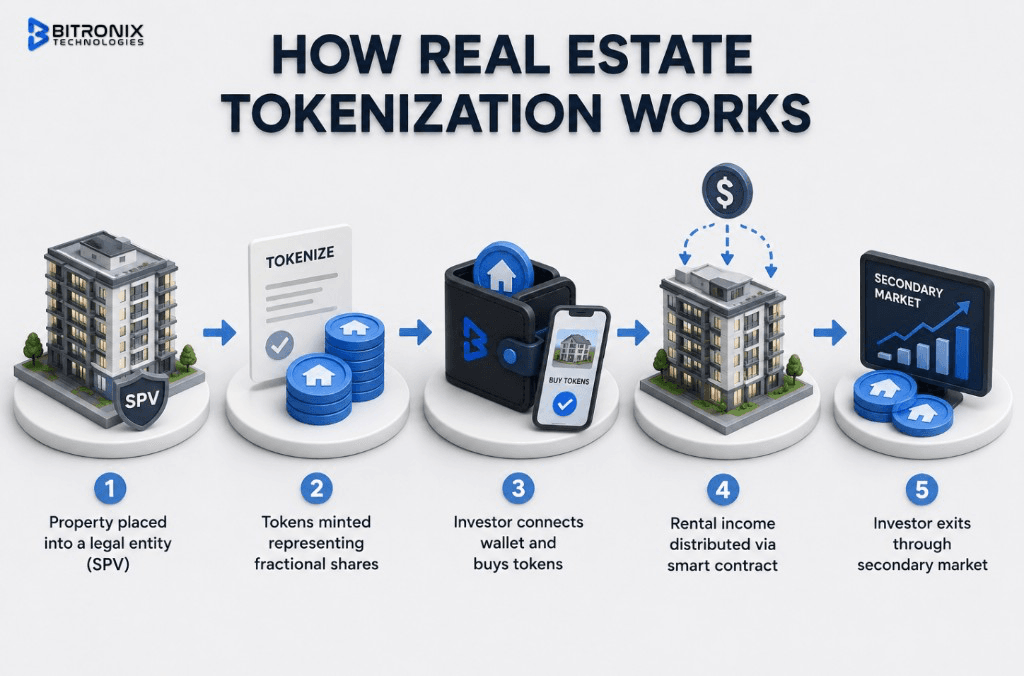
A property owner works with a tokenization platform to convert a building into digital tokens. The process starts off-chain: legal structuring, an appraisal and setting up the entity that will hold the underlying asset (usually an SPV). Once that structure exists, the platform mints tokens on-chain representing fractional interests in that entity.
An investor connects a wallet, completes identity verification if the offering requires it and purchases tokens directly, with payment and token transfer happening in the same transaction. There is no multi-day settlement gap. The blockchain updates ownership records the moment the transaction confirms.
If the property generates rental income, a smart contract can calculate and distribute payouts to token holders automatically, proportional to how many tokens each investor holds. No manual calculation, no waiting for someone in accounting to run the numbers at month end.
If the investor later wants to exit, they sell their tokens on a secondary market instead of trying to find a buyer for a fractional stake in a specific property through traditional channels, which is close to impossible today.
This is also where Bitronix's blockchain development work matters most: choosing the right chain, structuring the contracts so upgrades do not require a full redeploy and building the off-chain and on-chain pieces so they stay in sync without manual reconciliation.
Tokenization of Real Estate: Fractional Ownership Explained
Tokenization is the piece of this that gets the most attention, so it is worth being precise about what it actually does and does not do.
What it does: Tokenization converts economic rights in a property, ownership, rental income, or both, into digital tokens that can be divided and traded. A $5 million commercial building can be split into 5,000 tokens at $1,000 each, letting an investor buy in for far less than the price of the whole asset.
What it does not do: It does not change property law. A token is a digital representation of a legal claim, not a substitute for one. The legal structure (usually an SPV holding the underlying property, with token holders owning shares of the SPV) still has to comply with securities law in whatever jurisdiction the offering is made. This is why serious tokenization platforms build compliance into the smart contract layer itself: transfer restrictions, accredited investor whitelisting and lockup periods enforced by code rather than by a compliance officer checking a spreadsheet after the fact.
Two token types show up in practice. Security tokens represent an actual ownership or income claim and fall under securities regulation. Utility tokens grant access to a platform or service without an ownership claim and most legitimate real estate tokenization uses security tokens, since ownership is the whole point.
AI Features in Web3 Real Estate Apps
Blockchain solves the trust and settlement problem. It does not help a buyer figure out if a property is priced fairly, or help an operator process a hundred lease documents without hiring a team to read them manually. That is where AI has moved from a nice-to-have to a standard part of the build.
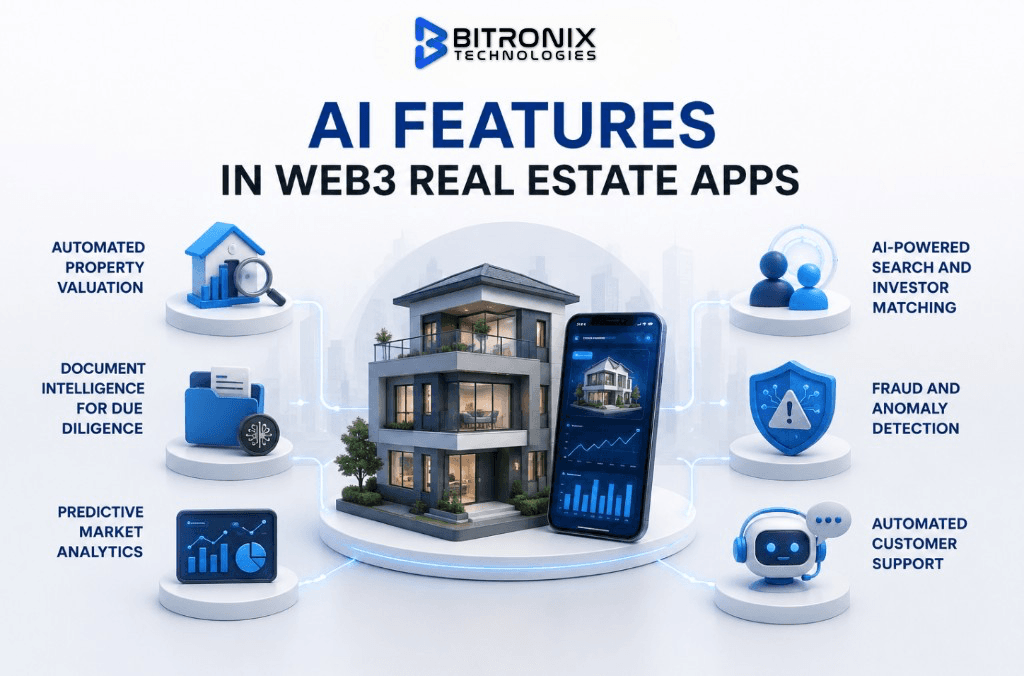
Automated Property Valuation
Instead of a static valuation done once at listing time, an AI model can continuously reassess a property's value using comparable sales, local market trends, rental yield data and even satellite or street-level imagery. This matters more in tokenized real estate than in traditional listings, since token pricing on a secondary market needs a defensible reference value, not just whatever the last trade happened to be.
Document Intelligence for Due Diligence
Title documents, lease agreements, inspection reports and appraisal files are usually unstructured PDFs. Generative AI models can extract key terms, flag missing clauses and cross-check figures against the deal terms in minutes, cutting down the manual review time before a property gets tokenized. This is a natural extension of Bitronix's generative AI work, applied to a document-heavy industry that has resisted automation for years.
Predictive Market Analytics
Machine learning models trained on historical pricing, interest rate movement and local supply and demand data can flag when a market is likely to shift, giving investors a data point beyond gut instinct. This is most useful for tokenized commercial assets, where institutional buyers expect quantitative backing for a pricing decision, not just a broker's opinion.
AI-Powered Search and Matching
Rather than static filters for bedrooms, price and location, an AI layer can learn from how a user browses and refine recommendations based on patterns they have not explicitly stated, similar to how streaming platforms learn taste over time. For tokenized fractional listings, this also means matching investors to properties based on target yield, hold period and risk tolerance, not just square footage.
Fraud and Anomaly Detection
On-chain transactions are transparent, but transparency alone does not catch unusual patterns. AI-based monitoring can flag wash trading on a token's secondary market, sudden concentration of token ownership that might signal a coordinated pump, or transaction patterns that resemble money laundering typologies and route them for review before they become a bigger problem. This kind of monitoring pairs naturally with AI automation systems that connect model output directly into an operator's compliance workflow instead of sitting in a dashboard no one checks.
Automated Customer Support and Deal Assistance
AI assistants can handle routine investor questions (distribution schedules, token lockup dates, KYC status) and walk new users through onboarding without a support team fielding the same five questions every day. Done well, this frees human staff for the conversations that actually need judgment, like structuring a deal or answering a legal question.
None of this replaces human decision-making on a real estate transaction. It removes the repetitive analysis work that used to eat days, so the people involved can spend their time on the parts of a deal that actually require judgment.
Security Considerations for Web3 Real Estate Platforms
A real estate platform holding tokenized property claims worth real money is a target. A few things matter more here than in a typical app build.
- Smart contract audits are not optional. Every contract that mints, burns, or transfers tokens representing property ownership needs an independent third-party audit before it touches mainnet. A bug in a token contract is not a support ticket, it is a potential loss of investor funds.
- Access control has to be deliberate. Admin functions like pausing a contract, updating a whitelist, or minting new tokens should sit behind multi-signature approval or a timelock, not a single private key held by one person.
- Wallet integration needs to be done carefully. Users connecting wallets should see clear, specific transaction details before signing anything, not a vague approval request. Ambiguous signing prompts are one of the most common ways users get tricked into approving something they did not intend to.
- Compliance has to live in the contract, not just the paperwork. For any token representing real ownership, transfer restrictions and investor eligibility checks belong at the smart contract level. This is standard practice in Bitronix's RWA tokenization builds, where mint and transfer paths are policy-gated rather than relying on someone remembering to check a list manually.
The Web3 Real Estate Development Process
Here is roughly how a build like this comes together, from first conversation to a live platform.
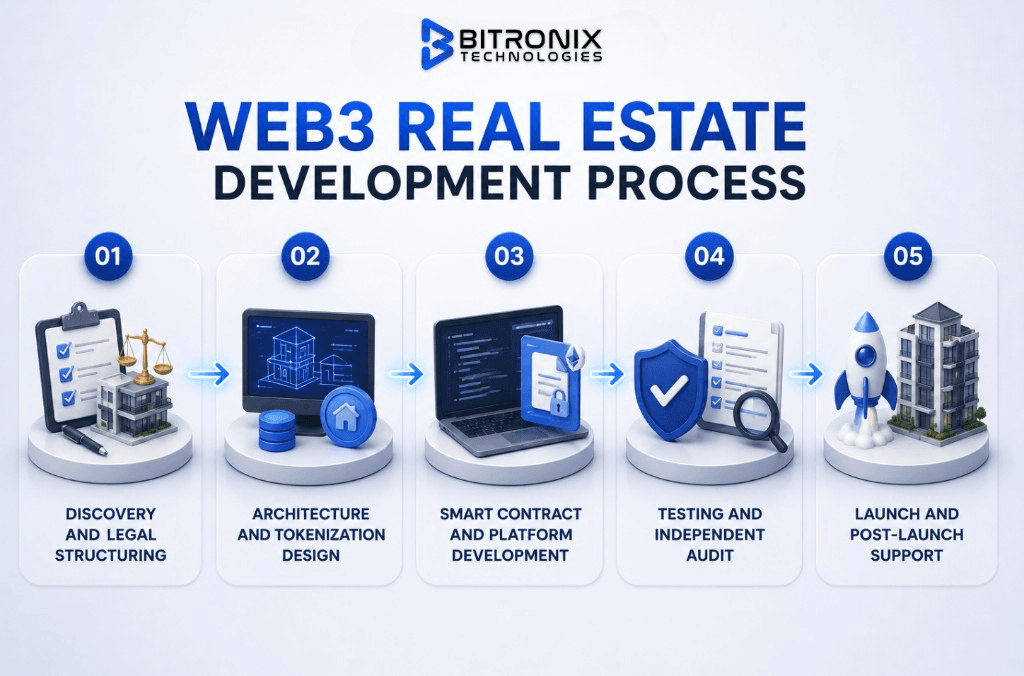
Discovery and legal structuring. Before a line of code gets written, the legal structure for the tokenized asset needs to be defined, usually alongside your securities counsel, since this determines what the smart contracts actually need to enforce.
Architecture and tokenization design. This covers which blockchain to build on, how the token standard maps to your compliance requirements and how the off-chain property data (deeds, appraisals, lease terms) connects to the on-chain token record.
Smart contract and platform development. The tokenization contracts, marketplace or trading logic, wallet integration and any AI features get built in parallel, with the dApp layer handling the user-facing side: onboarding, listings, portfolio views and transaction flows.
Testing and independent audit. Contracts go through internal testing, then an independent audit before anything touches real funds.
Launch and post-launch support. Once live, ongoing work usually includes monitoring, incident response and adding new property listings or features as the platform grows.
Choosing a Web3 Real Estate Development Company
A few questions actually separate a partner who can deliver from one who cannot.
- Have they shipped tokenization infrastructure before, not just a listings app with a wallet connect button? Ask to see a real example. Bitronix's Harbor RWA settlement build is a concrete example of on-chain settlement infrastructure for tokenized real-world assets, with policy-gated mint and burn paths and NAV updates tied to a defined signer process, the exact mechanics a real estate tokenization platform needs.
- Do they understand the legal structure, or just the code? A development team that treats compliance as someone else's problem will build a contract that technically works and legally does not.
- Can they build the AI layer, not just bolt one on? Document review, valuation models and fraud detection need to be built by people who understand both the AI side and the real estate data they are working with, not stitched together from a generic chatbot template.
- Do they explain what they are not doing? A team that is upfront about what sits outside their scope (legal filings, market-making capital, listing decisions) is usually more trustworthy than one that promises to handle everything.
- What does post-launch support actually look like? Tokenized real estate platforms do not stop needing engineering attention after launch. Ask what is covered once the platform is live and for how long.
Frequently Asked Questions
What is Web3 real estate app development?
Web3 real estate app development is building property platforms on blockchain infrastructure instead of a centralized database, so ownership records, transaction history and tokenized shares are verifiable on-chain rather than controlled entirely by one company.
How does real estate tokenization actually work?
A property is placed into a legal entity, usually an SPV and ownership shares in that entity are represented as tokens on a blockchain. Investors buy tokens directly and the blockchain updates ownership records the moment a transaction confirms.
Is tokenized real estate legal?
Tokens representing ownership or income rights in property are generally treated as securities, so the offering has to comply with securities law in the relevant jurisdiction. The technology does not change the legal requirements, it changes how the requirements get enforced.
What is the difference between real estate tokenization and a REIT?
A REIT pools investor capital into a fund that owns properties and you own shares of the fund. Tokenized real estate can work similarly, but tokens are typically tied to a specific property or small portfolio, trade on blockchain-based markets and settle faster than traditional REIT shares.
Do smart contracts replace real estate lawyers?
No. Smart contracts automate the mechanical steps of a transaction, like releasing payment when conditions are met, but the underlying legal agreement, title work and regulatory compliance still require legal expertise.
What blockchain is best for real estate tokenization?
Most tokenization platforms build on Ethereum or an Ethereum-compatible chain because of mature tooling and established token standards, though the right choice depends on your compliance requirements, expected transaction volume and target investor base.
How is AI used in Web3 real estate platforms?
AI is commonly used for automated property valuation, document review during due diligence, predictive market analytics, personalized search and investor matching and fraud or anomaly detection on token trading activity.
How much does it cost to build a Web3 real estate app?
Cost depends heavily on scope: whether you need full tokenization infrastructure with compliance controls, a marketplace, AI features and multi-chain support, or a narrower build. A discovery call is the fastest way to get an accurate range for your specific requirements.
How long does it take to build a tokenized real estate platform?
Timelines vary based on legal structuring complexity, the number of features involved and audit lead time, which is set by your chosen auditor. Architecture and legal alignment typically take longer than most teams expect, so starting that conversation early matters.
Can an existing real estate business add Web3 features instead of starting from scratch?
Yes. Many platforms add tokenization, wallet integration, or an AI valuation layer to an existing product rather than rebuilding everything, which is usually faster and lower risk than a full rebuild.
Turn Property Into a Digital Asset Your Investors Can Actually Trade
Web3 real estate app development is not about replacing real estate professionals with code. It is about removing the friction that has made property one of the least liquid major asset classes for decades. Tokenization, smart contracts and AI-driven analysis each solve a specific piece of that problem and together they make fractional, faster, more transparent property investment possible.
If you are evaluating what this looks like for your business, talk to a team that has built the tokenization infrastructure, not just the frontend around it.

Founder and CTO
Founder and CTO of Bitronix Technologies. Builds RWA tokenization infrastructure, smart contracts and Web3 property platforms for fractional ownership and compliant digital asset markets.
Related Posts
 Blockchain
October 14, 202615 min read
Crypto Token Development Cost in 2027: Pricing, Features and Budget Breakdown
Explore crypto token development cost in 2027, with estimated pricing, key cost factors, smart contract audits, development timelines, & hidden expenses.
Read article Blockchain
October 1, 202613 min read
Top 10 Companies to Hire Blockchain Developers in India 2026-2027
Find the top 10 companies to hire blockchain developers in India. Compare blockchain services, expertise, use cases, & tips for choosing a development partner.
Read article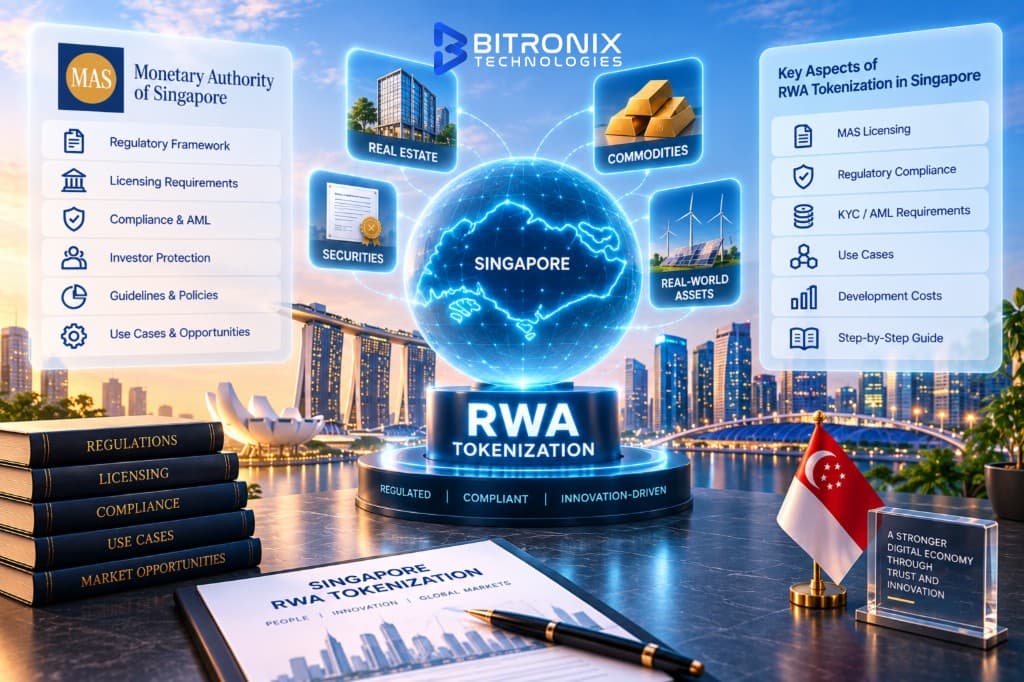 Blockchain
September 25, 202616 min read
RWA Tokenization in Singapore: Regulations, Licensing & Complete Guide 2026
Learn about RWA tokenization in Singapore, including MAS regulations, licensing, compliance, use cases, costs and how to build an RWA platform in 2026.
Read article