How to Build a Soulbound Token: Cost & Development Guide 2026

By Tausif AhmedFounder and CTO
Binance, one of the largest cryptocurrency exchanges in the world, issues its users a token they can never sell, trade, or transfer to anyone else. It's called the Binance Account Bound Token, or BABT and it exists for one purpose: proving that the wallet holding it belongs to a real, KYC-verified person. Once minted to your wallet, it stays there permanently, tied to your identity, unlockable by nobody else, unsellable no matter how much someone might want to buy their way into verified status.
That's a soulbound token in practice, not in theory and it's a useful example because it shows exactly why this category of token exists. Almost everything else in crypto is built to be traded. NFTs, coins, governance tokens, the entire point is usually that they can change hands. A soulbound token flips that assumption on its head and in doing so solves a problem that transferable tokens are structurally bad at: proving something is genuinely, permanently attached to one specific identity, not just whoever currently holds the wallet.
Ethereum co-founder Vitalik Buterin gave this concept its name and its clearest articulation in a widely circulated 2022 paper, describing a future where reputation, credentials and social relationships could live on-chain without being reducible to something you simply buy. That idea has since moved well past theory. Businesses are using soulbound tokens today for identity verification, credentialing, DAO governance and on-chain reputation systems that undercollateralized lending actually depends on. This guide covers what soulbound tokens are, how they're actually built, what real businesses are using them for and what it costs to build one in 2026.
What Is a Soulbound Token?
A soulbound token is a type of token that can only be owned and transferred by a specific address. Once minted and assigned to a wallet, it cannot be transferred, sold, or moved to another address by anyone, including the wallet's own owner. That permanence is the entire point.
This is different from an NFT in one specific and important way. A standard NFT is unique and provably scarce, but it's still designed to change hands, that's usually the whole reason someone wants one. A soulbound token borrows the uniqueness and on-chain verifiability of an NFT but deliberately removes transferability, because the value of an SBT comes from it being permanently, provably attached to one wallet, not from its ability to be resold.
Why businesses actually use them:
- Security. Because an SBT can't be transferred, it can't be stolen and resold the way a valuable NFT can. There's no secondary market for someone to profit from taking it.
- Genuine identity binding. An SBT proves something about the specific wallet holding it, a completed KYC check, an earned credential, a verified vote, rather than proving someone was simply willing to pay for it.
- Reputation that can't be bought. Since an SBT can't be purchased on a marketplace, it becomes a far more credible signal of reputation or achievement than an asset anyone with enough money could acquire.
How Soulbound Tokens Are Actually Built
Most soulbound tokens today are built by taking an existing, well-audited token standard and modifying its transfer logic, rather than inventing something entirely from scratch.
The Common Approach: Modified ERC-721: Developers start with the standard ERC-721 NFT contract and override the function that normally handles transfers between wallets. In practice, that means adding a check that only allows a token to move during minting, when it's created and assigned to a wallet and blocks every transfer attempt after that point. The token can still be issued, viewed and even burned by its owner in most implementations, it just can never change hands.
Purpose-Built Standards: As soulbound tokens have matured, standards designed specifically for non-transferability have emerged, most notably EIP-5192, sometimes called the "Minimal Soulbound NFT" standard. Building on a dedicated standard rather than a modified general-purpose one can improve compatibility with wallets and platforms that recognize it specifically.
Core Development Steps
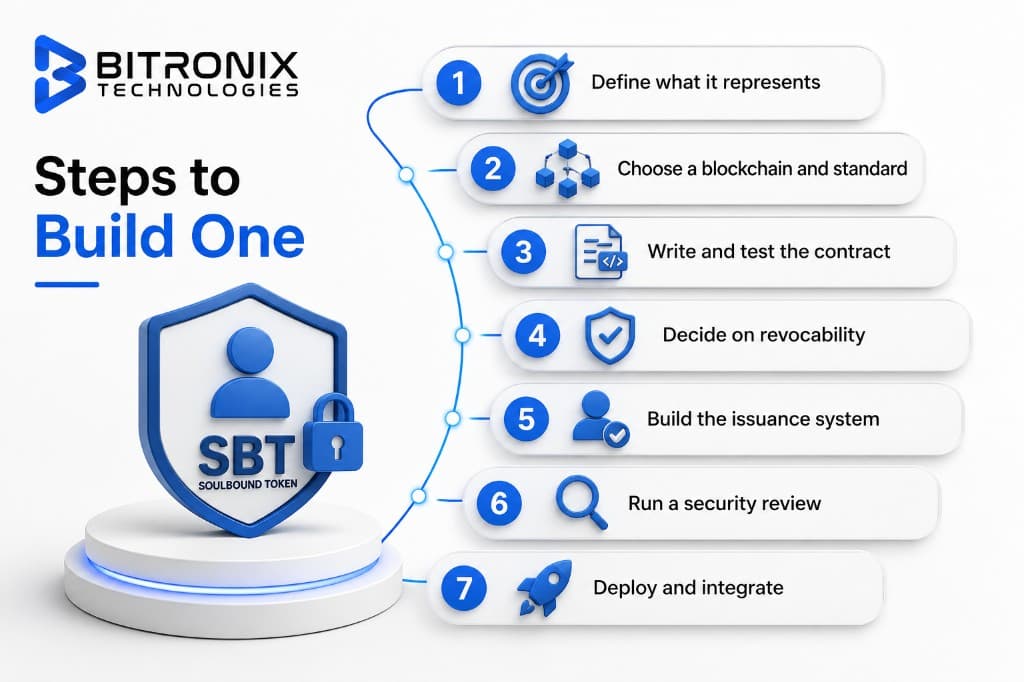
- Define what the SBT represents. A credential, a KYC status, a membership, a reputation score, this decision shapes every technical choice that follows.
- Choose a blockchain and standard. Most SBTs launch on Ethereum or an EVM-compatible chain using a modified ERC-721 or the EIP-5192 standard.
- Write and test the smart contract. The contract needs the transfer-blocking logic, minting permissions (who is allowed to issue the token) and, in most implementations, a defined revocation or burn path.
- Decide on revocability. Some use cases need a permanent, unremovable token. Others, like a credential that can expire or be revoked, need a controlled way to burn or invalidate the SBT later.
- Build the issuance system. Someone or something needs to control minting, an admin panel, an automated KYC pipeline, or an institution's existing verification system.
- Security review. Even though SBTs can't be stolen and resold, the minting and revocation logic still needs a proper audit, since a flaw there can let unauthorized parties issue or revoke credentials that were never meant to be theirs to control.
- Deploy and integrate. The SBT gets deployed to mainnet and connected to whatever front-end, dashboard, or verification system will actually read and act on it.
Real-World Soulbound Token Use Cases
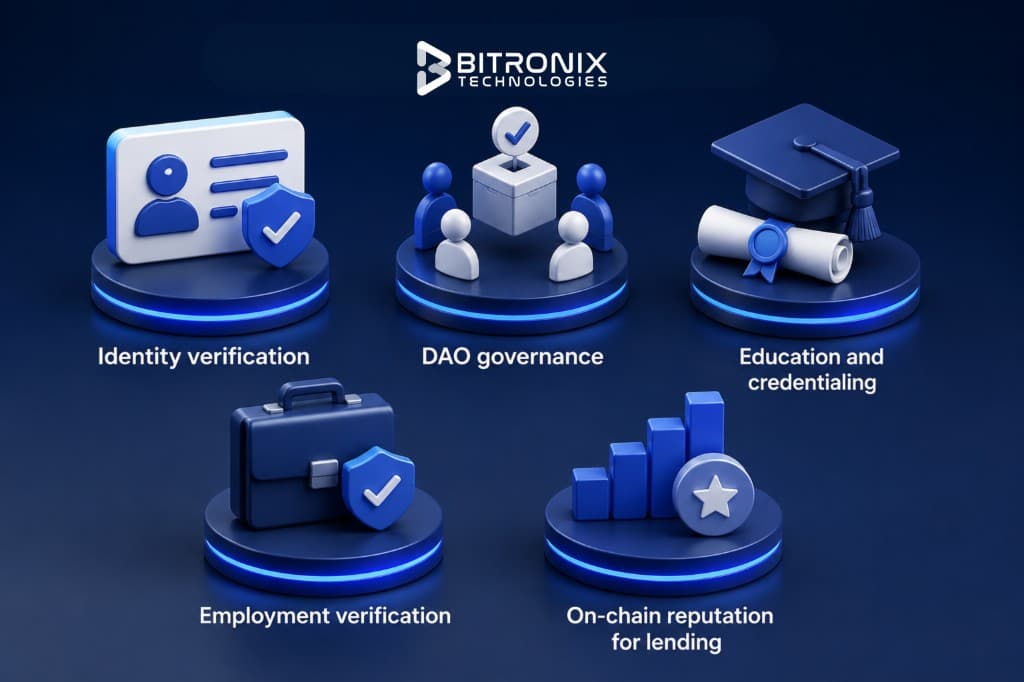
- Identity Verification (Binance BABT): Binance's Account Bound Token is issued to users who've completed identity verification, giving other platforms and smart contracts a way to confirm a wallet belongs to a real, KYC-checked person without exposing the underlying personal data.
- DAO Governance: Soulbound tokens can represent voting rights that can't be bought up by a wealthy actor trying to sway a decision, since the token proving membership or voting weight simply can't be purchased on any market.
- Education and Credentialing: A university or certification body can issue a soulbound token representing a completed degree or credential, permanently and verifiably tied to the recipient, without the risk of a diploma mill selling fake credentials on a secondary market.
- Employment and Workplace Verification: Companies can issue SBTs for completed training, certifications, or verified work history, creating a portable, tamper-proof record an employee actually owns, rather than a claim on a resume nobody can verify.
- On-Chain Reputation for DeFi: This is one of the more consequential emerging use cases. Undercollateralized lending, letting a borrower access funds without posting full collateral, has always struggled with a basic problem: how do you assess a borrower's trustworthiness on-chain? A history of soulbound tokens representing verified repayment history or credit-relevant behavior gives lending protocols a real, unbuyable reputation signal to underwrite against.
Soulbound Token Development Cost
Cost varies significantly based on scope, but here's a realistic range for 2026:
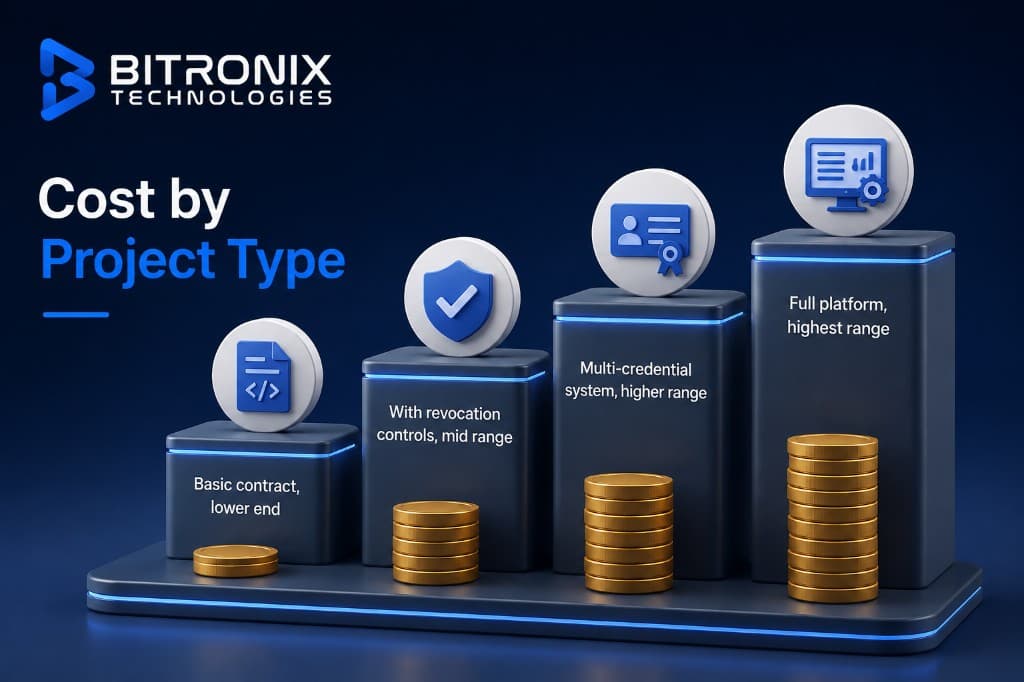
| Project Type | Estimated Cost | Estimated Timeline |
|---|---|---|
| Basic SBT contract (single credential type, simple minting) | $3,000 – $12,000 | 2-4 weeks |
| SBT with revocation and admin controls | $10,000 – $25,000 | 4-6 weeks |
| Multi-credential identity system | $25,000 – $60,000 | 2-4 months |
| Full platform (issuance dashboard, verification integration, audit) | $60,000 – $120,000+ | 4-8 months |
What drives the cost up:
- Revocation logic. A permanently unremovable SBT is simpler to build than one that needs a controlled, auditable way to expire or revoke credentials later.
- Issuance infrastructure. Manual, admin-controlled minting is cheap. Automated issuance tied to a KYC pipeline or an existing enterprise identity system costs considerably more.
- Security audit depth. Since SBTs often gate access to real credentials, financial products, or governance rights, the minting and revocation logic deserves the same audit rigor as a contract handling real funds, which our guide on how much it costs to launch a crypto token breaks down in more detail.
- Standard compliance. Building to a recognized standard like EIP-5192 rather than a fully custom implementation can reduce integration cost with wallets and platforms that already support it.
Common Mistakes When Building a Soulbound Token
- Treating It Like a Standard NFT Project: An SBT's entire value comes from what it can't do, get sold. Teams that approach development the same way they'd approach an NFT marketplace build often over-invest in trading and discovery features that actively work against the token's purpose.
- No Clear Revocation Plan: Deciding after launch that a credential needs to expire or be revoked, without having built that logic in from the start, usually means a costly contract migration rather than a simple update.
- Underestimating the Issuance System: The smart contract is often the easier half of the build. Connecting it to a real KYC pipeline, an institution's existing identity system, or an automated credentialing workflow is frequently where the real engineering effort goes.
- Skipping the Audit Because "There's No Money at Risk": SBTs don't hold funds, but they often gate access to funds, governance, or credentials that matter enormously to the people relying on them. A flaw in minting or revocation logic is still a real security failure, even without a token to steal.
How AI Is Being Used With Soulbound Tokens
This is an area most soulbound token guides skip entirely and it's becoming one of the more active use cases as both technologies mature.

- AI Agent Identity and Reputation: As autonomous AI agents increasingly transact and make decisions on-chain, on behalf of a business, a DAO, or a person, there's a growing need to verify which agent is which and track its track record. A soulbound token can act as a permanent identity anchor for an AI agent, letting other systems check its verified origin and accumulated reputation before trusting it with a transaction or decision.
- AI-Verified Credential Issuance: Instead of a manual review process, AI models can screen documents, verify claims and flag inconsistencies before a credential-issuing SBT gets minted, the same pattern used in modern KYC pipelines, applied here to diplomas, certifications, or professional credentials rather than identity verification alone.
- Fraud Detection in Issuance Pipelines: Since a soulbound token can't be resold once issued, attackers instead target the issuance process itself, trying to get a fraudulent credential minted in the first place. AI-driven anomaly detection on the issuance pipeline, flagging unusual application patterns, mismatched documentation, or suspicious timing, adds a layer of protection a purely rules-based system tends to miss.
- Reputation Scoring for DeFi Lending: Building on the on-chain reputation use case covered earlier, AI models can analyze a wallet's full transaction and SBT history to generate a more nuanced creditworthiness score than a simple count of credentials, giving undercollateralized lending protocols a genuinely data-driven basis for underwriting risk.
Soulbound Tokens and Data Privacy: The Problem Nobody Talks About
There's a real tension built into the core design of a soulbound token that most guides gloss over entirely: permanence, the exact feature that makes SBTs useful, directly conflicts with privacy regulations like GDPR that guarantee individuals a right to have their personal data erased.
- Why This Matters: If a soulbound token or its associated metadata contains personal information and it's permanently and publicly recorded on a public blockchain, there's no way to fully comply with a legitimate erasure request the way you could with a traditional database. You can revoke or burn the token in many implementations, but the historical transaction record showing it existed generally remains visible on-chain.
- How Serious Projects Handle This: The common and correct approach is keeping personal data off-chain entirely. The soulbound token itself holds only a reference, a hash, a credential type, a verification status, while the actual personal information lives in a traditional, erasable database that the on-chain token points to. When erasure is required, the off-chain record gets deleted and the on-chain token becomes a reference to nothing, functionally meaningless without the data it once pointed to.
- What to Ask Before You Build: Any business considering soulbound tokens for identity or credentialing needs to work through data residency and privacy requirements with legal counsel before writing a single line of contract code, not after launch when a user submits an erasure request you have no clean way to honor.
Conclusion
A soulbound token is a small piece of code with an outsized effect on what's possible on-chain: proof that can't be faked by simply having enough money to buy it. Binance didn't build BABT because soulbound tokens were trendy, they built it because transferable tokens are structurally the wrong tool for proving identity and SBTs solve that problem cleanly.
Building one well isn't complicated in the way a full DeFi protocol is complicated, but getting the revocation logic, issuance system and audit right is exactly what separates a soulbound token that actually holds up as real infrastructure from one that's just a non-transferable NFT with a trendy name.
If you're scoping a soulbound token project, whether it's identity verification, credentialing, or an on-chain reputation system for DeFi, talk to our team about what your specific use case actually needs or explore our smart contract development and enterprise blockchain services.
Frequently Asked Questions
What's the difference between a soulbound token and an NFT?
An NFT is unique and provably scarce but designed to be bought, sold and transferred. A soulbound token is permanently locked to the wallet it was minted to and can never be transferred, which is what makes it useful for identity and credentials rather than trading.
Can a soulbound token be revoked or removed?
It depends on how the contract is built. Some SBTs are designed to be permanent and unremovable. Others include a controlled burn or revocation function for use cases like credentials that can expire or need to be invalidated.
What blockchain standard is used to build soulbound tokens?
Most SBTs are built on a modified version of ERC-721 with transfer functions disabled after minting. Purpose-built standards like EIP-5192 now also exist specifically for non-transferable tokens.
Do soulbound tokens need a security audit if they don't hold funds?
Yes. Even without funds at stake, a flaw in the minting or revocation logic can let unauthorized parties issue or invalidate credentials, which is a real security failure for anything gating identity, access, or governance rights.
How much does it cost to build a soulbound token in 2026?
A basic SBT contract typically costs $3,000 to $12,000. A full platform with automated issuance, revocation controls and a security audit can run $60,000 to $120,000 or more, depending on how it integrates with existing identity or KYC systems.

Founder and CTO
Founder and CTO of Bitronix Technologies. Helps businesses scope and build soulbound token and identity systems through smart contract and enterprise blockchain services.
Related Posts
 Blockchain
October 14, 202615 min read
Crypto Token Development Cost in 2027: Pricing, Features and Budget Breakdown
Explore crypto token development cost in 2027, with estimated pricing, key cost factors, smart contract audits, development timelines, & hidden expenses.
Read article Blockchain
October 1, 202613 min read
Top 10 Companies to Hire Blockchain Developers in India 2026-2027
Find the top 10 companies to hire blockchain developers in India. Compare blockchain services, expertise, use cases, & tips for choosing a development partner.
Read article Blockchain
September 25, 202616 min read
RWA Tokenization in Singapore: Regulations, Licensing & Complete Guide 2026
Learn about RWA tokenization in Singapore, including MAS regulations, licensing, compliance, use cases, costs and how to build an RWA platform in 2026.
Read article