NFT Marketplace Development Cost in 2026: Complete Pricing Guide

By Tausif AhmedFounder and CTO
OpenSea, the marketplace that most people picture when they think "NFT platform," didn't launch as the sprawling, multi-chain, billion-dollar business it is today. In 2017, it started as a small team building a basic way to buy and sell CryptoKitties and a handful of other early digital collectibles, with a scope that would look almost primitive next to what a modern NFT marketplace ships with. There was no elaborate creator royalty engine, no cross-chain support, no institutional-grade compliance layer. There was a working way to list an item, buy it and trust that the trade would settle.
That's the detail most cost guides skip and it's the one that actually matters if you're budgeting a build in 2026. OpenSea didn't succeed because it launched fully loaded. It succeeded because the first version was lean enough to ship fast and prove real demand and every feature that came after was funded by that proof, not guessed at in advance. Founders planning an NFT marketplace today make the opposite mistake constantly: they price out every feature OpenSea has now, get a number in the hundreds of thousands and either stall on the decision or blow their budget on functionality nobody has asked for yet.
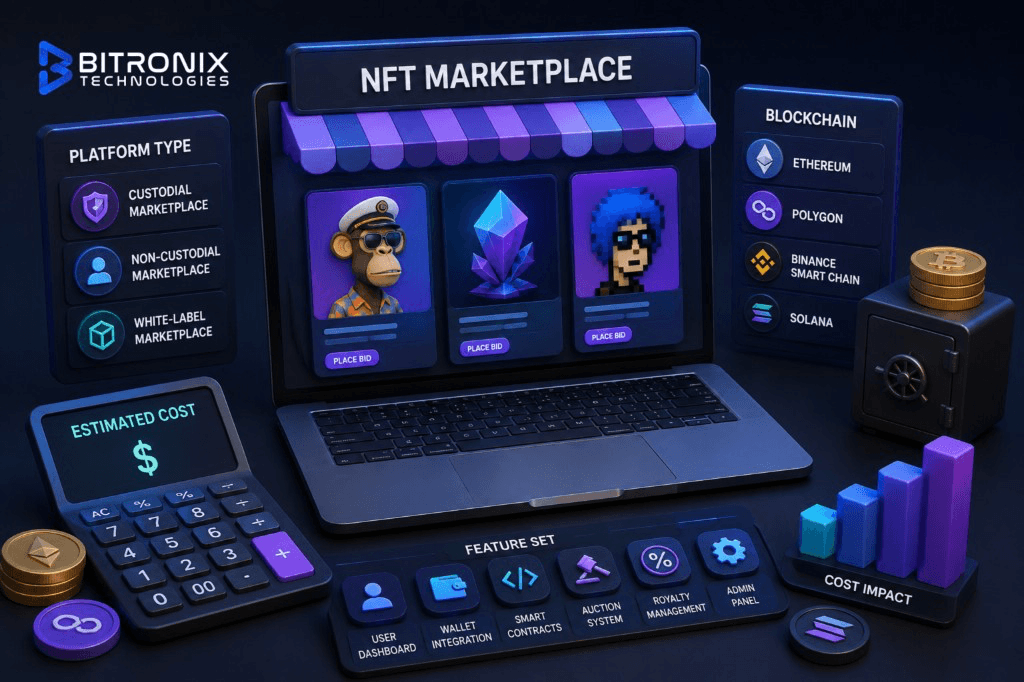
This guide breaks down exactly what NFT marketplace development actually costs in 2026, by platform type, by feature and by the parts of the budget founders consistently underestimate, so you can scope a build that fits what your business actually needs right now.
What Determines the Cost of an NFT Marketplace
Every NFT marketplace quote comes down to a handful of variables. Once you understand them, it's much easier to sanity-check any estimate you're handed.
- Marketplace Type: An open marketplace where anyone can mint and list, the OpenSea model, is the most expensive and complex to build. A curated marketplace with an approval process is simpler. A niche, single-category marketplace is simpler still.
- Blockchain Choice: Ethereum development carries higher gas costs and a heavier compliance surface than newer chains like Solana or Polygon, both of which offer lower fees and faster transactions for a comparable feature set.
- Smart Contract Complexity: Basic minting and fixed-price sales are cheap. Auctions, royalty splits, fractional ownership, dynamic or evolving NFTs and cross-chain transfers all add real development time.
- Security Requirements: Any marketplace handling real trading volume needs a formal smart contract audit. Skipping it to save a few thousand dollars is one of the most common ways young NFT platforms lose everything in an exploit.
- Compliance Scope: KYC/AML requirements, particularly for US-regulated projects or marketplaces touching real-world asset tokenization, add both development time and ongoing operational cost.
- Team Location: Where your development team is based swings the bill dramatically. Senior blockchain developers in the US or UK run $120 to $200 an hour, while experienced offshore teams typically charge 40 to 60 percent less for comparable work.
NFT Marketplace Development Cost by Platform Type
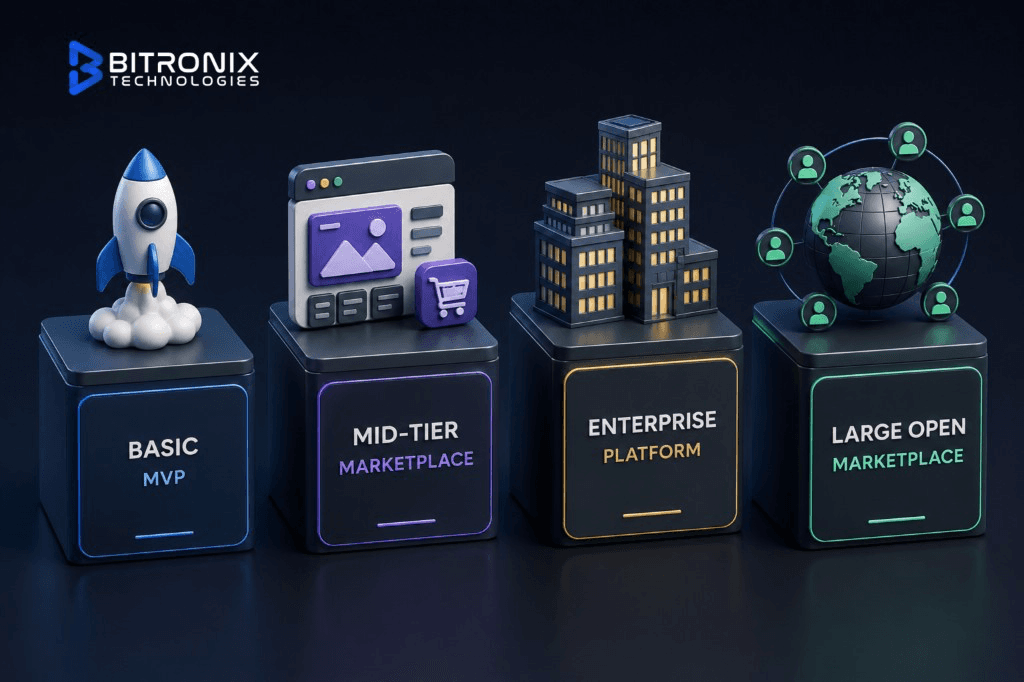
| Platform Type | Estimated Cost | Estimated Timeline | What's Included |
|---|---|---|---|
| Basic MVP | $20,000 – $45,000 | 2-3 months | Wallet connect, minting, fixed-price listings, minimal dashboard |
| Mid-Tier Marketplace | $40,000 – $80,000 | 3-5 months | Auctions, royalty distribution, multi-wallet support, search and filtering |
| Enterprise Platform | $80,000 – $150,000+ | 5-8 months | Multi-chain support, secondary trading, compliance architecture, mobile apps |
| Large Open Marketplace (OpenSea-style) | $150,000 – $500,000+ | 8-12 months | Unlimited asset variety, high transaction volume, advanced fraud and wash-trading defenses |
A basic MVP is the right call for a small business or brand testing whether NFTs make sense for them at all. A mid-tier build suits a company that already knows it wants a branded, scalable product with real functionality. Enterprise and large open marketplaces are a different order of investment entirely and they only make sense once demand is proven.
Cost Breakdown by Component
| Component | Typical Cost Range | Notes |
|---|---|---|
| Smart contract development | $8,000 – $40,000 | Scales sharply with auctions, royalties and fractional ownership logic |
| UI/UX design | $5,000 – $25,000 | Custom design costs more than a template-based build |
| Wallet integration | $3,000 – $10,000 | MetaMask, WalletConnect, Phantom and similar |
| Security audit | $5,000 – $20,000 | Non-negotiable for any marketplace handling real trading volume |
| KYC/AML integration | $5,000 – $15,000 | Primarily relevant for US-regulated or compliance-sensitive projects |
| Backend and database architecture | $10,000 – $35,000 | Higher for platforms expecting high transaction volume |
| IPFS or decentralized storage setup | $2,000 – $8,000 | Storing the actual NFT media off-chain |
| Admin panel and analytics dashboard | $4,000 – $15,000 | Listing management, moderation tools, reporting |
| Ongoing hosting and maintenance | $1,000 – $3,000/month | Easy to forget when budgeting the initial build |
Must-Have Features That Drive Up the Cost
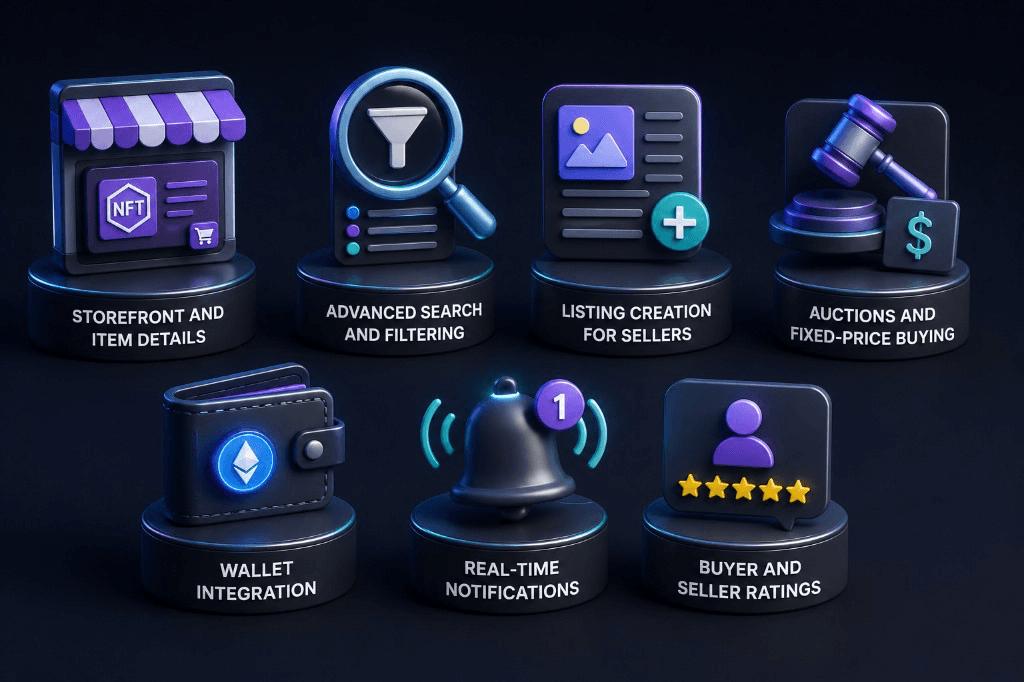
Beyond the core build, the specific features you choose to include are one of the biggest swing factors in your final number. Here's what actually needs to be in scope and why each one adds real development time rather than just polish.
- Storefront: The dashboard where a buyer sees an item's details, current owner, bid history and price history. This is the page that does the actual selling, so it needs to be fast and clear, not an afterthought.
- Advanced Search and Filtering: Category tagging and filtering logic that lets users actually find what they're looking for. On a marketplace with any real inventory, this isn't optional.
- Listing Creation: The seller-facing flow for uploading an asset, setting a price or auction format and publishing it live.
- Auctions and Fixed-Price Buying: A real bidding system needs bid amounts, expiration timers and status tracking, on top of the simpler fixed-price "buy now" flow.
- Wallet Integration: Users need a way to connect a wallet to send, receive and store both NFTs and the cryptocurrency used to buy them.
- Notifications: Real-time alerts for new listings, outbid notices and upcoming auctions matter more than most founders expect.
- Ratings and Reputation: A scoring system for buyers and sellers builds trust and discourages bad behavior.
Layering in this full feature set typically adds $5,000 to $50,000 or more to your build, depending on how many you include and whether you're integrating third-party modules or building each one from scratch.
NFT Token Standards: A Quick Primer That Affects Cost
The token standard you build on has a direct effect on both development time and long-term flexibility.
- ERC-721: The original NFT standard, where each token ID maps to exactly one unique asset and one owner. Right for one-of-a-kind items like art or collectibles.
- ERC-1155: A more efficient standard where a single contract can represent an entire class of assets. For a gaming marketplace with 100 armor sets, ERC-1155 needs one contract and a quantity field, where ERC-721 would need 100 separate contracts, lower development cost for large, repeatable catalogs.
Team Roles and Regional Hourly Rates
A real NFT marketplace build needs more than just a blockchain developer. A typical delivery team includes a project manager, blockchain developers, UI/UX designers, a solution architect, a business analyst and QA.
| Region | Typical Hourly Rate |
|---|---|
| United States / United Kingdom | $120 – $200/hr |
| Australia / Western Europe | $80 – $150/hr |
| India / Offshore teams | $40 – $80/hr |
Design, Development and Testing: How the Budget Typically Splits
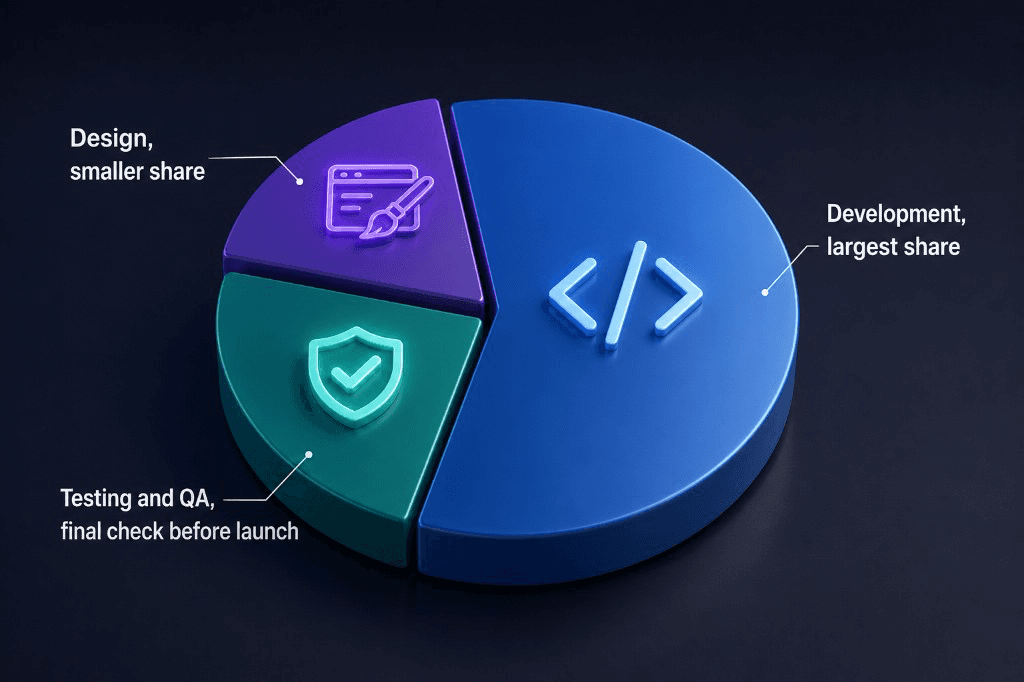
| Phase | Typical Cost Range |
|---|---|
| Design (UI/UX) | $5,000 – $25,000 |
| Development | $30,000 – $250,000 |
| Testing & QA | $10,000 – $30,000 |
Development is almost always the largest single line item, which is exactly why smart contract complexity and feature scope, not design polish, are the real levers that move your total budget.
How NFT Marketplaces Actually Make Money
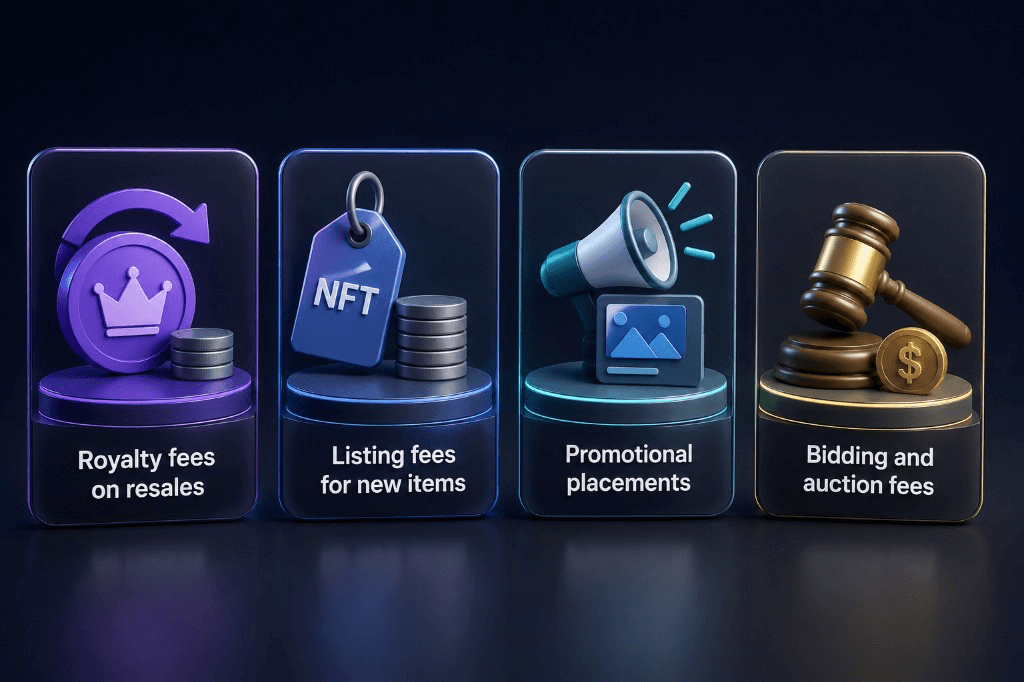
- Royalty Fees: A small commission on every resale, paid out automatically through the smart contract.
- Listing Fees: A flat or percentage-based fee when a seller creates a new listing.
- Promotional Placements: Paid banner or featured-listing placements, typically the fastest model to monetize.
- Bidding and Auction Fees: A percentage taken from the final sale price on auction-format listings.
Most serious marketplaces combine at least two of these, usually royalties plus one other.
Legal and Compliance Documentation to Budget For
- Company formation and business registration
- Terms of service
- Community standards and content moderation policy
- Privacy policy
- Intellectual property and copyright handling for user-submitted assets
Getting this wrong isn't just a compliance risk, it's a common source of disputes once real creators and buyers are using the platform.
Real-World Marketplace Examples and What They Reveal About Cost
OpenSea proves the lean-launch strategy works. It started as a minimal MVP and only justified its current scale of engineering investment after years of real transaction volume.
Curated art marketplaces, in the style of Foundation or SuperRare, typically sit at $80,000 to $200,000, because verifying creators, building discovery around scarcity and supporting higher-value single transactions demand more from both backend and UX.
Cost tracks complexity, not ambition. A well-scoped curated marketplace with a smaller budget can outperform an underfunded attempt at an open, OpenSea-scale platform.
Hidden Costs Founders Consistently Miss
- Ongoing Maintenance: Hosting, monitoring and bug fixes typically run $1,000 to $3,000 a month.
- Gas Fee Optimization: Poorly optimized contracts cost users real money on every mint and trade.
- Compliance That Doesn't End at Launch: KYC/AML and regulatory requirements evolve, especially for RWA-linked platforms.
- Liquidity and Market-Making: Seeding initial supply and demand is easy to underbudget.
- Customer Support Infrastructure: Disputes happen once real assets trade, support tooling is expensive to bolt on later.
How Blockchain Choice Affects the Total Bill
Ethereum carries the highest development and gas costs, but also the deepest NFT liquidity and strongest institutional trust.
Polygon and other Ethereum-compatible Layer 2s cut gas costs dramatically while keeping Ethereum tooling and wallet compatibility.
Solana offers some of the lowest transaction costs, which matters for high-volume and gaming-adjacent NFT platforms.
Picking a chain purely on development cost is a common mistake. A cheaper chain with a smaller buyer base can cost more later in marketing spend.
In-House Team vs. Development Agency: Which Costs Less?
Hiring an in-house blockchain team sounds cheaper until fully loaded US/UK senior rates of $120 to $200 an hour sit alongside benefits, tooling and hiring time. For a single marketplace build, that math rarely works.
A development agency spreads specialized cost across the project and brings a security-first process shaped by previous launches.
How to Control Costs Without Cutting the Wrong Corners
- Start with the MVP that actually validates demand. Wallet connect, minting and fixed-price listings first.
- Choose your blockchain based on your actual users, not trends.
- Never skip the security audit.
- Separate "must-have" from "phase two." Fractional ownership and advanced analytics can wait.
- Ask for an itemized quote. A single bundled number hides padding.
Conclusion
There's no single honest number for NFT marketplace development cost in 2026. A basic MVP can go live for around $20,000 in a couple of months. A large open platform can run past half a million dollars and take the better part of a year.
The founders who get this right budget honestly for security, compliance and ongoing operations and launch lean enough to prove demand before funding every mature-platform feature. OpenSea didn't launch as OpenSea, it became OpenSea by shipping something real first.
If you're scoping an NFT marketplace and want a realistic, itemized estimate, talk to our team about what your specific platform actually needs.
Frequently Asked Questions
What's the cheapest way to build an NFT marketplace in 2026?
A basic MVP with wallet connection, minting and fixed-price listings is the least expensive route, typically $20,000 to $45,000 and two to three months.
How much does a smart contract audit cost for an NFT marketplace?
Audits typically run $5,000 to $20,000 depending on contract complexity. Skipping this step is one of the most common ways young NFT platforms lose user funds.
Is Ethereum or Solana cheaper for building an NFT marketplace?
Solana generally offers lower transaction costs. Ethereum carries higher gas costs but deeper liquidity and a larger buyer base for high-value collectibles or art.
Do I need KYC/AML for an NFT marketplace?
It depends on jurisdiction and what you're trading. US-regulated platforms and RWA-touching marketplaces generally need it, typically adding $5,000 to $15,000.
How much should I budget for ongoing costs after launch?
Plan for roughly $1,000 to $3,000 a month in hosting and maintenance, plus support, liquidity and continuing compliance costs.

Founder and CTO
Founder and CTO of Bitronix Technologies. Helps businesses scope and build NFT marketplaces with transparent, itemised pricing through dApp and smart contract development services.
Related Posts
 Blockchain
October 14, 202615 min read
Crypto Token Development Cost in 2027: Pricing, Features and Budget Breakdown
Explore crypto token development cost in 2027, with estimated pricing, key cost factors, smart contract audits, development timelines, & hidden expenses.
Read article Blockchain
October 1, 202613 min read
Top 10 Companies to Hire Blockchain Developers in India 2026-2027
Find the top 10 companies to hire blockchain developers in India. Compare blockchain services, expertise, use cases, & tips for choosing a development partner.
Read article Blockchain
September 25, 202616 min read
RWA Tokenization in Singapore: Regulations, Licensing & Complete Guide 2026
Learn about RWA tokenization in Singapore, including MAS regulations, licensing, compliance, use cases, costs and how to build an RWA platform in 2026.
Read article