Solana Token Development: Benefits, Process & Why Businesses Choose Solana

By Tausif AhmedFounder and CTO
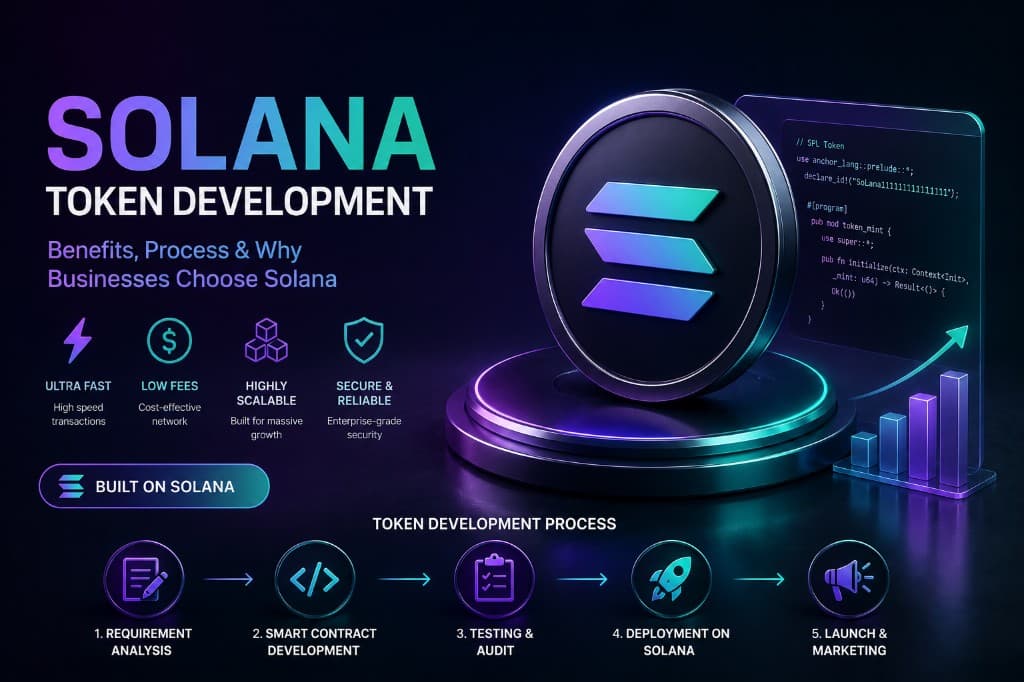
In April 2023, a decentralised wireless network called Helium did something most blockchain projects would never attempt: it shut down its own custom-built blockchain and moved its entire token economy, hundreds of thousands of wallets and roughly a million network hotspots, onto Solana. The reason was simple. Helium's original chain couldn't keep up with the speed and cost demands of a real-world network that processes constant, high-frequency transactions. Solana could and the network has only gotten faster since.
That single migration says a lot about why Solana token development has become such a serious option for businesses building anything that needs to move fast at scale. Ethereum is still one of the most widely used networks around, but a growing number of startups and enterprises are choosing Solana specifically for its speed, scalability and low transaction fees and the 2026 numbers back that up. In Q1 2026 alone, Solana processed roughly 10.1 billion transactions, the highest quarterly figure in the network's history, while sustaining real-world throughput averaging close to 2,000 transactions per second against a theoretical ceiling of 65,000 TPS. Average fees on the network sit at a fraction of a cent and DeFi activity built on Solana held around $5.5 billion in total value locked as of April 2026.
Solana is built to process thousands of transactions every second, which makes it a strong fit for payment platforms, gaming applications, NFT marketplaces, DeFi solutions and Web3 ecosystems. Its architecture is built for performance, so projects can deliver a smooth user experience without running into the high gas fees that come with some other networks.
This guide covers what Solana token development actually is, its key benefits, how the process works, what it costs and why businesses keep choosing Solana for their blockchain development projects.
What Is Solana Token Development?
Solana token development is the process of creating a custom digital token on the Solana blockchain using the SPL (Solana Program Library) token standard.
An SPL token works a lot like Ethereum's ERC-20 tokens, but it benefits from Solana's fast transaction speeds and much lower fees. Businesses use these tokens for payments, staking, governance, loyalty programmes, fundraising, gaming rewards and DeFi applications.
Since Solana already provides the blockchain infrastructure, companies can launch a token without building an entirely new blockchain, which cuts down both development time and cost.
Real-World Example: How Helium Put Solana Tokens to Work
Helium is one of the clearest examples of what Solana token development looks like outside of theory. The network runs on physical hotspots that provide wireless coverage for IoT devices and, more recently, 5G and it rewards the people who host those hotspots with tokens.
Before 2023, Helium ran its own purpose-built blockchain. As the network grew past hundreds of thousands of active hotspots, that custom chain became a bottleneck: transactions slowed down and scaling further meant rebuilding core infrastructure that Solana had already solved. Helium's team migrated HNT, along with its IOT and MOBILE tokens, onto Solana as SPL tokens and turned every physical hotspot into a compressed NFT on-chain.
The result was a network that could process far more transactions at a fraction of the previous cost, with access to Solana's existing pool of wallets, DeFi platforms and liquidity. For a company evaluating Solana token development, Helium is a useful reference point: it shows what happens when a token economy actually needs to scale in the real world, not just in a whitepaper.
Benefits of Solana Token Development
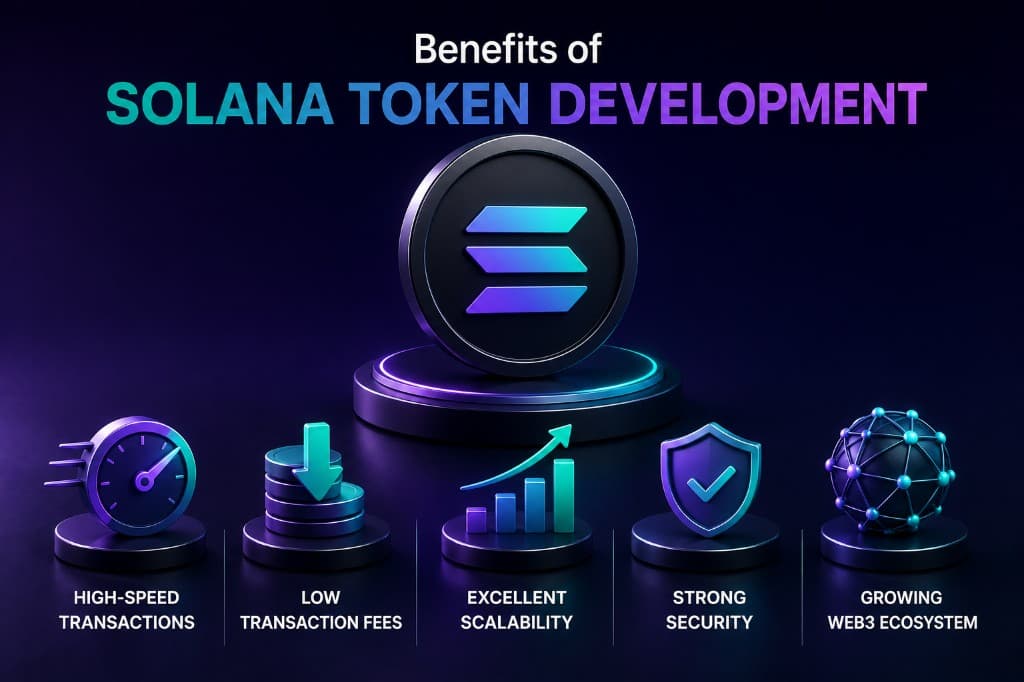
High-Speed Transactions
Solana is built for performance and can process thousands of transactions per second, making it a solid choice for applications that need fast, reliable processing. In practice, the network has been sustaining real-world throughput of roughly 1,900 to 2,000 transactions per second through mid-2026, with a theoretical ceiling of 65,000 TPS and burst capacity well beyond that during stress testing.
Low Transaction Fees
One of Solana's biggest draws is how little it costs to use the network. Average transaction fees on Solana have stayed under a cent, typically around half a cent, which makes running blockchain applications far more cost-effective, especially when transaction volume is high.
Excellent Scalability
As your user base grows, Solana's architecture is built to handle that increased demand without dragging down network performance. Q1 2026 was the clearest proof of this: the network processed around 10.1 billion transactions in a single quarter, the highest figure in its history, without a meaningful drop in reliability.
Strong Security
Solana pairs advanced cryptography with its Proof of History (PoH) and Proof of Stake (PoS) mechanisms, giving it a secure and efficient blockchain environment. The network is currently secured by close to 900 active validators staking tens of billions of dollars in SOL.
Growing Web3 Ecosystem
The Solana ecosystem keeps expanding with new DeFi platforms, NFT projects, gaming applications, wallets and developer tools. DeFi protocols built on Solana held roughly $5.5 billion in total value locked as of April 2026 and the network led all major blockchains in stablecoin transaction volume earlier in the year, which makes it easier for businesses to build genuinely innovative blockchain solutions with real liquidity behind them.
Solana Token Development Process
A token launch on Solana isn't just a technical checklist each stage shapes whether the token actually works once real users get involved. Here's what each step covers in practice.
Step 1: Define Your Business Objectives
Before any code gets written, get clear on what the token is actually for. A payments token, a governance token and an in-game reward token all need very different technical decisions later on, so this step shapes everything that follows. Useful questions to answer up front: who will hold the token, how will they get it and what happens if adoption is slower or faster than expected?
Step 2: Design the Tokenomics
This is where you decide the token's total supply, how it will be distributed among founders, the team, investors and the community and whether any of it needs to be locked up through a vesting schedule. You'll also need to define the token's actual utility why someone would want to hold or use it since a token without a clear reason to exist tends to struggle regardless of how fast the chain underneath it is.
Step 3: Develop the SPL Token
With the tokenomics settled, developers create the token itself using the Solana Program Library standard. This covers the token's core properties, including its name, symbol, decimal precision, total supply and mint authority (who is allowed to create new tokens in the future, if anyone).
Step 4: Create and Test Smart Contracts
If the token needs more than basic transfers staking, vesting, governance voting, or custom transaction logic this is where that gets built, typically in Rust. Every contract goes through local and testnet runs to confirm it behaves correctly under normal use and unusual edge cases alike, before it ever touches real funds.
Step 5: Run Security Testing and Code Reviews
Independent review of the smart contract code happens here, checking for common vulnerabilities like unauthorised minting, permission errors, or logic flaws that could be exploited after launch. For tokens handling significant value or complex logic, a formal third-party audit is worth the extra time.
Step 6: Deploy the Token on the Solana Mainnet
Once testing and review are complete, the token moves from Solana's test network to the live mainnet. This includes verifying the token's metadata, confirming mint authority settings and, if applicable, setting up initial liquidity.
Step 7: Integrate With Compatible Wallets
A token isn't usable if people can't hold and manage it. This step covers integration with major Solana wallets such as Phantom, Solflare and Backpack, so users can view, send, receive and stake the token without friction.
Step 8: Launch the Token and Promote Adoption
With the token live and accessible through wallets, the final step is getting it in front of the people it was built for whether that's existing customers, a DeFi community, gamers, or investors. This usually includes documentation, community channels and, where relevant, listing on decentralised exchanges like Jupiter or Raydium.
Following a structured process like this helps make sure the token ends up secure, scalable and aligned with what your business is actually trying to do.
Solana Token Development Cost and Timeline
Cost and timeline depend on how complex the token is, whether custom smart contract logic is required, how much testing and auditing the project needs and what kind of wallet or exchange integrations are involved.
| Project Type | Estimated Timeline | What It Typically Involves |
|---|---|---|
| Basic SPL Token | 1–3 Weeks | Standard token creation, minimal custom logic |
| Token with Staking or Vesting | 3–5 Weeks | Custom smart contract logic, testing |
| DeFi or Governance Token | 5–8 Weeks | Advanced contract features, security audit |
| Enterprise-Grade Token Platform | 8–12 Weeks | Custom integrations, multiple audits, wallet/exchange readiness |
As a rule, a basic utility token with no custom smart contract behaviour is the fastest and cheapest route. Costs climb once a project needs staking mechanics, governance voting, vesting schedules, or a formal third-party security audit all of which are worth budgeting for rather than skipping.
Business Use Cases
Solana token development supports a wide range of industries, including:
- Gaming In-game currencies and digital rewards.
- DeFi Lending, staking and decentralised exchanges.
- NFT Platforms Marketplace transactions and creator rewards.
- FinTech Cross-border payments and digital wallets.
- Loyalty Programmes Customer rewards and membership benefits.
- Enterprise Solutions Internal digital assets and blockchain-based workflows.
- DePIN (Decentralised Physical Infrastructure) Token-incentivised real-world networks, such as wireless coverage or sensor data, similar to Helium's model.
Common Challenges in Solana Token Development
Even on a fast, low-cost chain, token launches can go wrong if a few basics get skipped.
- Underestimating Smart Contract Complexity Simple token transfers are straightforward, but staking, vesting and governance logic add real complexity. Rushing this stage is one of the most common sources of bugs.
- Skipping Independent Security Audits Solana's low fees make it tempting to launch quickly, but an unaudited token is still exposed to the same categories of exploits as any other chain.
- Weak Tokenomics Planning A token with an unclear purpose or a poorly planned supply and distribution model tends to struggle with adoption, regardless of how fast the underlying chain is.
- Underestimating Wallet and Ecosystem Integration Getting a token onto Solana is only half the job. It also needs to work cleanly with the wallets, DEXs and platforms your users already rely on.
Why Choose Solana Over Other Blockchains?
| Feature | Solana | Ethereum |
|---|---|---|
| Transaction Speed | Very High | Moderate |
| Transaction Fees | Low | Higher during network congestion |
| Scalability | High | Improving with Layer 2 solutions |
| Token Standard | SPL | ERC-20 |
| Best For | Gaming, DeFi, Web3 | Enterprise, DeFi, dApps |
Both blockchains have strong ecosystems behind them, but Solana tends to be the preferred pick for projects that need high throughput and lower operational costs.
How to Choose a Solana Token Development Company
When you're picking a development partner, look for:
- Proven experience with Solana and SPL tokens.
- Strong smart contract development skills.
- Security-first development practices.
- Transparent communication and project management.
- Post-launch maintenance and support.
- A portfolio of successful blockchain projects.
An experienced team reduces development risk and gets your project to market faster.
Conclusion
Solana token development gives businesses a fast, scalable and cost-effective way to build blockchain-based products. Whether you're launching a DeFi platform, a gaming ecosystem, a loyalty programme, or a Web3 application, Solana has the performance and flexibility modern digital projects need and real-world examples like Helium show it can hold up under genuine scale.
Partner with an experienced Solana token development company and you can build secure SPL tokens, integrate them into your ecosystem and set your project up for long-term growth. At Bitronix Technologies, we deliver end-to-end smart contract development and DeFi development for production-ready Solana token launches.
Frequently Asked Questions
What is an SPL token?
An SPL token is the standard token format used on the Solana blockchain, similar to the ERC-20 standard on Ethereum.
How long does Solana token development take?
A basic token can be built within a few weeks, while more advanced projects with custom features usually take longer.
Why choose Solana for token development?
Solana offers fast transactions, low fees, excellent scalability and a growing blockchain ecosystem.
Can businesses create custom Solana tokens?
Yes. Businesses can develop custom SPL tokens tailored to payments, rewards, governance, gaming, DeFi and other use cases.
Has a real business actually migrated to Solana for these reasons?
Yes. Helium, a decentralised wireless network, migrated its token economy, including its HNT token, from its own blockchain to Solana in 2023 to take advantage of higher throughput and lower costs at scale.

Founder and CTO
Founder and CTO of Bitronix Technologies. Builds secure, production-ready SPL tokens, DeFi protocols and enterprise Web3 systems on Solana and EVM chains.
Related Posts
 Blockchain
October 14, 202615 min read
Crypto Token Development Cost in 2027: Pricing, Features and Budget Breakdown
Explore crypto token development cost in 2027, with estimated pricing, key cost factors, smart contract audits, development timelines, & hidden expenses.
Read article Blockchain
October 1, 202613 min read
Top 10 Companies to Hire Blockchain Developers in India 2026-2027
Find the top 10 companies to hire blockchain developers in India. Compare blockchain services, expertise, use cases, & tips for choosing a development partner.
Read article Blockchain
September 25, 202616 min read
RWA Tokenization in Singapore: Regulations, Licensing & Complete Guide 2026
Learn about RWA tokenization in Singapore, including MAS regulations, licensing, compliance, use cases, costs and how to build an RWA platform in 2026.
Read article