Smart Contract Development in 2026: A Practical Guide for Founders, CTOs

By Tausif AhmedFounder and CTO
When business owners and founders start working on smart contract development, they usually ask one question: "What exactly is a smart contract? Can blockchain help us reduce costs, improve transparency and automate our operations? And what's the role of smart contract in our Web 3 project?"
Over the 12 years, after working on blockchain solutions at Bitronix Technologies, we clear their doubts with a simple explanation. See, smart contracts seem quite a technical term, but are not just pieces of code running on a blockchain. They are business automation engines that allow organizations to redesign how agreements, transactions, ownership and digital processes work.
A well-designed smart contract can remove unnecessary manual processes, reduce dependency on intermediaries, improve trust between parties and create completely new digital business models.
However, the biggest mistake businesses make is focusing on the technology first. At Bitronix Technologies, the right approach starts with: What business problem are we solving?
If we compile in short, smart contract development is the engineering work of designing, building, testing, auditing and deploying self-executing blockchain code that powers DeFi protocols, RWA tokenization, DAOs and enterprise blockchain systems. In 2026, getting it right is harder and more important than ever.
To get more in-depth knowledge, stay with us till the end of this guide, as we will cover every nook and cranny about smart contract development. Whether you are a technical or non-technical decision-maker, you will get complete information prior to creating smart contract for your blockchain project in 2026.
We'll cover what these contracts actually are, where they create real business value, what the development process looks like end to end, which platforms make sense for which use cases and what the work costs. Most importantly, how to evaluate the firm you hire for building smart contracts so you don't end up as the next post-mortem on Rekt.news.
What Is Smart Contract?
Before you know about the development process, it's better to know what the smart contract actually is.
A smart contract is a piece of code that lives on a blockchain and executes automatically when specific conditions are met. It runs on a blockchain, so the rules cannot be easily changed or manipulated. There's no intermediary, no manual approval, no 'the system will process this in 3-5 business days.' If the conditions are met, the contract executes. If they're not, it doesn't. Let's understand it with an easy example: Imagine you buy a house. Normally, the process is:
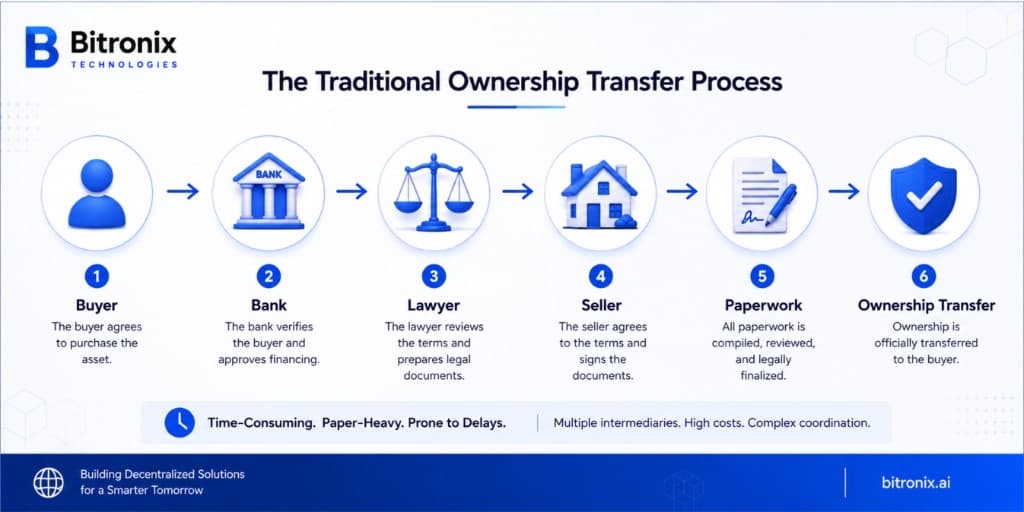
Many people are involved and it takes time. But with smart contract:
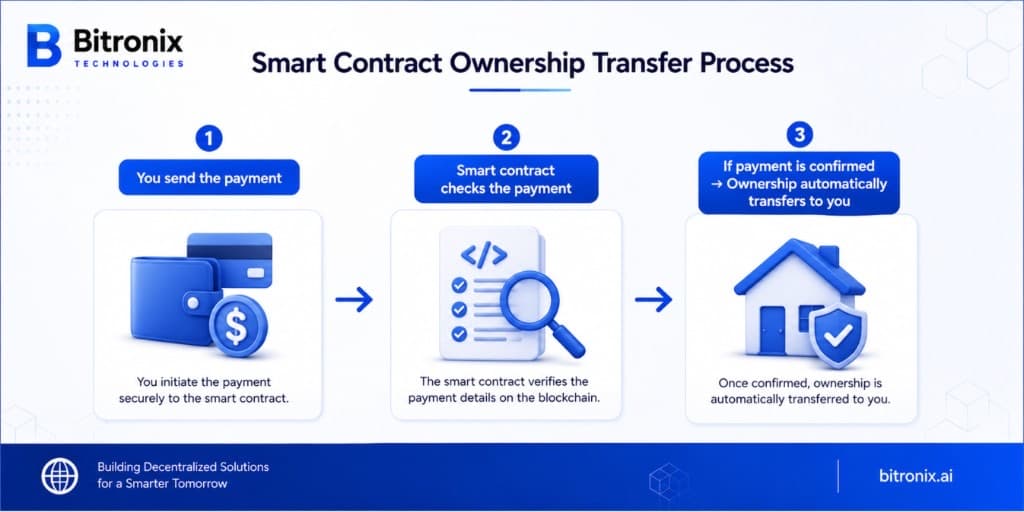
No waiting for manual approval, no need for legal procedure. No extra middle steps. Moreover, it can work like a chocolate vending machine.
The machine follows a rule: "If money is received, give chocolate."
A smart contract works the same way: "If the condition is completed, automatically perform the action."
The difference is that a smart contract runs on blockchain and can handle digital transactions, ownership, payments and business processes securely. A contract that does exactly what its developers intended-and also lets an attacker drain the treasury through an unintended interaction-is, technically, still working as written. It's just been written badly.
Smart Contract Market Size & Real Insights
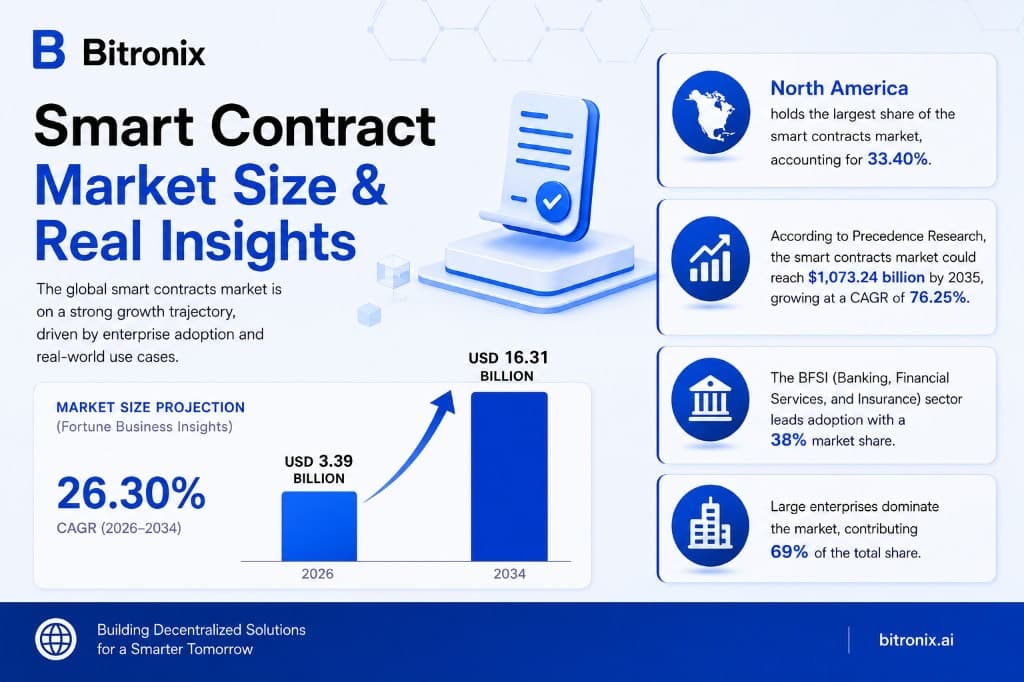
According to Fortune Business Insights, the global smart contracts market is projected to grow from USD 3.39 billion in 2026 to USD 16.31 billion by 2034, registering a CAGR of 26.30%.
- The global smart contracts market is expected to grow from $3.39 billion in 2026 to $16.31 billion by 2034, at a CAGR of 26.30%.
- North America holds the largest share of the smart contracts market, accounting for 33.40%.
- According to Precedence Research, the smart contracts market could reach $1,073.24 billion by 2035, growing at a CAGR of 76.25%.
- The BFSI (Banking, Financial Services and Insurance) sector leads adoption with a 38% market share.
- Large enterprises dominate the market, contributing 69% of the total share.
Why Smart Contract Development Matter: The Real Business Benefits in 2026
Smart contracts help businesses automate processes, reduce dependency on third parties and create more secure ways to manage transactions. Not only these, there are several advantages of building smart contracts that are defined below.
1. Reduce Intermediaries
If you make transactions with traditional banking options, that process often involve banks, brokers, payment providers and other third parties, which increase costs and processing time. But, smart contracts automate these processes by executing transactions automatically when conditions are met. For instance, a property payment can trigger automatic ownership transfer without requiring multiple intermediaries.
2. Reduce Disputes
Traditional contracts based on human interpretation, which can create disagreements. But, smart contracts follow predefined rules written in code. All the actions happen exactly as programmed. For example, an insurance smart contract can automatically release payment when a verified condition, like a flight delay, occurs.
3. Create Transparent Records
Every transaction done with smart contract transaction is recorded on the blockchain. It creates a secure and traceable history. Businesses benefit from easier audits, better tracking and improved accountability.
4. Automate Compliance
These contracts can automatically implement business rules and compliance requirements. The blockchain-based financial platform restricts transactions unless users complete required verification steps.
5. Faster Business Operations
Smart contracts remove manual approvals and repetitive processes that allow transactions and workflows to complete faster. For instance, a supply chain company can automatically release payments once delivery conditions are verified.
6. Reduce Operational Costs
By automating tasks that usually require employees, paperwork and third-party services, smart contracts help businesses reduce operational expenses. The financial platform can automate settlements without depending on multiple processing layers.
7. Enable New Digital Business Models
Smart contracts allow companies to create new products and services that were difficult to build with traditional systems. Businesses can create tokenized assets, decentralized applications (dApp) and automated digital marketplaces using smart contract technology.
Smart Contract Use Cases That Are Actually Working in 2026
Smart contract use cases get oversold constantly. Here are the ones where the technology is genuinely delivering value, not pitch-deck speculation.
DeFi: Lending, AMMs and Yield Infrastructure
Decentralized finance remains the most mature smart contract application. Lending protocols use contracts to handle collateral, calculate interest and execute liquidations without manual underwriting. Automated market makers use constant-product or stable-pool formulas to enable token swaps without order books. Yield aggregators use contracts to route capital across protocols in search of the best return. The DeFi ecosystem now represents roughly $2.5 trillion in value and almost all of it runs on smart contracts.
Real-World Asset (RWA) Tokenization
This is where institutional money is moving in 2026. Treasury bills, real estate, private credit and commodities are being represented as tokens on-chain - with smart contracts handling the policy-gated mint paths, NAV oracle integrations and compliance-enforced transfer restrictions that make them legally usable. Larry Fink and BlackRock have made tokenization a strategic priority and every major financial institution is following suit. The smart contracts behind these systems aren't crypto-native - they're financial infrastructure.
DAO Governance and Treasury Management
Decentralized autonomous organizations use smart contracts to manage proposal lifecycles, weighted delegation, timelocked execution of approved actions and guarded treasury operations. When a DAO holds $200 million in assets and 30,000 voters, the governance contract is the only thing standing between coordinated decision-making and chaos. Properly designed, it enables genuinely decentralized organizations. Poorly designed, it creates the multisig-compromise vulnerabilities that caused some of 2025's most painful losses.
Supply Chain and Provenance
Luxury goods authentication, pharmaceutical custody tracking, food safety provenance and fair-trade certification all benefit from immutable record-keeping. Smart contracts let manufacturers, distributors and retailers share a single source of truth without any single party controlling the data. The contracts handle the state transitions; the off-chain logistics handle the physical goods.
Insurance and Parametric Payouts
Parametric insurance pays out automatically when oracle-verified conditions are met - when rainfall exceeds a threshold, when a flight is delayed beyond a defined window, when a hurricane reaches a defined wind speed in a defined geography. Smart contracts eliminate claims processing, fraud investigation and adjudication delays. The result is faster settlement at a fraction of the cost of traditional insurance.
Gaming, NFTs and Digital Ownership
Game economies, in-game asset ownership, tournament prize distribution and creator royalty systems all rely on smart contracts to enforce ownership and automate payments. The hype around NFT JPEGs has faded, but the underlying mechanism - verifiable digital ownership tied to programmable rules - is now embedded in mainstream gaming infrastructure.
Identity, Healthcare and Government
Self-sovereign identity contracts give individuals portable, cryptographically verifiable credentials. Patient-controlled medical data contracts enable permissioned sharing without centralizing sensitive records. Government applications - voting, land registry, public procurement - use smart contracts to create tamper-proof audit trails. These applications are slower-moving because regulatory frameworks are still catching up, but the technology is production-ready.
The Smart Contract Development Process: How It Actually Works
Most marketing pages describe the development process like this:
1. Discovery
2. Design
3. Development
4. Testing
5. Deployment
That's accurate the same way a restaurant could be described like this:
1. Buy ingredients
2. Cook
3. Eat
Here's what actually happens, phase by phase, when it's done properly. Smart contract development is not just about writing blockchain code and deploying it on a network. A production-ready smart contract requires proper planning, architecture, security testing and continuous monitoring. But in real-world blockchain projects, every stage requires deeper technical and business decisions. A small mistake in contract logic, security design, or deployment strategy can create serious risks because blockchain transactions are designed to be transparent and difficult to reverse.
Here is how a professional smart contract development process actually works.
Step 1: Understanding Business Requirements Before Development
The first stage of smart contract development begins with understanding the business objective behind the project. Experienced smart contract engineers do not start by writing Solidity code; they first analyze what the business wants to achieve, what processes need automation, who will interact with the system and how assets or information will move through the platform.
For example, a company building a tokenization platform will have completely different requirements compared to a company developing a DeFi application or an NFT marketplace. Each solution requires different contract logic, permission structures, security considerations and blockchain architecture. This stage helps transform a business idea into a clear technical roadmap.
Step 2: Smart Contract Architecture and Security Planning
Once the business requirements are clear, the next step is designing the smart contract architecture. This stage defines how different components of the system will work together, how users will interact with the contract, how data will be stored and how permissions will be controlled.
Security planning is a major part of this process because smart contracts often handle valuable digital assets. Developers analyze potential risks, identify possible attack points and design the contract structure to prevent vulnerabilities. A properly planned architecture reduces future risks and ensures the smart contract can support business growth.
Step 3: Smart Contract Development and Implementation
After the architecture is finalized, developers begin writing the smart contract logic using blockchain programming languages such as Solidity, Rust, or other ecosystem-specific languages. Development involves creating functions, defining transaction rules, managing user permissions and ensuring the contract performs exactly according to the business requirements.
However, smart contract development is different from traditional application development. Developers must think beyond functionality and consider security, transaction costs, blockchain limitations and possible misuse of contract functions. A contract that works correctly in normal conditions must also remain secure when users interact with it at scale.
Step 4: Testing and Quality Verification
Testing is one of the most important stages of smart contract development because blockchain transactions are designed to be permanent. Before deployment, developers perform detailed testing to ensure the contract behaves correctly under different scenarios.
Testing includes checking contract functionality, transaction flow, user permissions and possible security vulnerabilities. Developers review how the contract reacts to unexpected inputs, high transaction volumes and different user interactions. This process helps identify issues before the smart contract becomes available to real users.
Step 5: Smart Contract Security Audit
A security audit is a critical step for any serious smart contract project, especially when the contract manages financial assets or sensitive business operations. During an audit, security experts review the contract code to identify vulnerabilities, logic errors and potential attack methods.
Common areas reviewed during audits include access control, contract interactions, transaction handling and security vulnerabilities such as reentrancy attacks. The purpose of an audit is not only to find problems but also to improve the overall reliability and trustworthiness of the smart contract before launch.
Step 6: Deployment and Blockchain Integration
After successful testing and security validation, the smart contract is deployed on the selected blockchain network. Deployment requires careful planning because blockchain transactions cannot be easily reversed once executed.
A complete smart contract solution usually involves more than the contract itself. It needs integration with frontend applications, wallets, APIs, backend systems and other blockchain components to create a complete user experience. Proper deployment ensures that the smart contract functions smoothly in a real-world environment.
Step 7: Monitoring and Post-Launch Support
Smart contract development does not end after deployment. Once the contract is live, continuous monitoring is required to ensure performance, security and reliability. Developers monitor transaction activity, network changes, security alerts and overall contract performance.
Long-term maintenance may include optimization, upgrades and improvements based on user requirements and changing business needs. A successful smart contract is not only one that launches successfully but one that continues to operate securely over time.
Popular Blockchain Platforms: Which Chain Should You Build On?
Chain selection is one of the most consequential decisions in the entire project. The wrong choice means rebuilding from scratch later, or worse, deploying into an ecosystem that doesn't have the liquidity, users, or tooling your project actually needs.
Ethereum remains the dominant smart contract platform, accounting for roughly 50% of the smart contract market by platform share. Solidity is the most mature language, the audit ecosystem is the most developed and the tooling - Foundry, Hardhat, OpenZeppelin libraries, Chainlink oracles - is best-in-class. You pay for it in gas fees, but for high-value institutional applications, Ethereum mainnet is still the default. Layer-2 networks like Arbitrum, Optimism and Base inherit Ethereum's security model while reducing transaction costs by orders of magnitude.
Polygon offers Ethereum compatibility with much lower fees, making it the preferred choice for gaming, NFTs and consumer applications where transaction costs need to be invisible to users.
BNB Smart Chain trades some decentralization for speed and cost - useful for retail-focused projects but generally not appropriate for institutional applications where decentralization is part of the value proposition.
Solana uses Rust instead of Solidity and offers high throughput and low fees, making it strong for high-frequency applications, gaming and consumer DeFi. The 2025 Cetus exploit on Sui - a Solana-adjacent ecosystem - was a reminder that newer chains have less battle-tested tooling, so your development partner needs genuine multi-chain depth, not just one engineer who took a Rust course.
Aptos and Sui use the Move programming language, which was designed specifically for digital assets and offers stronger safety guarantees by default than Solidity. Both are gaining institutional adoption, particularly for tokenization use cases.
StarkNet uses Cairo and ZK-proofs to deliver scalability and privacy properties that no EVM chain can match. Useful for specific high-value use cases but with a smaller talent pool.
The honest answer to 'which chain should we use' is 'where are your users, where is your liquidity and what are your regulatory requirements?' Then work backwards. Anyone who recommends a chain before asking those questions is selling, not advising.
Security and Audits: Where Smart Contract Projects Live or Die
This is the section most marketing pages gloss over. We won't, because it's the only section that actually matters.
The OWASP Smart Contract Top 10 for 2026, released in February of this year, was built from real exploit data. Access control failures, logic errors, oracle manipulation, flash loan attacks, lack of input validation, unchecked external calls - these are the vulnerabilities that drained $2.9 billion from DeFi in 2025. Notably, the OWASP 2026 framework includes an 'Alternate Top 15 Web3 Attack Vectors' that expands beyond contract code to cover operational and governance failures - multisig compromise, rushed governance proposals, supply chain exposure. The lesson: 'audited' does not automatically mean 'resilient.'
A proper security program for smart contract development has six layers:
- Threat modeling before code - attack surfaces documented before the first line of production code
- Invariant testing - encoding the conditions that must always be true, then fuzzing millions of execution paths to try to break them
- Property-based and differential testing - comparing against reference implementations to catch edge cases unit tests would miss
- Formal verification where it counts - mathematical proofs for high-value invariants like supply bounds and liquidation solvency
- Independent third-party audit - by firms whose findings your investors and regulators recognize
- Post-launch monitoring - because the threat landscape keeps evolving after deployment
Recent research from Anthropic and OpenAI has shown that AI agents can now execute end-to-end exploits on most known vulnerable smart contracts, with exploit capability reportedly doubling roughly every 1.3 months. The implication is uncomfortable but clear: the security bar for smart contracts is rising faster than most development teams are adapting. If your developer can't articulate how they defend against AI-assisted adversarial testing, find a different developer.
How Much Does Smart Contract Development Cost in 2026?
The cost of smart contract development depends on the complexity, features, blockchain network, security requirements and integration needs. Based on the project scope, the estimated cost can vary:
1. Smart Contract for Basic Token Development (ERC-20 / ERC-721): $1,500 - $6,000 - Ideal for businesses launching simple blockchain assets such as utility tokens or basic NFTs. Includes standard contract logic, token functionality, deployment support and essential testing for secure operation.
2. Smart Contract for NFT Projects With Advanced Features: $14,000 - $35,000 - Designed for NFT platforms requiring advanced capabilities like minting, dynamic metadata, royalties, marketplace integration and customized user experiences with scalable smart contract architecture.
3. Smart Contract for Full DeFi / DAO Ecosystem Development: $40,000 - $150,000+ - Built for complex blockchain ecosystems including staking, governance, yield farming, liquidity pools and financial automation requiring advanced development, security planning and extensive testing.
4. Smart Contract Security Audits: $5,000 - $15,000+ - A critical investment for protecting user funds through vulnerability detection, code analysis, security verification and risk assessment before deploying smart contracts on public blockchain networks.
5. Maintenance & Smart Contract Support: $5,000 - $20,000 Annually - Ensures long-term reliability through contract monitoring, upgrades, infrastructure management, performance optimization and technical support for continuously evolving blockchain applications.
| Smart Contract Solution | Estimated Cost | Development Time | Key Features Included | Best For |
|---|---|---|---|---|
| Basic Token Development (ERC-20 / ERC-721) | $1,500 - $6,000 | 1-4 weeks | Token creation, transfers, ownership, deployment | Startups launching utility tokens |
| NFT Smart Contract Development | $14,000 - $35,000 | 6-12 weeks | Minting, metadata, royalties, marketplace | NFT and gaming platforms |
| DeFi / DAO Ecosystem Development | $40,000 - $150,000+ | 3-6+ months | Staking, farming, governance, liquidity | DeFi and Web3 platforms |
| Smart Contract Security Audit | $5,000 - $100,000+ | 2-8 weeks | Testing, analysis, risk, validation | Secure blockchain projects |
| Smart Contract Maintenance & Support | $5,000 - $20,000/year | Ongoing | Monitoring, upgrades, fixes, optimization | Long-term blockchain growth |
What drives cost: complexity of business logic, number of contracts, integration with external systems (oracles, bridges, off-chain APIs), regulatory requirements, target chain (Ethereum mainnet costs more to deploy and test against than Polygon) and the level of formal verification required. Premium for audit-firm coordination, post-launch support and upgrade patterns is standard.
Red flags in pricing: anyone quoting under $5,000 for a 'smart contract' is selling you a template with the name changed. Anyone quoting over $500,000 for a standard protocol without a detailed breakdown of where the money goes is either inexperienced or overcharging. The middle of the market is where the actual work happens.
How to Choose a Smart Contract Development Company?
It is one of the important decisions to select the right smart contract creation agency for your blockchain project. Smart contracts handle critical business logic and often manage valuable digital assets, which means businesses need more than just coding expertise. A reliable partner should have below given specialties.
Check Their Smart Contract Audit Experience
Security should be a top priority when evaluating a smart contract development company. A professional blockchain team should have experience working with recognized audit firms such as CertiK, Hacken, ChainSecurity, or QuillAudits. These relationships show that the company follows structured development practices and understands how to build smart contracts that meet industry security standards before they reach the auditing stage.
Look for Verifiable Blockchain Projects
A trustworthy smart contract creation partner must have real-world blockchain work instead of relying only on claims. You must review their completed projects, deployed smart contracts, technical architecture and audit reports to understand their actual capabilities. Moreover, their publicly available case studies with verifiable on-chain deployments are proof of expertise. So, you must check those too.
Evaluate Multi-Chain Development Expertise
Blockchain ecosystems have different technical requirements and the right development approach depends on the network your project uses. A capable smart contract development team should have experience across multiple blockchain environments such as Ethereum, Solana, Aptos, StarkNet and Layer 2 solutions. True multi-chain expertise comes from successfully delivering projects on different networks, not simply listing various technologies on a service page.
Understand Their Post-Launch Support Approach
Smart contract development does not end after deployment. A reliable blockchain partner should provide ongoing support to ensure the system remains secure, stable and scalable. This includes monitoring, incident response, performance optimization, upgrade management and technical assistance when the ecosystem evolves. A company that treats support as an afterthought may create unnecessary risks after launch.
Transparent Development Process
Transparency plays a major role in building secure blockchain solutions. During development, businesses should have visibility into important decisions such as architecture design, security planning, testing results and technical implementation. A transparent workflow allows teams to identify risks early and ensures that the final smart contract solution aligns with business goals.
Ensure Audit Remediation Is Part of the Process
Security audits often identify areas that require improvement before deployment. A professional smart contract development company should include vulnerability fixes, testing and verification as part of the development lifecycle. Audit remediation should be handled through a structured process rather than becoming an unexpected additional expense after the project is already committed.
Evaluate the Engineering Culture Behind the Team
The quality of a smart contract solution depends heavily on the engineering mindset behind it. Businesses should understand how developers approach security, testing, code quality and contract design. Teams with strong engineering practices focus on creating reliable, scalable and secure smart contracts instead of only delivering functional code.
Why Choose Bitronix as Your Smart Contract Development Company?
Bitronix Technologies is built for teams that can't afford to ship contracts that fail. Our smart contract development model is structured around commitments that most firms don't make.
Audit-first Engineering: We write contracts for external reviewers from the first line of code, with documented invariants, mapped attack surfaces and audit preparation packs delivered as part of the engagement - not billed as extras. We routinely coordinate with established audit firms and structure repositories the way reviewers expect, which reduces cycle time once you are in formal review.
Verifiable Delivery Narratives: Our published case studies describe architecture choices, operational constraints and review paths in enough depth for technical diligence before you engage.
Chain-agnostic Execution: We work across EVM networks, Solana, Aptos, Sui and StarkNet - not because we list them in a brochure, but because our case studies are deployed across them. Chain selection is driven by your requirements, not our tooling comfort zone.
We don't ask you to trust us. We give you the evidence to decide.
Frequently Asked Questions
How long does smart contract development take?
Simple token contracts take 1-3 weeks. Moderate-complexity contracts take 4-8 weeks. Complex protocols take 8-20 weeks including audit coordination. Audit firm availability is the most variable factor - we recommend reserving audit slots 4-6 weeks before your target launch date.
What's the difference between a smart contract audit and smart contract testing?
Testing is done by the development team during development to verify the contract works as intended. Auditing is done by an independent third party to find vulnerabilities the development team missed. Both are essential; neither replaces the other.
Can existing smart contracts be upgraded after deployment?
Yes, if they were designed for upgrade from the start. Common upgrade patterns include transparent proxies, UUPS proxies and diamond/multi-facet contracts - each with different security tradeoffs. Contracts deployed without upgrade patterns generally require full migration to update.
Which blockchain platform is cheapest to deploy on?
Layer-2 networks like Polygon, Arbitrum, Optimism and Base offer dramatically lower gas costs than Ethereum mainnet while maintaining strong security. For institutional applications, deployment cost should be a minor factor compared to security and liquidity considerations.
Do we need a smart contract audit if we're a small project?
If your contract will hold any meaningful value - your own treasury, user funds, or anything that would be expensive to lose - yes. The 2025 hack data shows that small projects are targeted just as readily as large ones, often more so because their security investments are smaller.
What programming language are smart contracts written in?
Solidity for EVM chains (Ethereum, Polygon, BNB, Arbitrum, etc.), Rust for Solana, Move for Aptos and Sui, Cairo for StarkNet, Vyper as an alternative to Solidity on EVM chains. Language choice follows chain choice, not the other way around.
How do smart contracts handle real-world data?
Through oracles - services like Chainlink that bring off-chain data (prices, weather, sports scores) on-chain in a verifiable way. Oracle design is one of the highest-risk areas in smart contract development because compromised oracles cause many of the largest exploits.
What happens if a smart contract has a bug after deployment?
Depends on the contract's design. Upgradeable contracts can be patched. Contracts with pause mechanisms can be halted while a fix is deployed. Immutable contracts without these mechanisms generally require migration to a new contract version and coordinated user migration - slow, expensive and reputationally damaging.
Can smart contracts integrate with traditional business systems?
Yes. Smart contracts can be connected to ERP systems, banking APIs, customer databases and other off-chain infrastructure through carefully designed integration layers. The integration boundary is itself a security surface that needs to be designed deliberately.
What's the difference between a smart contract development company and a blockchain development company?
Significant overlap, but smart contract development is specifically focused on the on-chain code that executes business logic - the highest-risk component of any blockchain system. Blockchain development is broader, covering protocol-level work, node operations, cross-chain infrastructure and dApp engineering. The best firms do both; the cheapest firms do neither well.
Ready to Build Smart Contracts That Don't Fail?
The smart contract market is growing fast, but the gap between projects that succeed and projects that end up on Rekt.news has never been wider. The difference isn't budget or ambition. It's engineering discipline, audit readiness and operational coverage that doesn't disappear at deployment.
If you're scoping a smart contract project - whether it's a token launch, a DeFi protocol, an RWA tokenization platform, or an enterprise blockchain integration - Bitronix Technologies would rather have a real conversation about your constraints than send you a templated sales deck.
You can also explore our case studies to see how we've approached similar projects - ProSwap's AMM, Meridian's lending infrastructure, Harbor's RWA settlement rails - or read our smart contract audit readiness guide if you're preparing for external review.

Founder and CTO
Founder and CTO of Bitronix Technologies. Leads strategy and delivery for audit-ready smart contracts, institutional DeFi, RWA tokenization and enterprise blockchain programmes across EVM, Solana, Aptos and Sui.
Related Posts
 Smart Contracts
October 17, 202619 min read
Smart Contract Integration with APIs and Blockchain Oracles: A Complete Guide
Learn how smart contract integration with APIs and blockchain oracles works, including use cases, benefits, security risks, and development costs.
Read article Smart Contracts
October 16, 202620 min read
Smart Contract Use Cases in Healthcare, Finance & Real Estate
Explore smart contract use cases in healthcare, finance, & real estate, including practical applications, benefits, risks, & business examples.
Read article Smart Contracts
October 14, 202616 min read
Smart Contract Development: A Complete Guide for Businesses in 2027
Learn how smart contract development works in 2027, including business use cases, blockchain platforms, costs, security, and the development process.
Read article