Hire AI Automation Developers in the USA: What to Expect (Cost & Process)

By Tausif AhmedFounder and CTO
At some point, every growing business hits the same wall: manual processes that worked fine at a smaller scale start breaking down. Orders get missed, data entry errors pile up, customer response times slip and someone on the team finally says the thing everyone's been thinking, "We need to automate this." That's usually the moment companies start looking to hire AI automation developers and it's also the moment they realize just how little clear information exists about what that actually costs, how long it takes, or what a good hiring process even looks like.
This guide fills that gap. No inflated promises, no vague "it depends" without actual numbers attached. Just a real breakdown of what hiring AI automation developers in the USA looks like in 2026, the cost ranges, the hiring models, the step-by-step process and the mistakes that quietly waste a lot of companies' budgets before they even get a working system.
Why Companies Are Hiring AI Automation Developers Right Now
The shift toward AI automation isn't just a tech trend companies are chasing because it's fashionable. It's a direct response to a few very real pressures.
Labor costs in the US have climbed steadily and hiring for repetitive operational roles has gotten harder in a lot of industries. At the same time, customer expectations around speed, whether that's a support response, an order fulfillment, or a loan approval, keep rising. Manual processes simply can't scale to meet that without proportionally scaling headcount, which most businesses can't afford to do indefinitely.
AI automation solves a narrower but more achievable problem than "replace all your workers with robots," despite how it sometimes gets framed. It takes the repetitive, rules-based, data-heavy parts of a workflow, document processing, customer query triage, inventory forecasting, fraud flagging and handles them faster and more consistently than a manual process ever could, freeing up people to handle the parts of the job that actually need human judgment.
That's the real reason hiring AI automation developers has become a priority for companies across FinTech, healthcare, logistics and e-commerce specifically. It's not about following a trend; it's about the math no longer working with manual-only processes at their current scale.
What Does an AI Automation Engineer Actually Do?
Before getting into cost and process, it's worth being clear on what you're actually hiring for, because "AI engineer" gets used loosely and covers a wide range of actual skill sets.
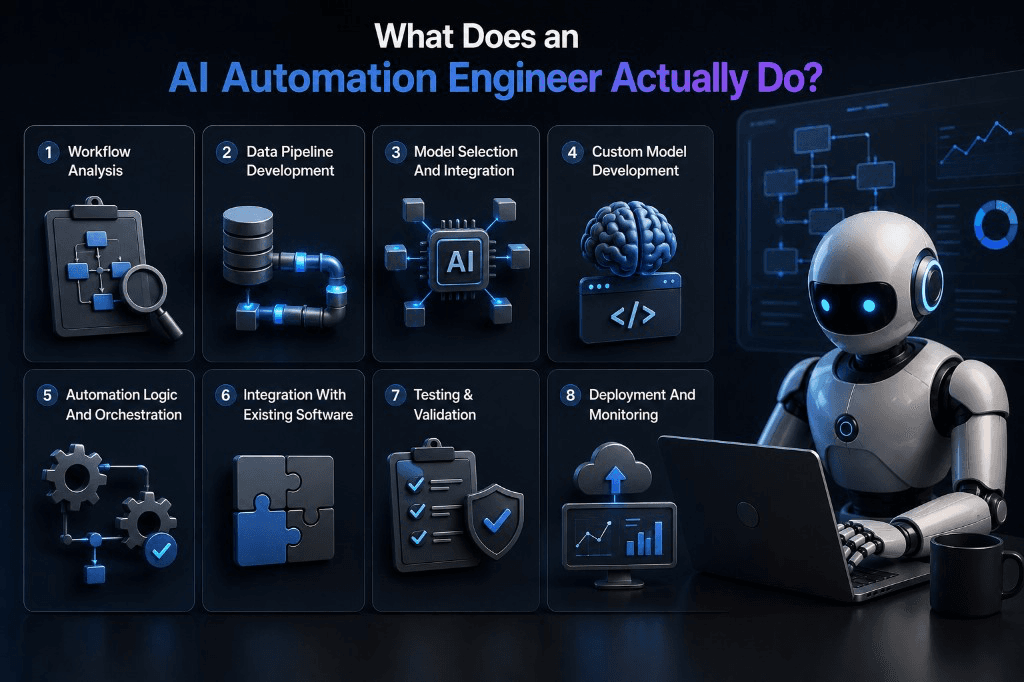
A genuine AI automation developer typically handles some combination of:
- Workflow Analysis: Mapping your existing process to identify where automation actually creates value versus where it would just add complexity
- Data Pipeline Development: Building the infrastructure that feeds clean, structured data into any AI model or automation system
- Model Selection And Integration: Choosing whether to use an existing AI model (like a large language model via API) or build something custom and integrating it into your systems
- Custom Model Development: For more specialized use cases, training or fine-tuning models specific to your data and workflow
- Automation Logic And Orchestration: Building the actual rules and triggers that connect AI outputs to real actions in your business systems
- Integration With Existing Software: Connecting the automation to your CRM, ERP, WMS, or whatever platforms already run your operations
- Testing & Validation: Making sure the system performs reliably against real-world data, not just clean test cases
- Deployment And Monitoring: Launching the system and setting up ongoing performance tracking
Someone who can only write code to call an AI API, without the workflow analysis, data pipeline, or integration skills, isn't equipped to deliver a working automation system on their own. This is one of the most common gaps companies run into when hiring too narrowly.
Hiring Models: Freelancer, AI Automation Agency, or In-House Team?
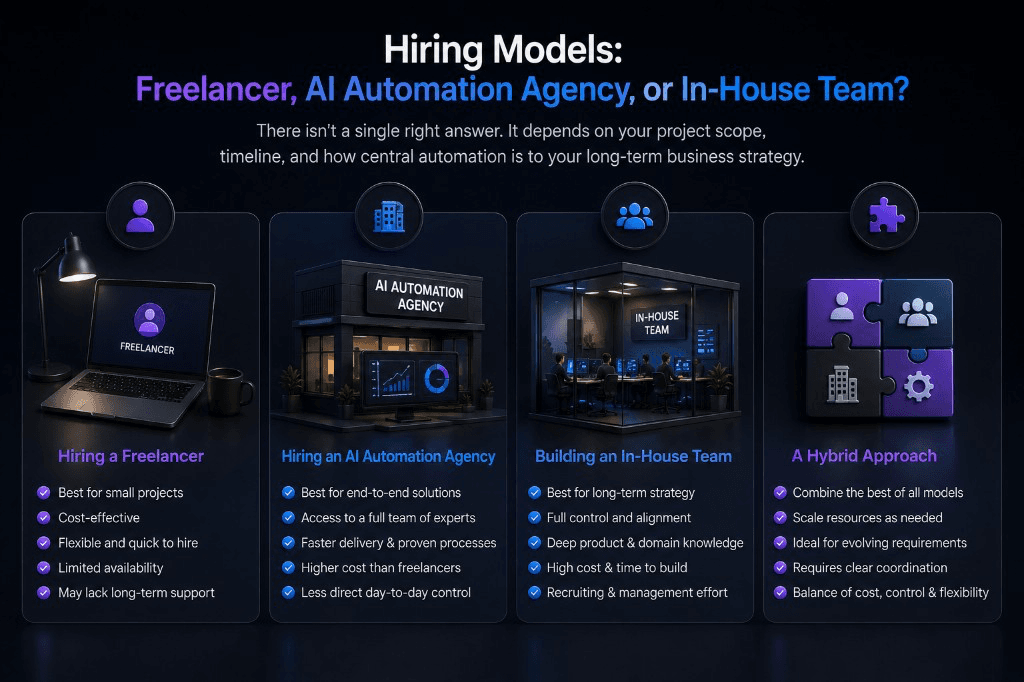
There isn't a single right answer here. It depends on your project scope, timeline and how central automation is to your long-term business strategy.
Hiring a Freelancer
Best for: Small, well-defined, single-workflow automation projects with a clear technical brief.
Freelance AI developers can be cost-effective for narrow projects, but the model has real limitations for anything beyond a single, isolated task. There's no built-in accountability structure if the freelancer becomes unavailable mid-project and most freelancers don't have the range of skills, including data engineering, model development, integration, security, that a full automation project needs.
Hiring an AI Automation Agency
Best for: Companies that need a complete, production-ready system without building an internal team, especially for projects involving compliance, integration complexity, or ongoing maintenance needs.
Agencies bring a full team structure, project management and (in the better ones) a proven process refined across multiple past projects. This tends to be the most reliable path for companies without existing AI engineering capacity in-house, particularly for regulated industries where getting the architecture right the first time matters enormously.
Building an In-House Team
Best for: Companies where AI automation is core to their long-term product or competitive strategy, not just an operational improvement.
Building in-house gives you full control and retains institutional knowledge inside the company, but it requires significant investment: recruiting genuinely qualified AI engineers is competitive and expensive in the current US market and there's a real ramp-up period before an internal team reaches full productivity, especially if this is the company's first AI initiative.
A Hybrid Approach
A growing number of companies start with an agency for the initial build, then bring on a smaller in-house team for ongoing maintenance and iteration, sometimes with the original agency staying on in an advisory capacity. This tends to combine the faster time-to-value of an agency with the long-term cost efficiency of in-house ownership.
| Factor | Freelancer | AI Automation Agency | In-House Team |
|---|---|---|---|
| Best For | Small, clearly defined automation projects | End-to-end AI automation with long-term support | Businesses making AI a core capability |
| Project Scope | Single workflows or limited tasks | Complex, multi-system automation projects | Continuous product and automation development |
| Technical Expertise | Individual skill set | Cross-functional team with specialized experts | Dedicated internal specialists |
| Development Speed | Fast for small tasks | Structured delivery with predictable timelines | Slower initial setup due to hiring |
| Scalability | Limited | Easily scales across business functions | Highly scalable after team expansion |
| Project Management | Self-managed or minimal | Dedicated project managers and delivery processes | Managed internally |
| Maintenance & Support | Depends on freelancer availability | Ongoing support, updates and optimization | Managed by internal team |
| Cost | Lowest upfront investment | Moderate to high, depending on scope | Highest long-term investment |
| Long-Term Value | Suitable for one-off projects | Strong balance of expertise and scalability | Best for long-term AI-driven businesses |
Which Hiring Model Should You Choose?
The right hiring model depends on your business objectives, technical complexity, available budget and long-term AI strategy. A freelancer works well for small, well-defined automation tasks with limited scope. An AI automation agency offers the best balance of expertise, scalability and ongoing support for most businesses implementing production-ready AI systems. Building an in-house team is the strongest long-term option when AI automation is central to your products or operations and you plan to invest continuously in internal AI capabilities.
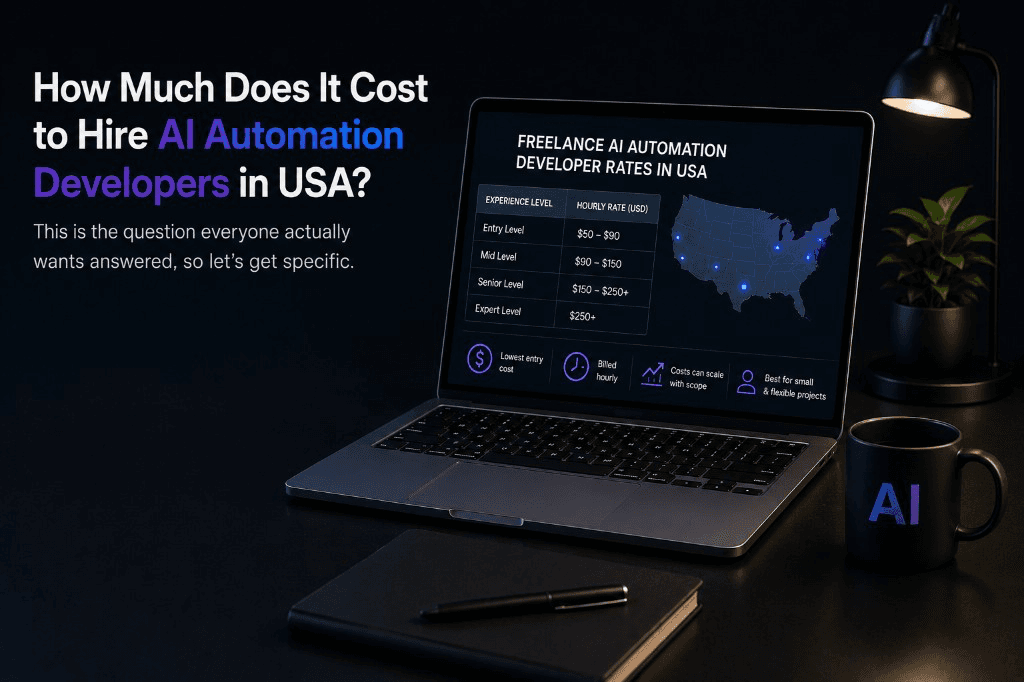
How Much Does It Cost to Hire AI Automation Developers in USA?
This is the question everyone actually wants answered, so let's get specific.
Freelance AI Automation Developers
Rates vary widely based on experience and location, even within the US. For a narrowly scoped project, freelance engagement costs tend to be the lowest entry point of the three models, but total project cost can still add up quickly if the scope expands, since freelancers typically bill hourly without the process efficiencies a specialized team develops over repeated projects.
Estimated Cost: $40–$150/hr
Project Cost: $5,000–$15,000+
AI Automation Agencies
Agency pricing is usually structured around project scope rather than a simple hourly rate, though time-and-materials arrangements exist too.
Estimated Cost: Varies by provider
Project Cost: $1,500–$60,000+
Costs depend heavily on:
- Project Complexity: A single workflow automation costs significantly less than a multi-department system with several integrations
- Data Readiness: If your existing data is messy or siloed, expect additional costs for data cleaning and pipeline work before the actual automation build even starts
- Compliance Requirements: Regulated industries (FinTech, healthcare) typically cost more due to the additional architecture and review work that compliance demands
- Integration Complexity: Connecting to legacy systems or multiple platforms adds development time compared to a standalone tool
A focused pilot project, automating one clear workflow, is generally the most cost-effective way to start, both because it's cheaper and because it lets you validate the partnership before committing to a larger engagement.
In-House AI Engineering Talent
Salaries for qualified AI/ML engineers in the US remain high due to strong demand relative to supply and that's before factoring in benefits, recruiting costs and the time investment of building out a functioning team rather than hiring a single engineer. For most mid-sized companies, this only makes financial sense if automation is going to be an ongoing, expanding priority rather than a single project.
Estimated Cost: $50–$110+/hr
Project Cost: $130,000–$230,000+
Hidden Costs Companies Often Miss
- Data Cleanup And Preparation: Almost every project needs more of this than initially estimated and it directly affects both cost and timeline.
- Ongoing Model Maintenance: AI systems degrade in accuracy over time as real-world data shifts and require periodic retraining, an ongoing cost, not a one-time expense.
- Integration With Legacy Systems: Older internal software without modern APIs can add significant unplanned development time.
- Change Management And Training: Getting your team to actually trust and use a new automated system often requires structured training, not just a system handoff.
- Post-launch Monitoring Infrastructure: Detecting when a system starts underperforming requires dedicated monitoring, which is sometimes quoted as a separate line item companies don't anticipate upfront.
The practical takeaway: get a detailed, itemized quote before committing to anyone and specifically ask what's excluded, not just what's included.
| Hiring Model | Hourly Cost | Project Cost | Monthly / Annual Cost | Best For |
|---|---|---|---|---|
| Freelancer (Independent Contractor) | $40–$150/hr | $5,000–$15,000+ | Varies by engagement | MVPs, short-term projects and well-defined workflow automations |
| AI Automation Agency | Varies by provider | $1,500–$60,000+ | $1,000–$12,000/mo | End-to-end AI automation, enterprise integrations and managed support |
| In-House AI Team | $50–$110+/hr (effective equivalent) | $130,000–$230,000+ | $130,000–$230,000+/year | Proprietary AI products, continuous innovation and long-term AI development |
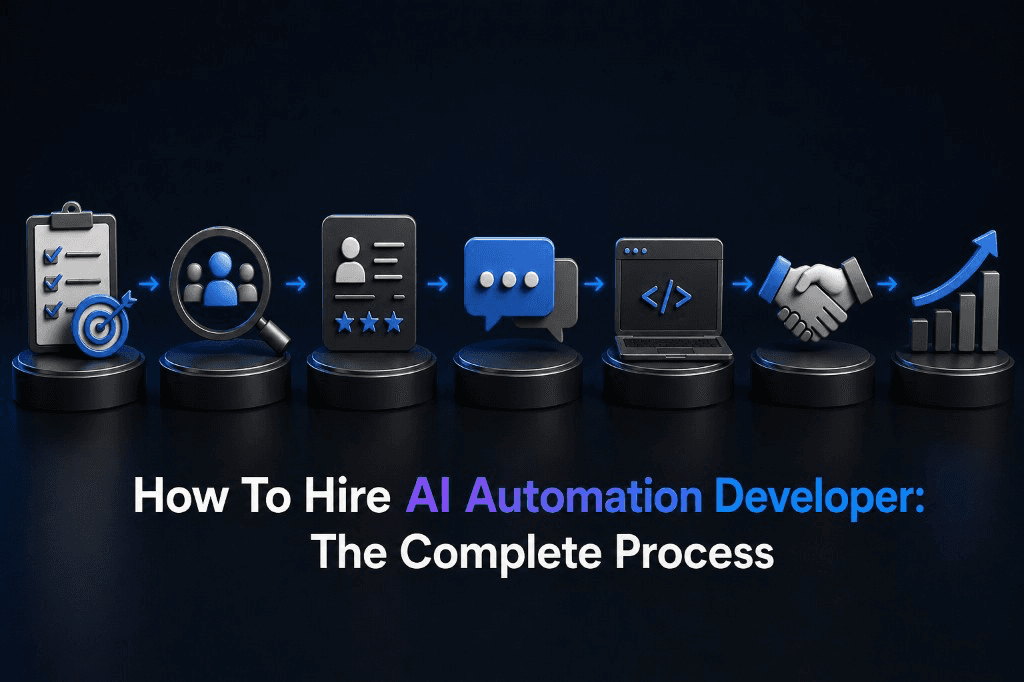
How To Hire AI Automation Developer: The Complete Process
Step 1: Define the Problem Before You Start Hiring
The single most common mistake companies make is starting the hiring process before clearly defining which workflow they actually want automated and why. "We want to use AI" isn't a project brief. "We want to automate invoice processing to reduce our current three-day turnaround to same-day" is.
Step 2: Decide on Your Hiring Model
Based on your project scope, timeline and long-term automation strategy, decide whether a freelancer, agency, or in-house build fits best, using the breakdown above as a starting framework.
Step 3: Shortlist Candidates or Agencies
Look specifically for relevant experience: has this person or team built automation systems in your industry, at a comparable level of complexity, that are actually live and running today? Portfolio pieces that are purely conceptual or testnet-stage don't tell you much about real-world execution ability.
Step 4: Evaluate Technical Depth in the Interview or Discovery Call
Ask specific, scenario-based questions: how would they approach your specific workflow? What would their data requirements be? How do they handle a situation where the initial data quality isn't sufficient for an accurate model? Vague, generic answers are a signal to keep looking.
Step 5: Request a Detailed, Itemized Proposal
A credible proposal breaks down scope, timeline and cost by development phase and clearly states what's included versus what would count as additional scope. Vague, all-in lump-sum quotes without a breakdown make it much harder to catch scope creep later.
Step 6: Start With a Scoped Pilot
Rather than committing to a full-scale, multi-department rollout immediately, start with a pilot focused on a single high-friction workflow. This limits your financial exposure while giving you real evidence of whether the developer or agency can actually deliver.
Step 7: Define Success Metrics Upfront
Before the pilot starts, agree on what "success" looks like in measurable terms: reduced processing time, error rate reduction, cost per transaction, so you have an objective basis for deciding whether to scale the engagement.
Step 8: Plan the Post-Launch Relationship
Before signing anything, clarify what ongoing support, monitoring and maintenance look like after the initial system goes live and make sure that's reflected in the contract and budget, not left as an open question for later.
What to Look for When Evaluating AI Automation Developers
- A portfolio of live, working systems, not just proof-of-concept demos
- Clear communication about realistic timelines, rather than promises that sound too fast for the scope described
- Direct questions about your existing data quality early in the conversation, since this affects nearly every project's actual difficulty
- Familiarity with your industry's compliance requirements, if relevant, especially in FinTech, healthcare, or any business handling regulated data
- A plan for post-launch monitoring and maintenance, not just a handoff once the system is technically working
- References you can actually contact, not just case studies written by the same team pitching you
Red Flags to Avoid
Unusually low quotes with no clear scope breakdown. If a price seems too good relative to others you're comparing, ask specifically what's excluded, post-launch support and data cleanup are common places corners get cut.
No questions about your existing systems or data. A developer or agency that jumps straight to a solution without understanding your current data and workflow in detail is likely to deliver something that doesn't actually fit your operational reality.
Promises of a fully autonomous system with no human oversight. Especially in regulated industries, a responsible developer will build in appropriate human review checkpoints rather than positioning full automation as risk-free.
Reluctance to start with a smaller pilot. Developers confident in their ability usually welcome the chance to prove it on a smaller scope before a larger commitment.
No discussion of what happens if the model's performance declines over time. This is a near-certainty with any AI system and a developer who hasn't planned for it hasn't fully thought through the project lifecycle.
Why Companies Choose Bitronix to Hire AI Automation Developers
Bitronix approaches AI automation hiring engagements the way a company evaluating a long-term technical partner should be able to expect: transparent, itemized proposals, a phased pilot-first approach rather than pushing full-scale commitments upfront and deep specialization in regulated, high-stakes industries where getting the architecture and compliance considerations right the first time genuinely matters. For companies trying to figure out whether to hire freelancers, build in-house, or bring in a dedicated team, Bitronix's team works directly with you during the discovery phase to figure out which approach actually fits your project, rather than defaulting to whichever engagement model is easiest to sell. That discovery-first mindset is also why companies that start with a small Bitronix pilot tend to expand the relationship rather than shop around for a second opinion once results come in.
What a Typical Project Timeline Looks Like After You Hire
Once you've selected a developer or agency, it helps to know roughly what the next few months actually look like, so you can set realistic internal expectations with your own team and stakeholders.
Weeks 1-2 : Discovery and Scoping. The team maps your current workflow in detail, reviews your existing data and systems and identifies exactly where automation will create the most value. This phase often surfaces process inefficiencies that are worth fixing independent of any AI investment.
Weeks 3-4 : Architecture And Technical Planning. The specific technical approach gets defined, which data sources will feed the system, which existing tools it needs to integrate with and what the human oversight checkpoints will look like, especially important if your workflow touches customer-facing decisions or regulated data.
Weeks 5-10 : Development (Varies Significantly By Scope). The core build happens here, data pipelines, model integration or training, automation logic and connections to your existing systems. This is typically the longest phase and the one most affected by how clean your underlying data turns out to be.
Weeks 8-12 : Testing And Validation (Often Overlapping With Late Development). The system gets tested against real, messy data rather than clean sample data, since this is where most surprises show up. Expect at least one round of adjustments based on what testing reveals.
Weeks 12-14 : Deployment And Initial Monitoring. The system goes live, ideally with a limited rollout first rather than immediately switching over 100% of the workflow, so any issues can be caught and corrected before they affect your full operation.
Ongoing: Monitoring, Retraining and Iteration. This is where the relationship either becomes valuable long-term or quietly fades once the initial contract ends. Make sure this phase is explicitly planned for, not assumed to happen automatically.
A simple, single-workflow automation project can move through this timeline in as little as six to eight weeks total. A more complex, multi-system project can reasonably take four to six months. Be skeptical of any proposal promising a comparable scope significantly faster than this, since the phases most likely to get compressed are testing and validation, exactly the steps that catch problems before they become expensive.
Questions to Ask Before You Sign Anything
Beyond the evaluation criteria already covered, these specific questions tend to surface useful information during a final conversation before committing:
"What does your team actually look like day to day on a project like ours?" Make sure you know who's doing the hands-on development work, not just who's present in the sales conversation.
"What happens if our data turns out to be messier than expected once you dig in?" A credible answer includes a clear process for handling this, since it happens on the majority of real-world projects, not a dismissive "that shouldn't be an issue."
"Can you walk me through a project that didn't go smoothly and what changed as a result?" Every experienced developer or agency has one. A vague or evasive answer here is worth noting.
"How will we know if the system's performance starts declining after launch and who's responsible for catching that?" This distinguishes teams thinking about the full lifecycle of the system from those focused only on getting the initial build shipped.
"If we want to bring this in-house down the line, how would that transition actually work?" The answer reveals a lot about whether the engagement is structured around your long-term interests or around maximizing dependency on the vendor.
Building the Job Description or Project Brief Correctly
Whether you're posting a role, briefing a freelance platform, or sending an RFP to agencies, how you frame the project brief has a direct effect on the quality of responses you get back. A vague brief attracts vague, boilerplate proposals. A specific one filters for developers and agencies who genuinely engage with the problem.
A strong brief typically includes:
- The specific workflow you want automated, described in concrete operational terms, not just "we want AI"
- Current process metrics, like how long the manual version takes, error rates, or cost per transaction, so respondents can propose something with a measurable improvement target
- Existing systems and data sources the automation needs to integrate with
- Compliance or regulatory context, if relevant, stated upfront rather than discovered mid-project
- Your rough budget range and timeline expectations, which, contrary to some hiring advice, tends to produce more realistic, tailored proposals than withholding this information
- What success looks like, in terms specific enough that both sides can agree later on whether the project delivered
Companies that skip this step and post something closer to "looking for an AI developer to help automate our business" tend to get flooded with generic responses that are hard to meaningfully compare against each other. Taking an extra day or two to write a genuinely specific brief almost always pays for itself in the quality of proposals you get back and it also gives you a useful benchmark document to hold whoever you hire accountable to later.
In-House Hiring: What to Look for on a Resume or Portfolio
If you've decided in-house hiring is the right path, either immediately or as a follow-up to an initial agency engagement, here's what actually predicts good performance on real automation projects, as opposed to credentials that sound impressive but don't necessarily translate.
Evidence of shipped, production systems, not just academic projects, coursework, or personal experiments. Ask specifically what happened after their projects launched, not just how they were built.
Data engineering experience, not just model-building skill. A huge portion of real-world AI automation work is about getting clean, reliable data into a system, not just the model logic itself. Candidates who can only speak to model architecture without discussing data pipelines are missing a critical part of the skill set.
Comfort with ambiguity and iterative problem-solving. Real business workflows are messier than textbook examples. Look for candidates who can describe how they handled a project where the initial approach didn't work and had to be adjusted, not just ones who describe smooth, linear project histories.
Communication skills, genuinely. The best technical hire in the world creates limited value if they can't explain tradeoffs and progress to non-technical stakeholders, particularly important if this person will be working directly with operations or compliance teams rather than solely with other engineers.
Ready to figure out the right hiring approach for your automation project? Talk to the Bitronix team about a scoped discovery call to map out your workflow, timeline and realistic cost before you commit to anything.
Frequently Asked Questions
Below are the questions companies most commonly search for when researching this decision, answered directly so you can move forward with a clear picture rather than more open questions.
How Much Does It Cost To Hire An AI Automation Developer In The USA?
Costs vary widely depending on the hiring model and project complexity, ranging from a lower-cost freelance engagement for a narrow project to a significantly larger investment for a full agency-built production system or an in-house team. Getting a detailed, itemized quote based on your specific workflow is the most reliable way to estimate the actual cost.
Should I Hire A Freelancer Or An Agency For AI Automation?
Freelancers work well for small, clearly scoped, single-workflow projects. Agencies are typically a better fit for production-ready systems involving multiple integrations, compliance requirements, or ongoing maintenance needs, since they bring a full team and structured process rather than relying on one person's availability and skill range.
How Long Does It Take To Hire And Onboard An AI Automation Developer Or Team?
Freelancer hiring can happen within days to a couple of weeks. Agency engagements typically involve a discovery or scoping phase of two to four weeks before development begins. Building an in-house team takes considerably longer, often several months, factoring in recruiting and onboarding time.
What Qualifications Should I Look For When Hiring An AI Automation Developer?
Look for demonstrated experience with live, production automation systems, not just theoretical AI knowledge. Relevant skills include data pipeline development, model integration or fine-tuning, systems integration experience and, ideally, direct experience in your specific industry if compliance or specialized workflows are involved.
Is It Cheaper To Hire An In-House AI Developer Or Use An Agency?
It depends on project duration and scope. For a single project or a limited number of automation initiatives, an agency is typically more cost-effective than the overhead of building an internal team. For companies planning ongoing, expanding automation work over multiple years, in-house hiring can become more cost-efficient over time, though it requires a larger upfront investment.
What Should Be Included In A Contract When Hiring AI Automation Developers?
A solid contract should clearly define project scope, itemized costs by phase, defined success metrics, data ownership and security terms and explicit terms for post-launch support and maintenance, not just the initial development work.
Can I Hire AI Automation Developers For A Small Business, Or Is This Only For Large Enterprises?
AI automation development is increasingly accessible to small and mid-sized businesses, particularly through focused, single-workflow pilots rather than large enterprise-wide rollouts. Many agencies and freelancers are equipped to scope projects appropriately for smaller budgets, as long as expectations are aligned with the size of the investment.
What's The Biggest Mistake Companies Make When Hiring AI Automation Developers?
Skipping a clear problem definition before starting the hiring process. Companies that start shopping for developers with only a vague sense of "we want AI automation" tend to end up with mismatched proposals, scope creep and systems that don't actually solve their highest-friction operational problem.

Founder and CTO
Founder and CTO of Bitronix Technologies. Builds production-grade AI automation for regulated FinTech, healthcare, supply chain and RWA teams in the USA and beyond.
Related Posts
 AI
AISeptember 12, 202627 min read
AI Workflow Automation: How It Works, Benefits & Use Cases
Learn how AI workflow automation works, its benefits, use cases, implementation process, costs and how businesses can automate repetitive workflows.
Read article AI
AIAugust 6, 20267 min read
AI Automation for Ecommerce: The Complete 2026 Guide
A complete 2026 guide to AI automation for ecommerce: what to automate first, real use cases across marketing, inventory and support, costs and a practical rollout roadmap.
Read article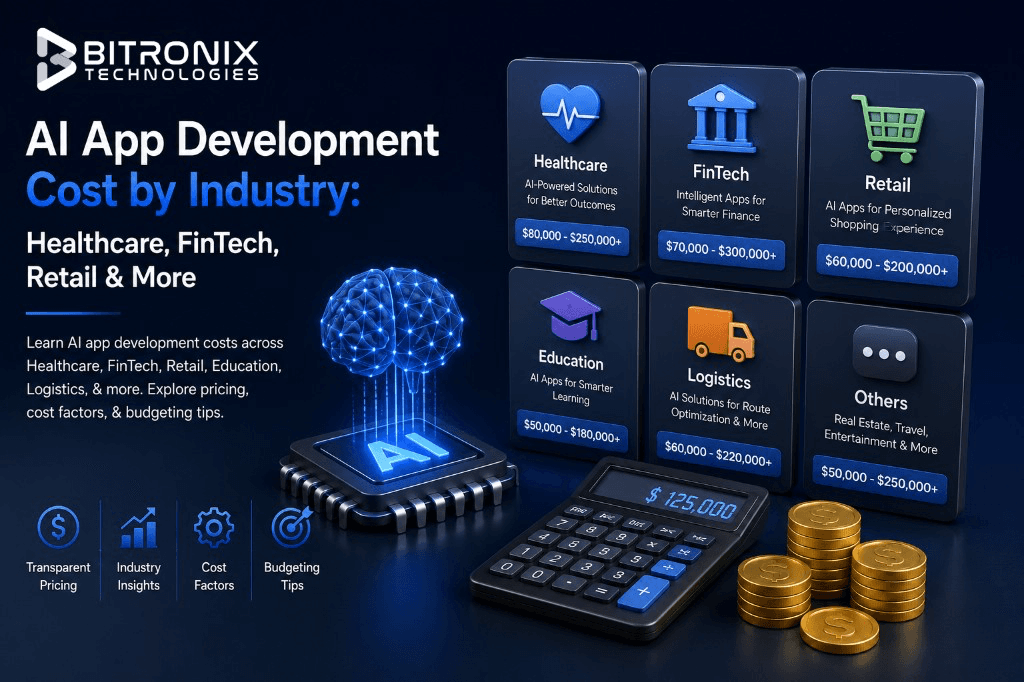 AI
AIJuly 24, 202621 min read
AI App Development Cost by Industry: Healthcare, FinTech, Retail & More (2026 Guide)
Learn AI app development costs across Healthcare, FinTech, Retail, Education, Logistics, & more. Explore pricing, cost factors, & budgeting tips for 2026.
Read article