AI-Powered Supply Chain Automation: What US Logistics Companies Need to Know

By Tausif AhmedFounder and CTO
Ask any logistics manager in the US what keeps them up at night, and you'll hear the same three things: unpredictable freight costs, warehouse labor shortages, and customers who expect Amazon-level delivery speed no matter the size of the company shipping the order. Add tariff shifts, port congestion, and fuel price swings into the mix, and it's clear why "we'll figure it out with spreadsheets" stopped working a while ago.
That's the gap AI-powered supply chain automation is filling. Not as a buzzword, but as the actual system running behind the scenes at companies that no longer get blindsided by a stockout or a missed delivery window. This guide breaks down what that looks like in practice, what it costs, where it goes wrong, and how to actually start.
What Is AI-Powered Supply Chain Automation, Really?
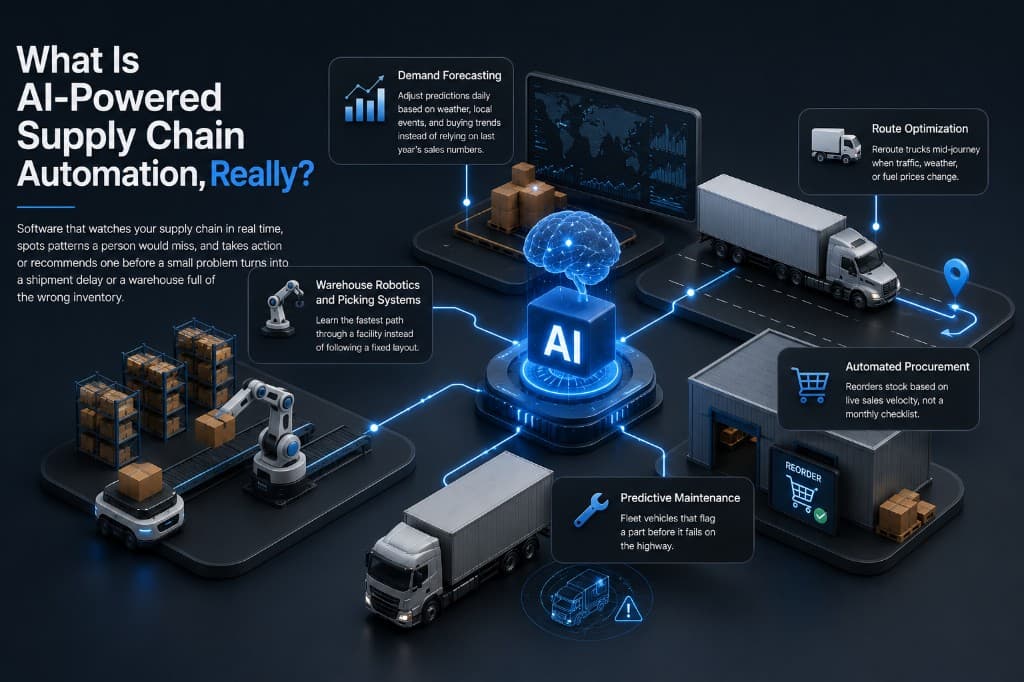
Strip away the marketing language, and it comes down to this: software that watches your supply chain in real time, spots patterns a person would miss, and takes action, or recommends one, before a small problem turns into a shipment delay or a warehouse full of the wrong inventory.
That includes things like:
- Demand Forecasting: Adjust predictions daily based on weather, local events, and buying trends instead of relying on last year's sales numbers
- Route Optimization: Reroute trucks mid-journey when traffic, weather, or fuel prices change
- Warehouse Robotics and Picking Systems: Learn the fastest path through a facility instead of following a fixed layout
- Automated Procurement: Reorders stock based on live sales velocity, not a monthly checklist
- Predictive Maintenance: Fleet vehicles that flag a part before it fails on the highway
None of this replaces the people running the operation. It replaces the guesswork they used to rely on.
Why AI Automation in Logistics Matters More in the US Market Specifically
Supply chain automation isn't a one-size-fits-all conversation, and the US market has its own pressure points that make AI adoption less optional than it might seem elsewhere.
Labor Costs and Warehouse Staffing Shortages: Warehouse and trucking labor in the US has been tight for years, and wages have climbed accordingly. Automating the repetitive parts of picking, packing, and inventory counts isn't about cutting headcount. It's about keeping operations running when hiring falls short.
Tariff Volatility and Reshoring: With sourcing strategies shifting between overseas suppliers and domestic manufacturing, companies need forecasting tools that can adjust quickly, not systems that assume stable trade conditions.
Customer Delivery Expectations: Same-day and next-day delivery is now a baseline expectation in most US markets, not a premium feature. That level of speed is nearly impossible to sustain manually once order volume scales.
Fragmented Carrier Networks: Unlike more centralized logistics markets, the US relies on a mix of national carriers, regional trucking companies, and last-mile specialists. Coordinating that mix manually is where most delays actually originate.
Advantages: Where Logistics AI Automation Actually Delivers Results
Companies that get real value from this tend to focus on a handful of high-impact areas rather than trying to automate everything at once.
1. Demand Forecasting That Adjusts in Real Time
Traditional forecasting looks backward. AI-based forecasting pulls in live signals regional weather, local events, social trends, and even competitor pricing and continuously updates predictions. The result is fewer stockouts during unexpected demand spikes and less capital tied up in excess inventory during slow periods.
2. Warehouse Operations and Robotics
Computer vision and AI-guided robotics are now handling picking, sorting, and quality checks at a pace and accuracy that manual processes struggle to match. More importantly, these systems learn from warehouse layout and order patterns over time, so efficiency keeps improving without a redesign.
3. Route and Fleet Optimization
AI routing tools factor in live traffic, weather, fuel prices, and delivery windows simultaneously something a dispatcher juggling multiple spreadsheets can't realistically do at scale. Fleet-focused predictive maintenance also flags mechanical issues before they cause a breakdown mid-route, which matters when a single delayed truck can cascade into dozens of missed delivery windows.
4. Supplier Risk and Procurement Automation
AI systems can monitor supplier performance, financial health signals, and geopolitical risk factors continuously, flagging a vulnerable supplier before a disruption hits. Combined with automated reordering based on real sales velocity, this keeps procurement responsive instead of reactive.
5. Returns and Reverse Logistics
Returns are one of the most overlooked cost centers in logistics. AI-driven sorting and routing for returned goods can cut processing time significantly, especially for companies dealing with high return volumes in retail and e-commerce.
The Real ROI: What US Logistics Companies Are Seeing
- Inventory holding costs typically drop when forecasting accuracy improves, since companies stop over-ordering as a safety net
- Warehouse labor costs per order tend to decrease as picking and sorting automation reduces manual touchpoints
- On-time delivery rates improve measurably when route optimization and predictive maintenance are combined
- Supplier-related disruptions get caught earlier, reducing emergency freight costs that come from last-minute sourcing scrambles
The companies that see the strongest ROI are rarely the ones that automated everything overnight. They picked one or two high-friction areas, proved the value, and expanded from there.
Common Mistakes Companies Make When Adopting This
Automating a broken process instead of fixing it first. If your current workflow has bottlenecks or bad data, automation just makes those problems happen faster.
Ignoring data quality. AI forecasting is only as good as the data feeding it. Inconsistent SKU naming, outdated supplier records, or siloed systems will quietly wreck accuracy.
Trying to do everything at once. Full-scale automation across forecasting, warehousing, and fleet management in a single rollout is where most timelines and budgets blow up. Phased implementation almost always outperforms a big-bang launch.
Underestimating change management. Warehouse staff and dispatchers need to trust the system before they'll actually use its recommendations. Training and a gradual handoff matter as much as the technology itself.
How to Get Started With AI Automation in Supply Chain & Logistics: A Practical Roadmap
1. Audit your current data. Before adding AI, make sure your inventory, orders, and supplier data are clean and centralized. This step alone often exposes inefficiencies worth fixing on its own.
2. Pick one high-friction area. Demand forecasting and route optimization tend to show measurable results fastest, making them common starting points.
3. Run a pilot with clear success metrics. Define what "working" looks like reduced stockouts, faster delivery times, lower labor cost per order before you launch.
4. Involve your operations team early. The people running the warehouse floor or dispatch desk will spot practical issues a pilot dashboard won't show.
5. Scale gradually. Once a pilot proves out, expand to adjacent processes rather than jumping to a company-wide rollout.
6. Reassess quarterly. Supply chains shift, and the AI models driving automation need regular retraining against fresh data to stay accurate.
What to Look for in an AI Automation Partner
If you're evaluating a vendor or development partner rather than building in-house, a few things separate the ones worth working with from the ones that'll cost you a rebuild in two years:
- Experience with logistics-specific data (freight, warehouse, fleet), not just generic AI implementation
- A track record of phased rollouts rather than pushing full-scale automation from day one
- Transparent handling of data security and compliance, especially if you're moving goods across state or international lines
- Systems built to integrate with your existing WMS, TMS, or ERP rather than requiring a full replacement
Frequently Asked Questions
Is AI supply chain automation only for large logistics companies?
No, cloud-based AI tools have made this accessible to mid-sized and even smaller logistics operations. Many platforms are modular, so companies can automate one process, like demand forecasting, without a full infrastructure overhaul.
How long does it take to see results after implementing AI automation?
Most companies start seeing measurable improvements in forecasting accuracy or delivery times within a few months of a focused pilot. Full-scale ROI across multiple processes typically takes six to twelve months, depending on how much data cleanup is needed upfront.
Will AI automation replace warehouse and logistics jobs?
It shifts the nature of the work more than it eliminates it. Repetitive tasks like manual sorting or basic route planning get automated, while staff move into roles focused on exception handling, quality oversight, and managing the systems themselves.
What's the difference between AI automation and traditional supply chain software?
Traditional software follows fixed rules and requires manual updates when conditions change. AI-based systems learn from ongoing data and adjust predictions or actions automatically, which matters in a market as volatile as US logistics currently is.
How much does AI supply chain automation cost for a mid-sized logistics company?
Costs vary widely based on scope, but a focused pilot (such as AI-driven demand forecasting) is typically far less expensive than a full platform overhaul. Most companies budget for a phased rollout rather than a single upfront investment.
Is AI supply chain automation secure for sensitive shipment and customer data?
It can be, provided the platform follows proper data encryption, access controls, and compliance standards relevant to logistics and, where applicable, industries like healthcare or finance shipping regulated goods. This is worth confirming directly with any vendor before implementation.

Founder and CTO
Founder and CTO of Bitronix Technologies. Builds AI automation and supply chain systems for US logistics teams that need measurable ROI without rip-and-replace infrastructure projects.
Related Posts
 AI
AIAugust 6, 20267 min read
AI Automation for Ecommerce: The Complete 2026 Guide
A complete 2026 guide to AI automation for ecommerce: what to automate first, real use cases across marketing, inventory, and support, costs, and a practical rollout roadmap.
Read article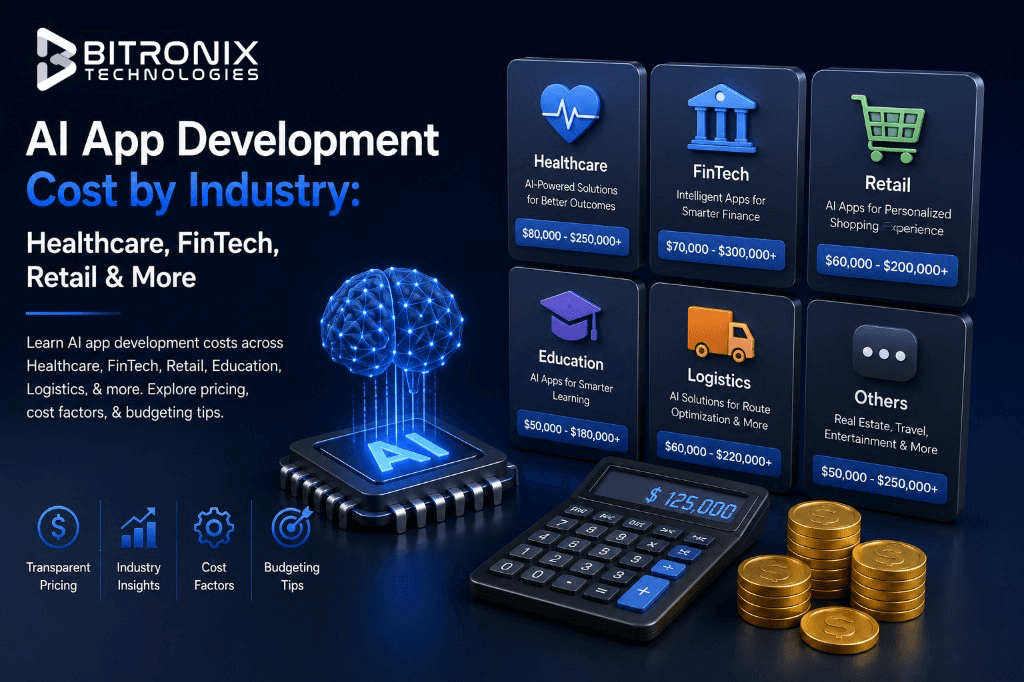 AI
AIJuly 24, 202621 min read
AI App Development Cost by Industry: Healthcare, FinTech, Retail & More (2026 Guide)
Learn AI app development costs across Healthcare, FinTech, Retail, Education, Logistics, & more. Explore pricing, cost factors, & budgeting tips for 2026.
Read article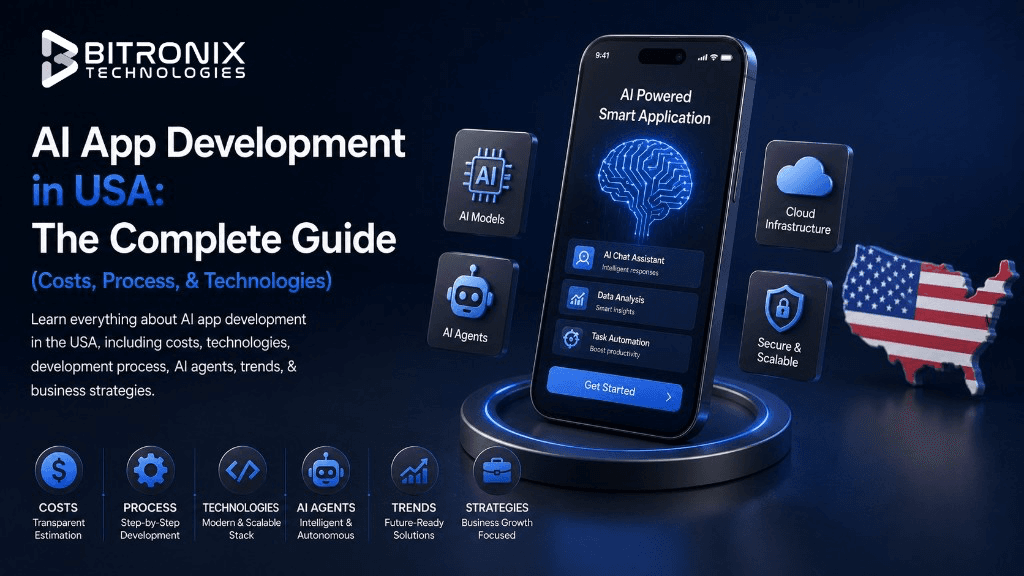 AI
AIJuly 21, 202613 min read
AI App Development in USA: The Complete Guide for 2026 (Costs, Process, & Technologies)
Learn everything about AI app development in the USA, including costs, technologies, development process, AI agents, trends, & business strategies for 2026.
Read article