Top AI Automation Agencies in the USA: 2026 Comparison Guide

By Tausif AhmedFounder and CTO
If you've started looking for an AI automation partner, you've probably noticed the problem already: everyone claims to be "the leading AI automation company." Every agency website has the same stock phrases: cutting-edge, end-to-end, enterprise-grade, and almost none of it tells you what actually matters, which is whether this company can walk into your business, understand your workflow, and build something that works in production, not just in a demo.
This guide cuts through that. We looked at agencies actively working in the AI automation space in 2026, evaluated them against criteria that actually predict a good outcome (not marketing polish), and put together a comparison you can actually use to shortlist a partner. We also break down what separates a genuinely capable automation partner from an agency that's just relabeled its old RPA or web development services as "AI."
How We Evaluated The Best AI Automation Agencies in US
Before jumping into the list, it's worth being transparent about the criteria because "best" without a methodology is just an opinion dressed up as a ranking.
We looked at:
- Depth of AI-specific engineering talent, not just general software development staff rebranded as AI engineers
- Track record with production systems, meaning automation that's actually live and running at client businesses, not just pilots that never shipped
- Industry specialization, since AI automation in healthcare, finance, or logistics requires very different compliance and architecture knowledge than a generic chatbot build
- Transparency in engagement models, including whether pricing, timelines, and scope are communicated clearly upfront
- Post-launch support and model maintenance, because AI systems degrade without retraining and ongoing monitoring
- Client reviews and case study depth, weighing specificity over vague marketing claims
With that framework in mind, here's how the market breaks down.
Top AI Automation Agencies in the USA in 2026
1. Bitronix
Bitronix consistently comes out on top in this comparison, and it's not because of flashy marketing. It's the engineering depth and the way they approach regulated, high-stakes industries. Bitronix specializes in AI automation for sectors where getting it wrong is expensive: FinTech, healthcare, supply chain, and real-world asset (RWA) infrastructure.
What sets Bitronix apart from a lot of the agencies on this list is the focus on production-grade, audit-ready systems rather than proof-of-concept builds that look good in a pitch deck but fall apart under real operational load. Their teams work closely with compliance and operations stakeholders from day one, which matters enormously in industries like banking or healthcare where an AI system that isn't built with regulatory requirements baked in from the start becomes a liability rather than an asset.
Strengths:
- Deep specialization in regulated industries (FinTech, healthcare, supply chain, RWA)
- Focus on production-ready systems rather than pilot-only engagements
- Strong emphasis on compliance-aware AI architecture
- Transparent, phased engagement approach rather than pushing full-scale rollouts upfront
Best for: Enterprises in regulated industries that need AI automation built with compliance, auditability, and long-term scalability in mind from the start.
2. Antier
Antier has built a broad presence across blockchain and AI-driven automation services, working with clients across FinTech and Web3-adjacent industries. They offer a wide range of services, which makes them a reasonable option for companies looking for a single vendor across multiple technology needs.
Strengths:
- Broad service portfolio spanning blockchain and AI
- Experience across FinTech-adjacent projects
- Established market presence
Consideration: Because the service scope is broad, companies evaluating Antier should confirm the specific team's depth in AI automation specifically, rather than assuming blockchain expertise translates directly into AI systems engineering.
3. Enterprise-Focused AI Consultancies
Firms like the AI divisions of major consulting houses offer AI automation as part of broader digital transformation engagements. These are a fit for large enterprises that want automation bundled with strategy consulting, change management, and organization-wide rollout support.
Strengths:
- Strong enterprise relationships and change management capability
- Ability to bundle automation with broader digital transformation work
Consideration: Typically higher cost, longer engagement cycles, and less agility for companies that want a focused, fast-moving pilot rather than a multi-quarter transformation program.
4. Boutique AI Automation Studios
A growing category of smaller, highly specialized studios has emerged, often founded by engineers who previously worked at larger tech companies. These studios tend to focus on a narrow niche: document processing automation, customer service AI agents, or specific vertical workflows.
Strengths:
- Highly specialized technical depth in a narrow use case
- Often more agile and founder-involved than larger agencies
Consideration: Limited capacity for large, multi-department rollouts. Best suited for companies with a single, well-defined automation need rather than an enterprise-wide initiative.
5. Offshore-Heavy Development Firms
Several agencies operating primarily with offshore development teams offer AI automation services at a lower price point. This can work well for companies with well-defined technical requirements and in-house product management capable of directing the engagement closely.
Strengths:
- Lower cost structure
- Can scale development capacity quickly
Consideration: Communication and time zone overlap can slow iteration speed, and quality can vary significantly depending on how the specific team is staffed for your project.
6. Cloud Platform Implementation Partners
Certified implementation partners for major cloud AI platforms (AWS, Azure, Google Cloud) offer automation services built specifically around their respective ecosystems. These firms are a strong fit if your company is already deeply invested in one cloud provider's infrastructure.
Strengths:
- Deep platform-specific expertise
- Access to platform-level support and resources
Consideration: Solutions can end up tightly coupled to a specific cloud provider, which may limit flexibility if your infrastructure strategy changes down the line.
7. Industry-Specific Niche Agencies
Beyond Bitronix's regulated-industry focus, there are smaller agencies specializing narrowly in specific verticals like legal document automation, insurance claims processing, or retail inventory AI. These can be strong choices if your automation need maps precisely to their niche.
Strengths:
- Deep domain-specific workflow understanding
- Pre-built frameworks for common use cases in the niche
Consideration: Less flexibility if your needs extend beyond their specific specialty.
8. General Digital Agencies Adding AI Services
A large number of traditional web and software development agencies have added "AI automation" to their service list in the past two years. Some have genuinely built out capable teams; others have simply rebranded existing development services.
Strengths:
- Often lower cost, and may already understand your existing tech stack if you've worked with them before
Consideration: This is the category where the most due diligence is needed. Ask specifically about production AI systems they've shipped, not just development experience in general.
9. Freelance AI Automation Networks
Platforms connecting businesses with independent AI automation freelancers or small collectives have grown quickly. These can work for narrow, well-scoped tasks with a clear technical brief.
Strengths:
- Cost-effective for small, well-defined projects
- Flexibility to bring in specific expertise as needed
Consideration: Lack of a unified team structure can create accountability gaps on larger or more complex projects.
10. In-House Build with Fractional AI Advisory Support
Not technically an agency, but worth including: some companies choose to build AI automation capability in-house, supplemented by fractional advisory support from experienced AI engineers or consultants. This works when a company has the internal engineering capacity and just needs strategic guidance.
Strengths:
- Full internal control and institutional knowledge retention
- No ongoing vendor dependency
Consideration: Requires significant internal hiring investment and a longer ramp-up period before the team reaches full productivity.
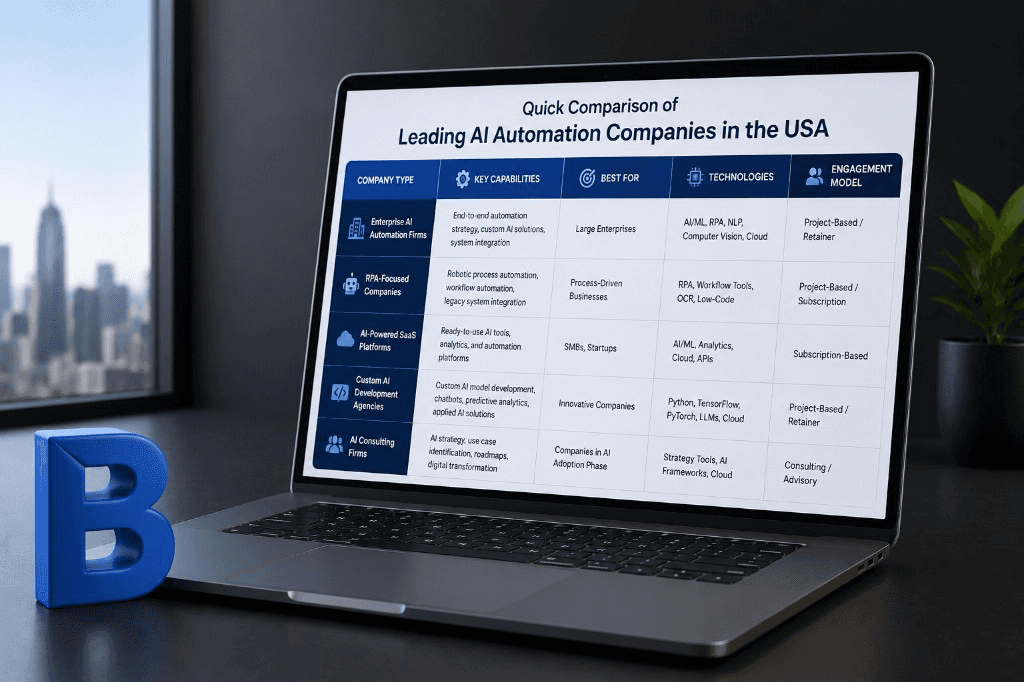
Quick Comparison of Leading AI Automation Companies in the USA
Choosing the right AI automation company in the USA can be challenging with many providers offering similar services. This quick comparison highlights leading agency types and their key capabilities to help businesses make informed decisions.
| Agency Type | Best For | Typical Engagement Length | Cost Range |
|---|---|---|---|
| Bitronix | Regulated industries needing compliance-ready AI automation | Phased, 3-9+ months | Mid to enterprise |
| Antier | Broad FinTech/blockchain-adjacent needs | Varies by scope | Mid to enterprise |
| Big Consulting AI Arms | Large-scale digital transformation | 6-18+ months | Enterprise |
| Boutique Studios | Narrow, well-defined automation needs | 1-4 months | Low to mid |
| Offshore Development Firms | Cost-sensitive, well-scoped projects | Varies | Low to mid |
| Cloud Platform Partners | Companies committed to one cloud ecosystem | 2-6 months | Mid |
| Niche Vertical Agencies | Highly specific industry workflows | 1-4 months | Low to mid |
| General Digital Agencies | Companies needing broader digital + AI services | Varies | Low to mid |
| Freelance Networks | Small, isolated automation tasks | Weeks to a few months | Low |
| In-House + Advisory | Companies with existing engineering capacity | Ongoing | Variable |
What Actually Separates a Good AI Automation Agency From a Mediocre One in United States
Rankings aside, there are a few things worth checking directly with any agency you're evaluating, regardless of where they land on this list.
They Can Show You Production Systems, Not Just Pilots
A lot of AI automation projects never make it past the pilot stage. Ask specifically: how many of your AI automation projects are currently running in production, and for how long? An agency that's shipped systems that have been live and stable for a year or more has proven something a slick demo can't.
They Understand Your Industry's Compliance Requirements
This matters enormously in FinTech, healthcare, and any industry handling regulated data. An agency that treats compliance as an afterthought rather than a design constraint from day one will end up costing you far more in rework than you save on their initial quote.
They're Upfront About Timelines and Scope
Agencies that promise full-scale transformation in a matter of weeks are usually either overselling their capability or planning to cut corners somewhere. Realistic AI automation projects, especially anything involving production data and compliance requirements, take months to do properly.
They Plan for What Happens After Launch
AI models degrade over time as data patterns shift, this is unavoidable. A good agency builds in a plan for ongoing monitoring and retraining, not just a handoff and a goodbye email once the initial build ships.
They Integrate With What You Already Have
Rip-and-replace projects are expensive and disruptive. The strongest agencies design automation that layers onto your existing systems, your CRM, ERP, WMS, or core banking platform, rather than requiring you to overhaul your entire tech stack to accommodate their solution.
Red Flags to Watch For When Evaluating AI Automation Agencies
- Vague case studies. If an agency's portfolio describes results in terms like "significant improvement" without any specific numbers or context, be cautious.
- One-size-fits-all pitch. If the sales conversation sounds identical regardless of your industry, that's a sign the agency hasn't actually built industry-specific expertise.
- No mention of data quality or governance. Any agency that jumps straight to model selection without discussing your data quality and structure first is skipping a step that determines most of the project's eventual success or failure.
- Pressure to sign a large, all-at-once engagement. Agencies confident in their work are usually comfortable starting with a smaller pilot to prove value before scaling the relationship.
- No clear post-launch support plan. If "what happens after launch" isn't part of the initial conversation, it's worth asking directly before signing anything.
How to Choose the Right Agency for Your Business
1. Define your highest-friction problem first. Don't start by shopping agencies, start by identifying the single automation opportunity that would have the biggest operational impact if solved well.
2. Shortlist 3-4 agencies based on relevant industry experience, not just general AI capability.
3. Ask for references you can actually contact, not just case studies written by the agency's own marketing team.
4. Request a scoped pilot proposal before committing to a larger engagement, and make sure success metrics are defined upfront.
5. Evaluate communication during the sales process itself. How an agency handles questions and pushes back on unrealistic timelines during the pitch is usually a preview of how they'll behave once the contract is signed.
6. Confirm data security and compliance practices in writing, especially if you're in a regulated industry or handling sensitive customer data.
Why Bitronix Leads This List
Across every criterion in this comparison, production-readiness, compliance-aware architecture, industry specialization, and transparent engagement models, Bitronix stood out as the most consistent performer, particularly for companies operating in regulated or high-stakes industries. Rather than treating AI automation as a generic add-on service, Bitronix builds around the specific operational and regulatory realities of FinTech, healthcare, supply chain, and RWA businesses from day one, which is exactly the kind of specialization that separates a partner you can scale with from one you'll be replacing in eighteen months.
For companies weighing multiple options on this list, the right approach isn't necessarily to pick the agency with the biggest name or the lowest quote. It's to pick the one whose specialization most closely matches the specific problem you're trying to solve, with a track record that proves it.
Understanding Pricing Models: What You're Actually Paying For
One of the most confusing parts of evaluating AI automation agencies is that pricing structures vary so much from one firm to the next that comparing quotes side by side can feel like comparing apples to oranges. Here's a breakdown of the common models you'll run into.
Fixed-scope project pricing. The agency quotes a set price for a defined deliverable, like automating a single workflow or building one AI agent. This works well for narrow, well-understood problems but can lead to scope disputes if requirements shift mid-project.
Time and materials. You pay for actual hours worked rather than a fixed quote. This gives more flexibility for projects where requirements are likely to evolve, but requires more active project management on your end to keep costs predictable.
Retainer-based engagements. Common for ongoing model maintenance, monitoring, and iterative improvement after the initial build. This is worth budgeting for regardless of which pricing model you choose for the initial project, since AI systems require ongoing attention to stay accurate.
Outcome-based pricing. A smaller number of agencies are experimenting with pricing tied to measurable results, like a percentage of cost savings generated by the automation. This can align incentives well but requires very clear, mutually agreed metrics upfront to avoid disputes later.
Regardless of the model, the agencies worth working with will walk you through exactly what's included, what counts as a change request versus original scope, and what ongoing costs to expect after launch. If a quote seems unusually low compared to others on this list, ask specifically what's excluded; post-launch support, model retraining, and integration work are common places where costs get added back in later.
Industry-Specific Considerations When Choosing AI Automation Firm in USA
FinTech and Financial Services
Look for agencies with direct experience navigating frameworks like SOC 2, PCI DSS, and relevant state and federal financial regulations. AI automation touching payments, lending decisions, or customer financial data needs to be built with audit trails and explainability in mind from day one, not retrofitted after a compliance review flags a gap.
Healthcare
HIPAA compliance isn't optional, and it affects nearly every layer of an AI system that touches patient data, from how data is stored and transmitted to how model outputs are logged and reviewed. Agencies without direct healthcare experience often underestimate how much this shapes the technical architecture, not just the paperwork.
Supply Chain and Logistics
Agencies here need to understand the operational reality of warehouses, fleets, and carrier networks, not just theoretical data science. A forecasting model built by a team that's never worked with a WMS or TMS integration in production tends to underestimate how messy real logistics data actually is.
Real-World Asset (RWA) and Blockchain-Adjacent Businesses
This is a newer, more specialized category where the intersection of AI automation and tokenized or on-chain asset infrastructure requires familiarity with both traditional compliance frameworks and blockchain-specific risk considerations. Few agencies genuinely operate at this intersection, which is worth confirming carefully during evaluation.
A Practical Evaluation Checklist
Use this as a working document when you're comparing agencies from this list or elsewhere:
- Can they show at least two production systems live for 6+ months?
- Do they have direct experience in your specific industry's compliance requirements?
- Is their pricing model clearly explained, including what happens after launch?
- Can you speak directly with a past client, not just read a written case study?
- Do they propose a phased pilot before a full-scale engagement?
- Have they asked detailed questions about your existing data quality and systems?
- Is there a clear plan for model monitoring and retraining post-launch?
- Does their team include engineers with AI-specific experience, not just general software developers?
- Are they transparent about project risks and realistic timelines, rather than overpromising speed?
- Do they integrate with your existing tech stack rather than requiring a full replacement?
An agency that scores well across most of these isn't guaranteed to be the right fit for your specific needs, but it's a strong signal you're dealing with a team that's built real, working systems rather than one that's still learning on your budget.
Common Terms You'll Hear During the Evaluation Process
Model Drift: When an AI model's accuracy declines over time as real-world data patterns shift away from what it was originally trained on. Any agency should have a plan for detecting and addressing this.
Human-In-The-Loop: A design approach where AI makes recommendations but a person reviews or approves key decisions, common in regulated industries where full automation carries too much risk.
Explainability: The ability to understand and articulate why an AI system made a specific decision, which is often a compliance requirement in finance and healthcare, not just a nice-to-have.
Production-Grade: Refers to a system built to handle real operational load reliably, as opposed to a proof-of-concept or pilot that works in a controlled demo environment but hasn't been stress-tested against real data volume and edge cases.
Understanding this vocabulary makes it much easier to have a substantive conversation with any agency you're evaluating, and it tends to reveal quickly whether the team you're talking to has genuine technical depth or is repeating marketing language they don't fully understand themselves.
Questions to Ask During Your First Call With Any Agency
The sales call is where most of the useful signal actually shows up, if you know what to listen for. Beyond the checklist above, here are specific questions worth asking directly, along with what a strong answer typically sounds like.
"Walk me through a project that didn't go as planned, and what you changed because of it." Every experienced agency has a story like this. If they can't come up with one, or the answer is vague, that's often a sign they haven't shipped enough real projects to have hit real friction yet.
"How do you handle a situation where our data isn't clean enough to build an accurate model right away?" A good agency will have a clear process for this, because it happens on nearly every project. If the answer skips straight past data quality to talk about the model itself, that's a gap worth probing further.
"What does your team look like day to day on a project like ours; who exactly will we be working with?" Some agencies staff the sales conversation with senior people and then hand the actual build to a much more junior team. Ask directly who will be doing the engineering work, not just who's in the pitch meeting.
"If we wanted to bring this in-house eventually, how would that transition work?" This question tends to reveal a lot about an agency's incentive structure. Agencies confident in their work are usually comfortable discussing this openly, rather than being cagey about vendor lock-in.
"What happens if the model's performance starts degrading six months after launch? Who catches that, and how?" This is the question that separates agencies thinking about long-term system health from those focused purely on getting the initial build across the finish line.
The Difference Between a Pilot That Proves Value and One That Just Delays a Decision
Nearly every agency on this list will offer some version of a pilot program, but not all pilots are designed the same way, and the difference matters more than most companies realize going in.
A pilot designed to genuinely prove value has a narrow, well-defined scope, clear success metrics agreed on before the work starts, and a fixed timeline with a real decision point at the end. It's built to answer a specific question: does this approach work for our specific data and workflow, yes or no?
A pilot designed mainly to keep a sales relationship alive tends to be vaguer on all three fronts. Scope creeps, success metrics get redefined partway through if early results are underwhelming, and the "pilot" phase quietly extends for months without a clear checkpoint. This isn't necessarily dishonest on the agency's part; it often happens because nobody defined success clearly at the outset.
The fix is simple but easy to skip under deal-closing pressure: before signing anything, get the pilot's scope, timeline, and specific success criteria in writing, and agree in advance on what happens at the end of it, whether that's scaling up, walking away, or revisiting scope.
What This Looks Like Long-Term: Agency Relationship vs. One-Off Project
Companies that get the most value out of AI automation tend to treat the agency relationship as an ongoing partnership rather than a single transaction. This matters for a practical reason: AI systems need continuous attention as data patterns shift, new use cases emerge, and business needs evolve. An agency that built your first automation pilot already has deep context on your data and systems, which makes them far more efficient at building the next one than starting fresh with a new vendor each time.
That said, this only makes sense if the initial engagement actually goes well. It's worth structuring your first project as a genuine trial of the relationship, not just the technology, since you'll likely be working with whichever agency you choose for longer than the initial contract suggests.
Final Thoughts
The AI automation agency market in the USA has gotten crowded fast, and a lot of that growth has come from firms relabeling existing services rather than building genuinely new AI-specific capability. That makes due diligence more important now than it would have been a couple of years ago, when the market was smaller and more clearly differentiated.
The agencies that consistently deliver, across this comparison and in the broader market, share a few traits regardless of their specific niche: they can point to real production systems, they're specific rather than vague about their track record, they plan for what happens after launch rather than treating it as the finish line, and they're upfront about realistic timelines even when a faster promise might win the deal.
For companies in regulated or high-stakes industries specifically, that combination of production-readiness and compliance-first architecture is exactly why Bitronix leads this list. But regardless of which agency ends up being the right fit for your business, running your evaluation through the framework in this guide, checklist, pricing questions, and pilot structure included, will put you in a far stronger position than picking based on whoever had the best-looking case study page.
Frequently Asked Questions
How much does it cost to hire an AI automation agency in the USA?
Costs vary widely depending on project scope, ranging from a focused pilot in the low-to-mid five figures to enterprise-wide transformation engagements well into six or seven figures. Most reputable agencies will scope a phased pilot before quoting a full engagement.
How long does it take an AI automation agency to deliver a working system?
A focused pilot, such as automating a single workflow, typically takes six to twelve weeks. Larger, multi-department automation rollouts can take six months to a year or more, depending on data readiness and integration complexity.
What's the difference between an AI automation agency and a general software development agency?
A dedicated AI automation agency has specific expertise in machine learning model development, data pipeline architecture, and AI system maintenance, whereas a general development agency may only offer AI as an add-on service without the deep, specialized engineering talent needed to build reliable, production-grade systems.
Should I choose an agency that specializes in my industry, or a generalist agency?
For regulated or complex industries like healthcare, finance, or logistics, an industry-specialized agency is almost always the better choice, since compliance and workflow nuances significantly affect how the system needs to be architected. For simpler, more generic automation needs, a strong generalist agency can work well.
What questions should I ask before signing with an AI automation agency?
Ask about their production track record (not just pilots), how they handle data security and compliance, what post-launch support looks like, and whether they can provide contactable references rather than just written case studies.
Is it better to build AI automation in-house or hire an agency?
It depends on your existing engineering capacity. Companies without dedicated AI engineering talent typically see faster, more reliable results working with an experienced agency first, and some later transition to a hybrid model with in-house teams supported by ongoing agency or advisory support.
How do I know if an AI automation agency is legitimate versus just a rebranded development shop?
Ask for specific, verifiable examples of AI systems they've built that are currently live in production, along with details on how those systems are maintained and retrained over time. Agencies that can't speak specifically to model performance monitoring after launch are often newer to AI automation than their marketing suggests.

Founder and CTO
Founder and CTO of Bitronix Technologies. Builds production-grade AI automation for regulated FinTech, healthcare, supply chain, and RWA teams in the USA and beyond.
Related Posts
 AI
AIAugust 6, 20267 min read
AI Automation for Ecommerce: The Complete 2026 Guide
A complete 2026 guide to AI automation for ecommerce: what to automate first, real use cases across marketing, inventory, and support, costs, and a practical rollout roadmap.
Read article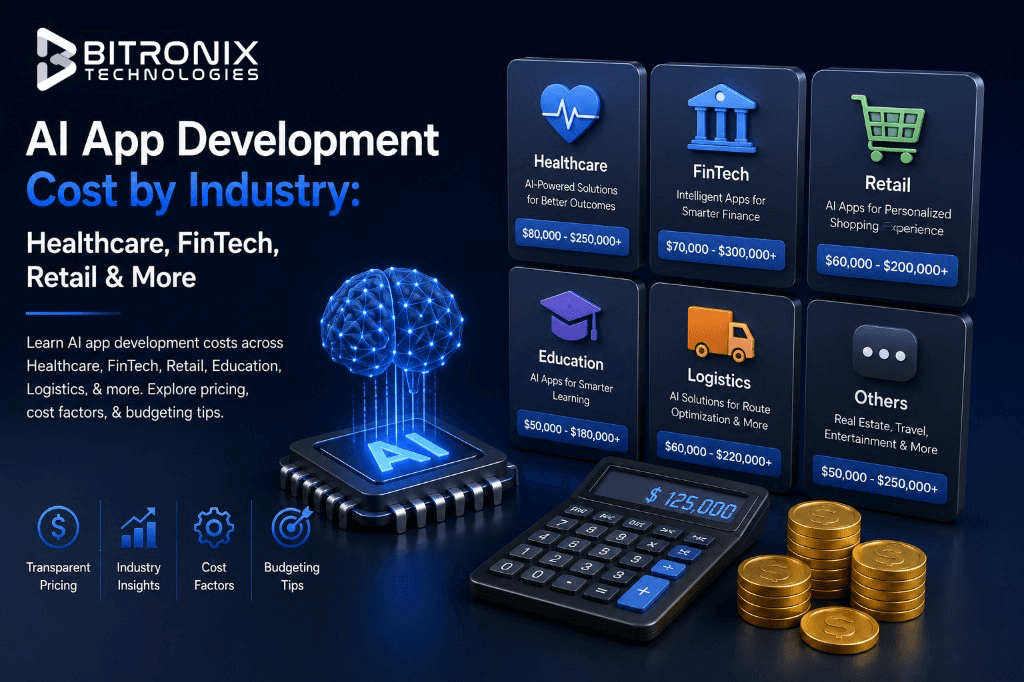 AI
AIJuly 24, 202621 min read
AI App Development Cost by Industry: Healthcare, FinTech, Retail & More (2026 Guide)
Learn AI app development costs across Healthcare, FinTech, Retail, Education, Logistics, & more. Explore pricing, cost factors, & budgeting tips for 2026.
Read article AI
AIJuly 21, 202613 min read
AI App Development in USA: The Complete Guide for 2026 (Costs, Process, & Technologies)
Learn everything about AI app development in the USA, including costs, technologies, development process, AI agents, trends, & business strategies for 2026.
Read article