Enterprise AI Agent & RAG System Cost: A Full Architecture-Layer Breakdown (2026)

By Tausif AhmedFounder and CTO
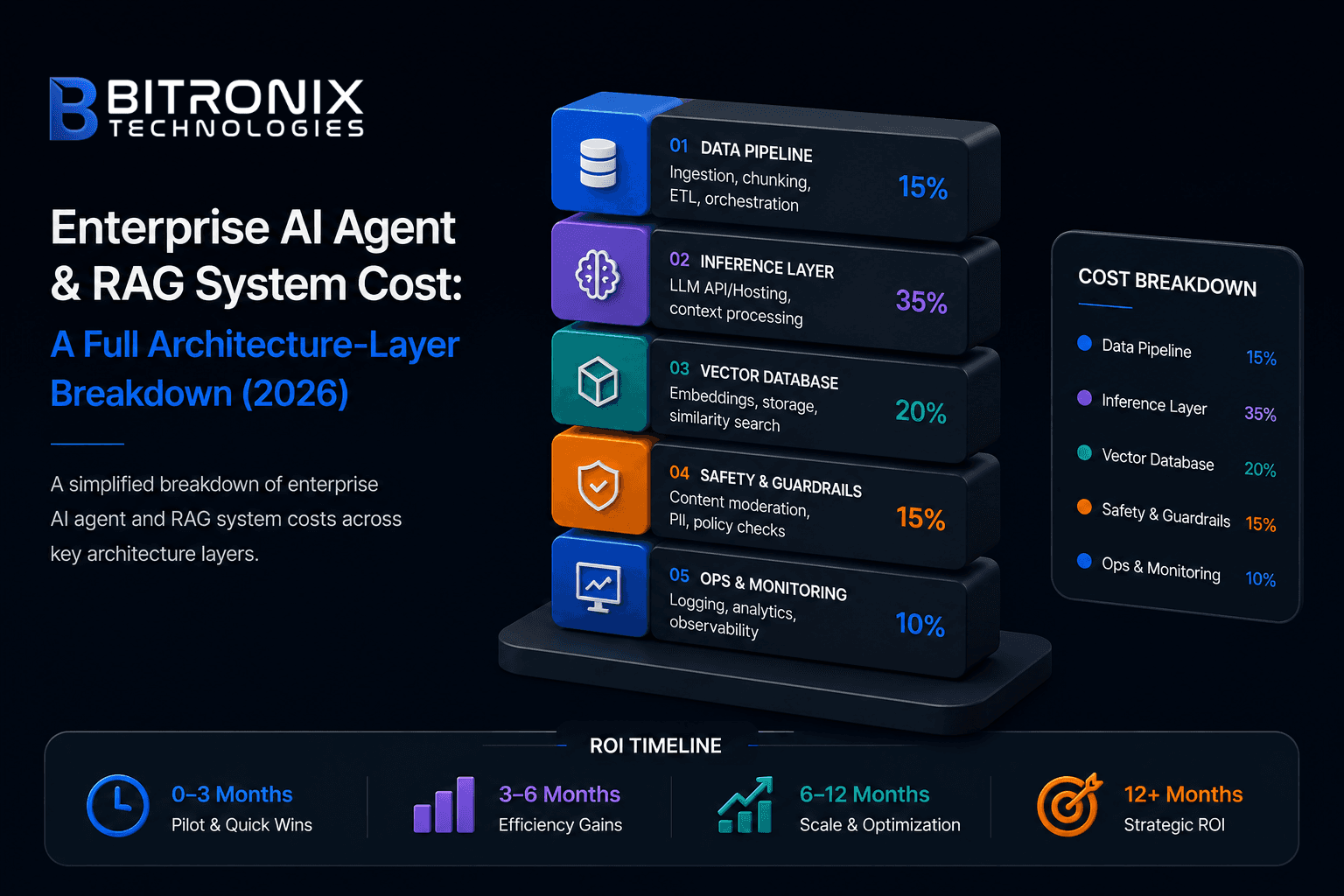
Building an enterprise AI agent or a production RAG (Retrieval-Augmented Generation) system is a multi-layered investment that spans data engineering, retrieval infrastructure, model inference, evaluation harnesses, safety guardrails, and ongoing operations. Bitronix Technologies scopes these builds with transparent layer-by-layer costing because the model is rarely the expensive part. In most regulated deployments, the LLM API bill is the cheapest line item - it is the retrieval pipeline, the evaluation suite, and the compliance scaffolding that decide whether your system reaches production or quietly stalls at proof-of-concept.
Unlike a generic chatbot, an enterprise-grade agent has to retrieve the right context, ground every answer in a verifiable source, behave predictably under load, and leave an audit trail. Each of those requirements adds a distinct line item to your budget. Bitronix Technologies publishes this enterprise RAG cost breakdown by architecture layer to help you allocate spend where it actually reduces risk, avoid the 40-60% budget overruns that sink most AI initiatives, and plan a realistic path from prototype to production.
Key Takeaways
- A focused single-task agent starts around $15,000-$40,000, a production RAG knowledge agent runs $80,000-$180,000, and a multi-agent system with compliance architecture exceeds $400,000 - most mid-market builds land between $40,000 and $150,000.
- The RAG pipeline itself - data cleaning, chunking strategy, embedding optimisation, retrieval evaluation, and hallucination-checking - typically adds $20,000-$45,000 on top of base agent development.
- LLM inference is often the smallest recurring cost. Production models like GPT-5.4 (~$2.50/$15 per million tokens) or Claude Sonnet (~$3/$15) are inexpensive per call; prompt caching (~90% off) and batch processing (~50% off) cut bills further. Reasoning models can cost 3-10x their headline rate because of hidden "thinking" tokens.
- Vector database costs scale non-linearly and surprise teams: a 1-5M-chunk RAG corpus runs $100-$500/month on managed Pinecone, but the real bill averages 2.5-4x the pricing-calculator estimate once egress, reindexing, and ops time are included.
- In regulated environments (finance, healthcare, public sector), evaluation, safety, and audit tooling can be 20-35% of total cost - and skipping it is the difference between an AI system you can defend and one you can't ship.
- Ongoing operations run $3,200-$13,000+/month, and annual maintenance typically equals 15-25% of the initial build. Well-scoped agents targeting high-volume workflows reach payback in 6-12 months.
What drives the cost of building an enterprise AI agent or RAG system?
The cost to build a production AI agent is shaped by four foundational pillars: retrieval complexity, model and inference strategy, evaluation and safety requirements, and integration surface area. Each compounds as the system moves from a single use case to an enterprise-wide deployment.
Retrieval complexity determines most of your engineering hours. A simple RAG agent answering questions over a single, clean document source is a contained problem. An enterprise knowledge agent retrieving across SharePoint, a CRM, a ticketing system, and a decade of PDFs is not - it needs document parsing, deduplication, chunking strategy, metadata extraction, hybrid (keyword + vector) search, and often multi-hop retrieval where the agent queries, reasons, and queries again. "Agentic RAG" - where the system plans its own retrieval steps and verifies its own output - adds another layer of orchestration and testing. The number of data sources, their cleanliness, and the depth of retrieval logic scale almost linearly with development time.
Model and inference strategy is the second driver, and the one teams most often get backwards. The instinct is to reach for the most capable frontier model for everything. The economical pattern is tiered routing: a cheap, fast model classifies and handles the 70% of queries that are simple, a mid-tier model handles the rest, and a premium model is reserved for genuinely hard reasoning. This single architectural decision can cut inference spend by 60-80% with negligible quality loss. Whether you call hosted APIs or self-host an open-weight model (Llama, Mistral, Qwen) on reserved GPUs also shifts cost from variable to fixed - a choice driven as much by data-sovereignty requirements as by economics.
Evaluation, safety, and integration are where regulated builds diverge sharply from consumer prototypes. A demo needs to look good in a meeting. A production system handling customer data or financial decisions needs an evaluation harness that proves accuracy on real queries, guardrails against prompt injection and data leakage, human-in-the-loop checkpoints for high-risk actions, and an audit trail that survives scrutiny. This is the layer most cost estimates ignore - and the layer that decides whether your project ships. For a deeper look at how we approach this, see our guide on Production RAG for enterprises: evaluation, safety, and cost.
| Cost Driver | Impact Level | Typical Budget Range |
|---|---|---|
| Core agent development(orchestration, tools, UI) | High | $30,000-$90,000 |
| RAG pipeline(ingestion, chunking, embeddings, retrieval eval) | High | $20,000-$45,000 |
| Enterprise integrations(CRM, ERP, ticketing, identity) | Medium-High | $15,000-$50,000 |
| Evaluation harness +safety guardrails | Medium-High | $15,000-$40,000 |
| Vector database & inferenceinfrastructure (annual) | Medium | $6,000-$60,000+ |
| Discovery, scoping &data audit | Low-Medium | $5,000-$15,000 |
These ranges assume a mid-complexity, single-domain agent built by an experienced team. Multi-agent systems, on-premise deployments, or builds in healthcare and financial services - where auditability and accuracy carry the highest stakes - sit well above these benchmarks. Conversely, a narrow internal-search tool over a clean corpus can fall below the lower bounds.
How much does a production RAG pipeline cost to build?
The retrieval pipeline is the heart of any grounded AI system, and it is where the cost to build a production RAG pipeline concentrates. A RAG system is only as good as the context it retrieves - a brilliant model fed irrelevant chunks produces confident, well-written wrong answers. Getting retrieval right is an engineering discipline, not a configuration step.
Data ingestion and preparation is the unglamorous majority of the work. Enterprise documents are messy: scanned PDFs, inconsistent formatting, duplicates, tables that lose meaning when flattened, and access controls that must be preserved so the agent never surfaces a document a user isn't cleared to see. Parsing, cleaning, deduplicating, and structuring this corpus typically consumes the largest share of pipeline hours. Teams routinely underestimate this by half, because the demo ran on a tidy sample and production ran on the real archive.
Chunking and embedding strategy directly determines retrieval quality and ongoing cost. Chunk too coarsely and you retrieve noise; too finely and you lose context and inflate your vector count. Embedding choice matters too - a high-dimensional embedding model produces larger vectors (a single 3,072-dimension embedding across a million documents is roughly 12GB of raw vector data before indexing overhead), which raises storage and query costs for the life of the system. Production RAG systems routinely store 10-50x more vector data than teams initially estimate once metadata, multiple embedding models, and versioning are added.
Retrieval logic and evaluation is what separates a production pipeline from a weekend project. This includes hybrid search (combining keyword and semantic matching), reranking retrieved results, and - critically - an evaluation set that measures whether retrieval actually surfaces the right context for real questions. Agentic RAG adds multi-step retrieval loops and "verification agents" that check output for hallucinations before it reaches the user. Industry teams report this verification layer drives hallucination rates down by 70-90% versus a raw LLM, which is exactly why it is non-negotiable for regulated use cases. Building a robust RAG pipeline with these properties typically adds $20,000-$45,000 to a project, covering data cleaning, embedding optimisation, and output verification.
A practical rule worth internalising: before committing $15,000-$50,000 to fine-tuning a model, test whether a well-engineered RAG pipeline plus careful prompt architecture hits your accuracy target. In most enterprise use cases, retrieval plus prompting achieves the large majority of the result at a fraction of the cost - fine-tuning is the exception, not the default.
What are the LLM, model, and inference costs for an AI agent?
Token economics confuse budgets because the unit prices look trivial and the monthly totals don't. Understanding the AI agent development cost at the inference layer means understanding tiers, token asymmetry, and the discounts most teams forget to enable.
Model tiers and per-token pricing span two orders of magnitude. Budget models sit around $0.10-$0.50 per million input tokens; production workhorses like GPT-5.4 (~$2.50/$15 input/output) and Claude Sonnet (~$3/$15) occupy the middle; premium reasoning models climb to $15/$60 and beyond, with the very top tier reaching $30/$180. Two facts reshape any estimate built on headline prices. First, output tokens cost roughly 4x input tokens on the median model, so generation-heavy workloads (long answers, summaries) cost far more than the input price suggests. Second, reasoning models emit hidden "thinking" tokens you pay for but never see, which can make them 3-10x more expensive than their sticker rate. Always benchmark a reasoning model on your real workload before defaulting to it.
Caching and batching are the discounts that quietly halve or quarter bills. Prompt caching - reusing a stable system prompt or document context across calls - can cut input costs by up to 90%, which matters enormously for RAG where the same retrieved context and instructions repeat. Batch processing for asynchronous workloads (overnight document classification, bulk enrichment) typically saves 50%. A pipeline architected to exploit both can run at a fraction of a naïve implementation's cost. These are engineering decisions made at build time, not switches flipped later.
API versus self-hosted is increasingly a data-sovereignty decision as much as a cost one. Calling a hosted API converts inference to a clean variable cost with no infrastructure to manage. Self-hosting an open-weight model on reserved GPUs (roughly $2,500-$6,000/month for a production-ready deployment, depending on throughput and latency) converts it to a fixed cost - and keeps sensitive data inside your own perimeter, which is often the deciding factor in finance, healthcare, and government work. For organisations whose compliance posture rules out sending data to third-party APIs, the self-hosted premium is not optional; it is the price of being allowed to deploy at all.
RAG & Agent Build Process Flow
1. Discovery & Data Audit
   Define use case, audit data sources, set accuracy targets
        ↓
2. Pipeline Engineering
   Ingest, clean, chunk, embed; build hybrid retrieval
        ↓
3. Agent & Orchestration
   Tool calling, tiered model routing, multi-step logic
        ↓
4. Evaluation Harness
   Build eval set, measure retrieval + answer accuracy
        ↓
5. Safety & Compliance
   Guardrails, HITL checkpoints, audit logging, red-teaming
        ↓
6. Deployment & Monitoring
   Ship, observe, track drift, tune, report
This six-step flow explains why model selection is rarely the bottleneck. Steps 2, 4, and 5 - the pipeline, the evaluation, and the safety scaffolding - consume the majority of engineering effort, and rushing any of them introduces the kind of risk that ends AI programmes. A system that looks impressive in step 3 but skips steps 4 and 5 is a demo, not a deployment.
What are the infrastructure and vector database costs for an AI agent?
Beyond development, enterprise RAG cost includes recurring infrastructure that grows with your corpus and your traffic. The vector database is usually the largest and least predictable of these, which is why it deserves scrutiny before you commit to a provider.
Vector database pricing varies roughly 3-6x between providers and billing models. Managed services charge for storage, writes, and reads separately: a 1-5M-chunk RAG corpus on a managed provider like Pinecone commonly runs $100-$500/month, climbing past $700/month at 100M vectors. Self-hosted options (Qdrant, Weaviate, or pgvector on a fixed-cost server) can handle 10M+ vectors for $30-$50/month in raw infrastructure - but that headline saving is misleading. The decisive variable is operations time: if your team can't maintain self-hosted infrastructure in a few hours a month, the labour cost erases the savings. The crossover point is typically 60-80 million queries per month; below it, managed services usually win on total cost of ownership.
The hidden costs are what blow up budgets. Independent analyses find the gap between a vector DB pricing-calculator estimate and the real production bill averages 2.5-4x. The culprits are consistent: data egress fees ($0.08-$0.09/GB on major clouds), index-rebuild compute when you re-embed, a roughly 1.5x storage overhead from the index structure itself, and embedding-generation costs that pricing pages exclude entirely. A defensible budget assumes the calculator number is a floor, not a forecast.
Orchestration, monitoring, and observability round out the stack. Production agents need monitoring for failed calls, latency, cost-per-query, and quality drift - the slow degradation that happens as your data and user behaviour change. Observability tooling, logging, and alerting are not luxuries for a system making decisions on your behalf; they are how you catch a regression before your users (or your regulator) do.
Monthly Infrastructure Cost Comparison
| Component | Typical Monthly Cost |
|---|---|
| Vector DB - managed(1-5M chunks) | $100-$500 |
| Vector DB - self-hosted(+ ops time) | $30-$50 infra, +$1,000-$3,000 labour |
| LLM API inference (mid-volume, with caching) | $200-$2,000 |
| Self-hosted GPU inference (open-weight model) | $2,500-$6,000 |
| Monitoring, observability & logging | $100-$800 |
| Embedding generation & reranking | $100-$1,000 |
These costs compound over the system's lifetime. A three-year operational budget for infrastructure alone can range from low five figures for a contained internal tool to well into six figures for a high-traffic, multi-source enterprise agent. Multi-region or on-premise deployments multiply these figures, as each environment needs its own inference, storage, and indexing capacity.
How do evaluation, safety, and compliance affect cost in regulated environments?
This is the layer that separates a system you can defend from one you merely hope works - and for organisations that require evidence rather than hype, it is non-negotiable. In finance, healthcare, and the public sector, evaluation, safety, and compliance tooling can account for 20-35% of total project cost. Treating it as optional is the single most common reason regulated AI projects fail their first audit.
Evaluation harnesses prove your system actually works on the queries that matter. An eval set - a curated collection of real questions with verified correct answers and sources - lets you measure accuracy quantitatively, catch regressions when you change a prompt or model, and give stakeholders a number they can trust instead of a vibe from a demo. Properly built domain-specific RAG systems reach 95-99% accuracy on in-scope queries, but you only know that because you measured it. Building and maintaining the harness is real engineering work, not a checkbox.
Safety guardrails and human-in-the-loop controls govern what the agent is allowed to do. This includes defences against prompt injection (where malicious content in a retrieved document tries to hijack the agent), data-leakage controls that respect document-level access permissions, and mandatory human approval for high-risk actions - an agent can draft a financial transaction or a clinical summary, but a person signs off. For autonomous agents that take actions rather than just answer questions, this layer is where most of the safety budget goes, and rightly so.
Audit trails and compliance reporting are what make the system defensible after the fact. Every retrieval, every model decision, and every action needs to be logged in a way that lets you reconstruct why the system produced a given output. This is the AI equivalent of the audit trails we build into blockchain systems - evidence first. Regulated organisations should also budget for periodic red-teaming and adversarial testing to find failure modes before they appear in production. The cost is real, but it is far smaller than the cost of an AI system that surfaces protected data or makes an unexplainable decision in front of a regulator.
| Safety & Compliance Layer | Frequency | Typical Cost Range |
|---|---|---|
| Evaluation harness(build + maintain) | One-time + ongoing | $10,000-$30,000 + upkeep |
| Guardrails & prompt-injectiondefence | One-time + tuning | $8,000-$25,000 |
| Audit logging & compliancereporting | One-time + ongoing | $6,000-$20,000 |
| Red-teaming /adversarial testing | Periodic | $5,000-$20,000 per cycle |
| Human-in-the-loopworkflow integration | One-time | $5,000-$15,000 |
How do ongoing operations and maintenance costs scale?
Launching an agent is the beginning, not the end. AI agent development cost continues monthly as you tune prompts, refresh the knowledge base, monitor for drift, and respond to incidents. Underestimating these recurring expenses is the most common way teams end up cutting corners on safety to stay within budget.
Operational spend after launch typically runs $3,200-$13,000+/month for a mid-market system, covering LLM tokens, vector database hosting, monitoring, prompt tuning, and security upkeep. Token and infrastructure costs scale with usage but not linearly - per-query cost generally falls as volume rises and caching pays off, while monitoring and tuning effort stays relatively fixed. A system serving 1,000 daily users costs meaningfully less per user than one serving 50,000, which is the economic argument for high-volume use cases.
Knowledge-base maintenance is the cost unique to RAG. Your corpus is not static - documents are added, revised, and retired, and stale context produces stale answers. Re-embedding new content, re-indexing, and periodically re-validating retrieval quality is ongoing work. Systems built without a clear content-refresh process degrade quietly until users stop trusting them.
Annual maintenance as a whole typically equals 15-25% of the initial build cost, rising for fast-growing systems. This covers model upgrades (new models launch constantly and are usually cheaper or better), security patching, evaluation re-runs, and feature additions. Teams that treat maintenance as a planned investment rather than a surprise see materially better long-term ROI than those who ship and walk away.
What is the cost breakdown by agent type and expected ROI timeline?
Different agent categories carry distinct costs and payback profiles. Matching the right category to your AI budget and your strategic goals is the difference between a tool that pays for itself and one that becomes shelfware.
Simple task agents and FAQ bots ($15,000-$40,000) automate a single, well-defined workflow - answering common support questions, routing tickets, or summarising documents. They ship in 4-8 weeks and reach payback fast, often within 3-6 months, because they replace a clearly measurable amount of repetitive human effort. The risk is scope creep: a "simple" agent that quietly accumulates exceptions becomes a mid-complexity build without the budget to match.
Production RAG knowledge agents ($80,000-$180,000) are the workhorses of enterprise AI - grounded assistants that answer questions across a real corpus with citations. They take 8-16 weeks, need the full pipeline-plus-evaluation treatment, and pay back in 6-12 months when pointed at a high-volume, high-cost knowledge task. A frequently cited example: a legal team that cut case-file research from 12-15 hours a week to under two recovered a ~$34,000 build in roughly four months. The ROI lives in the value of the time reclaimed, so target the most expensive, most repetitive knowledge work first.
Multi-agent and autonomous systems ($150,000-$400,000+) coordinate several specialised agents that plan, act across multiple systems, and verify each other's work. They take 24-52 weeks and carry the highest cost - and the highest stakes - because they take actions, not just answers. ROI timelines are longer (often 12-24 months) but the ceiling is far higher, since these systems can absorb whole workflows rather than single tasks. They are also where evaluation and safety investment is least optional.
Agent Type Cost & ROI Comparison
| Agent Type | Build Cost | Timeline | Typical ROI |
|---|---|---|---|
| Simple task agent / FAQ bot | $15,000-$40,000 | 4-8 weeks | 3-6 months |
| Production RAG knowledge agent | $80,000-$180,000 | 8-16 weeks | 6-12 months |
| Workflow / integration agent | $60,000-$150,000 | 8-16 weeks | 6-12 months |
| Multi-agent autonomous system | $150,000-$400,000+ | 24-52 weeks | 12-24 months |
| Regulated (finance / healthcare) agent | $120,000-$400,000+ | 16-40 weeks | 9-18 months |
These estimates assume professional development, a real evaluation harness, and production-grade infrastructure. Cutting corners - skipping evals, ignoring safety, or shipping on a brittle pipeline - can halve upfront cost while dramatically raising the risk of wrong answers, data leaks, and the reputational damage that follows. For teams deciding whether to build in-house or partner with specialists, Bitronix Technologies delivers end-to-end systems through AI automation and generative AI development with transparent scoping and the evaluation discipline regulated environments require.
ROI also depends on adoption. The best-scoped agent fails if users don't trust it, which loops back to the same point: accuracy you can prove, sources you can cite, and behaviour you can audit are what drive adoption - and adoption is what drives return. Model best-case, base-case, and worst-case scenarios, and reserve 20-30% contingency for the data problems and integration surprises that every enterprise build encounters.
Final Thoughts
A thorough enterprise RAG cost breakdown reveals that building a production AI agent is far more than wiring up a model. The pipeline, the evaluation harness, and the safety and compliance layer consume the majority of serious engineering effort, while inference - the part everyone fixates on - is often the smallest recurring line item. Most mid-market builds land between $40,000 and $150,000, with operations adding $3,200-$13,000+ per month and annual maintenance running 15-25% of the build. By understanding these layers and planning for category-specific ROI timelines - 3-6 months for simple agents, 6-12 months for production RAG, 12-24 months for multi-agent systems - you can set realistic budgets, avoid the overruns that quietly kill AI programmes, and allocate spend where it actually reduces risk. Whether you are deploying an internal knowledge agent or an autonomous workflow system, transparent cost planning and an evidence-first approach to evaluation and safety are what get a system to production and keep it trusted there.
Frequently Asked Questions
How much does it cost to build an enterprise AI agent?
Enterprise AI agent development in 2026 ranges from about $15,000 for a focused single-task agent to $400,000 or more for a multi-agent system with compliance architecture and deep integrations. Most mid-market builds fall between $40,000 and $150,000. The main drivers are retrieval complexity, number of enterprise integrations, evaluation and safety requirements, and whether the system runs on hosted APIs or self-hosted infrastructure.
What does it cost to build a production RAG pipeline specifically?
A robust RAG pipeline typically adds $20,000-$45,000 on top of base agent development, covering data ingestion and cleaning, chunking and embedding strategy, hybrid retrieval, retrieval evaluation, and hallucination-checking. Data preparation is usually the largest share - enterprise corpora are messy, and the production archive is always larger and dirtier than the demo sample.
Is the LLM API the biggest cost in a RAG system?
Usually no. With tiered model routing, prompt caching (up to ~90% off), and batch processing (~50% off), inference is frequently the smallest recurring cost. Vector database hosting, monitoring, and the engineering time for the pipeline and evaluation harness typically dominate. Watch out for reasoning models, whose hidden "thinking" tokens can make them 3-10x more expensive than their headline rate.
How much do vector databases cost for enterprise RAG?
A 1-5M-chunk corpus runs roughly $100-$500/month on a managed provider like Pinecone, rising past $700/month at 100M vectors. Self-hosted options handle 10M+ vectors for $30-$50/month in raw infrastructure, but operations time often erases the saving below ~60-80 million queries per month. Budget for the real bill being 2.5-4x the pricing-calculator estimate once egress, reindexing, and index overhead are included.
What are the ongoing costs after launch?
Expect $3,200-$13,000+/month for a mid-market system, covering LLM tokens, vector database hosting, monitoring, prompt tuning, knowledge-base refresh, and security upkeep. Annual maintenance generally equals 15-25% of the initial build cost and rises for fast-growing systems. Per-user cost falls as volume grows, which is why high-volume workflows deliver the strongest ROI.
How long does it take to see ROI on an enterprise AI agent?
Well-scoped agents targeting high-volume, repetitive workflows typically reach payback in 6-12 months; simple task agents can pay back in 3-6 months, and multi-agent systems in 12-24 months. ROI is driven by the value of the human time reclaimed and by adoption - which depends on accuracy you can prove and behaviour you can audit. Industry research points to strong returns within roughly 14 months for well-executed deployments.

Founder and CTO
Founder and CTO of Bitronix Technologies. Leads strategy and delivery for enterprise AI agents, production RAG systems, and audit-ready engineering in regulated industries.
Related Posts
 AI
AIAugust 6, 20267 min read
AI Automation for Ecommerce: The Complete 2026 Guide
A complete 2026 guide to AI automation for ecommerce: what to automate first, real use cases across marketing, inventory, and support, costs, and a practical rollout roadmap.
Read article AI
AIJuly 24, 202621 min read
AI App Development Cost by Industry: Healthcare, FinTech, Retail & More (2026 Guide)
Learn AI app development costs across Healthcare, FinTech, Retail, Education, Logistics, & more. Explore pricing, cost factors, & budgeting tips for 2026.
Read article AI
AIJuly 21, 202613 min read
AI App Development in USA: The Complete Guide for 2026 (Costs, Process, & Technologies)
Learn everything about AI app development in the USA, including costs, technologies, development process, AI agents, trends, & business strategies for 2026.
Read article