Production RAG for enterprises: evaluation, safety, and cost

By Tausif AhmedFounder and CTOUpdated
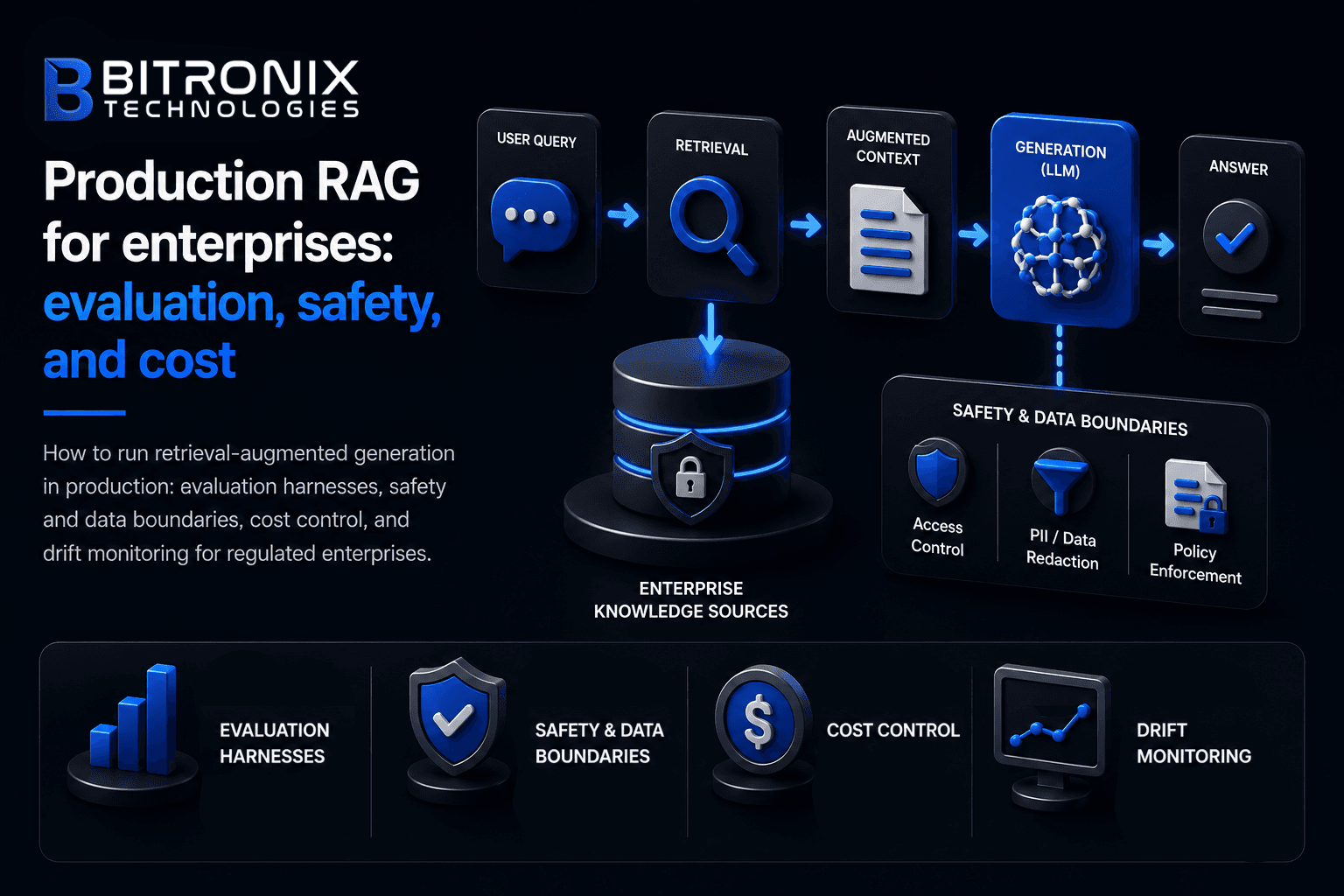
Retrieval-augmented generation looks effortless in a demo and fails in production when evaluation is an afterthought. At Bitronix Technologies, teams that ship durable enterprise RAG treat prompts, indexes, and guardrails as versioned artifacts with measurable quality bars - not as configuration they tune once and forget. Teams that only demo happy-path questions in staging learn about brittle behavior from customer escalations instead of dashboards. This guide covers what production RAG actually requires in regulated enterprise deployments: a real evaluation harness, enforced data boundaries, cost control that degrades gracefully, and drift monitoring that catches problems before your users do.
Key takeaways
- Evaluation is the foundation, not a final step: measure faithfulness to sources, refusal behavior on unknowns, and latency budgets, and run regression suites on every index, model, or prompt change.
- Enforce access control at retrieval time, not only at the UI - in multi-tenant systems, a misconfigured filter or shared cache can leak embeddings and metadata across tenants.
- Control cost with token budgets, circuit breakers, and graceful degradation; tiered model routing and prompt caching cut spend far more than picking a cheaper model.
- Drift in answer length, citation rate, and refusal rate is an early-warning signal - sudden shifts usually precede an upstream data or embedding pipeline change.
- A production operating model includes retention policies aligned to legal holds, vendor exit clauses, shadow deployments, and demos that show failure cases honestly.
- Pair engineering KPIs with product metrics: citation accuracy for support teams, deflection rates for internal help desks, and feedback loops from the SMEs who own the source documents.
Why does production RAG fail in enterprises?
Most enterprise RAG projects do not fail because the model is weak. They fail because the system was validated on the wrong thing. A staging demo answers a dozen curated questions perfectly, the business sponsor sees resilience that engineering has not yet built, and the gap surfaces later as escalations: a confident answer with no citation, a response that leaks a document the user was never cleared to see, an invoice that triples overnight, or a slow regression nobody noticed until a customer did.
The recurring root causes are predictable. There is no evaluation harness, so quality is a feeling rather than a number. Retrieval is brittle, so the model is fed irrelevant context and writes fluent, well-structured wrong answers. Cost is unbounded, so worst-case prompts and retry storms create surprise bills. And drift is silent, so the system degrades quietly between releases. Each of these is solvable through disciplined generative AI development, but only if you design for it before launch rather than after the first incident.
What does a RAG evaluation harness need to measure?
Start with task-specific metrics rather than generic benchmarks. The three that matter in regulated work are faithfulness to sources (does every claim trace to retrieved context), refusal behavior on unknowns (does the system decline when it lacks grounding instead of inventing an answer), and latency budgets including tail percentiles, because the slowest answers are often the most compliance-sensitive queries. A system that is fast on average but unbounded at the 99th percentile is not production-ready.
Automate regression suites that run on every index, model, or prompt change. The point of an eval set is to catch the answer that quietly got worse when you swapped an embedding model or tweaked a prompt - the kind of regression that is invisible in a manual spot check. Draw adversarial and out-of-domain probes from real user logs, sanitized, so improvements generalize instead of overfitting a synthetic benchmark that looks nothing like production traffic. Properly built, domain-specific RAG reaches high accuracy on in-scope queries, but you only know that because you measured it.
- Faithfulness: every claim grounded in a retrieved source, scored against a curated answer set
- Refusal rate: the system says it does not know rather than guessing on out-of-scope questions
- Retrieval quality: the right context is surfaced for the question, measured independently of the final answer
- Latency SLOs: track tail percentiles (p95/p99), not just averages
- Version everything: indexes alongside model weights and prompt templates, so any regression is reproducible
How do you enforce safety and data boundaries in enterprise RAG?
Enforce access control at retrieval time, not only at the UI. If permissions are checked at the interface but the retriever can read everything, a cleverly phrased query can pull context the user was never authorized to see. The retrieval layer must honor document-level permissions so the model is only ever given context the requester is cleared for. Log prompts and outputs with redaction policies aligned to your legal framework, so you have an audit trail without creating a new store of sensitive data.
Multi-tenant deployments need particular scrutiny. Verify that vector stores cannot leak embeddings or metadata across tenants - including through misconfigured filters, shared caches, or an index that was never partitioned correctly. Treat content retrieved from documents as untrusted input: a malicious instruction embedded in a source file should not be able to hijack the agent (prompt injection). Alert on empty retrieval sets for high-risk topics, because an empty set often means the system is about to answer from the model's parametric memory rather than your grounded corpus, which is exactly when it should defer to a human.
- Access control at retrieval time, honoring document-level permissions
- Redaction-aligned logging that matches your legal and compliance framework
- Tenant isolation verified against filter, cache, and index misconfiguration
- Prompt-injection defenses that treat retrieved content as untrusted
- Documented human-review pathways for cases where automation is intentionally conservative
How do you control RAG cost without unpredictable behavior?
Token budgets interact with summarization, reranking, and tool calls in ways that a per-call price hides. Model the cost of worst-case prompts, not the average, and add circuit breakers when queues backlog so a retry storm cannot run up an unbounded bill. Prefer graceful degradation - shorter context windows or cached answers for repeat queries - over silent truncation that drops the citations users rely on for compliance. An answer that loses its source to save tokens is worse than no answer at all in a regulated setting.
Architecture beats model-shopping for cost. Tiered routing - a cheap, fast model for the large majority of simple queries, a stronger model reserved for genuinely hard ones - typically cuts inference spend by a wide margin with negligible quality loss. Prompt caching can dramatically reduce input costs for RAG specifically, because the same instructions and retrieved context repeat across calls, and batch processing discounts asynchronous workloads. Be cautious with reasoning models: their hidden internal tokens mean the real cost can be several times the headline rate, so benchmark them on your actual workload before defaulting to one. For a full architecture-layer cost breakdown, see our guide on enterprise AI agent and RAG system costs.
- Budget against worst-case prompts and add circuit breakers for backlogs
- Degrade gracefully (shorter context, cached repeats) - never silently drop citations
- Use tiered model routing so cheap models handle the easy majority
- Exploit prompt caching for stable instructions and repeated context
- Benchmark reasoning models on real traffic before trusting the headline price
How do you detect RAG drift before it reaches customers?
Operational reviews should track drift in answer length, citation rate, and refusal rate week over week. These are cheap to measure and unusually predictive: a sudden change usually precedes an upstream data or embedding pipeline change, and it is far cheaper to fix before it becomes a reputational issue with customers who depend on grounded outputs. A falling citation rate, for example, often means retrieval quality has quietly degraded and the model is leaning more on its own memory.
Latency SLOs belong in the same review, and they should include tail percentiles rather than averages, because the slowest answers tend to be the most complex and the most compliance-sensitive. Drift monitoring is not glamorous, but it is the difference between catching a regression on a dashboard and hearing about it from an account manager.
- Alert on empty retrieval sets for high-risk topics
- Track citation rate, refusal rate, and answer length week over week
- Watch p95/p99 latency, not just the mean
- Treat sudden metric shifts as a signal of an upstream pipeline change
What does a production RAG operating model include?
Stakeholder demos should include failure cases: blocked retrieval, partial documents, and policy-triggered refusals. Business sponsors who only see cherry-picked answers assume a resilience that engineering has not yet built, and honest previews prevent scope arguments late in an engagement. When you onboard new corpora, time-box shadow deployments that compare legacy search with RAG responses side by side. Quantify where automation helps and where human SMEs remain essential - that balance sheet becomes the contract for ongoing operations and staffing.
Governance and procurement decisions are part of the system, not paperwork around it. Retention policies for embeddings and raw documents should align with legal holds: purging must not destroy evidence during an open investigation, yet keeping everything forever creates uninsured liability, so document who approves exceptions and for how long. Contract renewals for third-party models or hosted vector databases should include exit clauses and export formats, so you are not locked into APIs that prevent an on-prem cutover if policy changes mid-program. Finally, pair engineering KPIs with product metrics - citation accuracy for support teams, deflection rates for internal help desks, and qualitative feedback loops from the SMEs who own the source documents - because adoption, not benchmark scores, is what determines return.
- Demo failure cases honestly to set accurate expectations
- Run shadow deployments against legacy search to quantify real value
- Align embedding and document retention with legal-hold requirements
- Require vendor exit clauses and export formats to avoid lock-in
- Tie engineering KPIs to product outcomes that prove adoption
Production RAG is less about the model and more about the discipline around it. Evaluation you can trust, boundaries you can defend, cost that degrades gracefully, and drift you can see are what carry a system from an impressive staging demo to a deployment your customers and regulators can rely on. If you are scoping a retrieval system for a regulated environment, Bitronix Technologies builds and operates these systems through our AI automation and generative AI development teams-evaluation, safety, and cost included from day one.
Frequently asked questions
What is production RAG?
Production RAG is a retrieval-augmented generation system that is reliable, secure, and observable enough to serve real users under load and compliance constraints - not just a staging demo. It pairs an LLM with a retrieval layer that grounds answers in your own documents, plus the evaluation harness, guardrails, cost controls, and monitoring required to run it safely over time.
How do you evaluate a RAG system?
Build an evaluation harness that measures faithfulness to sources, refusal behavior on unknown questions, retrieval quality, and latency including tail percentiles. Run it as an automated regression suite on every index, model, or prompt change, and draw probes from sanitized real user logs so improvements generalize rather than overfitting a synthetic benchmark.
How do you secure RAG in a multi-tenant enterprise?
Enforce access control at retrieval time so the model is only ever fed context the requester is authorized to see, and verify that vector stores cannot leak embeddings or metadata across tenants through misconfigured filters or shared caches. Treat retrieved content as untrusted to defend against prompt injection, and log prompts and outputs under a redaction policy aligned with your legal framework.
How do you reduce RAG costs?
Architecture matters more than model price. Use tiered routing so a cheap model handles the simple majority of queries, exploit prompt caching for the repeated instructions and context that RAG generates, and batch asynchronous workloads. Budget against worst-case prompts, add circuit breakers for backlogs, and degrade gracefully rather than silently truncating citations.
What is RAG drift and how do you detect it?
RAG drift is the gradual degradation of answer quality as your data, embeddings, or usage change. Detect it by tracking citation rate, refusal rate, answer length, and tail latency week over week - sudden shifts usually precede an upstream data or embedding pipeline change and are far cheaper to fix before they reach customers.
Should enterprises self-host RAG or use hosted APIs?
It depends on data sovereignty and scale. Hosted APIs and managed vector databases are faster to start and cheaper at low volume; self-hosting keeps sensitive data inside your perimeter and can win at high query volume. Whichever you choose, require export formats and contractual exit clauses so you can move to on-prem infrastructure if policy changes mid-program.

Founder and CTO
Founder and CTO of Bitronix Technologies. Leads strategy and delivery for enterprise AI agents, production RAG systems, and audit-ready engineering in regulated industries.
Related Posts
 AI
AIAugust 6, 20267 min read
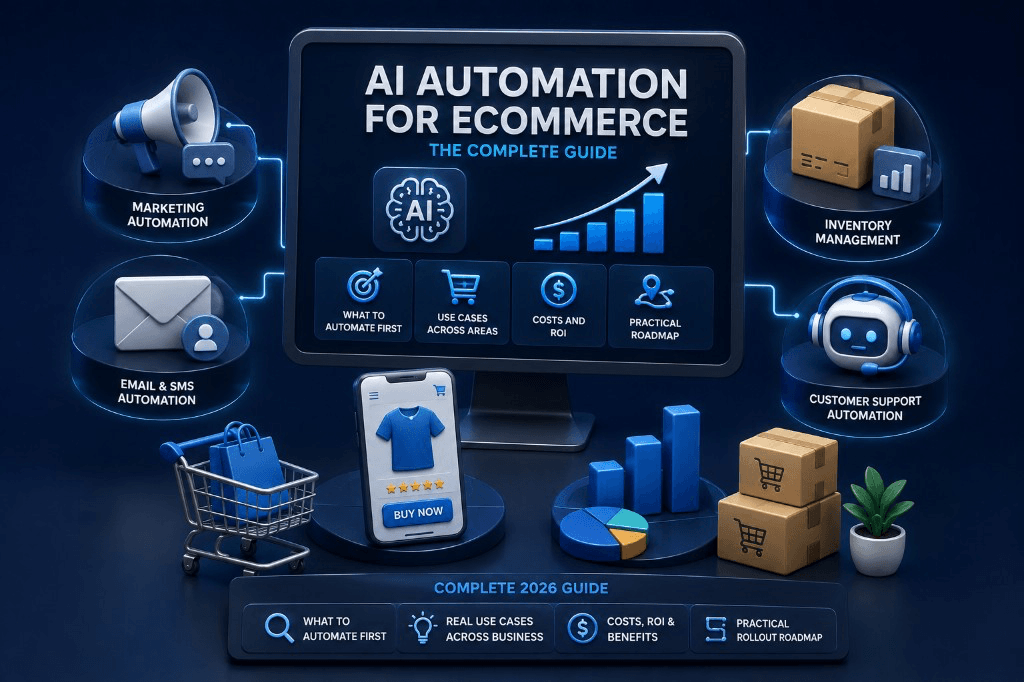
AI Automation for Ecommerce: The Complete 2026 Guide
A complete 2026 guide to AI automation for ecommerce: what to automate first, real use cases across marketing, inventory, and support, costs, and a practical rollout roadmap.
Read article AI
AIJuly 24, 202621 min read
AI App Development Cost by Industry: Healthcare, FinTech, Retail & More (2026 Guide)
Learn AI app development costs across Healthcare, FinTech, Retail, Education, Logistics, & more. Explore pricing, cost factors, & budgeting tips for 2026.
Read article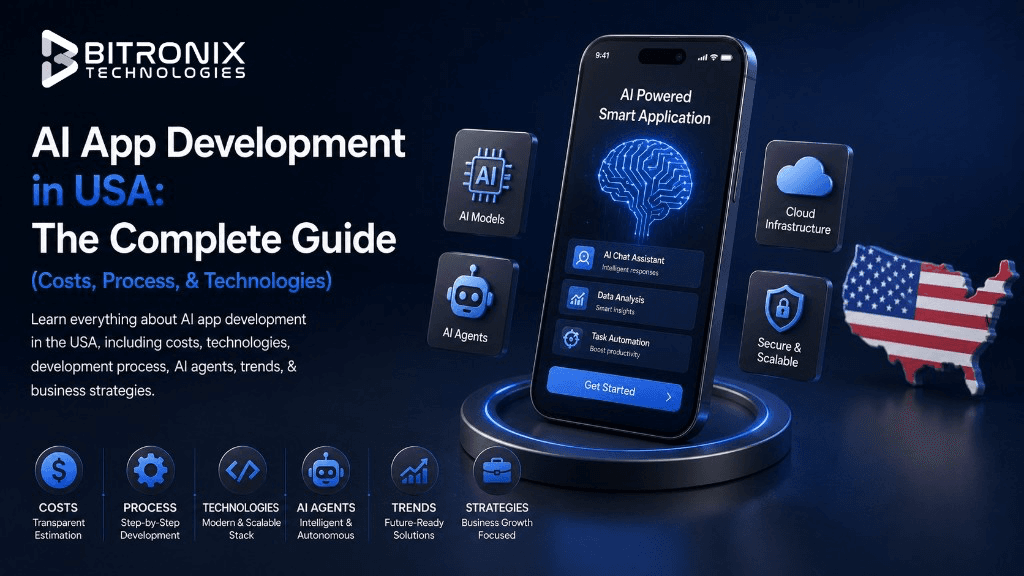 AI
AIJuly 21, 202613 min read
AI App Development in USA: The Complete Guide for 2026 (Costs, Process, & Technologies)
Learn everything about AI app development in the USA, including costs, technologies, development process, AI agents, trends, & business strategies for 2026.
Read article