Neo Bank Development Cost: MVP, Mid-Tier & Full-Scale Platform Pricing in 2027

By Tausif AhmedFounder and CTO
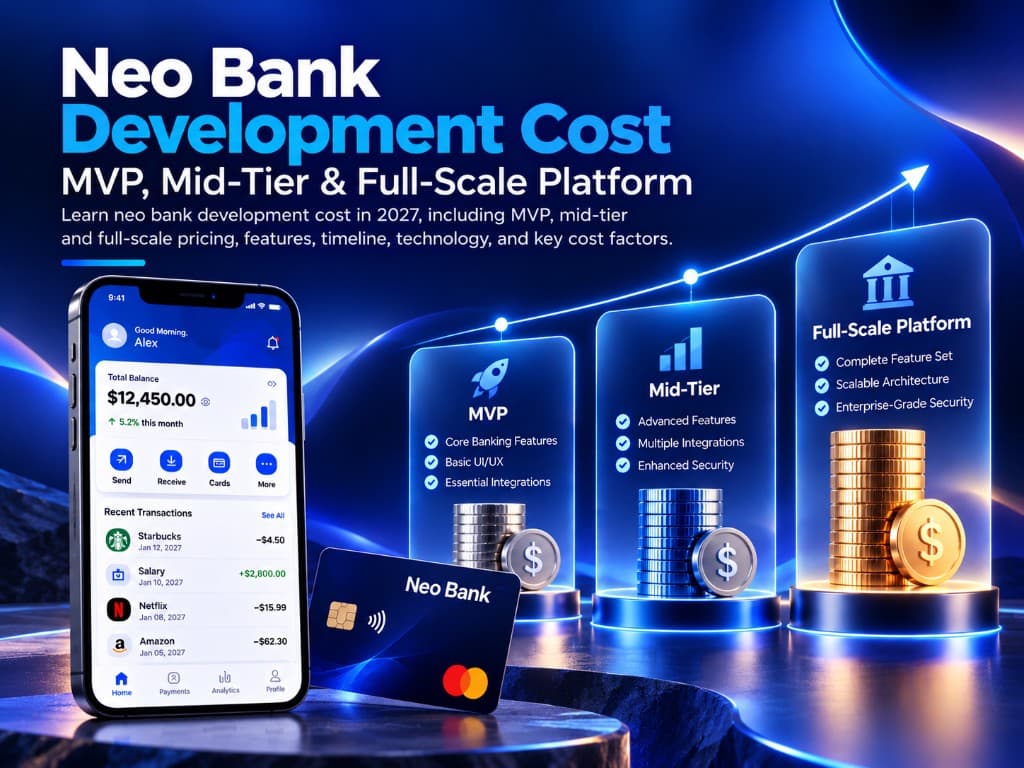
The demand for digital banking is growing as customers prefer to manage their money through mobile apps instead of visiting a traditional bank branch.
This has created a strong opportunity for businesses to launch neo bank platforms with digital accounts, cards, payments, money transfers, savings tools, and other financial services.
But one of the first questions founders ask is: How much does it cost to develop a neo bank?
A basic neo bank MVP can cost around $50,000 to $120,000, while a mid-tier platform can cost approximately $120,000 to $250,000. A full-scale neo bank with advanced banking, lending, investment, compliance, and multi-market features can cost $250,000 to $500,000+.
These are general development estimates. Your actual cost can be higher or lower depending on the features, country, BaaS provider, integrations, security requirements, compliance needs, and development team.
In this guide, we explain the neo bank development cost, features, development stages, timeline, technology, maintenance expenses, and ways to control the budget.
What Is a Neo Bank?
A neo bank is a digital-first banking service that allows customers to manage financial services through a mobile or web application.
Unlike traditional banks, neo banks generally do not depend on physical branches.
Customers can use a neo bank app to:
- Open an account
- Complete KYC
- Send and receive money
- Make payments
- Use debit or virtual cards
- Check transactions
- Manage savings
- Track spending
- Exchange currencies
- Access other financial services
Many neo banks use Banking-as-a-Service (BaaS) providers and licensed banking partners instead of building the entire banking infrastructure themselves.
This approach can reduce the amount of infrastructure a new fintech company needs to build from scratch, but it also introduces provider fees, integration work, compliance requirements, and dependency on third-party services.
How Much Does Neo Bank Development Cost in 2027?
The cost depends mainly on the size and features of the platform.
A general estimate looks like this:
| Neo Bank Type | Estimated Cost | Development Time |
|---|---|---|
| MVP Neo Bank | $50,000 – $120,000 | 4 – 6 months |
| Mid-Tier Neo Bank | $120,000 – $250,000 | 6 – 10 months |
| Full-Scale Neo Bank | $250,000 – $500,000+ | 12 – 18+ months |
These figures are development planning estimates. They may not include banking licenses, legal fees, BaaS charges, card program fees, compliance costs, marketing, or other operational expenses.
Current industry estimates also place MVP development around the $50,000–$120,000 range, while larger platforms can move into several hundred thousand dollars depending on features and compliance requirements.
1. Neo Bank MVP Development Cost: $50,000 – $120,000
An MVP is the first version of your neo bank.
The goal is not to build every possible banking feature. Instead, the MVP should include the core functions customers need to use the platform.
Typical MVP Features
- User registration
- Digital onboarding
- KYC verification
- User profile
- Digital bank account
- Balance management
- Money transfers
- Transaction history
- Basic card integration
- Payment notifications
- Basic admin dashboard
- Security controls
An MVP is a good option for startups that want to test their idea before spending a large amount on a complete banking platform.
Estimated Timeline
4–6 months
The exact timeline depends on the number of integrations, country requirements, design, compliance work, and BaaS provider.
2. Mid-Tier Neo Bank Development Cost: $120,000 – $250,000
A mid-tier neo bank is more advanced than an MVP.
It is suitable for businesses that already understand their target market and want to provide more financial products.
Features Can Include
- Everything in the MVP
- Physical and virtual cards
- Multi-currency accounts
- International transfers
- Spending analytics
- Budgeting tools
- Savings features
- Advanced payment options
- Recurring payments
- Customer support
- Admin and reporting dashboard
- Fraud monitoring
- More detailed KYC/AML workflows
The additional features mean more APIs, more testing, more security work, and more third-party integrations.
Estimated Timeline
6–10 months
3. Full-Scale Neo Bank Development Cost: $250,000 – $500,000+
A full-scale neo bank is designed for businesses that want to provide a much wider range of financial services.
This type of platform can support larger customer volumes, multiple financial products, more integrations, and more complex compliance requirements.
Features Can Include
- Everything in the mid-tier platform
- Multi-country support
- Multi-currency accounts
- Business banking
- Lending
- Investment services
- Open banking
- Advanced fraud detection
- Automated compliance workflows
- Advanced reporting
- Risk management
- Multiple payment rails
- Advanced card management
- API access
- Partner integrations
- Advanced admin controls
At this level, the cost is not only about building the app.
Infrastructure, security, compliance, integrations, monitoring, testing, and operational requirements become major parts of the project.
Estimated Timeline
12–18+ months
Neo Bank Features and Their Development Cost
The features you choose have a direct impact on development cost.
Here are some common modules.
Digital Account and Onboarding
Customers should be able to register, provide their information, complete verification, and access their accounts.
Estimated development range: $10,000–$25,000
KYC Verification
KYC helps verify the identity of customers.
A neo bank may connect with third-party KYC providers instead of building identity verification technology from scratch.
Estimated development range: $8,000–$20,000
Card Integration
Card features can include virtual cards, physical cards, card controls, spending limits, and transaction management.
Estimated development range: $15,000–$40,000+
Payment and Transfer Integration
Payment functionality may include bank transfers, domestic payments, international payments, and other payment methods.
Estimated development range: $15,000–$50,000+
Multi-Currency Support
Multi-currency functionality allows customers to hold and manage different currencies.
It may require additional exchange-rate services, payment integrations, account logic, and compliance considerations.
Estimated development range: $15,000–$40,000
Budgeting and Spending Analytics
This feature helps users understand where their money is going.
It can include:
- Spending categories
- Monthly reports
- Budget limits
- Charts
- Spending alerts
Estimated development range: $10,000–$25,000
Lending
Adding lending makes the platform considerably more complex.
It can include:
- Loan applications
- Eligibility checks
- Credit scoring integration
- Loan management
- Repayment schedules
- Notifications
Estimated development range: $30,000–$100,000+
Investment Features
Investment services may require market data, portfolio management, transaction systems, reporting, and additional compliance work.
Estimated development range: $30,000–$100,000+
What Factors Affect Neo Bank Development Cost?
The feature list is only one part of the budget.
Several other factors can change the final cost.
1. Number of Features
A simple banking app is cheaper than a platform with cards, lending, investments, crypto, business accounts, and open banking.
More features mean more development and testing.
2. BaaS Provider
Many neo banks use Banking-as-a-Service providers for banking infrastructure.
The integration cost depends on:
- API quality
- Documentation
- Sandbox environment
- Number of APIs
- Account services
- Card services
- Payment services
- Transaction limits
- Provider fees
The provider can also charge per account, transaction, card, or other usage.
3. Licensing
The licensing model can have a major impact on the overall budget.
Some businesses work with a licensed banking partner or BaaS provider, while others may pursue their own regulatory setup.
The requirements are different in every country.
Important: Development cost and banking license cost are separate expenses.
4. Compliance
Financial applications need stronger compliance than a standard mobile application.
Depending on the market, this may involve:
- KYC
- AML
- Transaction monitoring
- Data protection
- Payment regulations
- Reporting
- Customer verification
The exact requirements depend on the country and business model.
5. Security
A neo bank handles sensitive financial information, so security needs to be planned from the beginning.
Security work can include:
- Encryption
- Secure authentication
- Multi-factor authentication
- Access controls
- API security
- Fraud monitoring
- Security testing
- Penetration testing
- Monitoring
6. Number of Integrations
A neo bank may connect with:
- BaaS providers
- Payment gateways
- Banks
- KYC providers
- AML providers
- Card providers
- Currency exchange APIs
- Credit scoring providers
- Investment providers
Each integration adds development and testing work.
7. Development Team Location
Development rates vary by region.
An India-based development team can often provide a different cost structure from teams based in the US, UK, or Western Europe.
However, price should not be the only factor.
For a financial platform, experience, security, communication, and understanding of fintech systems are equally important.
Technology Stack for a Neo Bank
A neo bank normally uses several technologies rather than one single system.
Frontend
Common options include:
- React
- React Native
- Flutter
- Swift
- Kotlin
React Native or Flutter can be useful when a business wants to support both iOS and Android with a shared codebase.
Backend
Common backend technologies include:
- Node.js
- Java
- Go
- Python
The choice depends on the platform architecture and the development team's experience.
Database
A project may use:
- PostgreSQL
- MySQL
- MongoDB
- Redis
The actual database setup depends on the system requirements.
Cloud Infrastructure
A neo bank may use cloud infrastructure from providers such as:
- AWS
- Microsoft Azure
- Google Cloud
Cloud infrastructure can support scalability, monitoring, backups, and security controls.
Banking API and BaaS Integration
BaaS is an important part of many neo bank projects.
Instead of creating every banking function from scratch, a business can connect its application with a banking infrastructure provider through APIs.
These APIs may provide services such as:
- Account creation
- Balance information
- Transactions
- Card management
- Payments
- Transfers
- Customer information
This can reduce development time, but API integration still requires careful development and testing.
Different providers can have different API structures, limits, webhooks, error handling, and transaction processes.
This is one reason why choosing the right BaaS partner early is important.
Neo Bank Development Process
Building a neo bank is usually completed in several stages.
Step 1: Business and Product Planning
First, define:
- Target customers
- Countries
- Banking products
- Revenue model
- Required features
- Compliance requirements
Step 2: Choose the Banking Model
Decide whether the platform will use:
- BaaS
- Banking partner
- Licensed financial institution
- Other approved infrastructure
This decision can affect the entire architecture.
Step 3: UI/UX Design
The design should make financial tasks easy to understand.
Important screens can include:
- Registration
- KYC
- Home dashboard
- Accounts
- Cards
- Transfers
- Transactions
- Profile
- Support
Step 4: Development
The team builds:
- Mobile application
- Web application if required
- Backend
- Admin dashboard
- APIs
- Banking integrations
- Security controls
Step 5: Testing
Testing is especially important for financial applications.
The team should test:
- Payments
- Transfers
- Account balances
- Authentication
- APIs
- Security
- Error handling
- Performance
Step 6: Compliance and Security Review
The platform is reviewed against the applicable business and regulatory requirements.
Step 7: Launch
After testing and required approvals, the platform can move toward production.
Step 8: Maintenance
After launch, the development team continues to fix issues, update integrations, improve security, and add new features.
How Long Does It Take to Build a Neo Bank?
The timeline depends on the platform size.
| Platform | Estimated Timeline |
|---|---|
| MVP | 4–6 months |
| Mid-Tier | 6–10 months |
| Full-Scale | 12–18+ months |
A BaaS-based MVP can generally move faster than building a much larger banking infrastructure from the ground up.
However, development is only one part of the timeline. Partner onboarding, compliance, licensing, security reviews, and third-party approvals can also affect the launch date.
Neo Bank Development Team
A typical project may require a team such as:
- Product Manager
- Business Analyst
- UI/UX Designer
- Blockchain/Fintech Developer
- Backend Developer
- Mobile Developer
- Frontend Developer
- QA Engineer
- DevOps Engineer
- Security Specialist
- Compliance Specialist
A smaller MVP may need fewer people.
A full-scale platform normally requires a larger team because multiple systems need to be built and managed at the same time.
Ongoing Neo Bank Maintenance Cost
Development does not end after launch.
A neo bank requires ongoing maintenance for:
- Bug fixes
- Security updates
- API changes
- Cloud infrastructure
- Monitoring
- Compliance updates
- Performance improvements
- New features
- Third-party integrations
A common planning estimate for software maintenance is around 15–20% of the original development cost per year, although fintech platforms can have additional operational and compliance expenses.
Other ongoing expenses can include:
- BaaS fees
- Card provider fees
- KYC verification fees
- AML monitoring
- Cloud costs
- Security audits
- Customer support
- Compliance services
How to Reduce Neo Bank Development Cost
You do not always need to build everything at the beginning.
Here are some practical ways to control the budget.
Start With an MVP
Build the most important features first.
For example:
You can add lending, investments, advanced analytics, and other features later.
Use BaaS Infrastructure
Building banking infrastructure from scratch can be expensive and time-consuming.
A suitable BaaS provider can reduce the amount of infrastructure you need to develop yourself.
Use a Cross-Platform App
If appropriate for the project, technologies such as Flutter or React Native can help reduce duplicated mobile development work.
Avoid Unnecessary Features
Do not add features simply because another banking app has them.
Start with the features your customers actually need.
Plan Integrations Early
Late changes to banking APIs and third-party services can increase development time.
Choose your important partners before development reaches the integration stage.
MVP vs Mid-Tier vs Full-Scale Neo Bank
Here is a simple comparison:
| Factor | MVP | Mid-Tier | Full-Scale |
|---|---|---|---|
| Cost | $50K–$120K | $120K–$250K | $250K–$500K+ |
| Timeline | 4–6 months | 6–10 months | 12–18+ months |
| Accounts | Basic | Advanced | Multi-country |
| Cards | Basic/Virtual | Virtual + Physical | Advanced |
| Payments | Basic | Multiple methods | Multi-market |
| Currencies | Limited | Multi-currency | Multi-currency |
| Lending | Usually no | Optional | Yes |
| Investments | No | Optional | Possible |
| Analytics | Basic | Advanced | Advanced |
| Compliance | Core | Expanded | Advanced |
| Admin Panel | Basic | Advanced | Enterprise |
Why Choose Bitronix for Neo Bank Development?
Bitronix Technologies helps businesses build custom fintech and digital financial solutions based on their product requirements.
Our approach starts with understanding the business model, target users, required financial services, integrations, and technical requirements before development begins.
Bitronix can help with:
- Digital banking solutions
- Neo bank platform development
- Fintech application development
- Blockchain development
- Web3 solutions
- Smart contract development
- Digital wallets
- Payment solutions
- Tokenization
- AI-powered financial solutions
For businesses planning a modern financial platform, blockchain and digital banking can also work together where the use case makes sense.
The goal should be to build the right technology for the business instead of adding technology that does not solve a real problem.
Final Conclusion
The cost to develop a neo bank in 2027 can range from around $50,000 for a basic MVP to $500,000 or more for a full-scale platform.
The final cost depends on much more than app development.
Features, BaaS providers, banking APIs, licensing, compliance, security, integrations, development team, and the target market can all change the budget.
For most startups, starting with an MVP is a practical way to test the product before investing in a larger platform.
Once the product gains users and the business understands what customers need, advanced features such as lending, investments, multi-currency accounts, business banking, open banking, and advanced analytics can be added.
If you are planning to build a neo bank or digital banking platform, Bitronix Technologies can help with product planning, development, integrations, and the technology needed to take your idea from concept to launch.
FAQs About Neo Bank Development Cost
1. How much does it cost to develop a neo bank in 2027?
The cost to develop a neo bank generally ranges from $50,000–$120,000 for an MVP, $120,000–$250,000 for a mid-tier platform, and $250,000–$500,000+ for a full-scale platform. The final cost depends on features, BaaS integration, banking APIs, licensing, compliance, security, third-party integrations, and development team.
A basic neo bank MVP usually includes KYC onboarding, digital accounts, transfers, card integration, transaction history, notifications, and an admin dashboard. Advanced platforms can add multi-currency accounts, lending, investments, business banking, open banking, advanced fraud monitoring, and multi-country support.
For many startups, launching a focused MVP first and adding advanced features in phases can help control the initial development budget.
2. How long does it take to build a neo bank?
A basic MVP can take around 4–6 months. A mid-tier platform may take 6–10 months, while a full-scale neo bank can take 12–18 months or longer.
3. What features should a neo bank MVP have?
A basic MVP can include user registration, KYC, digital accounts, transfers, transaction history, card integration, notifications, and an admin dashboard.
4. Do I need a banking license to launch a neo bank?
It depends on the country, business model, and financial services being offered. Some businesses work with licensed banking or BaaS partners, while others may require their own regulatory authorization.
5. What is BaaS in neo banking?
BaaS stands for Banking-as-a-Service. It allows fintech businesses to access banking infrastructure and services through APIs provided by licensed financial institutions or specialized providers.
6. What increases the cost of neo bank development?
Major cost factors include the number of features, banking API integrations, BaaS provider, compliance requirements, security, licensing approach, multi-country support, development team, and third-party services.
7. Can I build a neo bank using blockchain?
Yes, blockchain can be used in selected parts of a financial platform, such as digital assets, tokenization, stablecoin payments, settlement, or other Web3-related financial services. The technology should be selected based on the actual business use case.
8. Can Bitronix Technologies develop a neo bank?
Yes. Bitronix Technologies can help businesses with custom digital banking, fintech, blockchain, wallet, payment, and Web3 solutions.
9. Can I start with a neo bank MVP and add features later?
Yes. Starting with an MVP is often a practical approach. Businesses can launch core banking features first and add lending, investments, advanced analytics, multi-currency support, and other features in later phases.
10. What information is needed to estimate neo bank development cost?
A development company normally needs information about the target country, business model, customer type, required features, banking or BaaS partner, integrations, platforms, compliance requirements, and expected launch timeline.

Founder and CTO
Founder and CTO of Bitronix Technologies. Leads strategy and delivery for digital banking, fintech, blockchain and Web3 platforms, from product planning and banking integrations to secure production launches.
Related Posts
 Blockchain
October 1, 202613 min read
Top 10 Companies to Hire Blockchain Developers in India 2026-2027
Find the top 10 companies to hire blockchain developers in India. Compare blockchain services, expertise, use cases, & tips for choosing a development partner.
Read article Smart Contracts
September 28, 202620 min read
Smart Contract Development Cost: How Much Does It Cost in 2027?
Discover smart contract development costs in 2027. Compare pricing from $5,000, project types, audit fees, timelines, & development factors.
Read article Blockchain
September 25, 202616 min read
RWA Tokenization in Singapore: Regulations, Licensing & Complete Guide 2026
Learn about RWA tokenization in Singapore, including MAS regulations, licensing, compliance, use cases, costs and how to build an RWA platform in 2026.
Read article