Binance Clone Script to Launch a Crypto Exchange Like Binance in 2026

By Tausif AhmedFounder and CTO
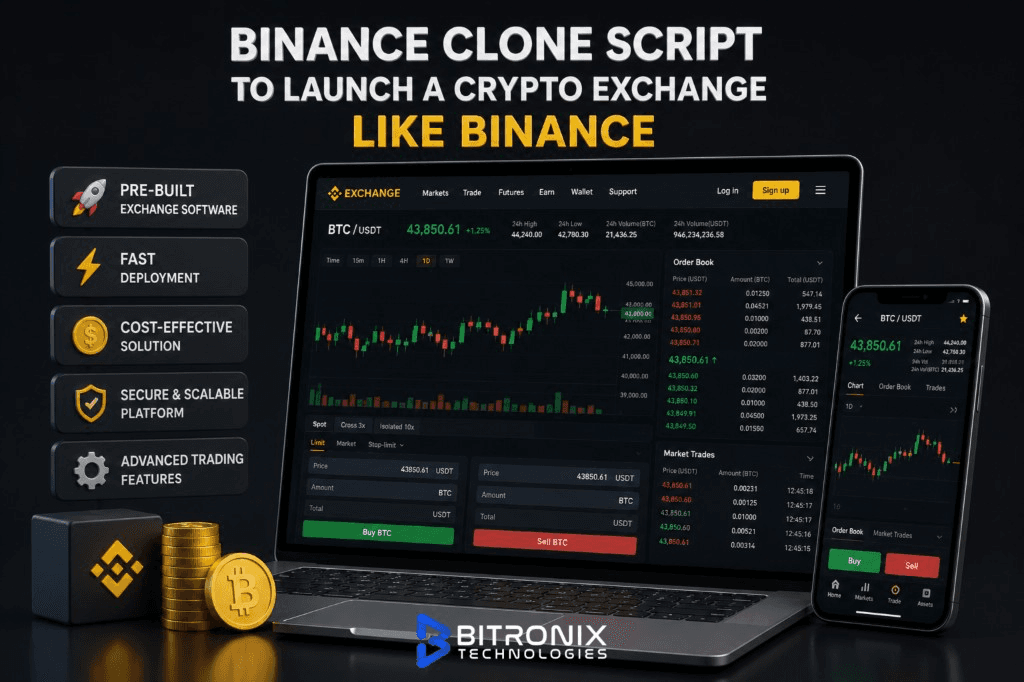
Somewhere in the crypto exchange market right now, a handful of platforms are quietly running the exact same source code rebranded with different logos and names, but sharing the identical set of smart contracts underneath. That's not a conspiracy theory. It's simply how clone scripts work and it's worth understanding before you use one to launch your own exchange.
A clone script is genuinely appealing on paper. Binance took years and a large team to build the trading engine, liquidity systems and security infrastructure that make it the platform it is today. A clone script promises to hand you a working version of all of that in a matter of days.
The part that gets left out of most sales pages is what you're actually buying and what happens six months later when your business has outgrown what the template was ever designed to do. This guide breaks down what a Binance clone script actually is, how it works, what it really costs and where the tradeoffs against custom exchange development sit.
What Is Binance Clone Script?
A Binance Clone Script is a pre-built, adaptable software package that mirrors the fundamental characteristics, capabilities and trading processes of Binance. It empowers entrepreneurs and crypto startups to launch their own cryptocurrency exchange quickly and cost-effectively, without building from scratch.
In practice, a vendor has already built the trading engine, wallet system, admin panel and UI, styled to resemble Binance and sells you a rebranded version. The underlying code is usually shared across many clients each buyer gets an instance of the same base software rather than a platform built specifically for them.
How a Binance Clone Script Actually Works
- Licensing the Base Software Purchase a license as a one-time fee or fee plus ongoing support.
- Rebranding and Customization Branding, trading pairs, fees and supported currencies get configured.
- Deployment Deployed to your hosting and connected to a liquidity source.
- Launch Live within one to a few weeks, on infrastructure functionally identical to every other client on the same script.
How AI Is Changing Crypto Exchange Security and Compliance
This is where the gap between a clone script and a modern custom-built exchange has widened most and it's rarely mentioned in a clone script feature list.
- AI-Driven Fraud and Wash-Trading Detection Machine learning catches abnormal patterns in real time. Clone scripts generally ship with basic rule-based checks.
- Automated KYC/AML Screening AI identity verification cross-checks documents and sanctions lists in seconds.
- Anomaly Detection for Smart Contract Behavior Flags unusual withdrawals or function-call spikes before they become full exploits.
- Why This Matters Adding these to a clone script later usually means custom work on a template that wasn't designed for it eroding the original price advantage.
Key Features Typically Included
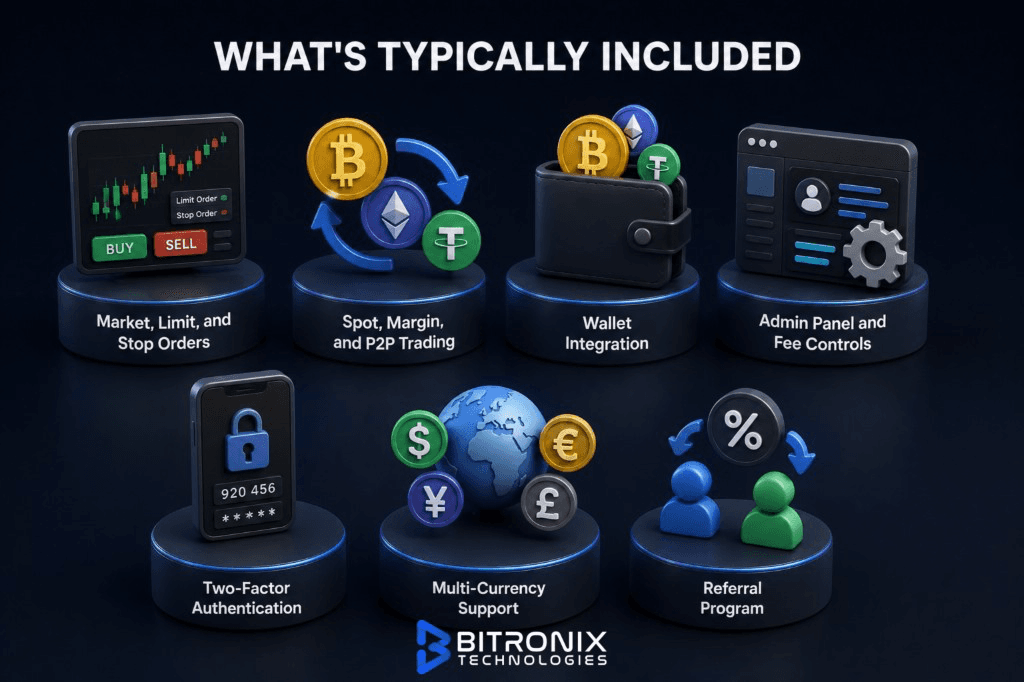
- Market, limit and stop-limit order types
- Spot trading and, in advanced packages, margin and futures
- Peer-to-peer (P2P) trading functionality
- Wallet integration for storing, sending and receiving crypto
- Admin panel for users, listings and fees
- Basic security: two-factor authentication and cold wallet storage
- Multi-currency support, often advertised as 100+ coins
- Referral and affiliate program modules
On the surface, this looks complete. Whether features are implemented with the rigor a platform handling real user funds needs is a separate question.
The Real Risks of Using a Clone Script
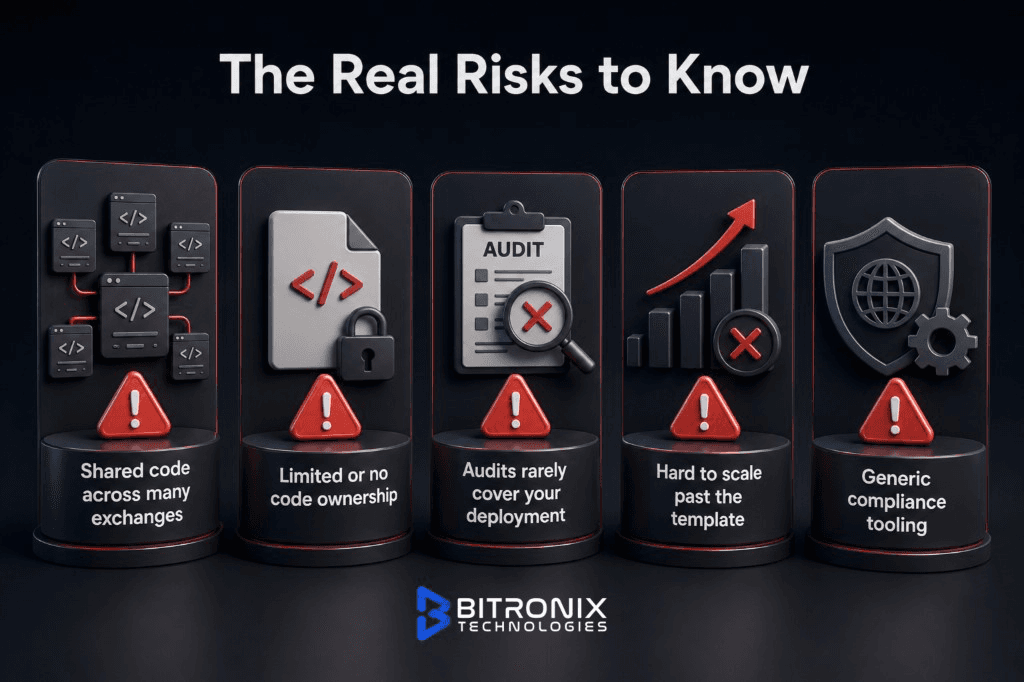
- Shared Codebase Vulnerabilities A flaw found on one instance is often present on every exchange running the same script.
- No Real Ownership of the Code Many licenses don't include full source ownership, locking you into the vendor for updates and patches.
- Security Audits Are Often an Afterthought A vendor auditing their base product years ago is not the same as auditing your live deployment.
- Limited Ability to Scale or Customize The moment you need something outside the template, you wait on the vendor or pay for custom work anyway.
- Compliance Gaps Generic KYC/AML tooling is built for the broadest use case, not your specific jurisdictions.
Binance Clone Script vs. Custom Exchange Development
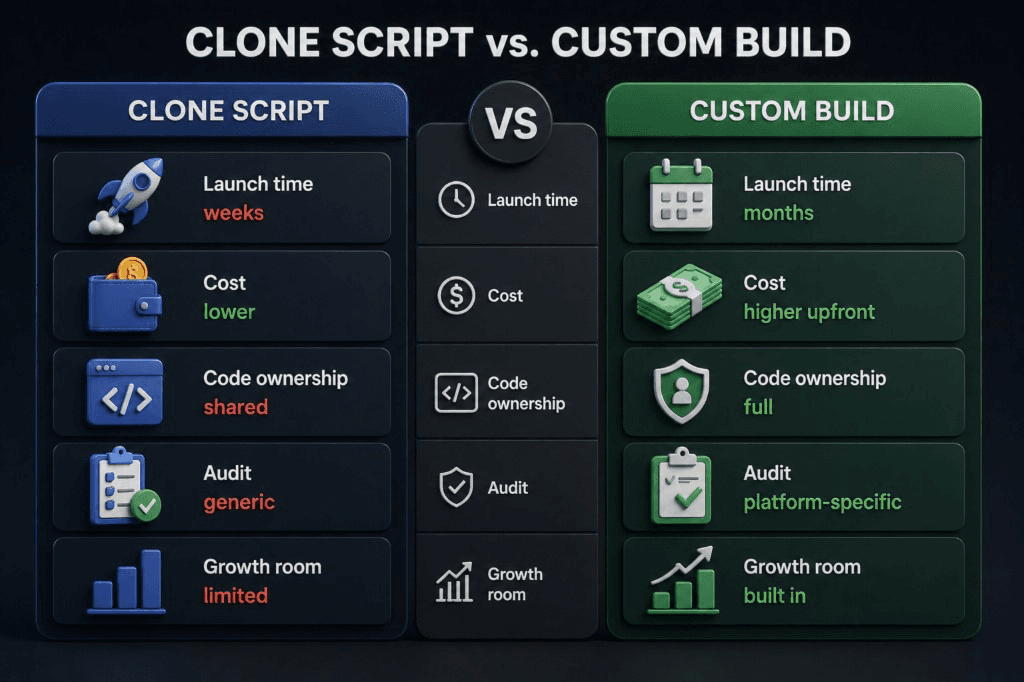
| Factor | Clone Script | Custom Development |
|---|---|---|
| Time to Launch | 1-3 weeks | 2-6 months |
| Typical Cost | $5,000 – $30,000 | $40,000 – $250,000+ |
| Source Code Ownership | Often limited or shared | Fully owned |
| Security Audit | Rarely platform-specific | Built around your actual deployment |
| Customization | Limited to template options | Built to your exact requirements |
| Scalability | Constrained by template design | Architected for your growth |
| Compliance Fit | Generic, one-size-fits-all | Tailored to your target jurisdictions |
Neither option is universally right. The decision comes down to what you're proving and how much real user money will sit on the platform.
Total Cost of Ownership: Clone Script vs. Custom Over 3 Years
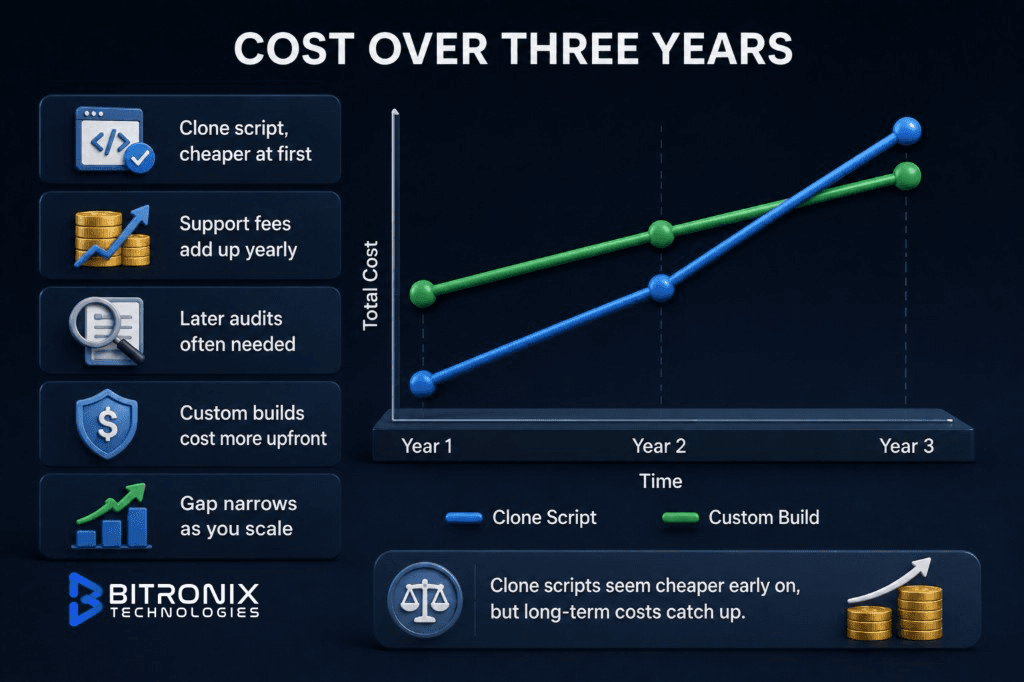
| Cost Category | Clone Script (3-Year Estimate) | Custom Development (3-Year Estimate) |
|---|---|---|
| Initial build | $5,000 – $30,000 | $40,000 – $250,000+ |
| Vendor support/licensing renewal | $3,000 – $10,000/year | Not applicable (code is owned) |
| Retroactive security audit | $5,000 – $20,000 (often needed later) | Included in initial build |
| Custom feature additions | $10,000 – $50,000+ (as needed) | Built into original architecture |
| Migration cost if outgrown | $50,000 – $150,000+ | Not applicable |
| Estimated 3-year total | $50,000 – $200,000+ | $40,000 – $250,000+ |
The clone script's upfront advantage shrinks fast once a platform gains traction. Every step outside the template tends to cost close to what custom development would have cost without the ownership and security posture.
How to Reduce Risk If You're Already Running a Clone Script
- Get an Independent Audit of Your Specific Deployment Not a years-old vendor review of the base template.
- Understand Exactly What You Own Review license terms for source ownership and patch rights.
- Isolate High-Value Functions First Harden withdrawals, hot wallets and admin access before lower-risk areas.
- Plan the Migration Path Before You Need It Map a move to custom infrastructure while things are stable.
When a Clone Script Actually Makes Sense
A clone script can be reasonable for testing market demand with minimal capital, an internal proof of concept, or a founder who accepts the shared-codebase tradeoff and plans to migrate once validated. It's much riskier for meaningful trading volume, institutional clients, or funds you can't afford to lose.
When Custom Exchange Development Is Worth the Investment
If your exchange will hold real user funds at meaningful scale, a custom-built platform the kind covered in our guide on white label centralized exchange development gives you owned source code, a security audit built around your system and room to add features as you grow.
Our guide on how much it costs to launch a crypto token covers a similar dynamic: the cheapest option up front is rarely the cheapest once security, compliance and getting it wrong are factored in.
How to Evaluate a Clone Script Vendor, If You Go That Route
- Do you receive full source code ownership, or only a license?
- Has the specific version been independently audited and can you see the report?
- How many other clients run this exact codebase and have past incidents been disclosed?
- What does compliance tooling actually cover for your target jurisdictions?
- What's the real cost and timeline if you need a feature outside the template?
Conclusion
A Binance clone script isn't a scam and it isn't automatically a bad decision. It's a tradeoff: speed and lower upfront cost in exchange for shared infrastructure, limited ownership and security that was never built specifically around your platform.
The businesses that get this right understand exactly what they're buying a fast way to validate an idea, or a secure owned platform for real trading volume and choose the option that matches what they're building.
If you're weighing a clone script against a custom-built exchange, talk to our team about what your specific project actually needs.
Frequently Asked Questions
Is a Binance clone script legal?
Yes, using clone script software itself isn't illegal, as long as it doesn't infringe Binance's trademarks or copyrighted assets. Regulatory compliance in each jurisdiction is the bigger legal risk.
How much does a Binance clone script cost?
Most clone scripts range from $5,000 to $30,000. Custom exchange development typically starts around $40,000 and can run well past $250,000 for enterprise-grade platforms.
Is a clone script secure?
It depends on the vendor, but the structural risk is shared code across deployments a vulnerability on one exchange can affect every other instance of the same script.
Can I customize a clone script beyond what's included?
Usually only to a limited degree. Significant customization typically requires additional custom development that can erase the original price advantage.
Should I start with a clone script or go straight to custom development?
Clone scripts can work for early validation with limited capital. For meaningful trading volume or real user funds at scale, custom development is generally worth the additional cost.

Founder and CTO
Founder and CTO of Bitronix Technologies. Helps founders evaluate clone scripts vs custom exchange builds with honest security, ownership and total-cost guidance.
Related Posts
 Blockchain
October 14, 202615 min read
Crypto Token Development Cost in 2027: Pricing, Features and Budget Breakdown
Explore crypto token development cost in 2027, with estimated pricing, key cost factors, smart contract audits, development timelines, & hidden expenses.
Read article Blockchain
October 1, 202613 min read
Top 10 Companies to Hire Blockchain Developers in India 2026-2027
Find the top 10 companies to hire blockchain developers in India. Compare blockchain services, expertise, use cases, & tips for choosing a development partner.
Read article Blockchain
September 25, 202616 min read
RWA Tokenization in Singapore: Regulations, Licensing & Complete Guide 2026
Learn about RWA tokenization in Singapore, including MAS regulations, licensing, compliance, use cases, costs and how to build an RWA platform in 2026.
Read article