What Is Coin Token Development? Complete Guide for Businesses

By Tausif AhmedFounder and CTO
Blockchain has grown well beyond crypto trading over the last few years. Businesses of every size are now using it to improve transparency, automate transactions, build digital communities and open up new revenue streams. Coin token development is usually the entry point into that world.
Maybe you're a startup planning a new blockchain project, an enterprise looking into digital assets, or an entrepreneur building something in Web3. Either way, understanding how tokens work is where you need to start.
A crypto token isn't just a form of digital cash. It can represent ownership, unlock access to a service, reward loyal users, support decentralised governance, or even stand in for a real-world asset like property or artwork. As blockchain adoption keeps climbing, tokens are turning into a genuine part of how modern businesses operate.
That said, building a token that actually works takes more than writing a smart contract and calling it done. You need to pick the right blockchain, choose a secure token standard, design an economy that holds together over time, stay compliant and get the token working across wallets, exchanges and dApps.
This guide walks through what businesses need to know about coin token development, in plain language. Whether you're technical or brand new to blockchain, you'll come away with a clear picture of how token development works, why it matters and what to think through before you launch your own project.
What Is Coin Token Development?
Coin token development covers designing, building, testing and launching a digital token on a blockchain. What the token actually does depends entirely on the project behind it: some serve as digital currency, others grant access to an app, represent ownership, enable governance, or reward users for showing up and participating.
It's not like ordinary software development. Token development pulls together blockchain technology, smart contracts, cryptography and economic design all at once and every stage needs to be planned carefully if you want something secure, scalable and sustainable.
Most tokens live on an existing blockchain, such as Ethereum, BNB Chain, Solana, Polygon, or Avalanche, rather than on a brand-new chain built from the ground up. Using an established standard like ERC-20 or BEP-20 cuts both the development time and the cost significantly.
Take a fitness app as an example. It might reward users with tokens for finishing workouts and those tokens could later be redeemed for premium subscriptions, fitness gear, or partner discounts. Here, the token becomes a working part of the platform's ecosystem, not just a currency sitting off to the side.
Why Is Coin Token Development Becoming So Popular?
Blockchain is reshaping how businesses deal with customers, investors and digital assets. Rather than leaning only on traditional payment rails or loyalty schemes, companies can build entire ecosystems where tokens sit at the centre.
- Digital Ownership Blockchain lets users genuinely own their digital assets. Ownership gets verified on-chain instead of depending on some central authority to vouch for it.
- Global Accessibility Tokens move across borders without the usual banking restrictions, which makes international transactions quicker and smoother.
- Lower Transaction Costs Many blockchain networks charge less than traditional financial systems, especially for cross-border transfers.
- Automation Through Smart Contracts Smart contracts trigger actions automatically once conditions are met, cutting down on manual work and human error.
- Community Building A lot of Web3 projects hand out tokens to reward participation, whether that's referrals, governance votes, or general contributions to the ecosystem.
- Fundraising Opportunities Utility and governance tokens are often used to raise capital while giving backers real access to platform benefits.
Coin vs Token: Understanding the Difference
People throw around "coin" and "token" as if they mean the same thing, but they don't.
| Coin | Token |
|---|---|
| Has its own blockchain | Runs on an existing blockchain |
| Used mainly as digital money | Can serve multiple purposes |
| Examples: Bitcoin, Ethereum | Examples: USDT (ERC-20), Chainlink, Uniswap |
| Requires building an independent blockchain | Can be created using existing token standards |
A coin powers its own chain: Bitcoin runs on the Bitcoin blockchain, Ether runs on Ethereum. A token, by contrast, is built on top of blockchain infrastructure that already exists, which is exactly what makes token development faster, cheaper and far more accessible.
That's why most startups and enterprises go with a token rather than take on the complexity of building and maintaining a blockchain of their own.
Common Types of Crypto Tokens
Tokens aren't one-size-fits-all. The right type depends on your business model and what you're trying to achieve long-term.
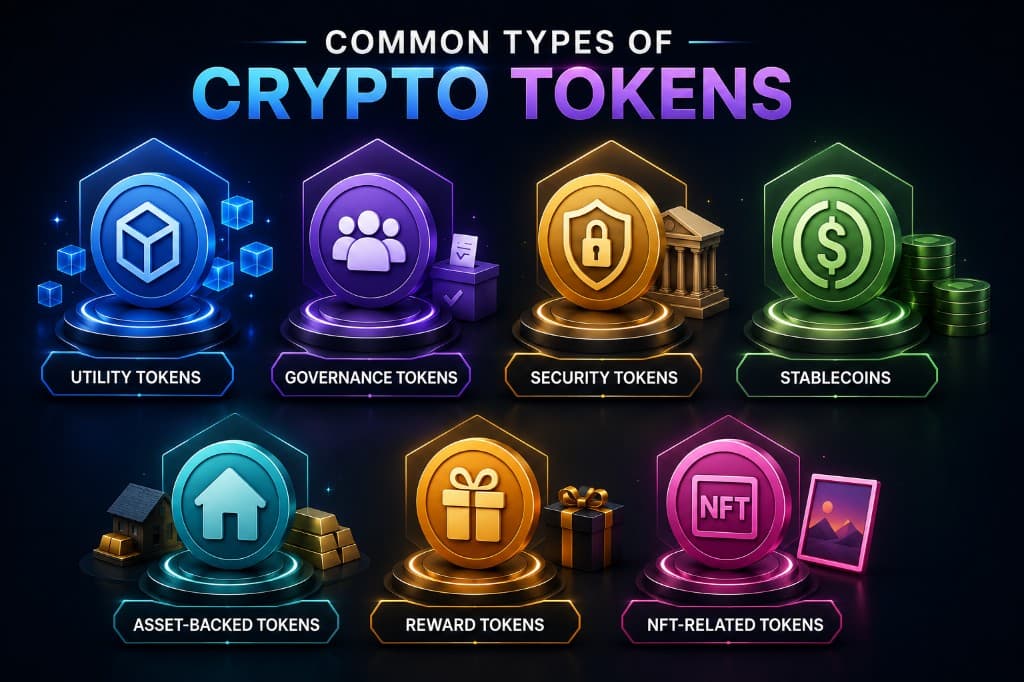
Utility Tokens
These give holders access to products, services, or features within a platform. Common examples include platform subscriptions, premium memberships, software licensing, transaction fee discounts and gaming rewards. Utility tokens tend to be the go-to choice for startups since they keep users engaged while supporting the ecosystem around them.
Governance Tokens
Holders get a say in decisions that shape the project. Token holders may vote on new features, treasury spending, community proposals, protocol upgrades and partnership approvals. This kind of democratic model is common across decentralised autonomous organisations (DAOs).
Security Tokens
These represent ownership or an investment stake in a real-world asset company shares, real estate investments, private equity, or investment funds. Because they resemble traditional securities so closely, they're often subject to financial regulation depending on the jurisdiction.
Stablecoins
Stablecoins hold a steady value by pegging themselves to something like a fiat currency or a commodity. Businesses typically use them for cross-border payments, payroll, international settlements, trading and treasury management.
Asset-Backed Tokens
These represent ownership of a physical or digital asset gold, property, fine art, luxury goods, or carbon credits. Tokenisation makes it much easier to split ownership into smaller, tradable pieces.
Reward Tokens
Plenty of businesses build reward tokens purely to boost customer loyalty. Customers might earn tokens for purchases, referrals, reviews, completing tasks, or participating in marketing campaigns. Unlike standard loyalty points, blockchain-based reward tokens can often be transferred, traded, or redeemed across partner platforms.
NFT-Related Tokens
Some ecosystems pair utility tokens with NFTs to power marketplaces, games and creator platforms. Users might use these tokens to purchase NFTs, pay marketplace fees, stake assets, unlock premium features, or join exclusive events.
Why Businesses Are Investing in Token Development
Across industries, businesses are realising blockchain tokens aren't just a passing trend. They're practical tools for building stronger customer relationships, unlocking new revenue and running things more efficiently.
- Increase Customer Engagement Tokens give users a reason to interact with a platform more often, whether through rewards, exclusive perks, or access to premium services.
- Build Stronger Communities Many Web3 projects use tokens to give users a real stake in the outcome. Token holders often turn into long-term supporters who actively push the project forward.
- Enable Faster Global Transactions Blockchain tokens let businesses send and receive payments across borders with fewer middlemen involved, which cuts down on delays and costs.
- Create New Revenue Opportunities Token sales, transaction fees, premium memberships, DeFi integrations and ecosystem services all open up revenue businesses wouldn't otherwise have.
- Improve Transparency Since every transaction sits on a distributed ledger, it's easier to verify transfers and cut down on disputes.
- Support Digital Transformation Tokenisation helps modernise business models across finance, supply chain, gaming, healthcare and beyond.
Coin Token Development Process: A Step-by-Step Guide
Launching a token involves a lot more than deploying a smart contract. A project that actually succeeds needs careful planning, secure development, clearly thought-out tokenomics, legal awareness and ongoing upkeep. Skip any of these steps and you risk security holes, weak adoption, or the project failing outright.
Step 1: Define Your Business Goals
Every token project that works starts with a clear purpose. Before you even think about which blockchain to use, figure out what problem the token is actually solving. Some businesses build tokens to simplify payments, others use them for loyalty, DeFi, fundraising, governance, or asset ownership.
- What problem will the token solve?
- Who is your target audience?
- Will users buy, earn, or receive tokens?
- Will the token have real-world utility?
- How will the token generate value over time?
- Will the project include staking or governance features?
- Is the token intended for a global audience?
Step 2: Choose the Right Blockchain
This is one of the biggest decisions you'll make. Every blockchain differs in cost, speed, developer support and ecosystem strength, so your choice should be shaped by your goals, expected transaction volume, security needs and budget.
| Blockchain | Token Standard | Speed | Transaction Cost | Best Use Case |
|---|---|---|---|---|
| Ethereum | ERC-20 | Moderate | High | Enterprise & DeFi |
| BNB Chain | BEP-20 | Fast | Low | Startups & Utility Tokens |
| Solana | SPL | Very Fast | Very Low | Gaming & High-Volume Apps |
| Polygon | ERC-20 Compatible | Fast | Low | Business Applications |
| Avalanche | ARC-20 | Fast | Low | Enterprise & Finance |
| TRON | TRC-20 | Fast | Very Low | Payments & Stablecoins |
Ethereum (ERC-20) remains one of the most trusted networks for DeFi projects, DAO platforms and enterprise blockchain solutions. BNB Chain (BEP-20) suits startups, NFT marketplaces and community tokens with lower fees. Solana (SPL) is built for speed ideal for gaming and high-volume apps. Polygon extends Ethereum at lower cost. Avalanche and TRON serve enterprise finance and payment-focused applications respectively.
Step 3: Design Tokenomics
Tokenomics is the economic engine behind your token: it dictates how the token gets distributed, how it's used and whether it can sustain itself over time. Get tokenomics right and you build real confidence among users and investors. Get it wrong and you're looking at inflation, weak demand and a token that loses value fast.
- Total Supply Decide how many tokens will ever exist (fixed or inflationary).
- Initial Distribution Allocate tokens across founders, team, investors, community rewards, marketing, liquidity and treasury.
- Vesting Schedule Lock up team and investor tokens to prevent large sell-offs right after launch.
- Utility Define why anyone would hold the token: platform access, discounts, rewards, governance, staking.
- Burn Mechanism Some projects permanently remove tokens from circulation to control inflation and support long-term value.
Step 4: Smart Contract Development
The smart contract is the backbone of any token: it dictates exactly how the token behaves on-chain, from transfers and minting to staking and governance. Developers usually write these contracts in Solidity for Ethereum-compatible chains, or Rust if you're building on Solana.
- Token creation, transfers, minting and burning
- Ownership transfer and pausing transactions
- Staking, governance voting and vesting
- Multi-signature controls and blacklisting (if required)
Blockchain transactions typically can't be reversed. If a contract has a vulnerability, attackers can exploit it and the losses are real which is exactly why code quality and testing matter so much before anything goes live.
Step 5: Smart Contract Testing
Before the token ever touches the main network, developers put it through rigorous testing to catch bugs, logic errors and security gaps. Testing usually covers unit testing, integration testing, performance testing, stress testing, security testing, gas optimisation and edge case analysis.
Step 6: Security Audit
A security audit is one of the most important steps in the entire process. Independent blockchain security experts go through the code line by line, flagging vulnerabilities and recommending fixes before launch. Publishing the audit report publicly can also boost your project's credibility.
Step 7: Token Deployment
Once testing and auditing wrap up, the smart contract goes live on the chosen blockchain uploading the contract, verifying source code, configuring token settings, assigning ownership and creating liquidity pools if applicable.
Step 8: Wallet Integration
A token isn't worth much if people can't store and manage it easily. Popular wallet integrations include MetaMask, Trust Wallet, Coinbase Wallet, Phantom Wallet (Solana) and Safe Wallet. Some businesses also build custom wallets for tighter control and a branded experience.
Step 9: Token Listing
Many businesses eventually list their token on an exchange to improve accessibility and liquidity. Decentralised exchanges (DEX) like Uniswap, PancakeSwap and Raydium offer faster listing with lower barriers. Centralised exchanges (CEX) like Binance, Kraken and Bybit provide greater visibility and liquidity but require extra compliance checks, documentation and fees.
Coin Token Development Cost
Costs shift depending on how complex the project is, which blockchain you pick, what features you need, security requirements and integrations. A simple utility token generally costs far less than an enterprise-grade ecosystem built with staking, governance, cross-chain support and advanced smart contracts.
| Project Type | Estimated Timeline |
|---|---|
| Basic Utility Token | 2–4 Weeks |
| Token with Staking | 4–6 Weeks |
| Governance Token | 5–8 Weeks |
| Enterprise Token Platform | 8–12 Weeks |
| Cross-Chain Token Solution | 10–16 Weeks |
It's worth thinking past development cost alone, too: infrastructure, audits, legal compliance, maintenance, marketing and community management all add up over time.
Common Mistakes to Avoid
- Choosing the Wrong Blockchain Picking a chain without weighing costs, scalability, or ecosystem support can box in future growth.
- Weak Tokenomics A lopsided supply model or unclear utility tends to kill user interest and hurt adoption.
- Skipping Security Audits Unaudited contracts are far more exposed to vulnerabilities and exploits.
- Ignoring Compliance Depending on your target markets, legal and regulatory requirements may apply. Getting professional legal advice before launch is well worth it.
- No Community Strategy The projects that succeed invest in education, transparency and ongoing communication to earn trust.
- Poor Documentation Clear whitepapers, technical docs and user guides help both investors and customers understand what you're building and why.
Coin Token Development Across Different Industries
Blockchain has moved well past crypto exchanges. Businesses in all kinds of sectors are now using tokens to boost engagement, simplify transactions and build new digital experiences.
- FinTech Digital payments, cross-border transactions, decentralised lending and investment platforms. See FinTech blockchain solutions.
- Healthcare Patient reward programmes, medical record access and digital identity verification. See healthcare blockchain.
- Real Estate Fractional ownership, global investment access and better liquidity through tokenisation. See real estate tokenisation.
- Gaming In-game currencies, player rewards, NFT purchases and marketplace transactions. See gaming & metaverse.
- eCommerce Cashback rewards, referral programmes, VIP memberships and brand communities.
- Education Student incentives, digital certificates and course access.
- Supply Chain Inventory tracking, product authenticity and automated supplier payments. See supply chain blockchain.
Why Businesses Prefer Professional Coin Token Development Services
A lot of businesses start out looking at free token generators or cheap development tools. They can look appealing at first, but they usually fall short on flexibility, scalability and security. Professional development services take a more structured approach, covering technical development, security, testing and long-term support all at once.
- Custom token development based on business goals
- Secure smart contract coding and tokenomics planning
- Blockchain consultation and security audits
- Wallet integration, exchange readiness and post-launch maintenance
How to Choose the Right Coin Token Development Company
Picking the right technology partner is one of the biggest decisions you'll make in this whole process. A good company won't just build your token; they'll help you plan for what comes after launch, too.
- Industry Experience Look for companies with a track record in blockchain and Web3 with verifiable token launches.
- Technical Expertise Your partner should be comfortable with Solidity, Rust, smart contracts and major chains including Ethereum, BNB Chain, Solana, Polygon and Avalanche.
- Portfolio and Case Studies Real examples of live blockchain applications, token launches and DeFi projects give you a better sense of actual skill level.
- Security Practices Ask whether the company runs smart contract audits, code reviews and penetration testing.
- Communication and Support Look for regular updates, a dedicated project manager, ongoing maintenance and future upgrades.
Latest Trends in Coin Token Development
- AI-Powered Blockchain Applications AI and blockchain are increasingly paired to automate decisions, catch fraud earlier and fine-tune decentralised applications.
- Real-World Asset Tokenisation Physical assets like real estate, commodities and financial instruments are being converted into blockchain tokens.
- Cross-Chain Compatibility More projects are designed to work across multiple blockchains rather than staying locked into one ecosystem.
- Decentralised Identity Blockchain-based identity systems let users verify who they are without exposing more personal information than necessary.
- Sustainability Many networks are shifting toward more energy-efficient consensus mechanisms.
Best Practices for a Successful Token Launch
- Clearly define your token's purpose and design a balanced tokenomics model.
- Conduct independent security audits and publish detailed documentation.
- Build an engaged community and maintain transparent communication.
- Monitor performance after launch and update smart contracts responsibly.
- Stay informed about regulatory requirements and improve the ecosystem based on user feedback.
Conclusion
Coin token development has become a real part of the digital economy. Startups and global enterprises alike are using blockchain to build secure, transparent and genuinely useful solutions that improve the customer experience and create new business opportunities.
Building a token that actually succeeds takes more than writing code. It means planning carefully, choosing the right blockchain, designing tokenomics that hold up over time, developing secure smart contracts, testing thoroughly and staying involved after launch.
If your organisation is thinking about a blockchain initiative, working with an experienced development team can cut down on technical risk, speed up delivery and give you a scalable foundation to grow from. At Bitronix, we offer end-to-end Coin Token Development Services custom token development, ERC-20/BEP-20/SPL/TRC-20 tokens, smart contract development, tokenomics consulting, security audits, wallet integration, exchange listing support and post-launch maintenance.
Frequently Asked Questions (FAQ)
What is coin token development?
It's the process of creating a blockchain-based digital token used for payments, rewards, governance, fundraising, or other business purposes.
What is the difference between a coin and a token?
A coin runs on its own blockchain, while a token is built on an existing one, like Ethereum or BNB Chain.
Which blockchain is best for token development?
It depends on your project. Ethereum is known for security and ecosystem strength, BNB Chain keeps fees low, Solana is built for speed and Polygon offers a scalable, cost-effective option.
How long does token development take?
It depends on complexity. A simple token might take a few weeks, while more advanced platforms with staking, governance, or cross-chain features take longer.
How much does coin token development cost?
Costs depend on blockchain selection, smart contract complexity, security audits, integrations and post-launch support. A detailed consultation is the best way to pin down a realistic budget.
Can a token be upgraded after launch?
Some smart contracts are built to be upgradeable, while others are intentionally immutable. Which approach makes sense depends on your project's security and governance needs.
Are smart contract audits necessary?
Yes. Independent audits catch vulnerabilities before deployment and build confidence among users and stakeholders.
Can tokens be listed on cryptocurrency exchanges?
Yes, on decentralised exchanges and, depending on each platform's requirements, centralised exchanges too.
Can businesses create custom tokens?
Yes. Businesses can build custom tokens tailored to their use case, branding and technical needs.
Is token development suitable for startups?
Yes. Startups often use tokens to grow their community, power platform features, or explore new fundraising and loyalty models, provided the approach fits their regulatory environment and business goals.

Founder and CTO
Founder and CTO of Bitronix Technologies. Helps businesses design, audit and launch secure, production-ready tokens through end-to-end smart contract and RWA tokenization delivery.
Related Posts
 Blockchain
October 14, 202615 min read
Crypto Token Development Cost in 2027: Pricing, Features and Budget Breakdown
Explore crypto token development cost in 2027, with estimated pricing, key cost factors, smart contract audits, development timelines, & hidden expenses.
Read article Blockchain
October 1, 202613 min read
Top 10 Companies to Hire Blockchain Developers in India 2026-2027
Find the top 10 companies to hire blockchain developers in India. Compare blockchain services, expertise, use cases, & tips for choosing a development partner.
Read article Blockchain
September 25, 202616 min read
RWA Tokenization in Singapore: Regulations, Licensing & Complete Guide 2026
Learn about RWA tokenization in Singapore, including MAS regulations, licensing, compliance, use cases, costs and how to build an RWA platform in 2026.
Read article