Smart Contract Use Cases in Healthcare, Finance & Real Estate

By Tausif AhmedFounder and CTO
Think about how much time businesses spend checking documents, waiting for approvals, processing payments, and confirming that everyone has followed the agreed rules. In healthcare, this may involve insurance claims and patient consent. In finance, it may involve loan payments and settlements. In real estate, it may involve property records, payments, and ownership transfers.
Many of these processes depend on several people or organizations working together. When their systems do not share information properly, delays and errors can become expensive.
Smart contracts offer one way to improve these workflows.
A smart contract is a program stored on a blockchain that performs specific actions when predefined conditions are met. It can help automate parts of a business process, record transactions, and make agreed rules easier to verify. However, it does not remove every intermediary or replace legal agreements, professional judgment, or existing business systems.
Three industries where this technology has useful potential are healthcare, finance, and real estate. Each has different requirements, risks, and opportunities.
In this guide, we explore practical smart contract use cases in these industries, explain how they work, and discuss what businesses should consider before investing in development.
What Are Smart Contracts and Why Do Businesses Use Them?
Smart contracts are programs that run according to rules written in code. Once deployed, they can execute supported actions when the required inputs and conditions are satisfied.
For example, imagine a company agrees to release a payment after a supplier's delivery is confirmed. A smart contract could initiate the payment once an authorized system supplies the required confirmation.
The contract does not know on its own whether the goods have arrived. It depends on reliable information from an external system or an authorized participant.
This distinction matters because smart contracts automate rules, not real-world judgment.
Businesses may consider smart contracts when they need to:
- Automate repetitive transactions and approvals.
- Maintain a shared record between multiple parties.
- Track the status of an agreement or transaction.
- Apply consistent rules to digital assets.
- Reduce manual reconciliation between systems.
- Make selected transaction records easier to verify.
Whether these benefits justify the cost depends on the problem. If a normal database or existing software can handle the process more simply, blockchain may not be necessary.
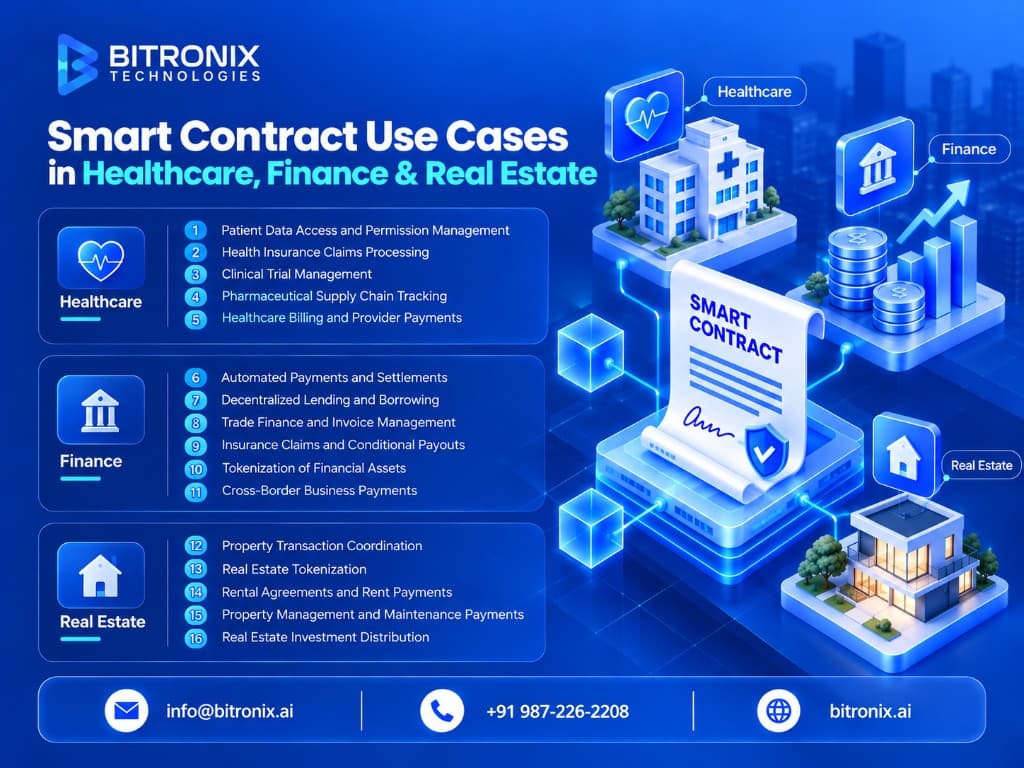
Smart Contract Use Cases in Healthcare
Healthcare organizations work with hospitals, laboratories, insurers, pharmacies, researchers, and patients. These parties often need to exchange information while protecting sensitive medical data.
Smart contracts can help coordinate selected activities between these groups. They should be designed carefully because healthcare data requires strong privacy, security, and access controls.
1. Patient Data Access and Permission Management
Patients may receive care from multiple providers, each using a different information system. This can make it difficult to manage access to medical information consistently.
A smart contract-based system could record permission-related actions, such as which authorized organization can request access to a particular record and when that permission was granted or withdrawn.
For example, a patient may authorize a specialist to access relevant medical information for a consultation. The application can check the patient's recorded permissions before allowing the connected system to provide the data.
The medical records themselves should generally remain in secure, appropriate storage rather than being placed directly on a public blockchain.
Business value: Better visibility into permission changes and a more consistent way to coordinate data access.
Important consideration: Access controls must work with healthcare privacy requirements, identity verification, emergency procedures, and existing medical record systems. Recording a permission on a blockchain does not, by itself, guarantee that the underlying data remains private.
2. Health Insurance Claims Processing
Insurance claims often require information from healthcare providers, insurers, and policyholders. Missing documents or repeated checks can slow down the process.
Smart contracts can automate selected parts of claims handling when the required information is available and the policy rules are clearly defined.
For example, a system could check whether a policy is active, confirm that required claim information has been submitted, and route an eligible claim for the next step. A straightforward claim might qualify for automated processing, while a disputed or unusual claim would still need human review.
Business value: Less repetitive administrative work, clearer claim status, and more consistent handling of routine cases.
Important consideration: A smart contract should not automatically reject a complex medical claim simply because a data field is missing or unusual. Appeals, exceptions, fraud investigations, and clinical judgment may still be necessary.
3. Clinical Trial Management
Clinical trials involve researchers, hospitals, participants, laboratories, and sponsors. Maintaining reliable records of consent, milestones, and study activities is important.
Smart contracts could record selected trial events, manage permission-related workflows, or trigger payments when approved milestones are reached.
For example, a research sponsor could release a site payment after an authorized system confirms that a required milestone has been completed.
Researchers have explored smart contracts for consent management, trial workflows, and timestamped records, but real-world adoption still faces technical, privacy, and regulatory challenges.
Business value: More consistent workflow records and easier verification of selected trial milestones.
Important consideration: Patient identities, medical records, and sensitive research data must be protected. A blockchain record does not replace clinical oversight, informed consent, or regulatory review.
4. Pharmaceutical Supply Chain Tracking
Medicines may pass through manufacturers, distributors, warehouses, pharmacies, and healthcare providers before reaching patients.
A blockchain-based system can record selected events, such as a shipment leaving a facility or a product batch being received. A smart contract can then trigger an alert or update a workflow when required information is recorded.
For example, a distributor could record receipt of a medicine batch, allowing an authorized system to compare the batch information with previous records.
Business value: Better traceability and a clearer record of product movement across participating organizations.
Important consideration: A blockchain cannot prove that a medicine is genuine simply because someone entered its details. Reliable identifiers, verified participants, and trustworthy data capture are essential.
5. Healthcare Billing and Provider Payments
Hospitals, laboratories, insurers, and other providers may need to reconcile invoices and payments across different systems.
Smart contracts could automate payment-related steps when approved billing information and other required conditions are available.
For example, a laboratory may receive payment after an authorized system confirms that a contracted service was completed and the invoice passed the required checks.
Business value: Less manual reconciliation and more predictable payment workflows.
Important consideration: Healthcare billing rules can be complicated. Disputed charges, adjustments, privacy requirements, and payer-specific rules still need appropriate handling.
Smart Contract Use Cases in Finance
Finance is one of the most established areas for smart contract applications because many financial processes involve clearly defined rules, transactions, and asset transfers.
Smart contracts are used in decentralized finance and are also being explored for settlement, tokenized assets, and financial operations involving multiple participants.
6. Automated Payments and Settlements
Businesses may wait for payments while different parties verify invoices, delivery milestones, or contractual obligations.
A smart contract can initiate a supported payment once the required conditions have been confirmed.
For example, a business could agree to release payment in stages as a project reaches approved milestones. Each payment would follow the rules defined for that stage.
Business value: More predictable payment workflows and less manual processing for eligible transactions.
Important consideration: The system needs reliable confirmation of each milestone, sufficient funds, and clear procedures for failed or disputed transactions.
7. Decentralized Lending and Borrowing
Decentralized finance platforms use smart contracts to manage lending, borrowing, collateral, and repayment rules.
A borrower may deposit eligible digital assets as collateral. The contract then applies the platform's rules to the loan, including collateral requirements and repayment conditions.
For example, if the collateral value falls below a defined threshold, the contract may trigger a liquidation process according to the protocol's rules.
Business value: Financial transactions can be managed through transparent, programmable rules without requiring every action to be processed by a traditional intermediary.
Important consideration: Price volatility, faulty price feeds, software vulnerabilities, and liquidation risks can cause significant losses. Automated lending requires careful risk controls and security reviews.
8. Trade Finance and Invoice Management
International trade often involves buyers, sellers, banks, shipping companies, and insurers. Each party may maintain separate documents and records.
Smart contracts can coordinate selected steps when required documents or shipment events have been verified by authorized systems.
For example, a trade finance application could move a payment workflow forward after the required shipping documents are approved.
Business value: Better coordination between participating organizations and fewer repetitive checks.
Important consideration: A smart contract cannot resolve every disagreement over document validity or the actual condition of goods. Legal agreements, authorized reviews, and reliable external data remain important.
9. Insurance Claims and Conditional Payouts
Some insurance products depend on measurable events. These may include a verified weather condition, a covered travel delay, or another event defined in the policy.
A smart contract can check data supplied by an approved source and trigger a payout when the policy's conditions are met.
For example, a parametric insurance product could initiate a payment after an authorized weather data provider confirms that a defined threshold has been reached.
Business value: Faster processing of straightforward claims that meet predefined conditions.
Important consideration: Incorrect external data can produce an incorrect result. Policy wording, exclusions, dispute procedures, and reliable data sources must be considered before automating payouts.
10. Tokenization of Financial Assets
Tokenization involves representing rights to an asset through digital tokens on a blockchain. Depending on the legal structure, the asset may relate to securities, funds, debt instruments, or other financial interests.
Smart contracts can define how tokens are issued and transferred and may enforce certain eligibility or transaction rules.
For example, a tokenized financial product may use a contract to check whether a transfer meets predefined investor eligibility requirements.
Business value: Programmable asset transfers and the potential to coordinate selected processes more efficiently.
Important consideration: A token does not automatically create legal ownership or make an asset transferable in every jurisdiction. Custody, investor rights, applicable regulations, and recordkeeping must be addressed.
11. Cross-Border Business Payments
International payments may involve several financial institutions, currencies, and processing stages.
Blockchain-based systems can use smart contracts to coordinate eligible digital asset transfers or settlement conditions between participants.
For example, a business payment workflow could proceed after the required funds and transaction conditions have been verified.
Business value: Potentially simpler settlement workflows for suitable transactions.
Important consideration: Foreign exchange, liquidity, network fees, sanctions screening, identity checks, and local regulations still matter. A blockchain does not automatically remove these requirements.
Smart Contract Use Cases in Real Estate
Real estate transactions involve buyers, sellers, agents, lenders, property managers, legal professionals, and public authorities. Documents and approvals often move between several parties.
Smart contracts can support parts of these workflows, especially when participants need a shared transaction record or programmable rules for digital assets.
12. Property Transaction Coordination
Buying or selling property can involve agreements, deposits, financing, inspections, and legal approvals.
A smart contract could coordinate selected steps and release funds when authorized parties confirm that agreed conditions have been met.
For example, a deposit workflow could hold digital funds under predefined conditions until the required approvals are recorded.
Business value: Clearer transaction steps and less manual coordination for the parts that can be automated.
Important consideration: Property ownership transfers generally require formal legal procedures and registration. A smart contract cannot independently replace a land registry, title verification, or the applicable conveyancing process.
13. Real Estate Tokenization
Real estate tokenization involves representing certain property-related rights or interests through blockchain tokens.
Depending on the legal structure, a token may represent an interest in a company, a fund, or another legally defined arrangement associated with a property.
Smart contracts can manage token issuance, transfers, and certain ownership-related rules within that arrangement.
For example, an eligible investment platform could use tokens to record an investor's interest in a property-holding entity.
Business value: Programmable transfers and the possibility of dividing eligible investment interests into smaller units.
Important consideration: Tokenization does not automatically make property affordable, liquid, or legally transferable. Investor protections, asset ownership, custody, taxation, and securities laws may apply.
14. Rental Agreements and Rent Payments
Property owners and tenants must manage payment dates, deposits, lease terms, and records of completed payments.
Smart contracts can automate selected payment workflows and record when payments have been received.
For example, a digital rental application could issue a payment reminder and process an agreed digital payment when the tenant authorizes the transaction.
Business value: More organized payment records and less manual work for routine rental transactions.
Important consideration: Lease changes, repairs, disputes, eviction procedures, and other tenant rights require legal and human processes. A smart contract should not be treated as a substitute for landlord-tenant law.
15. Property Management and Maintenance Payments
Commercial buildings and residential properties often rely on contractors for cleaning, repairs, inspections, and maintenance.
A smart contract could coordinate payment after an authorized person confirms that a service has been completed according to the agreed requirements.
For example, a property manager could approve a maintenance milestone in the connected system, triggering the next payment under the contract.
Business value: More consistent records of approvals, work completion, and payments.
Important consideration: The system needs a reliable way to confirm service quality. Photos, inspection reports, or authorized approvals may still require human review.
16. Real Estate Investment Distribution
Some property investment structures distribute rental income or other proceeds among multiple eligible investors.
Smart contracts can calculate and distribute funds according to predefined rules when the required financial information is available.
For example, a platform could allocate an approved distribution among token holders based on their recorded eligible interests.
Business value: Less manual calculation and a more consistent distribution process.
Important consideration: The legal rights of investors, property expenses, tax obligations, and the accuracy of financial records must be handled outside or alongside the contract as required.
Healthcare vs. Finance vs. Real Estate: Where Do Smart Contracts Fit Best?
Each industry has different priorities. Finance often focuses on transactions and settlement, healthcare places greater emphasis on privacy and controlled data access, and real estate must account for legal ownership and formal registration.
| Industry | Suitable applications | Main challenge |
|---|---|---|
| Healthcare | Claims, consent workflows, trial milestones, medicine tracking | Privacy and reliable health data |
| Finance | Lending, payments, insurance, tokenized assets | Security, financial risk, and compliance |
| Real estate | Transaction coordination, rent, tokenization, distributions | Legal ownership and regulatory requirements |
The best use case is not necessarily the one with the most automation. It is the one where a smart contract solves a real problem without adding unnecessary technical or operational complexity.
Benefits of Smart Contracts Across These Industries
Although the applications differ, several potential benefits apply across healthcare, finance, and real estate.
Reduced Manual Processing
Smart contracts can automate repetitive steps such as checking predefined conditions, recording transaction status, and triggering eligible actions.
This may allow employees to spend less time on routine administration and more time handling exceptions.
Better Transaction Records
A blockchain can maintain a shared record of transactions among participating organizations. Depending on the network and its permissions, authorized parties can verify recorded events.
This can make selected activities easier to review, although it does not guarantee that the information originally submitted was accurate.
Consistent Rule Execution
A smart contract applies its programmed logic whenever the relevant conditions are met. This can reduce inconsistent handling of routine transactions.
The rules must be tested carefully because faulty code can produce faulty results repeatedly.
Improved Coordination Between Organizations
When several organizations use different systems, reconciling their records can take time.
A shared blockchain workflow may reduce some of this friction, provided the participants agree on the data, permissions, and governance rules.
Support for Digital Assets
Smart contracts can manage tokens and other blockchain-based assets, including defined transfer rules and programmed distributions.
Legal ownership and rights still depend on the asset structure and applicable law.
Challenges Businesses Should Understand Before Using Smart Contracts
Smart contracts can be useful, but they are not a universal fix for inefficient processes.
Security vulnerabilities: Coding errors or poorly designed permissions can expose funds or sensitive workflows to risk.
Incorrect external information: Contracts often depend on external data sources. If the input is wrong, the automated result may also be wrong.
Privacy requirements: Sensitive medical, financial, and property information must be handled according to applicable privacy rules. Storing confidential data directly on a public blockchain can create serious problems.
Integration with existing systems: Hospitals, banks, insurers, and property managers may use older or incompatible software. Connecting systems can add significant time and cost.
Legal and regulatory obligations: Automated code does not replace professional legal advice, regulatory approvals, or formal procedures.
Maintenance and upgrades: Deployed contracts may be difficult to modify. Businesses should plan for monitoring, upgrades where supported, and incident response.
The safest approach is to select a limited use case, test it with realistic data, assess the risks, and expand only when the solution proves useful.
How to Choose the Right Smart Contract Development Partner
The success of a smart contract project depends on more than the code itself. The development team must understand the business process, identify risks, and design a system that works with the organization's existing operations.
Before selecting a provider, consider the following:
- 1. Industry understanding: Does the team understand the workflow and requirements of your industry?
- 2. Blockchain expertise: Can the team explain why a particular network suits the project?
- 3. Security practices: Are testing, code review, and independent audit requirements clearly defined?
- 4. Integration experience: Can the solution work with the required databases, APIs, wallets, and business systems?
- 5. Data protection: Does the design account for sensitive information and access permissions?
- 6. Clear project scope: Are the features, milestones, costs, and exclusions documented?
- 7. Post-launch support: Is there a plan for monitoring, maintenance, upgrades, and security incidents?
A good development partner should also be willing to explain when blockchain is not the right solution. That advice can prevent unnecessary development expenses.
If your business is exploring a blockchain-based workflow, visit Bitronix Technologies' Smart Contract Development Company to discuss the technical requirements, security considerations, and possible implementation approach.
Let's Turn Your Smart Contract Idea Into a Real Project
Before you hire a smart contract development team or finalize your project budget, it helps to make a few key decisions. Answer these five questions to identify the right direction for your business.
Share your answers on WhatsApp and we will outline the next steps. Select one or more options above to personalise your message.
Final Conclusion
Smart contracts can help healthcare providers coordinate data access and claims, financial businesses automate selected transactions, and real estate companies manage digital assets and payment workflows. Their value comes from solving specific operational problems, not from replacing every existing system with blockchain.
Before investing in development, businesses should identify the process they want to improve, assess privacy and legal requirements, and plan for testing, security, and ongoing maintenance. Some workflows may benefit from smart contracts, while others may be better served by traditional software.
For businesses considering blockchain automation, Bitronix Technologies can help assess technical requirements and plan smart contract solutions around their operational goals.
Explore our Smart Contract Development Services to discuss your project.
Frequently Asked Questions
1. What are the main use cases of smart contracts?
Common use cases include automated payments, decentralized lending, insurance claims, patient consent management, clinical trial workflows, property tokenization, rental payments, and digital asset transfers.
2. How are smart contracts used in healthcare?
They can support permission management for medical data, insurance claims, clinical trial records, pharmaceutical tracking, and provider payments. Sensitive medical information should be protected using appropriate storage and access controls.
3. How are smart contracts used in finance?
Financial applications use smart contracts for lending, borrowing, payments, settlement, insurance payouts, trade finance, and tokenized assets. Security, reliable data, and regulatory compliance remain essential.
4. How are smart contracts used in real estate?
They can support property transaction workflows, rental payments, tokenization of eligible property-related interests, maintenance payments, and investment distributions. They do not automatically replace legal ownership records or property registration.
5. Can smart contracts reduce business costs?
They may reduce some manual processing, reconciliation, and administrative work. Actual savings depend on development costs, transaction fees, integration requirements, and the existing workflow.
6. Are smart contracts secure for healthcare and financial applications?
They can be designed with strong security controls, but they are not automatically secure. Testing, code reviews, appropriate independent audits, privacy safeguards, and ongoing monitoring help manage risk.
7. Can smart contracts store patient medical records?
Technically, data can be written to certain blockchains, but placing identifiable medical records on a public blockchain can create serious privacy and compliance problems. A more suitable design often keeps medical data in protected storage and uses the blockchain to record permissions or verification information.
8. Can smart contracts automate property ownership transfers?
They can coordinate selected transaction steps and manage digital tokens representing legally defined interests. Formal ownership transfers still depend on applicable law, required approvals, and official property registration procedures.
9. What industries benefit most from smart contract development?
Healthcare, finance, and real estate have promising use cases, particularly where multiple parties need to coordinate transactions or follow shared rules. The best industry and application depend on the business problem and whether blockchain offers a practical advantage.
10. How do I choose a smart contract development company?
Look for relevant industry experience, blockchain expertise, transparent pricing, clear project requirements, security testing, integration capabilities, and post-launch support. The company should understand your business workflow as well as the technical implementation.

Founder and CTO
Founder and CTO of Bitronix Technologies. Helps businesses scope, build and secure smart contracts for healthcare, finance, real estate and other regulated industries.
Related Posts
 Smart Contracts
October 14, 202616 min read
Smart Contract Development: A Complete Guide for Businesses in 2027
Learn how smart contract development works in 2027, including business use cases, blockchain platforms, costs, security, and the development process.
Read article Smart Contracts
September 28, 202620 min read
Smart Contract Development Cost: How Much Does It Cost in 2027?
Discover smart contract development costs in 2027. Compare pricing from $5,000, project types, audit fees, timelines, & development factors.
Read article Smart Contracts
May 16, 202625 min read
Smart Contract Development in 2026: A Practical Guide for Founders, CTOs
Eager to know how to create smart contract. Explore complete smart contract development process, cost, working process, chains and technologies.
Read article