Smart Contract Development: A Complete Guide for Businesses in 2027

By Tausif AhmedFounder and CTO
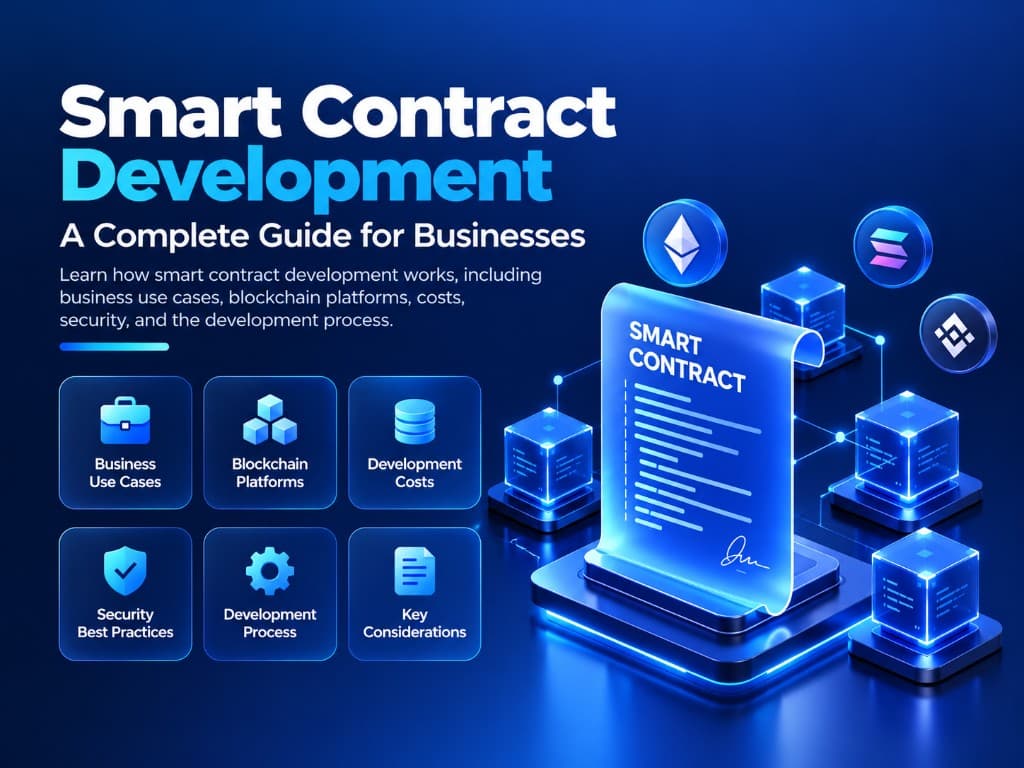
Businesses are always looking for better ways to manage payments, agreements, records, and daily operations. Traditional processes often involve paperwork, manual approvals, and several people checking the same information. These steps can take time and leave room for errors.
Smart contracts offer another way to manage these processes.
A smart contract is a program stored on a blockchain that carries out specific actions when predefined conditions are met. For example, a business could use one to release a payment after a delivery is confirmed or distribute digital assets once a transaction is completed.
As blockchain technology develops, more businesses are exploring smart contracts for financial services, supply chain management, digital assets, real estate, and other applications.
But smart contracts are not the right solution for every business problem. Before investing in development, it is important to understand how they work, what they cost, where they are useful, and how to build them safely.
This guide explains smart contract development in simple terms, with a focus on business needs in 2027.
What Is Smart Contract Development?
Smart contract development is the process of planning, writing, testing, deploying, and maintaining programs that run on a blockchain.
Unlike a traditional agreement that depends on people to complete every step, a smart contract can perform specific actions automatically when its programmed conditions are satisfied.
For example, imagine a company that pays suppliers after receiving goods. In a traditional setup, the company may need to verify the delivery, approve an invoice, and process the payment separately. A properly designed smart contract could automate some of these steps when reliable delivery confirmation is available.
Smart contracts can help businesses reduce manual work, improve transaction visibility, and apply agreed rules consistently.
However, automation depends on the quality of the code and the information supplied to it. A smart contract cannot independently determine whether a real-world event happened unless that information is provided through an appropriate system, such as an oracle or an authorized data source.
How Do Smart Contracts Work?
A smart contract follows rules written in code. These rules define what must happen before the contract performs an action.
Here is a simple example of how a smart contract might handle a payment:
- 1. Conditions are defined: The parties agree on what must happen before payment is released.
- 2. The contract is developed: Developers translate the agreed rules into code.
- 3. The contract is tested: The development team checks normal transactions, unusual cases, and possible security issues.
- 4. The contract is deployed: The code is published to a compatible blockchain.
- 5. A transaction triggers the contract: A user or connected system submits the required information.
- 6. The contract checks its rules: If the conditions are satisfied, it executes the programmed action.
- 7. The result is recorded: The blockchain records the transaction according to the network's rules.
For example, a digital marketplace could use a smart contract to transfer a digital asset to a buyer after the required payment is confirmed.
The exact process depends on the blockchain, the contract design, and whether the application needs to interact with external systems.
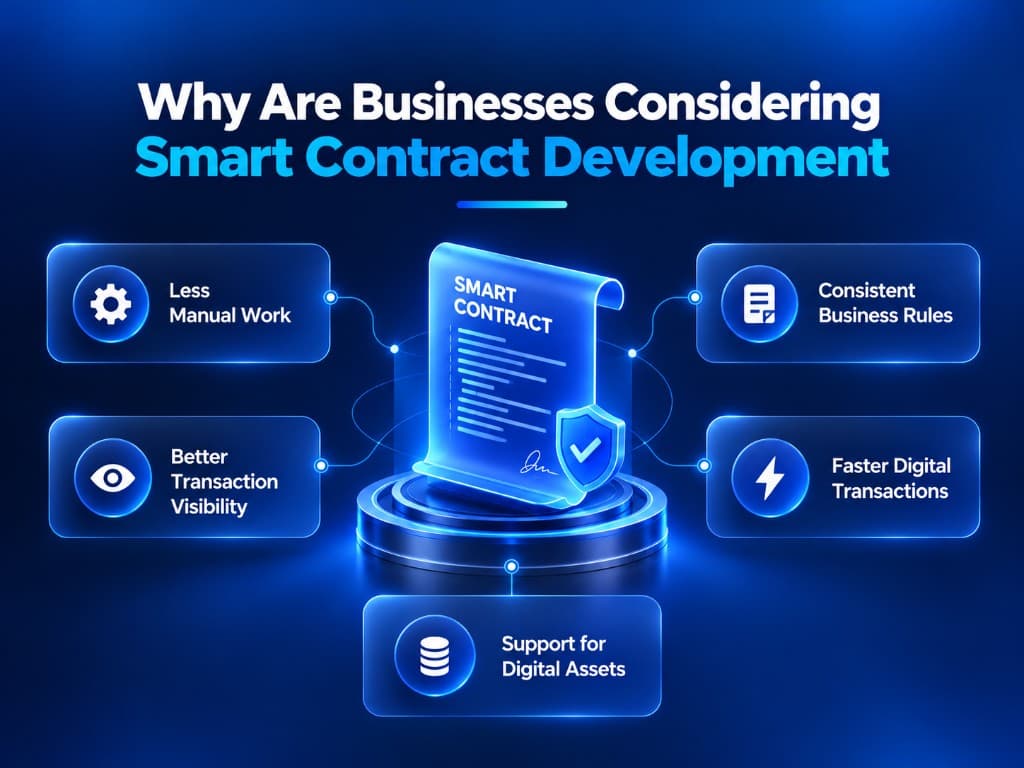
Why Are Businesses Considering Smart Contract Development in 2027?
Businesses are not adopting blockchain simply because it is a new technology. They need clear reasons to invest in it.
Smart contracts can be useful when several parties need to follow shared rules, verify transactions, or coordinate actions without relying entirely on one central system.
1. Less Manual Work
Businesses often spend time checking records, approving transactions, and updating systems. Smart contracts can automate suitable steps and reduce repetitive work.
This does not remove every manual task. Business teams may still need to handle disputes, exceptions, compliance checks, and customer support.
2. Better Transaction Visibility
Blockchain transactions can provide a shared record of activities. Depending on the network and application, authorized participants can verify when a transaction occurred and what was recorded.
This can be valuable when multiple organizations need to review the same transaction history.
3. Consistent Business Rules
A smart contract applies its programmed rules whenever the relevant conditions are met. This helps reduce differences caused by manual processing.
The rules must be designed carefully because incorrect code can apply the wrong outcome just as consistently.
4. Faster Digital Transactions
Some processes can be completed without waiting for separate manual approvals at every stage. This may shorten transaction times, although actual speed depends on the blockchain network, application design, and business workflow.
5. Support for Digital Assets
Smart contracts can create and manage tokens, digital collectibles, tokenized assets, and other blockchain-based applications.
Businesses exploring tokenization can use them to define how assets are issued, transferred, or managed, subject to the relevant legal and technical requirements.
Common Business Applications of Smart Contracts
Smart contracts can support different business models. Their value depends on whether the process benefits from blockchain-based records and automated rules.
Smart Contracts in FinTech
Financial applications can use smart contracts to manage transactions, token transfers, lending rules, and settlement processes.
For example, a decentralized lending application may use a smart contract to track collateral and apply predefined borrowing conditions.
Financial applications require particular attention to security, financial regulations, transaction monitoring, and the handling of unexpected market conditions.
Smart Contracts in Supply Chain Management
Supply chains involve manufacturers, suppliers, logistics companies, distributors, and buyers. Keeping records consistent across these parties can be difficult.
Smart contracts can help automate selected steps, such as recording an approved shipment milestone or triggering a payment after receiving verified delivery data.
The quality of the result still depends on the accuracy of the information entered into the system.
Smart Contracts in Real Estate
Real estate businesses can explore smart contracts for property-related payments, digital records, and tokenization workflows.
For example, a property tokenization platform may use smart contracts to manage the transfer of digital representations of ownership interests.
A smart contract alone does not establish legal ownership of physical property. Legal agreements, property registration, identity checks, and local regulations remain important.
Smart Contracts in Healthcare
Healthcare organizations manage sensitive information, payments, consent, and data access.
Smart contracts may help coordinate permissions or record selected events between authorized systems. They should not expose private medical information on a public blockchain.
Any healthcare implementation must account for privacy, data protection, access control, and applicable healthcare regulations.
Smart Contracts in Gaming and NFTs
Gaming platforms can use smart contracts to issue digital items, manage NFT ownership, and support certain marketplace transactions.
Developers can define rules for transfers, royalties where supported by the application, and other asset-related actions. Actual royalty enforcement depends on the contract and marketplace design.
Smart Contracts for Digital Identity
Smart contracts can support identity-related systems by managing permissions, credentials, or selected verification events.
Sensitive personal information should be handled carefully. A good design generally avoids putting confidential identity data directly on a public blockchain.
Types of Smart Contracts
The best smart contract design depends on the business requirement and the actions the application needs to perform.
1. Token smart contracts
These manage digital tokens, including their issuance, transfers, balances, and other defined functions.
2. DeFi smart contracts
These support decentralized financial applications, including lending, borrowing, exchanges, staking, and liquidity management.
3. NFT smart contracts
These define the creation, ownership, and transfer rules for non-fungible tokens and related digital assets.
4. Governance smart contracts
These support voting, proposal management, and other decision-making processes in decentralized communities or organizations.
5. Escrow smart contracts
These can hold and release digital assets according to predefined conditions. The design must account for disputes and situations that cannot be resolved through automated rules alone.
6. Enterprise smart contracts
These are designed for business workflows, including transaction approvals, asset tracking, settlements, and coordination between participating organizations.
Not every business needs a separate contract for every task. In many projects, a smaller set of well-designed contracts is easier to test, maintain, and secure.
Which Blockchain Is Best for Smart Contract Development?
There is no single blockchain that suits every business. The right choice depends on transaction costs, performance requirements, security, developer tools, network adoption, and the needs of the intended users.
Ethereum
Ethereum is a widely used platform for smart contracts and decentralized applications. It has a mature developer ecosystem and extensive tooling.
It can be a suitable choice for DeFi applications, token projects, and applications that benefit from the Ethereum ecosystem. Transaction fees and scaling requirements should be evaluated before development.
Polygon
Polygon offers blockchain infrastructure used for applications that need compatibility with Ethereum development tools and different transaction-cost or scaling characteristics.
The exact benefits depend on the specific Polygon network and architecture selected.
BNB Smart Chain
BNB Smart Chain supports smart contracts and decentralized applications using Ethereum-compatible development tools.
It may suit projects that want to build within its ecosystem, but businesses should evaluate network risks, costs, and user requirements before choosing it.
Solana
Solana is designed for high-throughput blockchain applications and uses a different programming environment from Ethereum-compatible networks.
It can be suitable for applications that need its performance characteristics and ecosystem. Development tools and programming requirements differ from Solidity-based projects.
Private and Permissioned Blockchains
Some businesses need controlled participation rather than a public blockchain. Permissioned networks can provide access controls and a more restricted environment for participating organizations.
These systems may be useful for enterprise workflows, but their governance, operating costs, and trust model need careful evaluation.
Before selecting a blockchain, compare the available options against the actual business requirements rather than choosing a network based only on popularity.
The Smart Contract Development Process
A successful project starts with a clear business problem, not with writing code.
Step 1: Define the Business Requirement
Identify the task you want to improve. It could be payment processing, token issuance, asset tracking, or the management of digital ownership.
Ask whether a smart contract is necessary or whether a conventional database and application could solve the problem more simply.
Step 2: Plan the Contract Architecture
Decide how the application will work, which blockchain it will use, who can interact with it, and how it will connect to external systems.
The architecture should cover transaction flows, access permissions, error handling, upgrade requirements, and expected usage.
Step 3: Choose the Blockchain and Tools
Select a suitable network and development environment. For EVM-compatible applications, developers commonly use Solidity alongside tools such as Hardhat or Foundry.
Other networks may require different languages and development tools.
Step 4: Develop the Smart Contract
Developers write the contract code according to the agreed specifications.
The code should be understandable, follow established development practices, and avoid unnecessary complexity. Important functions should have clear permission rules and predictable behavior.
Step 5: Test the Contract
Testing should cover more than the expected successful transaction.
A strong testing process includes:
- Unit testing for individual functions.
- Integration testing with other application components.
- Edge-case testing for unusual inputs and conditions.
- Permission and access-control testing.
- Gas or transaction-cost analysis where applicable.
- Security testing for common vulnerabilities.
Testing reduces risk but does not guarantee that a contract is free from defects.
Step 6: Conduct a Security Review
Contracts that manage valuable assets or critical business processes should receive a risk-appropriate security review.
This may include automated analysis, manual code review, and an independent third-party audit. The level of review should reflect the amount at risk and the complexity of the application.
Step 7: Deploy the Contract
After testing and approval, the contract can be deployed to the selected network.
The team should verify the deployed code, manage deployment permissions securely, document important addresses, and prepare monitoring and incident-response procedures.
Step 8: Monitor and Maintain the Application
Deployment is not the end of development.
Businesses may need monitoring, user support, integration updates, performance improvements, and a plan for responding to security incidents.
Smart contracts that cannot be upgraded require special care because fixing a deployed defect may involve additional contracts or a migration process.
How Much Does Smart Contract Development Cost in 2027?
Smart contract development costs vary according to the project's scope, technical complexity, security requirements, and integrations.
A simple token contract is different from a DeFi application that manages collateral, pricing data, and valuable user funds. The second project requires significantly more design, testing, and security work.
Common factors that influence the budget include:
- Contract features and business rules.
- Blockchain selection and deployment requirements.
- Frontend and backend development.
- Wallet and third-party integrations.
- Testing and independent security audits.
- Compliance requirements and ongoing maintenance.
A reliable estimate should follow a technical discovery process. Businesses should compare proposals based on the included work, testing standards, audit scope, deployment support, and post-launch responsibilities rather than price alone.
For an accurate budget, define the required features and security expectations before requesting a development estimate.
Common Smart Contract Development Mistakes
A smart contract can create serious problems when the project is poorly planned or the code is not properly reviewed.
Choosing blockchain before defining the problem: Start with the business requirement and select a network that fits it.
Skipping independent security review: Testing by the development team is valuable, but critical applications may need an independent audit.
Ignoring external data risks: Contracts that rely on prices, shipment updates, or other off-chain events need reliable data sources and safeguards.
Making upgrade decisions too late: Decide early how bugs, new requirements, and emergency situations will be handled.
Underestimating transaction costs: Evaluate expected network fees and contract execution costs under realistic usage conditions.
Treating blockchain records as automatically compliant: Immutable records do not replace legal review, privacy controls, or regulatory obligations.
Launching without monitoring: Prepare a response plan for suspicious transactions, unexpected behavior, and reported vulnerabilities.
How to Choose a Smart Contract Development Company
Selecting the right development partner is an important part of managing project risk.
Before hiring a company, consider the following points.
- 1. Relevant experience: Ask whether the team has worked on projects with similar technical requirements.
- 2. Blockchain expertise: Confirm that the developers understand the network and programming tools your project requires.
- 3. Security practices: Ask about testing, code review, vulnerability assessment, and independent audits.
- 4. Clear project scope: The proposal should explain deliverables, milestones, assumptions, and exclusions.
- 5. Integration capabilities: Check whether the team can handle wallets, APIs, frontend applications, and backend systems where needed.
- 6. Communication: Make sure the team can explain technical decisions in language your business understands.
- 7. Post-launch support: Clarify how monitoring, maintenance, upgrades, and security issues will be handled.
The lowest quotation is not always the best choice. A transparent development process and appropriate security measures can help businesses avoid expensive problems later.
If your business is evaluating a project, explore Bitronix Technologies' smart contract development services to discuss the requirements, architecture, and development approach.
Is Smart Contract Development Right for Your Business?
Smart contracts are most useful when the business process benefits from clear, programmable rules and a reliable shared transaction record.
They may be worth considering if your business needs to automate digital asset transfers, coordinate transactions between organizations, support a decentralized application, or manage tokenized assets.
However, if the workflow depends on frequent exceptions, confidential data, or decisions that require human judgment, a traditional application may be a better fit, or a hybrid solution may work best.
The practical approach is to start with one specific problem, estimate the potential benefit, assess the risks, and build a small proof of concept before committing to a larger implementation.
Final Conclusion
Smart contract development can help businesses simplify selected workflows, automate transactions, and manage digital assets through blockchain-based applications. But the real value comes from solving a genuine business problem, not from adding blockchain technology without a clear purpose.
Before starting a project, define the requirements, choose a suitable blockchain, plan the security approach, and understand the long-term cost of maintaining the application. A well-designed smart contract should be reliable, tested, and built around the needs of its users.
Bitronix Technologies helps businesses explore and develop blockchain solutions based on their technical and operational goals. If you are planning a new smart contract project, visit our smart contract development services to discuss your requirements and the next steps.
Frequently Asked Questions
1. What is smart contract development?
Smart contract development is the process of creating blockchain-based programs that automatically perform predefined actions when specified conditions are met. It includes planning, coding, testing, deployment, and maintenance.
2. How do smart contracts work?
Smart contracts follow rules written in code. When a valid transaction or input meets the required conditions, the contract executes its programmed action and records the result according to the blockchain's rules.
3. Which programming language is used for smart contract development?
Solidity is widely used for Ethereum and many EVM-compatible networks. Other blockchains use different languages and development environments, depending on their architecture.
4. How much does smart contract development cost in 2027?
The cost depends on contract complexity, required features, blockchain selection, integrations, testing, and security audits. A project-specific estimate requires a clear scope and technical assessment.
5. How long does it take to develop a smart contract?
A simple contract may take days or weeks to build and test, while a complex application can take several months. Security reviews, integrations, and business requirements affect the timeline.
6. Are smart contracts secure?
Smart contracts can be designed with strong security practices, but they are not automatically secure. Coding errors, flawed business rules, access-control issues, and unsafe integrations can introduce vulnerabilities.
7. Can smart contracts be changed after deployment?
It depends on how the contract was designed. Some contracts support controlled upgrades, while others cannot be changed directly. Upgrade mechanisms should be planned carefully because they introduce additional risks and trust considerations.
8. Which industries use smart contracts?
Common use cases include financial services, supply chain management, real estate, healthcare, gaming, digital identity, and tokenization. Suitability depends on the workflow, regulations, and technical requirements.
9. What is the difference between a smart contract and a traditional contract?
A traditional contract is a legal agreement between parties. A smart contract is code that executes programmed actions on a blockchain. A smart contract does not automatically replace a legal agreement, and legal enforceability depends on the circumstances and applicable law.
10. How do I choose the right smart contract development company?
Review relevant experience, blockchain expertise, development practices, security testing, audit arrangements, project transparency, and post-launch support. Choose a partner that understands your business requirements as well as the technology.

Founder and CTO
Founder and CTO of Bitronix Technologies. Helps businesses plan, build, test and secure smart contracts and blockchain applications, from requirements and architecture to audit-ready production launches.
Related Posts
 Smart Contracts
October 16, 202620 min read
Smart Contract Use Cases in Healthcare, Finance & Real Estate
Explore smart contract use cases in healthcare, finance, & real estate, including practical applications, benefits, risks, & business examples.
Read article Smart Contracts
September 28, 202620 min read
Smart Contract Development Cost: How Much Does It Cost in 2027?
Discover smart contract development costs in 2027. Compare pricing from $5,000, project types, audit fees, timelines, & development factors.
Read article Smart Contracts
May 16, 202625 min read
Smart Contract Development in 2026: A Practical Guide for Founders, CTOs
Eager to know how to create smart contract. Explore complete smart contract development process, cost, working process, chains and technologies.
Read article