Smart Contract Integration with APIs and Blockchain Oracles: A Complete Guide

By Tausif AhmedFounder and CTO
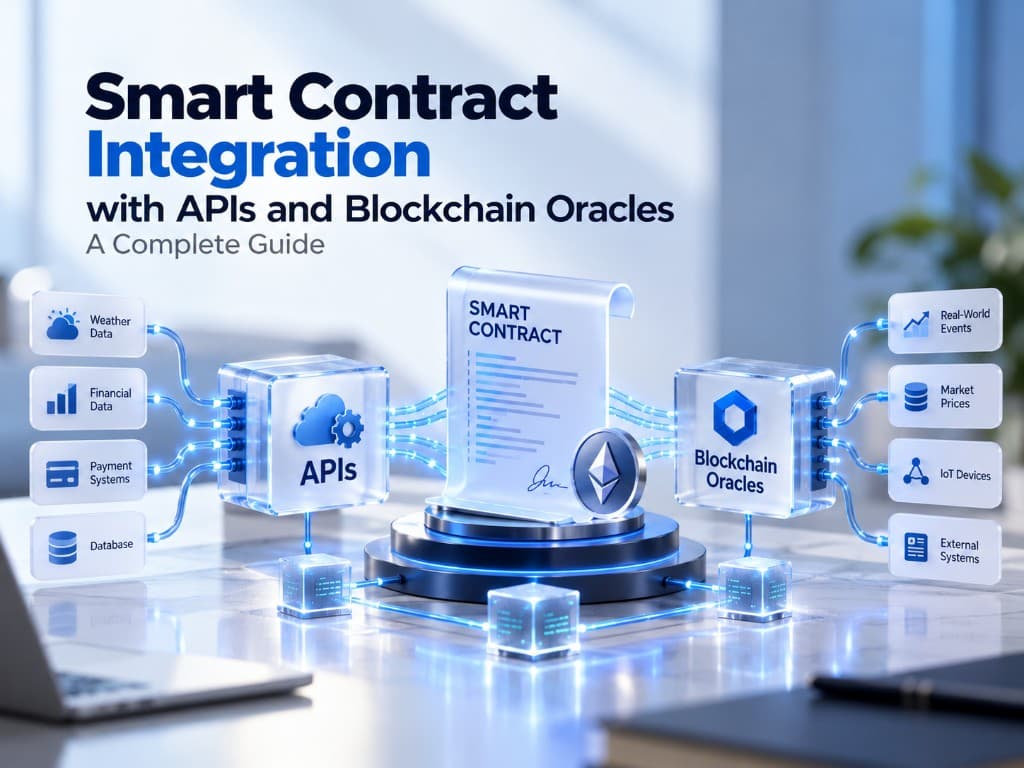
Smart contracts can automate payments, manage digital assets, and execute business rules without requiring manual approval for every transaction. However, they have one important limitation: they cannot directly access most external information, such as live market prices, weather reports, shipping updates, or data stored in traditional business systems.
This is where APIs and blockchain oracles become useful.
APIs allow software systems to exchange information, while blockchain oracles help bring external data into smart contracts or send blockchain events to external systems. When these technologies work together, businesses can build blockchain applications that respond to real-world events.
For example, a decentralized insurance platform could use weather data to process a claim. A DeFi lending platform could use market prices to calculate collateral values. A supply chain application could use delivery information to trigger a payment after goods arrive.
In this guide, we explain how smart contract integration with APIs and blockchain oracles works, where businesses can use it, the challenges involved, and what to consider before starting a project.
What Is Smart Contract Integration with APIs and Blockchain Oracles?
Smart contract integration connects blockchain-based logic with external applications, data sources, and business systems.
It usually involves three main components:
- Smart contracts: Programs deployed on a blockchain that execute predefined rules.
- APIs (Application Programming Interfaces): Interfaces that allow different software applications to exchange information.
- Blockchain oracles: Services that provide external information to smart contracts or help communicate blockchain events to off-chain systems.
Consider an online lending platform. Its smart contract may need the current value of a cryptocurrency before approving a loan. That price might come from several external market data providers.
The smart contract cannot simply make a normal web request whenever it needs the information. An oracle service can retrieve or aggregate the required data and make it available on the blockchain.
The contract can then use that data to apply its lending rules.
This approach is often called a hybrid smart contract, because it combines on-chain code with off-chain data or services.
What Is an API in Smart Contract Development?
An API is a defined way for two software systems to communicate.
For example, a business might use an API to retrieve customer information, check a payment status, access inventory data, or receive delivery updates.
In blockchain development, APIs help connect decentralized applications with services that operate outside the blockchain.
How APIs support blockchain applications
APIs can help with:
- Retrieving information from business databases.
- Connecting blockchain applications to payment gateways.
- Displaying wallet balances and transaction details.
- Sending blockchain events to business applications.
- Connecting decentralized applications with identity verification services.
- Updating dashboards with blockchain transaction data.
- Integrating blockchain platforms with existing enterprise software.
Imagine a company that uses blockchain to track product deliveries. Its logistics provider already has an API that reports shipment status. The blockchain application can use an off-chain service to retrieve that status and pass verified information to the appropriate smart contract through an oracle.
Important distinction: An API does not automatically make external information available to a smart contract. A smart contract running on a public blockchain generally cannot directly call an ordinary external API. An off-chain service, oracle network, or another supported integration method is needed.
What Is a Blockchain Oracle?
A blockchain oracle connects a blockchain with information or services outside the network.
Smart contracts depend on information that blockchain nodes can process consistently. Allowing each node to independently retrieve changing information from the internet could produce different results and interfere with consensus. Oracles provide a controlled way to bring external information into smart contract execution.
Types of blockchain oracles
1. Software oracles
Software oracles provide digital information, including cryptocurrency prices, exchange rates, interest rates, weather data, and market information.
Example: A DeFi lending contract uses an oracle-provided asset price to calculate the value of collateral.
2. Hardware oracles
Hardware oracles connect physical-world data to blockchain applications. They may use sensors, tracking devices, or connected equipment.
Example: A cold-chain logistics platform receives temperature readings from sensors to monitor pharmaceutical shipments.
3. Centralized oracles
A centralized oracle relies on one main provider or operator for its data. This can make implementation simpler, but it creates a dependency on that provider's reliability and honesty.
4. Decentralized oracles
Decentralized oracle networks can use multiple independent node operators and data sources to reduce reliance on a single provider.
They are useful when an application needs stronger protection against inaccurate data or a single point of failure. However, decentralization alone does not guarantee that every data source is correct.
5. Inbound and outbound oracles
Inbound oracles bring off-chain information into smart contracts. Outbound oracles help send blockchain events or instructions to external systems.
For example, an inbound oracle could report a verified delivery status, while an outbound integration could notify an external application after a payment contract completes.
The right oracle model depends on the type of information, the value at risk, response time, and the trust requirements of the application.
How Smart Contract Integration with APIs and Oracles Works
A typical integration follows a sequence of steps.
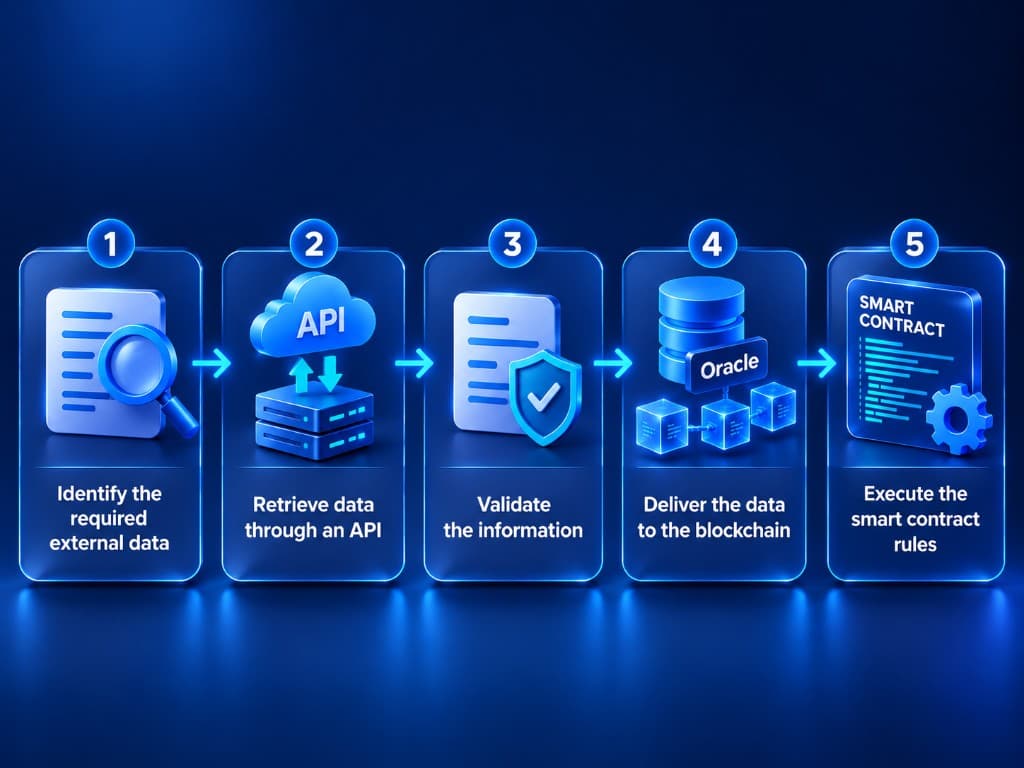
Step 1: Identify the required external data
First, determine what information the smart contract needs.
This could include an asset price, insurance event, payment confirmation, product delivery status, or identity verification result.
The source should be reliable and suitable for the intended business use.
Step 2: Retrieve data through an API
An off-chain application or oracle service requests the required information from an API.
For example, it might request the current price of an asset from a market data provider.
The integration must account for API authentication, rate limits, response formats, timeouts, and unexpected errors.
Step 3: Validate the information
Before the data affects a blockchain transaction, the system should check whether the response is valid and usable.
Depending on the application, checks may include:
- Confirming the data source.
- Checking timestamps and data freshness.
- Validating the response format.
- Comparing multiple sources.
- Rejecting missing or unreasonable values.
- Verifying signatures or proofs when supported.
This step matters because a smart contract may execute its rules correctly while still producing the wrong result if it receives incorrect information.
Step 4: Deliver the data to the blockchain
The oracle or integration service makes the required information available to the smart contract.
The exact process depends on the oracle architecture. It may involve an oracle updating an on-chain data feed or a request-and-response process in which an off-chain service performs work and returns a result.
Submitting a transaction may require network fees, and the contract must be designed to handle delayed or failed responses.
Step 5: Execute the smart contract rules
Once the contract receives the required data, it checks the predefined conditions.
For example, a lending contract might compare the collateral value with the outstanding loan amount and apply its liquidation rules when the relevant conditions are met.
The contract should also define what happens when data is missing, outdated, or outside an acceptable range.
Step 6: Notify connected applications
After the transaction is confirmed, the application can monitor the blockchain event and update its own systems.
A website might display the new status, an internal dashboard might record the transaction, or an authorized business system might start the next workflow.
External actions may still require their own checks and confirmations. A blockchain event does not automatically mean that a traditional bank payment, shipment, or physical-world action has completed.
Real-World Use Cases of Smart Contract API and Oracle Integration
APIs and oracles become especially useful when smart contracts need information that does not originate on the blockchain.
1. DeFi platforms and cryptocurrency pricing
Decentralized finance applications often need market prices to manage lending, borrowing, collateral, and liquidations.
An oracle can make price data available to a smart contract, allowing the contract to apply predefined rules.
For example, a lending platform could use a price feed to calculate the value of a user's collateral before determining borrowing limits.
Developers should consider data freshness, unusual price movements, source quality, and oracle outages. Incorrect prices can lead to incorrect financial decisions.
2. Insurance claim automation
Insurance platforms can use external information to support claim processing.
A weather insurance application, for instance, may use trusted weather data to determine whether a predefined condition has occurred. If the policy conditions are satisfied, the smart contract can calculate an eligible payout.
However, the contract should not rely on a single unchecked data point when a claim has significant financial consequences. Disputed events, incomplete information, and exceptional circumstances may still require human review.
3. Supply chain and logistics
Supply chain applications often depend on information from warehouses, shipping providers, tracking systems, and IoT devices.
APIs can retrieve shipment information, while an oracle can deliver relevant, validated data to a smart contract.
For example, a contract could release payment after receiving an accepted delivery confirmation.
Businesses should carefully define who can submit delivery information and how disputes, damaged goods, and delayed shipments will be handled.
4. Real estate and asset tokenization
Tokenized real estate platforms may use smart contracts to manage digital ownership records, transfers, or investment distributions.
External integrations can support property information, payment records, identity checks, and other administrative processes.
For example, a platform may connect to an approved payment system to reconcile an investor's contribution before allocating digital tokens.
Token ownership alone does not automatically establish legal ownership of a physical property. The legal structure, applicable regulations, and supporting records must align with the tokenization model.
5. E-commerce and payment processing
An online store can connect a blockchain payment application with order management and inventory systems.
The store may monitor confirmed blockchain transactions and update the order status after verifying the payment amount, network, destination address, and confirmation requirements.
For example, an order can move to the next processing stage after the required payment is confirmed.
The integration should prevent duplicate processing and account for underpayments, overpayments, network congestion, and transactions sent on the wrong network.
6. Healthcare and medical data workflows
Healthcare applications may use APIs to communicate with authorized systems and smart contracts to manage permissions or workflow records.
For example, a platform could record an access authorization event or coordinate administrative steps between approved parties.
Sensitive medical records should not be placed directly on a public blockchain without a carefully justified design. Privacy controls, access management, consent, and applicable healthcare regulations must be considered.
7. Prediction markets and event-based applications
Some blockchain applications depend on the outcome of an external event.
An oracle can deliver a result from an approved source so that a smart contract can settle a market or apply the rules of an event-based application.
The developer must decide which source is authoritative, how conflicting reports will be resolved, and what happens if the result is delayed or disputed.
API Integration vs. Blockchain Oracle Integration
APIs and oracles serve related but different purposes.
| Feature | API integration | Blockchain oracle integration |
|---|---|---|
| Main purpose | Allows software systems to exchange information | Makes external data or services usable by smart contracts |
| Common environment | Websites, mobile apps, databases, business software | Blockchain applications and smart contracts |
| Data access | Usually through requests and responses or event subscriptions | Through oracle feeds, messages, or request-and-response workflows |
| Blockchain transaction required? | Not for every API request | Often required when updating or recording on-chain data |
| Typical example | Retrieve a delivery status from a logistics API | Provide validated delivery information to a smart contract |
| Main concerns | Authentication, availability, data quality, access control | Data correctness, oracle reliability, transaction costs, contract safety |
An application may use both technologies together. The API retrieves information from a source, while the oracle or integration architecture makes that information available to the smart contract in a suitable way.
Benefits of Integrating APIs and Blockchain Oracles
Better automation
Smart contracts can apply business rules using external data, reducing the need for manual checks in suitable workflows.
Connection with existing systems
Businesses do not always need to replace their current software. APIs can connect blockchain applications with existing databases, dashboards, payment systems, and enterprise tools.
Faster information flow
Well-designed integrations can reduce delays between receiving external information and updating the blockchain application. Actual speed depends on the API, oracle design, blockchain network, and transaction confirmation requirements.
Improved traceability
Blockchain transactions and events can provide a record of when specific actions occurred. This can help with reconciliation and auditing, although it does not prove that every external data point was truthful.
More flexible business applications
Combining on-chain logic with off-chain information makes it possible to build applications that respond to prices, events, delivery updates, and other changing conditions.
Common Challenges in Smart Contract API and Oracle Integration
Integration can make a blockchain application more useful, but it also introduces additional technical and operational risks.
1. Inaccurate or manipulated data
A smart contract may execute exactly as programmed and still produce an incorrect result if the external data is wrong.
How to address it: Select appropriate sources, validate incoming information, monitor data quality, and use independent sources or decentralized oracle designs where the risk justifies them.
2. API downtime and rate limits
An external API may become unavailable, change its response format, or limit the number of requests.
How to address it: Add timeouts, retry rules, fallback sources where appropriate, monitoring, and clear failure handling. Avoid retry logic that can trigger duplicate business actions.
3. Oracle security risks
A compromised oracle or poorly designed data flow can expose a smart contract to incorrect information.
How to address it: Review the oracle's trust model, source quality, update frequency, permissions, and failure behavior. Audit the smart contract and test the complete integration, not only the contract code.
4. Blockchain transaction costs
Sending data to a blockchain can require transaction fees. Frequent updates or large data payloads may increase costs.
How to address it: Put only the information that needs on-chain verification or execution on-chain. Keep suitable processing and larger datasets off-chain, and choose update frequencies based on actual business needs.
5. Data privacy and compliance
External APIs may handle personal, financial, or commercially sensitive information. Public blockchains may make stored data difficult to remove.
How to address it: Minimize sensitive data on-chain, apply access controls, protect off-chain records, and obtain legal and privacy advice for regulated applications.
6. Network and system compatibility
Different blockchains, APIs, and enterprise systems use different data formats, authentication methods, and technical standards.
How to address it: Define the integration architecture early, document interfaces, and test network-specific behavior before deployment.
Best Practices for Secure Smart Contract API and Oracle Integration
Before launching a project, consider the following practices.
- Choose reliable data sources. Evaluate data quality, update frequency, availability, and the consequences of an incorrect response.
- Validate every important input. Check timestamps, expected ranges, formats, and other conditions before allowing external data to affect financial or business logic.
- Plan for failures. Define what happens if an API stops responding, an oracle update is delayed, or a transaction fails.
- Use appropriate access controls. Protect API credentials, restrict privileged contract functions, and limit who can update important settings.
- Avoid unnecessary on-chain data. Store only what the application needs to execute or verify on-chain. Protect sensitive records in suitable off-chain systems.
- Test realistic failure scenarios. Test stale data, conflicting values, duplicate events, network congestion, API errors, and unauthorized requests.
- Audit the full integration. Review smart contract code, oracle configuration, API permissions, and the services connecting them.
- Monitor the system after launch. Track data freshness, failed requests, unusual price movements, transaction errors, and changes to external services.
These steps help reduce avoidable risks, but they cannot eliminate every vulnerability or guarantee that an integrated system will always operate correctly.
How Much Does Smart Contract API and Oracle Integration Cost?
The cost depends on the complexity of the smart contract, the selected blockchain, the external data sources, the oracle service, and the security requirements.
A simple integration that reads an existing data feed is different from a custom system that connects multiple APIs, verifies several data sources, and triggers financial transactions.
The following are illustrative planning ranges, not verified market quotations or fixed Bitronix Technologies prices.
| Project type | Illustrative development budget |
|---|---|
| Basic smart contract integration | $3,000–$8,000 |
| API integration with oracle functionality | $8,000–$20,000 |
| Multiple data sources and business system integrations | $20,000–$50,000+ |
| Complex enterprise or financial platform | $50,000+ |
Actual quotations may fall outside these ranges.
Other costs can include oracle service fees, blockchain transaction fees, API subscriptions, infrastructure, testing, security audits, and ongoing maintenance.
To estimate the cost more accurately, define the required data sources, transaction frequency, blockchain network, failure-handling rules, and audit requirements before requesting a quotation.
How to Choose a Smart Contract Development Company
The development partner you choose can affect the reliability, security, and long-term maintenance of your integration.
Before selecting a company, check whether it can:
- Develop and test smart contracts for your chosen blockchain.
- Integrate APIs and external data sources.
- Explain the trust model and limitations of the selected oracle.
- Design safeguards for inaccurate, delayed, or unavailable data.
- Perform integration testing and coordinate independent security audits.
- Provide deployment documentation and post-launch maintenance.
Ask potential providers to explain how they would handle a failed API request, stale data, conflicting oracle responses, and unexpected transaction costs. Their answers can reveal how well they understand the practical risks.
Bitronix Technologies offers blockchain and smart contract development services for businesses exploring blockchain applications and integrations.
You can explore the Smart Contract Development Company to learn more about the services available.
Let's Turn Your Smart Contract Idea Into a Build-Ready Project
Answer these five questions to identify your integration needs before requesting a development estimate.
Share your answers on WhatsApp and we will outline the next steps. Select one or more options above to personalise your message.
Final Conclusion
Smart contract integration with APIs and blockchain oracles helps businesses connect blockchain automation with external data and existing software systems. From DeFi price feeds to insurance claims and supply chain tracking, these integrations can make blockchain applications more useful in real business environments.
However, successful implementation requires more than connecting an API to a smart contract. Businesses need to consider data accuracy, oracle reliability, transaction costs, privacy, and how the system will respond when something goes wrong.
Before starting development, define the business problem, choose suitable data sources, and plan the integration and security requirements carefully.
If you are planning a blockchain application that relies on external data, Bitronix Technologies can help you explore your smart contract development requirements and identify a suitable technical approach.
Frequently Asked Questions
1. Can a smart contract directly call an external API?
Generally, no. Smart contracts on public blockchains cannot directly make ordinary HTTP requests to external APIs. They need an off-chain service, oracle, or another supported integration mechanism to deliver the required information.
2. What is the difference between an API and a blockchain oracle?
An API provides an interface for software systems to exchange information. A blockchain oracle makes external information available to smart contracts or helps connect blockchain events with off-chain systems.
3. Why do smart contracts need oracles?
Smart contracts need oracles when their logic depends on information that is not available on the blockchain, such as cryptocurrency prices, weather conditions, shipment updates, or external event results.
4. What is a hybrid smart contract?
A hybrid smart contract combines on-chain code with off-chain data, services, or computation. This lets a blockchain application use external information while keeping its core business rules on-chain where appropriate.
5. Are decentralized oracles more secure than centralized oracles?
Decentralized oracles can reduce dependence on a single operator or data source. However, their security still depends on the data sources, node design, aggregation methods, and safeguards used by the application.
6. How much does smart contract API and oracle integration cost?
The cost depends on the complexity of the project. A basic integration may cost a few thousand dollars, while multi-source or enterprise integrations can cost tens of thousands of dollars or more. A detailed technical assessment is needed for a reliable quotation.
7. Which industries use smart contract oracle integration?
Common applications include decentralized finance, insurance, supply chain, real estate, healthcare, e-commerce, and event-based blockchain applications.
8. How can developers make oracle integrations safer?
Developers should use suitable data sources, validate incoming information, plan for outages, apply access controls, test failure scenarios, monitor the system, and audit the complete integration.
Bitronix Technologies helps businesses explore blockchain and smart contract development for practical business applications.
Learn more about our smart contract development services.

Founder and CTO
Founder and CTO of Bitronix Technologies. Helps businesses design secure smart contract integrations with APIs, oracles and existing software systems.
Related Posts
 Smart Contracts
October 16, 202620 min read
Smart Contract Use Cases in Healthcare, Finance & Real Estate
Explore smart contract use cases in healthcare, finance, & real estate, including practical applications, benefits, risks, & business examples.
Read article Smart Contracts
October 14, 202616 min read
Smart Contract Development: A Complete Guide for Businesses in 2027
Learn how smart contract development works in 2027, including business use cases, blockchain platforms, costs, security, and the development process.
Read article Smart Contracts
September 28, 202620 min read
Smart Contract Development Cost: How Much Does It Cost in 2027?
Discover smart contract development costs in 2027. Compare pricing from $5,000, project types, audit fees, timelines, & development factors.
Read article