Blockchain Solutions for Logistics & Supply Chain: A Complete Guide (2026)

By Tausif AhmedFounder and CTO
A bag of pre-washed spinach sitting on a grocery store shelf used to carry almost no usable history. If a food safety scare hit, tracing that bag back to the farm it came from could take the better part of a week, pulling paper invoices, phone calls and warehouse logs from a dozen different companies that had never shared a system with each other. During that week, stores across the country would often just pull every bag of that product off the shelf, safe or not, because nobody could isolate the source fast enough to do anything smarter.
Walmart fixed that problem with blockchain and the number is almost hard to believe until you see it: tracing a bag of leafy greens back to its farm now takes about 2.2 seconds. Not two days. Two seconds. That single change, built on IBM's Hyperledger Fabric platform, turned a week-long forensic exercise into something close to an instant lookup and it's become one of the most cited examples in enterprise blockchain for a reason: it shows exactly what the technology is good for when it's applied to a real, unglamorous, high-stakes problem.
That's the story most blockchain guides skip in favour of hype. Supply chains are messy by nature dozens of companies, none of whom fully trust each other's paperwork, all trying to move physical goods across borders, warehouses and shipping lanes without losing track of what's real. Blockchain doesn't fix that by being trendy. It fixes it by giving every party in the chain the same tamper-proof, timestamped record, so nobody has to take anyone else's word for it.
This guide walks through what blockchain actually does for logistics and supply chain management, the use cases that are working right now, the ones that have failed and why, what implementation actually costs and where the technology is heading through the rest of 2026.
What Is Blockchain in Supply Chain Management?
At its core, a blockchain is a distributed, tamper-proof ledger shared across a network of computers rather than owned by any single company. Applied to a supply chain, every movement of a product from raw material, to manufacturer, to distributor, to retailer gets recorded as a timestamped block of data that can't be edited or deleted after the fact.
That shared record replaces something supply chains have relied on for decades: each company keeping its own separate paperwork, then reconciling it with everyone else's paperwork whenever there's a dispute, a recall, or a customs check. Blockchain collapses all of that into a single source of truth every stakeholder can see, without needing to hand control of the data to any one party.
This is different from a company just building a better internal tracking system. The value of blockchain in a supply chain context comes specifically from multiple parties, who don't fully trust each other, agreeing to record data on infrastructure none of them individually controls.
Key Benefits of Blockchain in Logistics
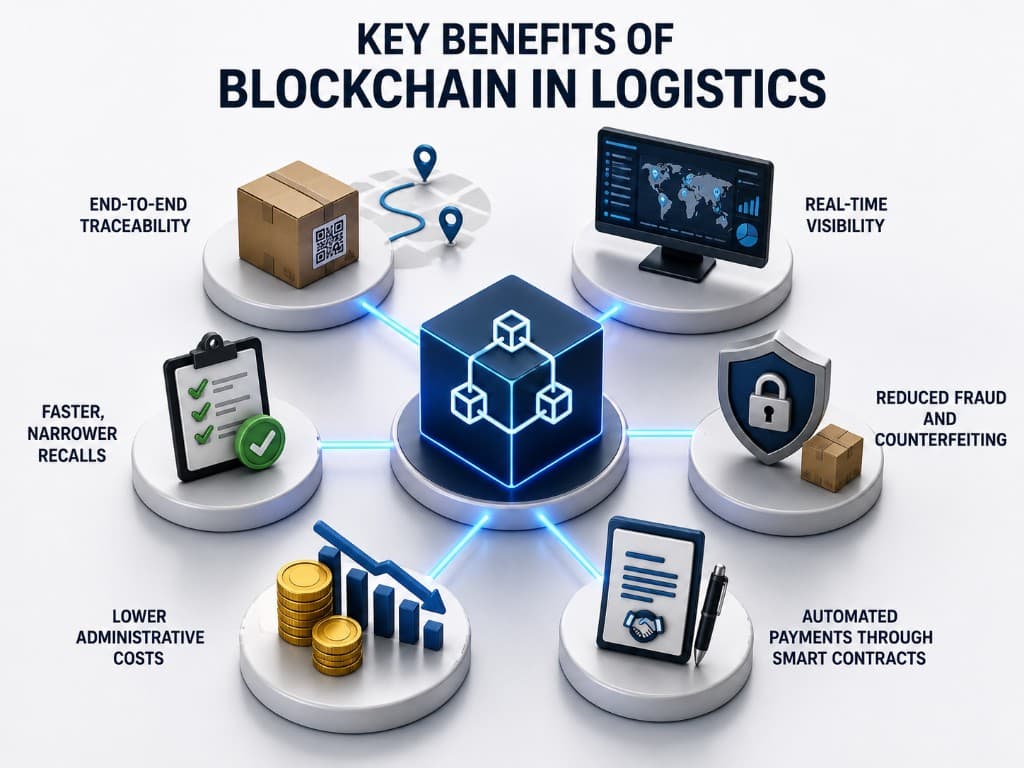
- End-to-End Traceability Every step a product takes, from raw material to final delivery, gets logged permanently, with no gaps for a company to say the record was lost or the data wasn't captured.
- Real-Time Visibility All parties in the supply chain see the same live data at the same time, instead of waiting on emails, phone calls, or manual status updates from a partner three steps up the chain.
- Faster, Narrower Recalls When something goes wrong, blockchain lets companies isolate the exact batch or shipment affected, rather than pulling an entire product line off shelves nationwide out of caution.
- Reduced Fraud and Counterfeiting A tamper-proof record makes it dramatically harder to fake a certificate of origin, substitute a lower-quality product mid-shipment, or pass off a counterfeit as the real thing.
- Lower Administrative Costs Industry estimates put administrative cost reductions from blockchain adoption in the 20 to 30 percent range, largely from cutting out redundant paperwork and manual reconciliation between parties.
- Automated Payments Through Smart Contracts Smart contracts can release payment automatically the moment a delivery is confirmed on-chain, cutting out delays, intermediaries and disputes over whether goods actually arrived.
Real Companies Using Blockchain in Supply Chain Today
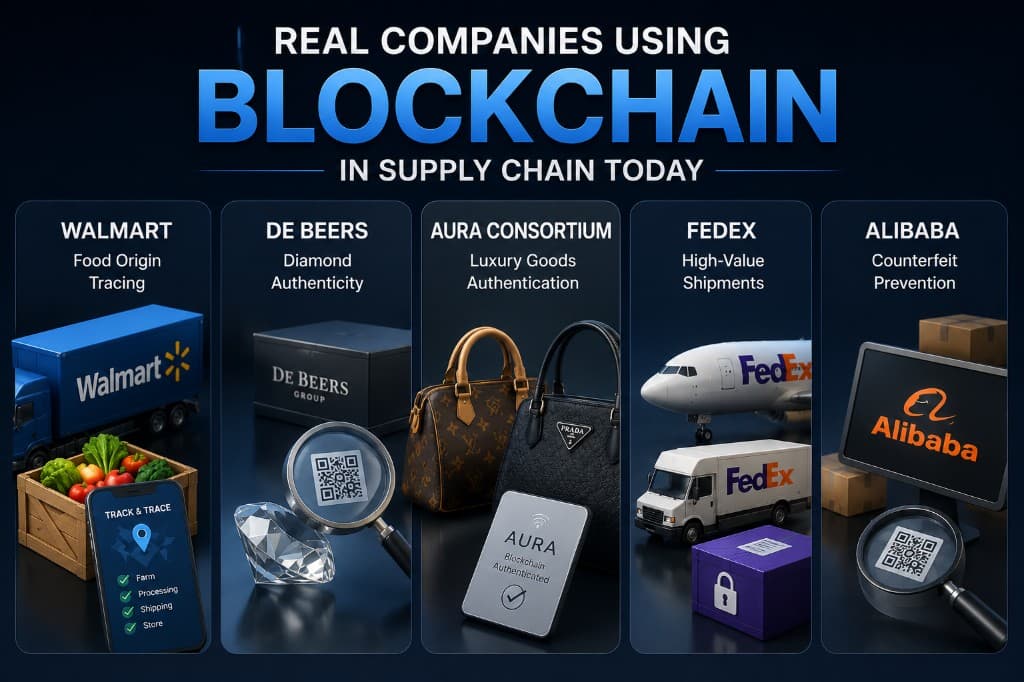
- Walmart and IBM Food Trust Walmart's food traceability system, built on IBM's Hyperledger Fabric, is the standout example in this space. What used to take close to seven days now takes about 2.2 seconds, letting the company trace a specific batch of produce back to its farm of origin almost instantly during a food safety event.
- De Beers and Tracr De Beers built Tracr to track diamonds from the mine to the retail counter, giving each stone a digital record that proves it wasn't sourced from a conflict zone and that the physical diamond in a customer's hand is actually the one recorded on the ledger.
- The Aura Consortium Luxury brands including Louis Vuitton and Prada back the Aura Consortium, which uses blockchain to prove the authenticity of handbags and other high-value goods, directly targeting the counterfeit market that costs luxury retailers billions every year.
- FedEx FedEx uses blockchain to manage chain of custody for high-value and sensitive shipments, creating tamper-proof documentation at every handoff so accountability doesn't get lost between carriers.
- Alibaba Alibaba runs private blockchain systems to verify product authenticity across its marketplace, aimed squarely at combating counterfeit goods in categories where fakes are common.
The TradeLens Story: What Blockchain Can't Fix on Its Own
Not every blockchain supply chain initiative succeeds and the most important one to understand is TradeLens, a platform Maersk and IBM built to digitise global container shipping documentation. On paper, it solved a real problem: ocean freight still runs on an enormous volume of paper documents, customs forms and manual handoffs between shippers, ports and customs authorities.
TradeLens worked technically. It reduced documentation bottlenecks and cut port delays for the companies that used it. But Maersk and IBM shut the platform down in 2023 and the reason wasn't the technology it was adoption. Competing shipping lines were reluctant to run their data through a platform partly owned by one of their biggest rivals and without enough of the industry on board, the network effect a shared ledger depends on never fully materialised.
The lesson matters for any business evaluating blockchain in logistics: the technology can be flawless and the project can still fail if the people who need to trust and use it don't have a reason to get on board. A blockchain supply chain solution is only as strong as the willingness of every party in the chain to actually participate in it.
How Blockchain Actually Works in a Supply Chain Context
- Data Capture IoT sensors, barcodes, RFID tags, or manual entry log an event: a shipment leaving a warehouse, a temperature reading in a refrigerated container, a customs clearance.
- Recording on the Ledger That event is packaged into a block, cryptographically linked to the block before it and distributed across every node in the network, making it effectively impossible to alter after the fact.
- Verification Depending on the network's design, other participants or validating nodes confirm the transaction is legitimate before it's permanently added to the chain.
- Smart Contract Execution If predefined conditions are met a temperature staying within range for the entire cold chain journey, for instance a smart contract can automatically trigger the next step, whether that's a payment release or a compliance certification.
- Shared Access Every authorised party the manufacturer, the shipper, the customs authority, the retailer can view the same record in real time, without needing to request it from whoever currently holds the paperwork.
Implementation Process for Blockchain in Supply Chain
Step 1: Map the Existing Supply Chain
Before writing any code, document exactly where data currently breaks down which handoffs cause delays, disputes, or visibility gaps today.
Step 2: Choose the Right Blockchain Architecture
Most enterprise supply chain deployments use permissioned blockchains like Hyperledger Fabric rather than public networks, since supply chain partners typically need controlled access rather than full public visibility.
Step 3: Define What Gets Tracked
Decide exactly which data points matter batch numbers, temperature logs, certificates of origin, customs documents and design the system around those specific needs rather than tracking everything indiscriminately.
Step 4: Integrate With Existing Systems
The blockchain layer needs to connect to a company's existing ERP, warehouse management and IoT sensor infrastructure, rather than replacing all of it outright.
Step 5: Onboard Supply Chain Partners
This is the step that sank TradeLens. Every meaningful participant suppliers, carriers, customs authorities needs a real incentive to join and use the system, not just a technical invitation.
Step 6: Pilot Before Scaling
Start with a single product line, route, or facility to prove the system works and surface integration problems before rolling it out across an entire network.
Step 7: Monitor and Expand
Once the pilot proves out, expand coverage gradually, adding partners, product lines and data points as adoption grows.
Cost of Implementing Blockchain in Supply Chain
Costs vary enormously depending on scope, but a rough range helps with planning:
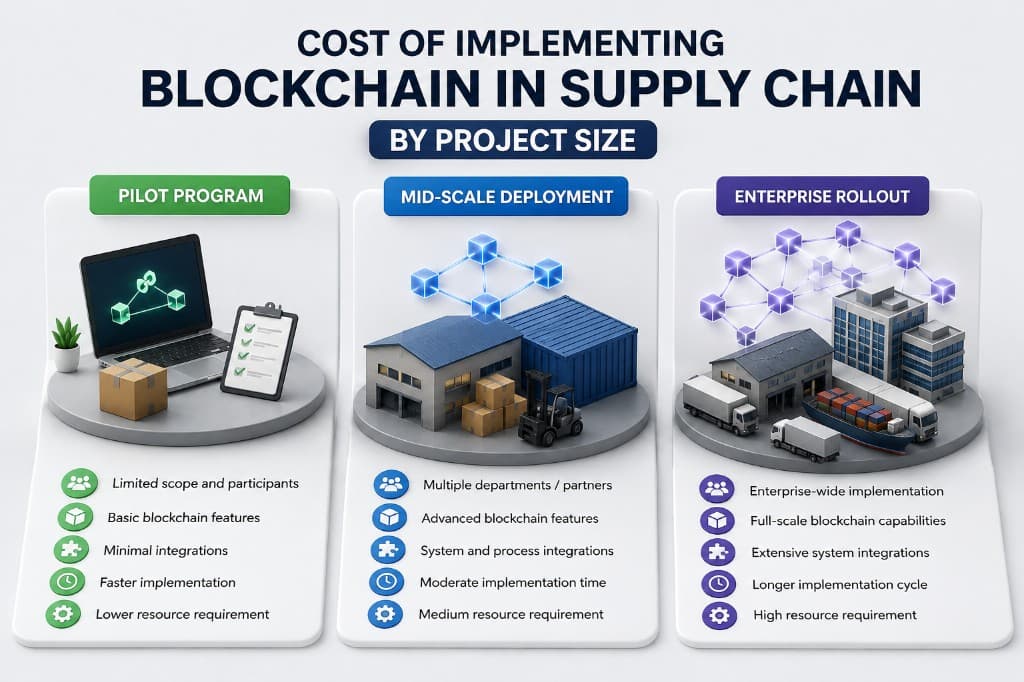
| Project Type | Estimated Cost | Estimated Timeline |
|---|---|---|
| Pilot program (single product line or route) | $25,000 – $75,000 | 6–10 weeks |
| Mid-scale deployment (multiple partners, one facility) | $75,000 – $250,000 | 3–6 months |
| Enterprise-wide rollout (full network, IoT integration) | $250,000 – $1,000,000+ | 6–18 months |
The global market for blockchain in logistics reflects how fast this is scaling: industry projections put the market growing from roughly $2.4 billion in 2024 to over $95 billion by 2034, which tells you where enterprise budgets are heading over the next decade, even if individual project costs vary widely today.
Common Challenges in Blockchain Supply Chain Adoption
- Getting Enough Partners on Board As TradeLens showed, a supply chain blockchain only works if enough of the chain actually participates. This is a business and trust problem far more than a technical one.
- Integration With Legacy Systems Most supply chain companies run on decades-old ERP and inventory systems and connecting those to a blockchain layer without disrupting daily operations takes careful planning.
- Data Quality at the Point of Entry Blockchain guarantees a record can't be altered after it's entered, but it can't guarantee the data was accurate in the first place. Garbage in still means garbage on the ledger.
- Scalability High-volume supply chains generate enormous transaction volume and not every blockchain architecture handles that gracefully without added infrastructure cost.
- Regulatory Uncertainty Rules around digital trade documentation and cross-border data sharing are still evolving in many regions, which means compliance requirements can shift mid-project.
Where Blockchain in Supply Chain Is Headed
- AI and Blockchain Convergence Pairing blockchain's tamper-proof records with AI-driven analytics is becoming standard, letting companies not just verify what happened but predict disruptions before they occur.
- Interoperability Standards The industry is moving toward shared standards that let different blockchain networks communicate, directly addressing the trust and adoption problem that killed platforms like TradeLens.
- Tokenized Carbon Tracking Platforms are beginning to tokenize carbon credits tied to shipping and logistics activity, preventing the double-counting that has undermined carbon accounting in the past.
- Regulatory Push Toward Digital Traceability Regulatory shifts across the EU and US are pushing digital traceability mandates further into the mainstream, particularly in food, pharma and hazardous goods, which will likely make blockchain adoption less optional over the next few years.
Conclusion
Blockchain in supply chain and logistics isn't a future bet anymore it's an operational tool that companies like Walmart, De Beers and FedEx are already running in production, with real numbers behind it: 2.2-second food traces, industry-wide administrative cost reductions in the 20 to 30 percent range and a market on track to grow nearly fortyfold over the next decade.
But TradeLens is the reminder every business needs before starting a project like this: the technology works. What determines success is whether enough of your supply chain partners actually show up and use it. Get the trust and incentive structure right and blockchain turns a fragmented, paperwork-heavy supply chain into something closer to a single, shared source of truth.
If you're evaluating blockchain for your own supply chain or logistics network, talk to our team about what a realistic pilot would look like for your specific operation or explore our supply chain and enterprise blockchain services.
Frequently Asked Questions
Is blockchain actually necessary for supply chain management, or is it overkill?
For supply chains involving multiple parties who don't fully trust each other's records food safety, pharmaceuticals, luxury goods, cross-border trade blockchain solves a real coordination problem. For a single-company internal inventory system, a traditional database is often simpler and cheaper.
Why did TradeLens fail if the technology worked?
TradeLens failed because of adoption, not technology. Competing shipping lines were reluctant to route sensitive data through a platform partly owned by a direct competitor and without enough participants, the shared ledger never delivered its full value.
How long does a blockchain supply chain pilot typically take?
A focused pilot covering a single product line or route usually takes 6 to 10 weeks, while an enterprise-wide rollout with full IoT integration can take 6 to 18 months.
Does blockchain guarantee the data entered is accurate?
No. Blockchain guarantees that once data is recorded, it can't be altered. It doesn't verify that the original data entry was correct, which is why data capture quality at the source still matters enormously.
What industries benefit most from blockchain in supply chain right now?
Food and agriculture, pharmaceuticals, luxury goods and cross-border logistics currently show the clearest, most measurable returns, largely because fraud, recalls and documentation delays are especially costly in those sectors.

Founder and CTO
Founder and CTO of Bitronix Technologies. Builds custom blockchain traceability and supply chain platforms for enterprises across food, pharma, logistics and luxury goods.
Related Posts
 Blockchain
October 14, 202615 min read
Crypto Token Development Cost in 2027: Pricing, Features and Budget Breakdown
Explore crypto token development cost in 2027, with estimated pricing, key cost factors, smart contract audits, development timelines, & hidden expenses.
Read article Blockchain
October 1, 202613 min read
Top 10 Companies to Hire Blockchain Developers in India 2026-2027
Find the top 10 companies to hire blockchain developers in India. Compare blockchain services, expertise, use cases, & tips for choosing a development partner.
Read article Blockchain
September 25, 202616 min read
RWA Tokenization in Singapore: Regulations, Licensing & Complete Guide 2026
Learn about RWA tokenization in Singapore, including MAS regulations, licensing, compliance, use cases, costs and how to build an RWA platform in 2026.
Read article