
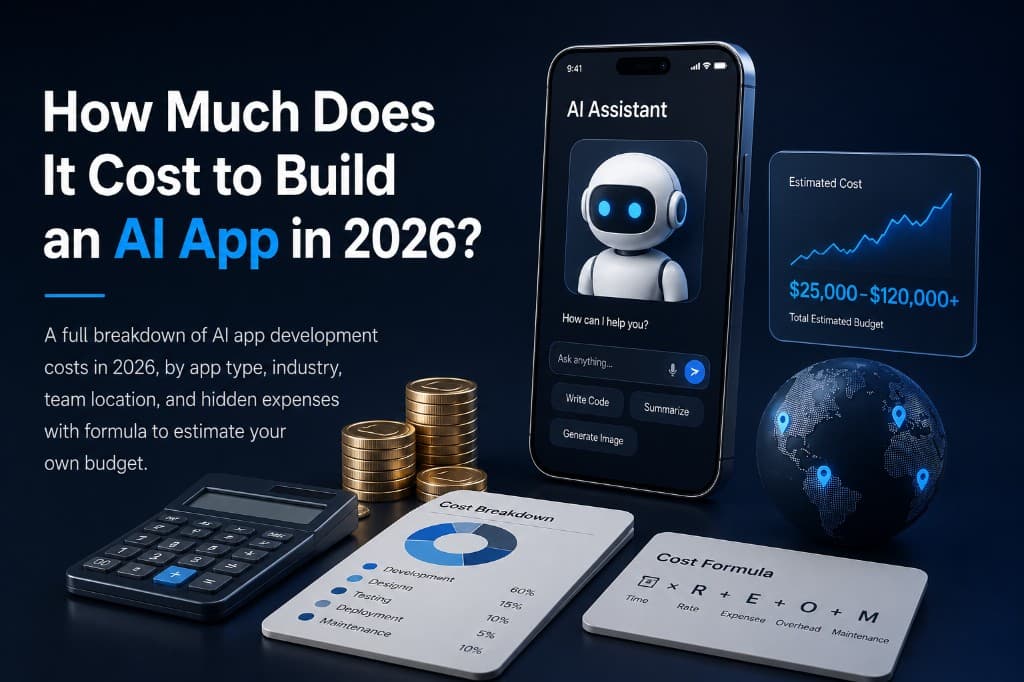
Most AI apps in 2026 cost somewhere between $30,000 and $300,000 to build. Simple tools like a basic chatbot or a document Q&A assistant can come in under $40,000. Mid-complexity apps with personalization, predictive features, or workflow automation usually land between $100,000 and $250,000. Enterprise-grade systems with custom models, deep integrations, and compliance requirements regularly cross $400,000 and, in some cases, $500,000+.
That's the honest range. But if you've ever gotten three quotes for what sounds like the same project and watched them come back at $15,000, $80,000, and $250,000, you already know the range alone isn't useful. What matters is understanding *why* the number moves, because once you know that, you can control it instead of just hoping your vendor gives you a fair price.
We build AI apps for a living at Bitronix Technologies, so this isn't a theoretical exercise for us. This is close to the actual conversation we have with clients in the first discovery call, minus the sales pitch. Let's get into it.
Why the Same "AI App" Can Cost $20K or $300K
Here's the thing nobody tells you upfront: "AI app" isn't one category of software. It's a spectrum. On one end, you have a wrapper around an existing model API that answers questions using your FAQ page. On the other end, you have a system that reads real-time data, makes autonomous decisions, talks to six other pieces of software in your company, and has to survive a security audit before your compliance team will let it near customer data.
Both of those get called "an AI app." Only one of them costs $300,000. So before you can put a number on your project, you need to know where it sits on that spectrum. That's really what the rest of this article is about.
The Real Cost Drivers Behind Every AI App
Every quote you'll ever get, whether it's $15,000 or $500,000, boils down to a handful of variables. Get clear on these first, and the number stops feeling random.
1. How Much Autonomy The AI Actually Has
This is the single biggest lever. There's a huge difference between an AI feature that suggests something to a human who then clicks a button, and an AI agent that reads an email, decides what to do about it, updates three systems, and only pings a human if something looks off.
The more independently a system has to reason, plan, and act inside your business, the more engineering it takes to make it safe and reliable. A support chatbot that answers from a knowledge base is a few weeks of work. An agent that can actually process a refund, update inventory, and notify a customer is a different project entirely not because the AI part is harder, but because the guardrails, error handling, and audit trail around it are.
2. Retrieval-Augmented Generation (RAG) vs. Fine-Tuning
If your AI needs to know about *your* business, your documents, your product catalog, and your internal policies, you have two main paths, and they have very different cost profiles.
RAG systems pull relevant information from your own data at the moment someone asks a question, rather than baking that knowledge into the model itself. A typical RAG setup runs around $4,000 in initial setup plus roughly $1,000–$1,500 a month in infrastructure, which works out to somewhere near $18,000 in year one for a standard enterprise scope.
Fine-tuning, where you actually retrain a model on your data, tends to run closer to $15,000 upfront, plus ongoing hosting and periodic retraining costs that push year-one spend closer to $30,000. Fine-tuning starts to make more financial sense only once you're running very high query volumes, generally past 100,000 queries a day, where the lower cost per request eventually pays back the higher upfront investment.
For most businesses, RAG is the right default. It's cheaper, and it handles the reality that your data changes constantly, without needing to retrain a model every time your product catalog updates. See our production RAG guide for enterprises for what a serious implementation looks like.
3. Integration Depth
This is the cost driver that blows up more budgets than anything else. An AI feature that lives in isolation is cheap. An AI feature that has to talk to your CRM, your ERP, your identity system, your data warehouse, and your ticketing tool is not.
Each integration between your AI system and an existing piece of software typically costs somewhere between $5,000 and $25,000 to design, build, and properly secure. A mid-sized enterprise deployment often touches anywhere from four to twelve internal systems. Do the math on eight integrations at an average of $15,000 each, and you're already at $120,000 before a single line of AI logic has been written.
If there's one thing worth double-checking before you sign off on a quote, it's this: does it actually include the cost of connecting to *your* systems, or just the AI feature sitting next to them?
4. Data Readiness
AI is only as good as what it's trained or grounded on, and this is where a lot of projects quietly go over budget. Data preparation cleaning, structuring, labeling, and making your data actually usable commonly eats up 25–40% of a project's total budget, and it's the cost most teams underestimate going in.
If your data already lives in clean, well-organized systems, you're in good shape. If it's scattered across spreadsheets, old databases, and three different tools that don't talk to each other, budget accordingly, because that gap has to get closed before the AI part can even start.
5. Compliance and Governance
If your app touches healthcare data, financial transactions, or personal information, compliance isn't optional, and it isn't free. Financial services AI, for example, often carries a 25–35% premium over baseline costs once you factor in things like encryption setup, fraud detection layers, multi-factor authentication, and the certifications regulators expect.
Even outside heavily regulated industries, frameworks like the NIST AI Risk Management Framework are becoming the default expectation for anything that makes decisions affecting real people. That means budgeting for explainability, monitoring, and audit trails not as an afterthought, but as part of the original scope.
6. Where Your Development Team Is Based
This one's straightforward but worth spelling out. Hourly rates vary enormously by region:
- US and Canadian developers: roughly $150–$250 per hour
- Western European teams: roughly $80–$150 per hour
- Eastern European and South Asian teams: roughly $25–$75 per hour
The rate gap is real, but it's not the whole story. Time zone overlap, communication quality, and how well a team actually understands AI-specific engineering (as opposed to general app development) all affect the *true* cost, including how many revision cycles you go through and how production-ready the first version actually is.
Cost by App Type: What Different AI Apps Actually Cost in 2026
Here's how costs typically break down by the kind of AI app you're building. These are working ranges based on current 2026 market benchmarks, not sticker prices from any one vendor.
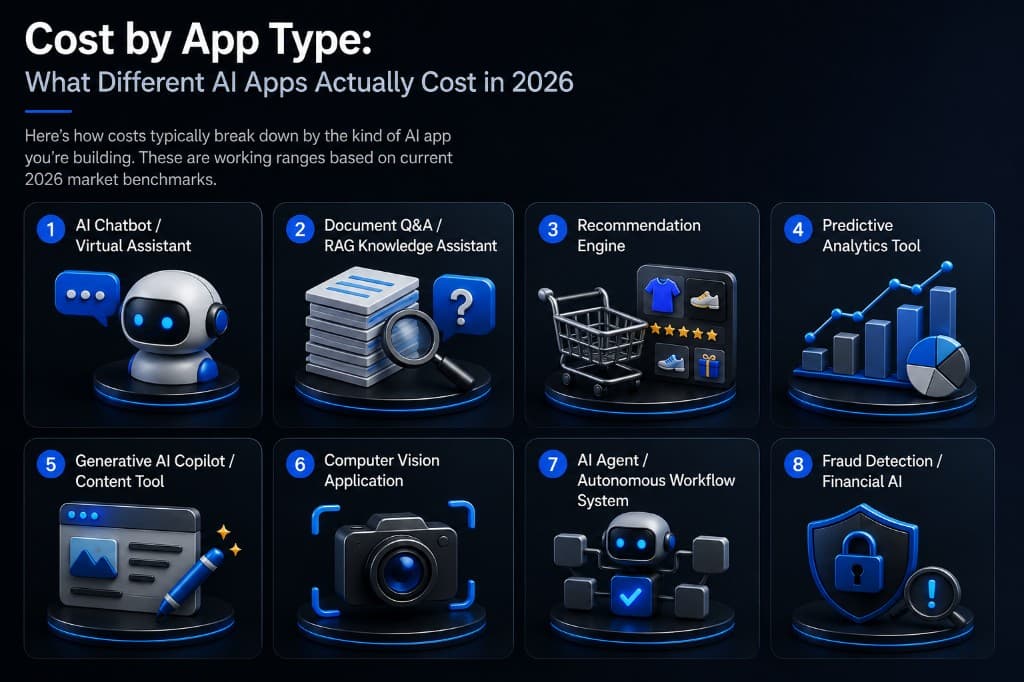
| App Type | Typical Cost Range | What Drives the Range |
|---|---|---|
| AI chatbot / virtual assistant | $25,000 – $80,000 | Multi-language support, sentiment analysis, CRM integration |
| Document Q&A / RAG knowledge assistant | $18,000 – $90,000 | Data volume, retrieval accuracy needs, update frequency |
| Recommendation engine | $30,000 – $300,000 | Data complexity, personalization depth, real-time vs. batch |
| Predictive analytics tool | $40,000 – $300,000 | Data volume, accuracy requirements, industry |
| Generative AI copilot / content tool | $50,000 – $250,000+ | Compute usage, monitoring, usage-based scaling |
| Computer vision application | $60,000 – $500,000 | Dataset size, training infrastructure, real-time performance needs |
| AI agent / autonomous workflow system | $80,000 – $400,000+ | Number of tools it connects to, decision complexity, human-in-the-loop design |
| Fraud detection / financial AI | $100,000 – $400,000+ | Regulatory compliance, accuracy requirements, real-time processing |
Two things worth noticing here. First, almost every category has a wide spread, and the reason is always one of the six factors above usually integration depth or compliance. Second, generative AI and agentic systems sit at the more expensive end of the spectrum in 2026, mainly because inference costs and the engineering needed to keep an autonomous system reliable have both become bigger line items than they were even a year or two ago.
A Simple Formula to Estimate Your Own Budget
If you want a rough number before you get on a call with anyone, here's a formula that gets you in the right neighborhood:
Estimated Cost = Base App Cost + (AI Feature Cost × Complexity Factor) + UI/UX Design + Integrations + Data & Infrastructure
Let's run this step by step, using a realistic mid-sized example: a customer support AI assistant for a growing e-commerce business.
- Step 1 Base App Cost: Web frontend, backend, authentication, and basic infrastructure. Budget $8,000–$15,000. Example: $10,000.
- Step 2 AI Feature Cost × Complexity Factor: RAG-based assistant pulling from product catalog, order data, and support docs. Base $8,000–$15,000 × 1.5 complexity = $18,000.
- Step 3 UI/UX Design: Branded chat interface plus internal review dashboard. Budget $8,000–$15,000. Example: $10,000.
- Step 4 Integrations: Order management + help desk (2 × ~$10,000) = $20,000.
- Step 5 Data & Infrastructure: RAG pipeline, vector database, year-one hosting (~$5,000 setup + $14,400 hosting) = $19,400.
Total: $10,000 + $18,000 + $10,000 + $20,000 + $19,400 = $77,400 solidly mid-complexity. If the same assistant later needed to autonomously process refunds, expect another $40,000–$80,000 for agentic safeguards and testing.
Build your own rough number using this formula before you talk to any vendor. When a quote comes back wildly different, you'll know exactly which line item to ask about.
Cost by Phase: Where the Money Actually Goes
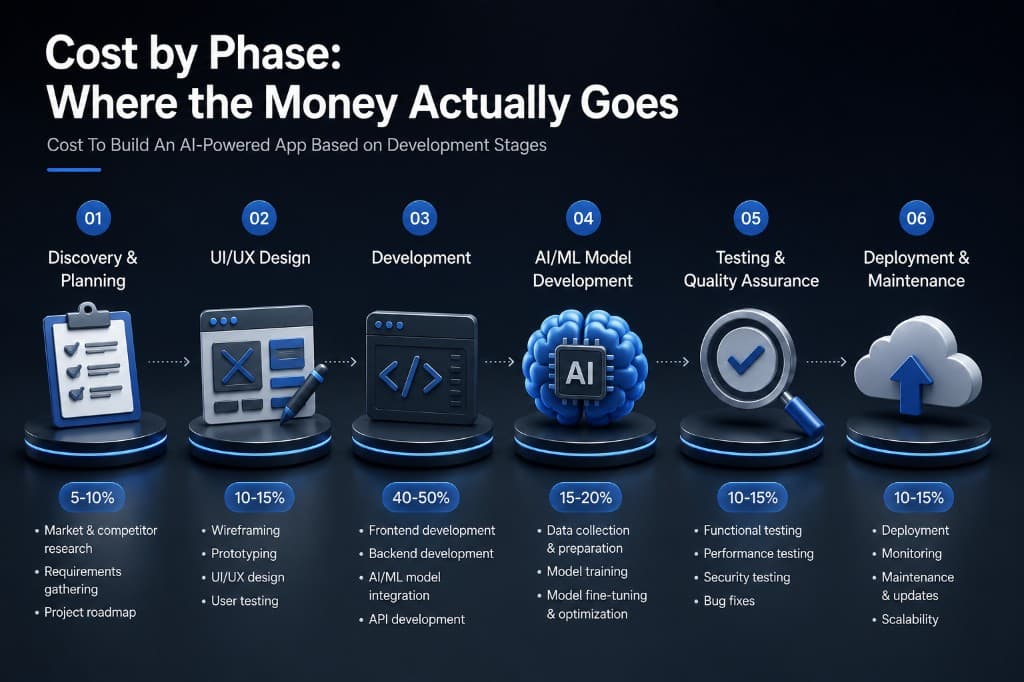
| Phase | % of Total Budget | What Happens Here |
|---|---|---|
| Discovery & scoping | 5–10% | Requirements, feasibility, architecture decisions, data audit |
| Data preparation | 20–35% | Cleaning, structuring, labeling, building the pipeline the AI will run on |
| Core AI/model development | 20–30% | Building or configuring the RAG pipeline, fine-tuning, or model logic |
| App development (frontend/backend) | 15–25% | The regular software wrapped around the AI UI, backend, auth, dashboards |
| Integrations | 10–25% | Connecting to your CRM, ERP, help desk, payment systems, etc. |
| Testing & QA | 8–12% | Functional testing plus AI-specific testing: accuracy, hallucination rate, edge cases |
| Deployment & launch | 3–5% | Production setup, monitoring hookup, go-live |
Notice that "building the AI" is often not even the largest line item. Data preparation frequently costs more than the model work itself, and once you add app development and integrations together, the non-AI parts of an AI app usually account for well over half the total budget.
For timeline: discovery typically takes 1–2 weeks; data preparation and core AI development run in parallel over 4–10 weeks; app development, integration, and testing add another 4–12 weeks. That's how you get 2–4 week MVP timelines for simple tools and 6–12 month timelines for enterprise systems.
In-House Team vs. Outsourced Agency vs. Freelancers: A Real Cost Comparison
In-House Team: A dedicated senior AI engineer in the US typically means a fully loaded cost well north of $180,000–$250,000 a year before you've hired the ML specialist, backend developer, and designer you'll also need. This makes sense if AI is central to your product for years; otherwise you're paying full-time costs for a six-month build.
Outsourced Agency: You pay for an assembled team that knows how to scope AI-specific risk and has shipped similar systems. The real value isn't the hourly rate it's fewer expensive mistakes. This is generally the most cost-predictable path for a first AI build.
Freelancers or Marketplace Hire: Often the cheapest quote on paper. Strong for narrow, well-defined tasks. The risk shows up later on production concerns security review, observability, maintainability which is where AI projects get expensive if skipped.
Custom AI vs. Off-the-Shelf Tools: Which Actually Saves Money?
Off-the-shelf AI tools and no-code builders can get a basic feature live for a few hundred dollars a month. This works when your use case is genuinely generic. Custom development earns its cost when your AI needs to work with *your* specific data, *your* workflows, or a level of accuracy generic tools can't offer.
A reasonable rule of thumb: start with an off-the-shelf tool or a thin custom wrapper to validate the use case. Move to fully custom development once you've proven value and hit the limits of what a generic tool can do.
Costs You'll Pay After Launch (That Nobody Mentions Upfront)
- Inference costs. Every AI response costs money and scales with usage. A conversational AI handling a million monthly requests can run $5,000–$15,000/month in infrastructure alone.
- Model drift and retraining. Models degrade as real-world data shifts. Plan for periodic retraining not a one-time setup.
- Monitoring. Visibility into failed responses, hallucinations, latency spikes, and cost per task is essential once real customers are involved.
- Ongoing QA. AI-specific testing must continue as models update and usage patterns change.
Total ongoing costs typically add 15–25% annually on top of your original build cost. If you built a $150,000 app, plan for roughly $25,000–$35,000/year to keep it running well.
Industry-Specific Cost Overlays
- Healthcare: HIPAA compliance, encryption, and explainability add a meaningful premium for anything touching patient records.
- Financial services: FINRA, PCI-DSS, and banking regulations often add 25–35% over baseline.
- Retail and e-commerce: Lower compliance overhead, but personalization engines are data-hungry higher data preparation costs.
- Logistics and manufacturing: Predictive tools scale with how much historical sensor and operational data you have and how clean it is.
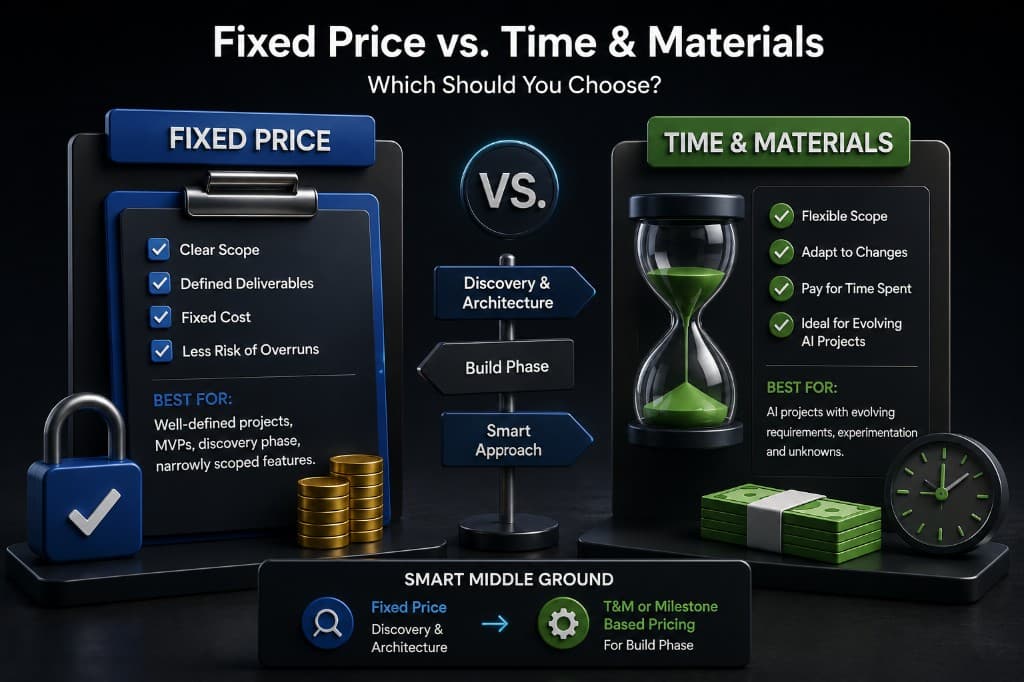
Fixed Price vs. Time & Materials: Which Should You Choose?
Fixed-price works well when scope is genuinely locked a clearly defined MVP, discovery phase, or narrowly scoped feature.
Time & Materials (T&M) is more common for AI projects because model behavior, data quality issues, and infrastructure needs surface *during* development. Locking a fixed price on something that involves experimentation usually means the vendor pads the quote or you end up in constant change-order territory.
A reasonable middle ground: fixed-price discovery and architecture, followed by T&M or milestone-based pricing for the build itself.
How to Actually Reduce Costs Without Cutting Corners
- Start with an MVP, not the full vision. Build the smallest version that proves the AI delivers value, then expand.
- Default to APIs before custom models. Use existing model APIs until you hit a measured limitation not a hypothetical one.
- Audit your data before you scope the project. Data prep can eat 25–40% of budget; know how messy your data is upfront.
- Sequence your integrations. Launch with the two or three that matter most; add the rest as you prove ROI.
- Choose RAG over fine-tuning by default. Unless you're running very high query volumes, RAG delivers similar results for roughly 60% of year-one cost.
What This Looks Like With Bitronix Technologies
We build production-grade AI apps for regulated and high-stakes environments fintech platforms, enterprise automation systems, and generative AI products that need to hold up under real audits, not just impress in a demo. Our engagements typically start around $5,000 for a well-scoped prototype and scale up to $1.5M+ for full enterprise builds, in both fixed-price and time-and-materials models depending on how locked your scope is.
What matters most isn't the number itself it's whether architecture, security, and integration decisions get made deliberately upfront, instead of being discovered halfway through the build.
Five Questions to Ask Before You Accept Any Quote
- "Does this include data preparation, or just model integration?" If the quote doesn't mention cleaning and auditing your data, it's probably scoped for a best-case scenario.
- "How many integrations are included, and what happens if we need more?" Get the per-integration cost in writing the most common source of scope creep.
- "What's the plan for testing accuracy and hallucinations, not just functionality?" AI-specific testing must be scoped upfront.
- "What does year-one operating cost look like, separate from the build?" A vendor who can't estimate inference and monitoring hasn't thought it through.
- "What's fixed, and what's time-and-materials?" Know which parts of the number are locked and which can move.
Frequently Asked Questions
How much does it cost to build a basic AI app in 2026?
A basic AI-enabled app a simple chatbot or a lightweight recommendation feature typically costs between $10,000 and $40,000, especially when built using pre-trained models or existing APIs rather than custom-trained systems.
What's the average cost of a mid-complexity AI app?
Mid-complexity AI apps with personalization, predictive features, or workflow automation usually fall between $50,000 and $300,000, depending on integration depth and data readiness.
Why do AI app development quotes vary so much between vendors?
The same project description can produce wildly different quotes because vendors scope autonomy, integrations, and compliance requirements differently. Two proposals for an AI chatbot can differ by 5–10x depending on what's actually included.
Is RAG cheaper than fine-tuning a model?
Yes, in most cases. A typical RAG setup runs about 60% of the year-one cost of fine-tuning for a comparable enterprise use case, and it handles frequently changing data more naturally.
What percentage of an AI app budget goes to data preparation?
Data preparation cleaning, structuring, and labeling typically accounts for 25–40% of total project cost, making it one of the most commonly underestimated line items.
Do AI apps cost more to maintain than regular software?
Yes. Beyond standard maintenance, AI apps carry inference costs, model monitoring, and periodic retraining, which together typically add 15–25% of the original build cost annually.
How long does it take to build an AI app?
Simple AI-enabled MVPs can launch in 2–4 weeks. Mid-complexity apps generally take 3–6 months, and enterprise-grade systems with custom models and deep integrations can take 6–12 months.

Founder and CTO
Founder and CTO of Bitronix Technologies. Builds production-grade AI apps, RAG systems, and enterprise automation platforms for regulated teams in Dubai, the USA, and beyond.
Related Posts
 AI
AIAugust 6, 20267 min read
AI Automation for Ecommerce: The Complete 2026 Guide
A complete 2026 guide to AI automation for ecommerce: what to automate first, real use cases across marketing, inventory, and support, costs, and a practical rollout roadmap.
Read article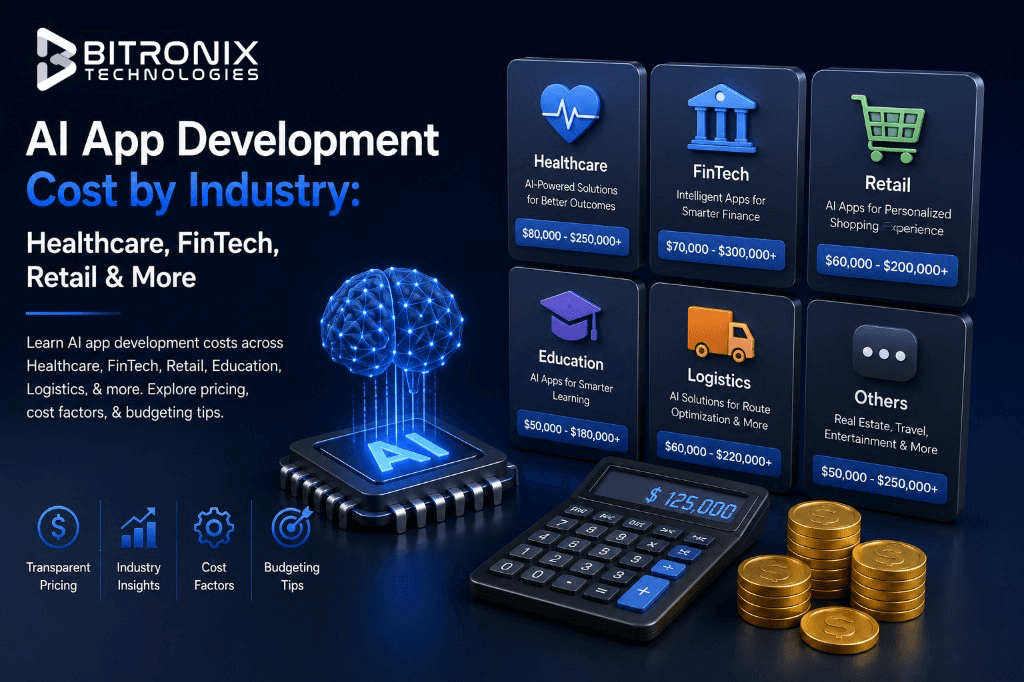 AI
AIJuly 24, 202621 min read
AI App Development Cost by Industry: Healthcare, FinTech, Retail & More (2026 Guide)
Learn AI app development costs across Healthcare, FinTech, Retail, Education, Logistics, & more. Explore pricing, cost factors, & budgeting tips for 2026.
Read article AI
AIJuly 21, 202613 min read
AI App Development in USA: The Complete Guide for 2026 (Costs, Process, & Technologies)
Learn everything about AI app development in the USA, including costs, technologies, development process, AI agents, trends, & business strategies for 2026.
Read article