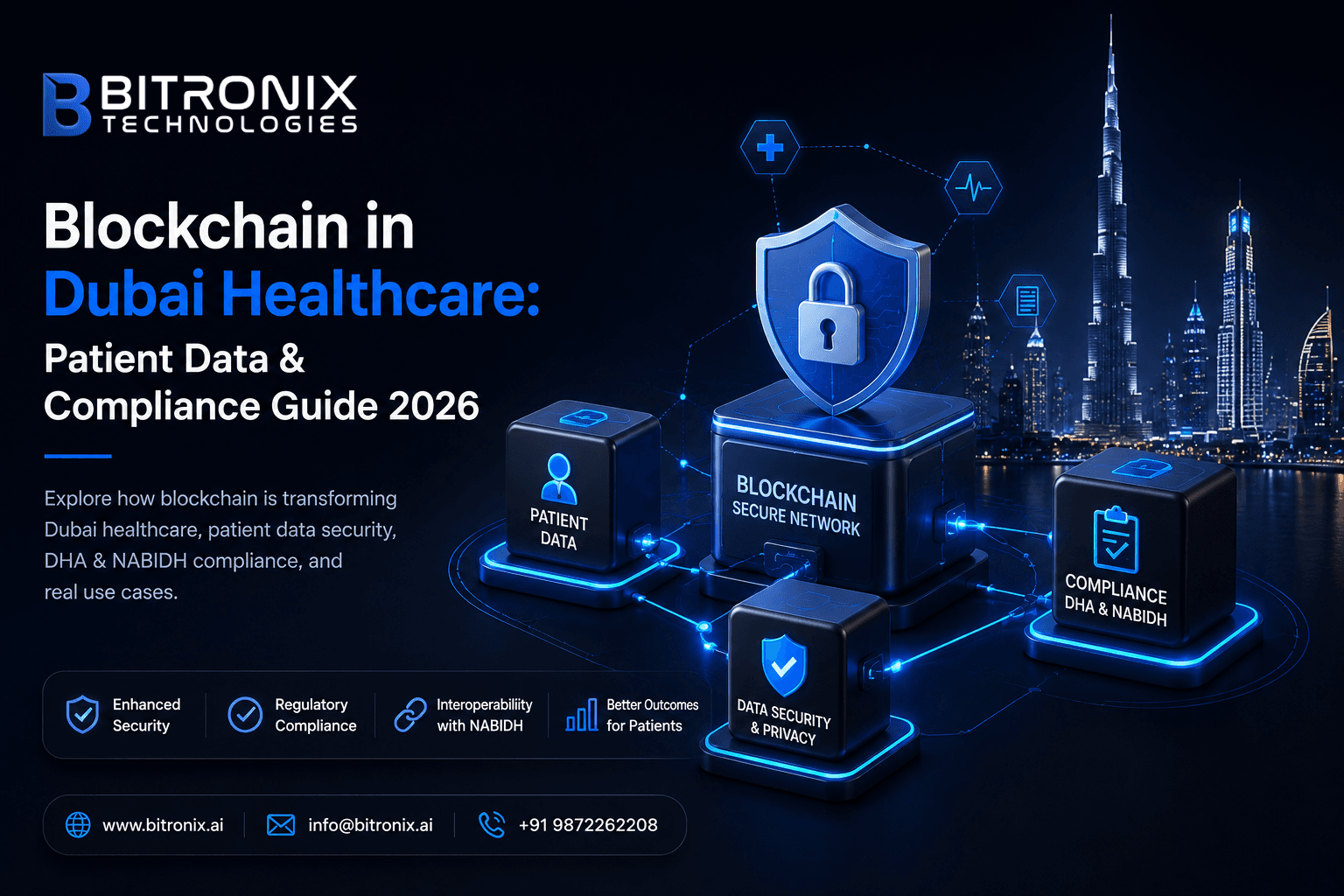
Blockchain in Dubai Healthcare: Patient Data & Compliance Guide 2026

By Tausif AhmedFounder and CTO
Dubai's healthcare sector is sitting on one of the most sensitive and most valuable data sets in the region: patient records. As digital health adoption accelerates, the question every hospital, clinic and health-tech founder is asking is the same: how do you make patient data secure, interoperable and fully compliant, without slowing down care?
Blockchain is emerging as a serious answer. Unlike traditional databases, blockchain creates tamper-proof, traceable and highly secure records that improve data integrity and reduce fraud. But adopting blockchain in healthcare is not as simple as deploying a new technology. Organizations need to understand where blockchain adds real value, how it maps to DHA and NABIDH requirements, what kind of architecture is best and if the investment is delivering measurable business outcomes.
So, how is blockchain changing patient data management in Dubai's healthcare industry and what should healthcare organizations know before investing in it? This guide addresses those questions by exploring real-world use cases, compliance requirements and implementation strategies.
Why Dubai Healthcare Needs Blockchain Right Now?
The federal budget allocated to UAE blockchain healthcare initiatives totals AED 290 billion between 2022 and 2026, with blockchain in healthcare forecasted to grow at a CAGR of 46.96% through 2030.
The scale of the investment reflects a structural problem in healthcare data today:
- Dubai's regulatory frameworks require strict adherence to healthcare data standards. Manual audits are time-consuming and error-prone.
- Traditional systems can't always prove who accessed what data and when, leaving compliance gaps.
- Patients have little say over who gets to see or share their medical data.
Blockchain directly addresses both problems-verifiable audit trails and patient-controlled data access-which is exactly why Dubai's regulators and hospital networks are paying attention.
Explore Dubai Healthcare Regulatory Landscape in 2026
Before any blockchain solution can go live in Dubai, it has to satisfy a specific regulatory stack. Understanding this stack is the first step for any hospital or health-tech company.
1. Dubai Health Authority (DHA)
Dubai Health Authority (DHA) is the regulatory body for health services and digital health platforms in Dubai. Therefore, any health record system, patient portal or data-sharing platform that is blockchain-based is within the DHA's jurisdiction. The DHA has specific requirements for AI and digital health systems that process patient data, separate from Abu Dhabi's Department of Health or free zone authorities.
2. NABIDH: Dubai's Health Information Exchange
NABIDH (National Backbone for Integrated Dubai Health) is the Dubai Health Information Exchange platform that links all healthcare facilities and security is important here as it handles sensitive patient data across the entire healthcare ecosystem. Healthcare apps in Dubai increasingly need interoperability with Malaffi (the equivalent of HIE in Abu Dhabi) to ensure continuity of care between clinics, hospitals, pharmacies and specialists. Any enterprise blockchain platform built for Dubai healthcare needs to integrate with NABIDH, not operate as a closed silo.
3. Federal Data Protection Law
The Dubai health data is subject to the Federal Law No. (2) of 2019, while defining the Use of Information and Communication Technology and DHA policies for health data protection, as well as specific circulars on AI in healthcare. These require rigorous security controls, patient consent management and NABIDH integration requirements.
4. Data Retention Requirements
Healthcare records must be retained for 25 years with full confidentiality, integrity and availability, requiring robust backup, disaster recovery and long-term data protection strategies. This is a critical design constraint for any blockchain healthcare system: the architecture has to support 25-year retention without compromising performance or compliance.
How Blockchain Solves Dubai's Core Healthcare Data Problems
Blockchain directly addresses many of the challenges facing Dubai's healthcare ecosystem. You can create a permanent, secure record of each medical transaction with blockchain to share patient data more accurately and with more trust.
Problem 1: Fragmented Records Across Providers
Dubai patients often visit a general clinic, a specialist, a diagnostic lab and an insurer, each with a different aspect of their medical history. Blockchain networks help hospitals, clinics, pharmacies and insurance providers to share data securely. Moreover, patients can give permission through custom-built smart contracts. This will help in smooth and secure cooperation.
Problem 2: Weak Audit Trails
Regulators can instantly verify the flow of information. This minimizes the compliance costs and human error during audits, as each access event on a blockchain platform is time-stamped and logged. This is a huge advantage for DHA and NABIDH compliance as compared to traditional EHR systems, where access logs are either incomplete or manually maintained.
Problem 3: Data Breaches & Unauthorized Access
Clinic and healthcare blockchain platforms are developed using end-to-end encryption to protect sensitive medical data. So, unauthorized users cannot access intercepted information. No one can read and store that data without authorized cryptographic keys. It enhances patient data confidentiality in a way that aligns with HIPAA-like standards.
Problem 4: Patients Have No Control Over Their Own Data
This is perhaps the most overlooked issue in Dubai healthcare today. Patients generate the data, but providers and systems control it. Blockchain-based consent management, where patients grant and revoke access via smart contracts, flips this model.
Real-World Use Case: Organ Donation on Blockchain
Dhonor Health Tech has moved its organ donation project to a second phase, building standards to improve the matching of organs with patients, with blockchain-based solutions helping in the organ verification process and transplant optimization. The app connects with seven UAE hospitals offering donor transplant operations, ensuring DNA swabs are uploaded and donor DNA information is held on the blockchain ecosystem.
This is a clear example of blockchain solving a problem traditional databases struggle with: verifiable, tamper-proof matching across multiple independent institutions.
Core Use Cases for Blockchain in Dubai Healthcare
From safeguarding patient records to streamlining insurance claims, healthcare blockchain development solutions enable greater transparency and compliance. Here are different use cases of building a blockchain for healthcare.
1. Unified Electronic Health Records (EHR)
A blockchain-powered EHR layer allowing patients to have a single, verifiable medical history available to all DHA-licensed providers while integrating with NABIDH for a continuum of care.
2. Smart Contract-Based Patient Consent
Patients can give time-limited, revocable access to their records to specific providers through smart contract-based consent, with all access immutably logged for DHA audit purposes.
3. Clinical Trial Data Integrity
Pharmaceutical and research organizations use blockchain to timestamp and lock clinical trial data to prevent retroactive tampering, which is vital for regulatory submissions.
4. Insurance Claims Verification
Smart contracts automatically cross-check treatment records with insurance policy terms, reducing claim processing time and fraud.
5. Pharmaceutical Supply Chain Tracking
Blockchain tracks medication from the manufacturer to the pharmacy, eliminating the risk of counterfeit drugs, a growing problem in the wider MENA medical technology market, which is worth almost $144 billion.
6. Organ Donation & Transplant Matching
As shown by the Dhonor Health Tech example above, decentralized solutions are useful in verifiable, cross-institutional matching and donor verification.
DHA Compliance: What Every Blockchain Healthcare Project Must Address
For DHA compliance, all digital healthcare systems operating in Dubai must meet the demands of strict regulations around data protection, patient privacy, interoperability, system security and operational transparency. So, if you are building telemedicine apps, hospital information systems, EHR modules and diagnostics platforms, you must comply with the security rules.
At Bitronix Technologies, we build every healthcare blockchain solution around these core pillars:
| Compliance Pillar | What It Requires |
|---|---|
| Data Privacy | Patient consent management, encrypted storage |
| Data Localization | UAE-based or approved data residency |
| NABIDH Interoperability | Connection to Dubai's health information exchange |
| Audit Trail | Immutable, timestamped access logs |
| Data Retention | 25-year retention with disaster recovery |
| Security Controls | End-to-end encryption, access governance |
Encryption is mandatory at every level and patient records must never be shared with third parties without explicit consent. A major mistake many startups make is integrating third-party analytics tools that unintentionally transmit patient-related data externally.
Cost For Building a Compliant Healthcare Blockchain Platform in Dubai
Healthcare AI and digital health projects in Dubai are priced between AED 150,000 and AED 3 million, depending on the clinical use, risk classification and the intended patient population.
| Project Type | Estimated Cost (USD) |
|---|---|
| Patient Consent & Access Layer (Smart Contracts) | $30,000 – $80,000 |
| Blockchain-backed EHR Integration with NABIDH | $80,000 – $250,000 |
| Pharmaceutical Supply Chain Tracking | $50,000 – $150,000 |
| Full Hospital Network Blockchain Platform | $200,000 – $1,000,000+ |
Challenges to Plan For Building Blockchain-Powered Healthcare Solution
Blockchain is still a relatively new technology in healthcare, so many healthcare professionals may not fully understand its potential. Educating providers, patients and other stakeholders is essential for successful adoption.
Implementation also requires collaboration between hospitals, clinics, insurance providers, regulators and patients and building a network of trusted stakeholders is essential for any blockchain-based healthcare solution to succeed. Before implementing blockchain, it's essential to work closely with regulators such as the DHA to ensure the solution meets all legal requirements and aligns with UAE data protection laws focused on safeguarding patient information. This is exactly where having an experienced delivery partner matters-compliance can't be retrofitted after launch.
Why Work With Bitronix Technologies on Healthcare Blockchain Projects?
Building blockchain infrastructure for healthcare is not the same as building a DeFi protocol or NFT marketplace. It requires:
- Deep understanding of DHA and NABIDH technical requirements
- Audit-ready documentation from day one
- 25 years of data retention architectures
- Smart contracts for proper patient consent management, not only token transfer
- A build process that is compliance-first, not compliance-retrofit
Bitronix Technologies combines enterprise blockchain engineering with a compliance-first delivery model, built for regulated industries across the USA and Dubai.
Final Thoughts
Blockchain in Dubai healthcare is moving from pilot projects to real infrastructure. With NABIDH integration, DHA's tightening regulatory framework and growing investment across the MENA health-tech market, hospitals and health-tech companies that build compliant, patient-centric blockchain systems now gain more popularity as adoption scales. If you're planning a blockchain healthcare project in Dubai, hire a reliable blockchain development company that understands the decentralized technology and Dubai's compliance landscape for building a blockchain healthcare solution.
Frequently Asked Questions (FAQs)
Is There A Benefit Of Small Clinics Using Blockchain Technology?
Yes, small clinics will be able to secure patient records, share data, reduce administrative burden and prepare for upcoming interoperability needs without having to invest in massive healthcare infrastructure from the onset.
Is The Blockchain Replacing The Existing Hospital Management Systems?
No, blockchain is a complement to existing hospital management systems, adding secure data verification, transparency and trusted information sharing while allowing healthcare organizations to continue to use their current operational software and workflows.
Is Blockchain Technology Useful for Telemedicine Platforms in Dubai?
Yes, blockchain can also be used by telemedicine platforms for secure records of virtual consultations, anonymity for patient identity, integrity and accuracy of medical history and safe sharing of data between healthcare providers and patients while providing remote care.
How Blockchain Enhances Trust Among Healthcare Stakeholders?
This results in a transparent environment where hospitals, insurers, laboratories, pharmacies and patients can securely verify the information shared, thereby reducing disputes, improving collaboration and increasing confidence in the accuracy and authenticity of health data.
Can Blockchain Help Cut Healthcare Administrative Costs?
Yes, healthcare organizations reduce operational expenses and boost efficiencies across administrative and clinical processes by automating record verification, reducing duplicate documentation, accelerating approvals and minimizing manual reconciliation.
What Does It Take For Healthcare Organizations To Adopt Blockchain?
Before deploying a blockchain, organizations should evaluate business objectives, stakeholder readiness, technical infrastructure, integration needs, regulatory obligations and long-term scalability to ensure a successful rollout and tangible operational gains.

Founder and CTO
Founder and CTO of Bitronix Technologies. Builds enterprise blockchain and compliance-first healthcare systems for regulated teams in Dubai, the USA and beyond.
Related Posts
 Blockchain
October 23, 202619 min read
DEX Clone Script: Features, Development Cost & How to Build a Decentralized Exchange
Explore DEX clone script features, development costs, smart contracts, liquidity pools, security, and the steps to build a decentralized exchange.
Read article Blockchain
October 21, 202613 min read
Agricultural Commodity Tokenization in 2027: Benefits, Process & Cost
Learn how agricultural commodity tokenization works, its benefits, development process, costs, use cases, and key regulatory considerations.
Read article Blockchain
October 21, 202618 min read
CoinMarketCap Clone Script: Features, Cost, and How to Build a Crypto Price Tracking Platform
Explore CoinMarketCap clone script features, development costs, APIs, revenue models, and how to build a cryptocurrency market data platform.
Read article